The Downswing's Right Shoulder Deception: Re-sequencing the Kinematic Chain for a Pure Strike
For right-handed golfers, the premature surge of the right shoulder 'over-the-top' during the downswing is the primary culprit behind pull hooks and weak slices. This essay dissects the biomechanics of kinematic chain inversion, elucidates the critical role of right-side bend, and details four high-impact corrective drills to re-establish an inside-out swing path.

Key Insight: For right-handed golfers, the premature surge of the right shoulder forward and outside the target line during the downswing—colloquially known as “Over the Top” or “Spin Out”—is the quintessential fault leading to a severely outside-to-in swing path. If the clubface is square or closed relative to this path at impact, the ball will rocket directly left of the target (a pull hook). Should the clubface fail to close in time, the result is a powerless, high-flying slice. The root of this error isn’t a lack of arm strength, but a fundamental inversion of the kinematic sequence.

Figure 1: A professional golfer demonstrating lower body dominance and right-side bend in the downswing’s slot position.
I. Core Mechanism Dissection: Why the Right Shoulder Instinctively Surges Forward?
The transition from the top of the backswing to impact takes a mere 0.25 seconds. In this fleeting moment, amateur golfers most commonly fall into the intuitive trap of “muscling the ball with the right hand.”
1. Kinematic Sequence Inversion
A standard golf swing’s energy transfer strictly adheres to the biomechanical kinematic chain: ground reaction forces ➔ pelvic and hip rotation ➔ thoracic spine and shoulder girdle rotation ➔ natural arm drop ➔ club release. As explored in our previous analysis, The Biomechanical Advantage of Orthopedic Surgeons Learning Golf, the foundation of rotation fundamentally relies on axial torque from the hips and thoracic spine. However, when a golfer subconsciously rushes to power the ball with their arms, the chest and right shoulder prematurely rotate horizontally before the lower body initiates, causing the entire upper body to face the target too early.
2. Lack of Spinal Side Bend, Rotational Plane Degenerates into a Horizontal Sweep
During a correct downswing, the body must maintain its address-position forward tilt while simultaneously rotating left along the target line. Because the right hand grips below the left, the right shoulder should be significantly lower than the left shoulder in space as it enters the impact zone, accompanied by a natural right-side bend (or crunch) in the torso. Without this conscious side bend, rotation devolves into a purely horizontal turn, flinging the right shoulder forward and outward along the shoulder axis, forcing the clubhead off its inside track and into a steep, outside-in cut.
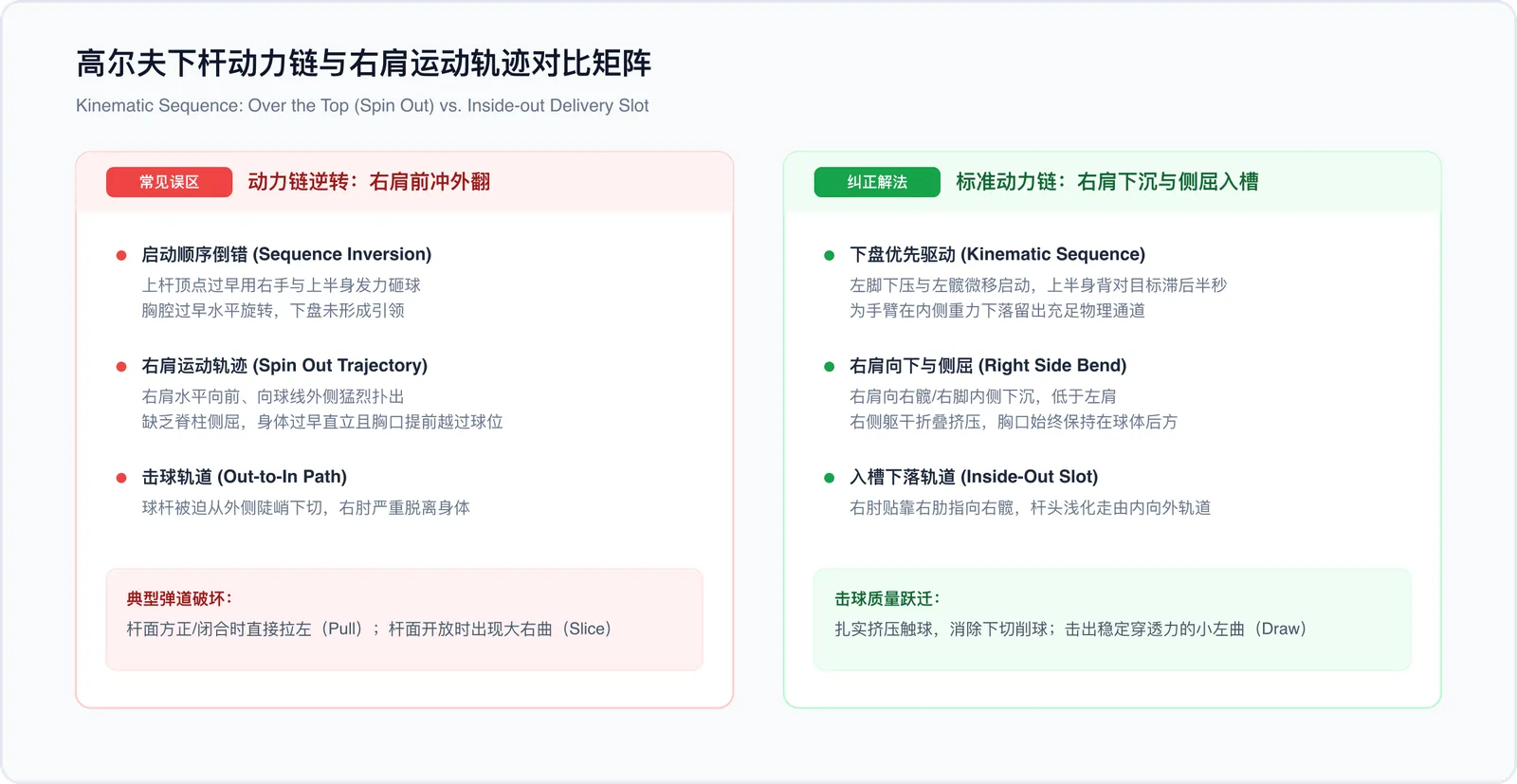
Figure 2: Mechanical comparison matrix of kinematic inversion (right shoulder surge) versus an inside-slot path.
II. Reconstructing Key Impact Sensations: Feel vs. Real
When correcting a golf swing, the intended mental command (Feel) often diverges from the actual physical movement (Real). Establishing the following three mental anchors can help sever the compensatory impulse of the right shoulder surging forward:
1. “Keep Your Back to the Target for an Extra Instant”
- Intended Feel: At the moment of transition from the top of the backswing, as weight transfer begins, consciously feel your back lingering towards the target for an extra half-second.
- Biomechanical Benefit: This delays the premature horizontal rotation of the torso and shoulders, creating ample time for the arms and hands to drop vertically into the “slot” in front of the body, guided by gravity.
2. The Right Shoulder’s Path is “Down,” Not “Forward”
- Intended Feel: As the downswing initiates, sense your right shoulder sinking vertically towards the ground inside your right foot or in front of your right pocket, creating a distinct sensation of folding and compression in your right ribs.
- Biomechanical Benefit: This preserves spinal tilt and side bend, allowing the right elbow to naturally stay close to the right side of the ribs (Trail Elbow Pitch), ensuring the clubhead approaches the impact zone shallowly and from the inside.
Instructional Video 1: PGA Master Instructor Eric Cogorno details the "downward and side bend" feel for the right shoulder in the downswing (approx. 4 mins).
3. Chest and Nose Remain Behind the Ball
- Intended Feel: At impact, sense that the center of your sternum is still anchored behind and to the right of the ball, rather than prematurely surging over or in front of it.
- Biomechanical Benefit: This prevents lateral sway and forward lunge of the head and torso, ensuring the lowest point of the swing consistently lands on the turf in front of the ball, leading to a solid, compressed strike.
III. Four High-Efficiency Advanced Correction Drills
Drill 1: The Drop Foot Drill – Most Immediate Impact
- Execution Steps:
- Address the target line with a normal stance.
- Step your right foot back half a step to a full step (right toe roughly aligned with left heel, right heel slightly lifted, only the ball of the foot on the ground), creating a significantly closed stance.
- Maintain a stable lower body base and practice hitting shots at 70% swing power.
- Correction Mechanism: Physically, stepping back the right foot locks out the space for the right hip and shoulder to prematurely rotate forward. If the golfer attempts to swing horizontally with the shoulders, the body will immediately lose balance. This stance forces the arms to deliver the club smoothly from inside-out, rapidly re-establishing muscle memory for an inside-out strike.
Instructional Video 2: Drop Foot Drill in action (restricting right-side surge, forcing inside-out delivery, approx. 3 mins).
Drill 2: The Pump Drill
- Execution Steps:
- Perform a normal backswing to the top and pause completely.
- First movement: Only allow the pelvis to slightly squat down, while the arms and club drop vertically to waist height (right elbow lightly touching the right ribs, right shoulder remaining low, shoulders still relatively closed). Pause in this position for 1 second.
- Second movement: Return the club to the top of the backswing, then repeat the vertical drop and pause.
- Third movement: Execute a full, fluid swing with continuous body rotation to hit the ball.
- Correction Mechanism: By segmenting the downswing with pauses, this drill interrupts the brain’s instinctive reflex to “accelerate and smash the ball directly from the top.” It establishes a clear kinematic rhythm: arms first settle into the slot, then the lower body rotates to release.
Drill 3: Towel/Glove Under Right Armpit Drill
- Execution Steps:
- Place a golf glove or a folded small towel under your right armpit.
- Perform half-swings, ensuring the towel does not fall out before impact and follow-through.
- Correction Mechanism: When the right shoulder surges forward or the right elbow flares outward, the upper right arm detaches prematurely from the torso, causing the towel to drop instantly. Keeping the towel in place forces the inside of the upper right arm to stay close to the torso’s rib cage, ensuring the swing plane unfolds from inside-out.
Drill 4: Alignment Stick & Wall Constraint Drill (Indoor Dry Swings)
- Execution Steps:
- Stand about 25-30 cm in front of a wall in your address posture (or have a friend hold an alignment stick vertically about 10 cm to the right of your head).
- Practice slow-motion downswing movements.
- If your right shoulder or head lunges horizontally forward during the downswing, you will immediately hit the wall or alignment stick.
- Correction Mechanism: This drill provides an objective external physical reference, forcing the right shoulder to dive deeply underneath the constraint.
IV. Root Cause Check: Latent Inducers from Setup & Backswing
A surging right shoulder in the downswing is rarely an isolated issue; it often stems from a chain of compensatory errors originating in the setup and backswing:
| Diagnostic Dimension | Common Latent Error | Corrective Action Principle |
|---|---|---|
| Reverse Pivot | Upper body tilts towards the target during the backswing, weight incorrectly remains on the left foot. | Ensure weight is fully loaded into the inside of the right heel and right hip socket at the top of the backswing, creating space for downswing weight transfer. |
| Ball Position Too Far Left at Setup | Ball positioned excessively outside the left foot, subconsciously prompting the brain to lunge forward to hit the ball. | Adjust ball position slightly to the right by half a ball, bringing the impact zone closer to the body’s rotational low point. |
| Disconnected Right Hand & Over-Grip Pressure | Right hand grips the club too tightly (grip pressure > 6/10), leading to stiff and guarded upper right limb muscles. | Maintain a relaxed grip pressure of 4/10 in both hands, allowing for free hinging and swinging elasticity in the wrist and elbow joints. |
V. Self-Assessment & Training Loop
When practicing at the range, it is highly recommended to record slow-motion video with your phone positioned down-the-line (DTL) at eye level:
- Observe whether the butt end of the grip and the shaft “cut down” through the angle between your right shoulder and upper right arm during the downswing transition.
- If the shaft clearly crosses above your right shoulder or cuts down from neck height, it indicates the right shoulder is still initiating too quickly.
- If the shaft smoothly shallows and cuts down below the right shoulder, and your ball flight transforms into a powerful draw or straight shot, it signifies that the kinematic chain has restored its correct sequential operation.
Related Research & Topics
Tello Mobile eSIM
SafetyWing Nomad Insurance
* Disclosure: This post contains affiliate links. If you make a purchase through these links, V-G Journal may earn a small commission at no additional cost to you. We only recommend services we independently evaluate and trust.
FIRE and Golf:自由旅居之路
专注于为追求 FIRE 与品质生活的人群提供特惠打球权益与候鸟微度假。不持一砖一瓦,运营品质生活。