Deconstructing Early Extension and the Chicken Wing: A Biomechanical Protocol for the Modern Golf Swing
A quantitative kinematic analysis of early pelvic extension and the compensatory lead-arm chicken wing. Using 3D skeletal tracking and split-screen motion capture, this protocol outlines a four-stage neuromuscular intervention to restore impact dynamics.

Executive Summary: The amateur golfer’s most persistent pathologies—the lead-arm “chicken wing” and erratic contact patterns ranging from thinned balls to fat divots—are rarely failures of grip strength or forearm mechanics. They are defensive compensations triggered by a breakdown in the kinetic chain. When the pelvis thrusts forward toward the ball during the transition (early extension), the torso is forced to stand up prematurely to keep the clubhead from digging into the turf. As hand path clearance evaporates, the nervous system has only one viable release: flaring the lead elbow outward to manufacture room. Through 3D skeletal tracking, this protocol breaks down the physical causality of early extension and provides a four-stage neuromuscular prescription to rewire the pattern.
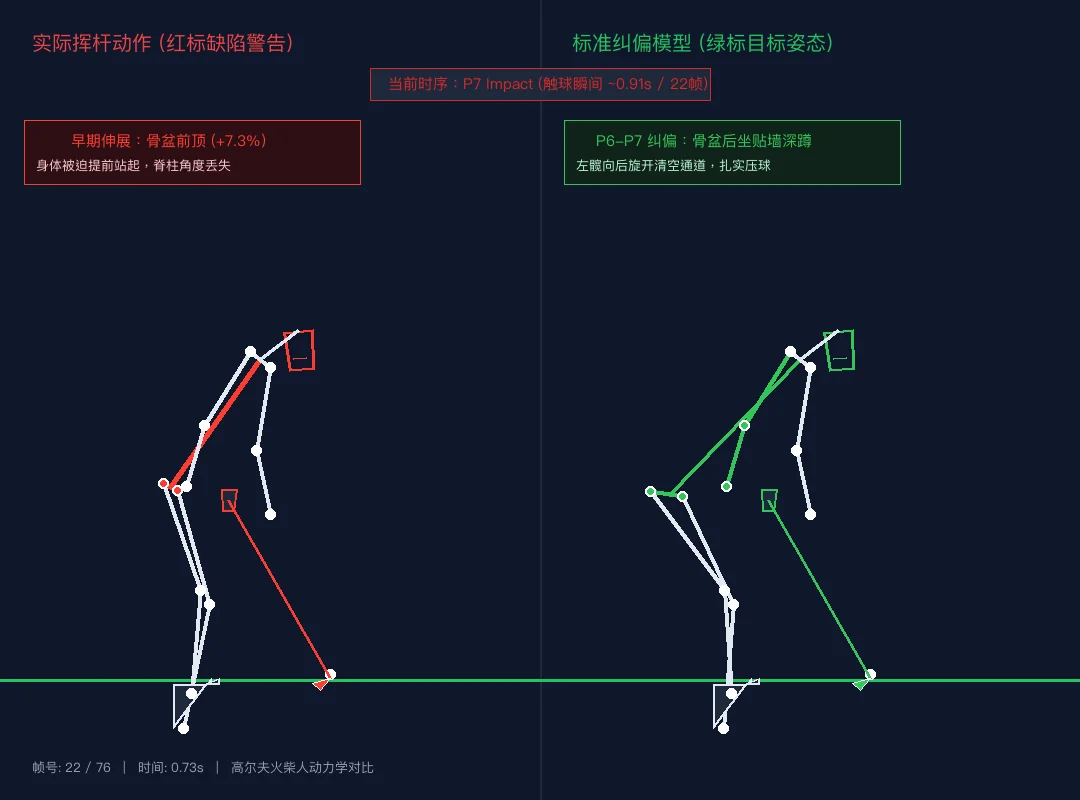
Figure 1: Skeletal kinematic comparison at impact (P7) between the mechanical fault (red highlight) and the optimized Tour model (green highlight).
In both orthopedic rehabilitation and golf dynamics, the swing is never a collection of isolated limbs; it is an unforgiving sequential chain of energy transmission. Echoing the mechanical laws explored in our analyses of Orthopedic Biomechanics in the Golf Swing and Correcting the Over-the-Top Downswing via Shoulder Kinematics, distal joint distortions—in the wrist, forearm, or elbow—are almost invariably passive compensations for a destabilized pelvic-torso axis.
Attempting to “straighten the lead arm” through sheer conscious willpower while ignoring pelvic kinematics does not fix the strike. It merely converts a flared elbow into a violent pull-hook or a catastrophic chunk.
1. Dual-Skeletal Motion Capture: Kinematic Fault vs. Reference Model
Using 3D human pose estimation, we map the swing into a dynamic skeletal kinetic chain. In the diagnostic framework below, the amateur kinematic breakdown is rendered in Alert Red (#FF3B30), while the optimized target model, derived from elite PGA Tour kinematic averages, is overlaid in Precision Green (#34C759):
Figure 2: Interactive split-screen engine tracking faulty kinematics (left, red) against the biomechanical reference model (right, green). Scrub the timeline to review frame-by-frame divergence.
Tracing the swing sequence from address (P1) through the top of the swing (P4), delivery (P6), impact (P7), and follow-through (P8) exposes two divergent physical realities:
| Swing Phase | Fault Pattern (Left, Red) | Corrected Model (Right, Green) | Biomechanical Determinant |
|---|---|---|---|
| P1: Setup | Forward spine angle: 59.4°; initial Tush Line established | Forward spine angle: 58°–60°; stable hip hinge depth | Anchors the primary axis of rotation and pelvic flex |
| P4: Top of Swing | Adequate thoracic turn; cervical axis stable | Full thoracic coil; flat lead wrist; deep trail hip | Stores elastic potential energy along the core sling |
| P6: Delivery | Pelvis migrates forward toward the ball | Pelvic depth maintained; lead hip clears rearward | The mechanical crossroads dictating impact clearance |
| P7: Impact | Pelvis thrusts forward (+7.32%); spine angle collapses to 13.7° | Tush Line depth preserved; spine angle holds near 58° | Fault forces torso upright; model compresses the ball |
| P8: Follow-Through | Lead elbow flares outward (13.7° chicken wing) | Lead arm fully extended (>165°), tracking target | Fault scoops defensively; model achieves natural release |
2. The Pathological Cascade: Why Willing the Arm Straight Fails
Many players spend months on the driving range attempting to isolate and straighten the lead elbow, only to see ball-striking worsen. The intervention fails because it treats a terminal symptom as the primary cause.

Figure 3: Systematic breakdown of early extension, downstream compensations, and the corrective biomechanical matrix.
The physical cascade linking early extension to the chicken wing is entirely predictable:
- Failure of Hip Clearance (The Root Failure): At the initiation of the downswing, anxious to apply power from the hands, the player fails to initiate transition via lead-hip depth and clearance. Instead of rotating back and away, the pelvis translates anteriorly toward the ball.
- Torso Erection via Self-Preservation (Geometric Interference): As the pelvis migrates forward by over 7% of total frame scale, the distance between the golfer’s center of mass and the ball shrinks instantly. If the torso were to maintain its initial 59.4° forward flexion, the clubhead would bury itself inches behind the ball. The central nervous system overrides the intended movement: within milliseconds, it straightens the spine, reducing the angle to 13.7°. The body stands up to avoid a violent fat shot.
- Annihilation of Hand Clearance (Spatial Compression): As the chest stands upright, the physical corridor required for the arms to drop and swing freely on-plane is wiped out. Forward shaft lean (8°–10°) becomes geometrically impossible.
- Radial Escape and Elbow Flaring (The Manifestation): Trapped between an upright torso and the ground, the hands must flip and scoop to sweep the ball off the turf. Post-impact, the club’s radius cannot extend down the target line without grounding. The only open escape vector is for the lead elbow to fold outward and retract. The chicken wing is born.
The organizing principle is hierarchical: corrections must flow from ground to grip. If pelvic depth along the Tush Line is secured, the forward spine angle stays intact. The hitting corridor remains wide open, and the lead arm extends naturally through impact without conscious effort.
3. Four-Stage Neuromuscular Training Protocol
To eliminate this compensation pattern, the nervous system must build a new motor program. The following four progressive drills rewire pelvic mechanics, spatial clearance, and release dynamics.
Stage 1: Proprioceptive Anchor — Butt-to-Wall Drill
- Objective: Neutralize early extension and establish the feeling of pelvic depth in transition.
- Protocol:
- Assume a standard address position with both glutes lightly touching a flat wall (or the back of a secure chair).
- Perform a slow backswing, maintaining trail glute contact.
- Initiate downswing transition exclusively through the lead hip: scrape the lead glute deeper along the wall away from the target line. Neither hip is permitted to lose contact with the wall.
- Prescription: Perform 3 sets of 20 dry reps daily. Use this as a mandatory pre-range warmup to cement the feeling of “sitting and clearing” rather than sliding.
Stage 2: Kinetic Connection — Towel-Under-Arms Drill
- Objective: Eradicate the lead-arm chicken wing by eliminating independent, disconnected arm swing.
- Protocol:
- Tuck a standard golf towel across the chest, pinning it firmly beneath both armpits.
- Take an 8-iron or 9-iron and execute waist-high to waist-high half-swings (L-to-L swings).
- Power the swing solely through thoracic rotation and pelvic weight transfer. The towel must remain pinned throughout delivery and follow-through.
- Prescription: Hit 30 balls at half-speed before every full-speed session, ingraining the feeling of synchronized torso-arm delivery.
Stage 3: Compression Dynamics — Impact Bag Compression Drill
- Objective: Condition forward shaft lean and a flat lead wrist at impact, extinguishing the urge to scoop.
- Protocol:
- Position a dedicated impact bag (or heavy, dense cushion) against the lead foot. Swing into it at 50% speed.
- Hold the impact posture and inspect angles: lead wrist flat to slightly bowed, trail wrist in extension, shaft leaning 8°–10° forward, lead hip open and deep.
- Maintain static pressure against the bag for 3 seconds, feeling the mechanical load of driving down through the strike.
- Prescription: 15 isometric compression holds per session to overwrite early release instincts.
Stage 4: Dynamic Clearance — Step-Through Drill
- Objective: Eliminate hanging back on the trail leg and establish full, unobstructed follow-through balance.
- Protocol:
- Execute a full swing. As the clubhead moves through the release zone post-impact, allow the trail foot to unweight and step forward toward the target.
- The natural forward momentum forces the pelvis to clear fully, shifting over 95% of body weight cleanly into the lead heel.
- Prescription: Finish range sessions with 15 dynamic step-through strikes, prioritizing rhythm, clearance, and complete rotation over raw speed.
4. Video Diagnostic Benchmarks
When conducting Down-the-Line (DTL) high-speed video analysis, evaluate mechanics against three empirical checkpoints:
| Diagnostic Metric | Camera Perspective | Pass Standard | Failure Trigger |
|---|---|---|---|
| Pelvic Depth | DTL (Down-the-Line), Posterior Tush Line | Lead glute remains on or crosses behind the line at P7 | Pelvis drifts forward off baseline by more than half a fist width |
| Spine Angle | DTL, Head level & Thoracic inclination | Head level stable; spine maintains primary setup tilt | Head rises markedly; spine collapses into vertical extension |
| Lead Arm Geometry | Face-on or DTL, P8 (Lead arm parallel to ground) | Lead elbow points toward ground; arms form a wide triangle | Lead elbow points backward and flares out into a chicken wing |
Meaningful mechanical progress does not come from battling the distal joints. It emerges when you satisfy the underlying biomechanics. Create the space down below, abandon the urge to flip the ball into the air, and extension takes care of itself.
Related Research & Topics
Tello Mobile eSIM
SafetyWing Nomad Insurance
* Disclosure: This post contains affiliate links. If you make a purchase through these links, V-G Journal may earn a small commission at no additional cost to you. We only recommend services we independently evaluate and trust.
FIRE and Golf:自由旅居之路
专注于为追求 FIRE 与品质生活的人群提供特惠打球权益与候鸟微度假。不持一砖一瓦,运营品质生活。