Spatial Psychology and the Architecture of FIRE: Beyond the Mysticism of Feng Shui
Stripping away the metaphysical veneer, Feng Shui is revealed as a proto-scientific system of micro-climate geography and spatial psychology. This essay explores how optimizing your physical environment—reducing cognitive friction and entropy—is the ultimate strategy for maintaining the decision-making clarity required for long-term FIRE success.

Core Thesis: Buried under layers of commercial exploitation and superstitious dogma, “Feng Shui” is often polarized into either absurd feudalism or magical wealth-generation sorcery. Strip away the metaphysical accretions, and the underlying logic is a sophisticated system of micro-climate geography and empirical habitat engineering—honed by our ancestors through centuries of trial and error in an era devoid of modern structural engineering, climate control, and urban infrastructure.
When re-translated through the lens of modern spatial psychology and neurobiology, the influence of our environment on the individual is not merely real; it is physically and physiologically mapped. In the pursuit of exiting the “rat race” and achieving Financial Independence (FIRE), reconstructing a personal micro-ecosystem with low physical damping and minimal cognitive consumption is the critical barrier protecting your decision-making quality and long-term success rate.
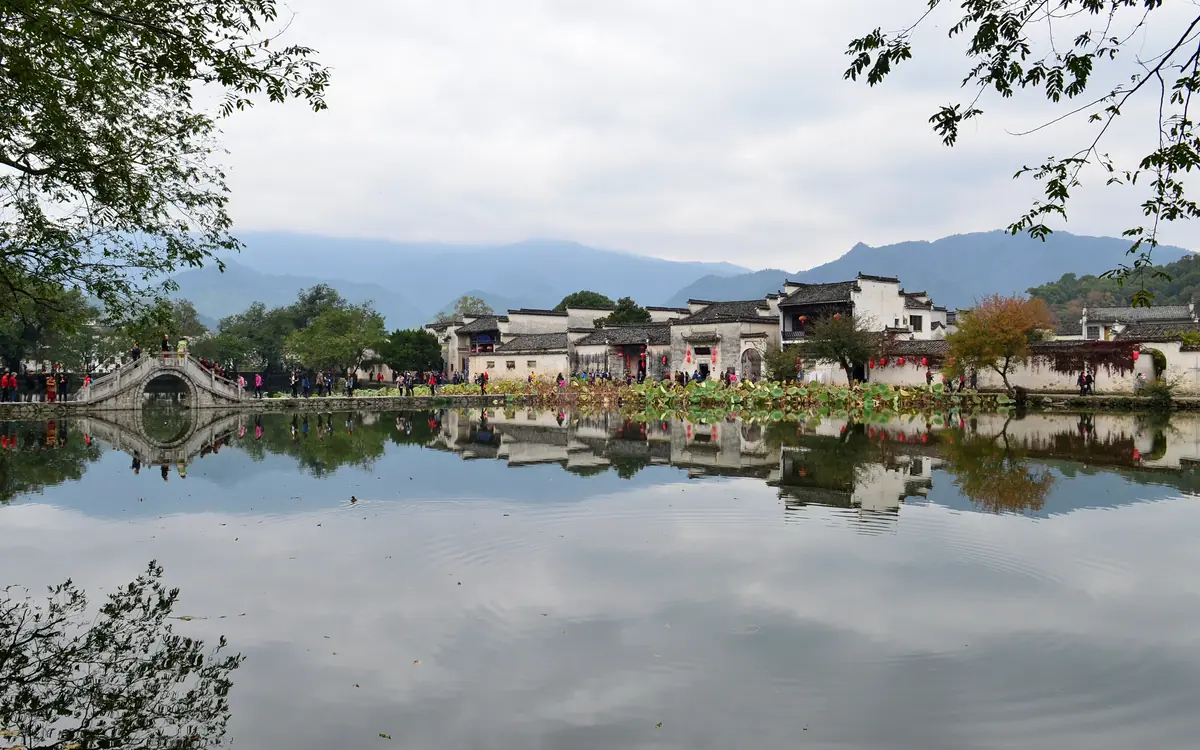
Figure 1: The water system of Hongcun, a UNESCO World Heritage site. A masterpiece of classical Chinese habitat engineering, it utilizes the Leigang Mountain to block northern winds while channeling water through the village to regulate micro-climate, humidity, and fire safety.
I. The “Factory Settings” of Survival: Ancient Site Selection
In the agrarian era, lacking seismic-resistant steel, municipal drainage, or meteorological satellites, humans survived by treating the landscape as a high-stakes engineering problem.
- “Back to the Mountain, Face to the Water”: In the Northern Hemisphere’s monsoon climate, a mountain at the rear acts as a thermal barrier against Siberian cold fronts, while an open southern exposure maximizes solar radiation. Proximity to water is essential for survival, but elevation is required to mitigate flood risks. This is not about “dragon veins,” but about optimizing solar zenith angles and wind circulation.
- “Storing Wind, Gathering Qi”: Strong, direct winds strip the body of heat and moisture, while stagnant air breeds mold and pathogens. “Gathering Qi” is simply the search for a micro-climate with natural convection that avoids the “wind tunnel effect.”
- “The Threat of Direct Paths”: Ancient warnings against roads pointing directly at a doorway were practical safety measures. In an era of runaway horses and limited visibility, a straight path was a structural liability. Furthermore, in houses without modern airtight seals, a “straight-through” wind draft would strip a home of heat in winter and induce respiratory illness.
Ancient practitioners used concepts like “Qi,” “Yin-Yang,” and “Five Elements” because they lacked the vocabulary of thermodynamics, fluid dynamics, and microbiology. They were solving for thermal comfort and structural longevity.
II. The Alienation of Mysticism: From Common Sense to “Anxiety Tax”
If Feng Shui had remained a manual for habitat engineering, it would be a respected field of study. Instead, it was hijacked by two forces:
- The Legitimation of Power: From the Han Dynasty onward, imperial regimes used “Dragon Veins” to anchor the legitimacy of their rule to the land itself. By making the fate of the nation synonymous with the topography of the capital, they turned geography into an ideological tool of control.
- The Commercialization of Randomness: Humans are biologically wired to fear randomness. When a merchant loses a ship to a storm or a family collapses due to plague, the brain seeks a narrative. Feng Shui masters became the “painkillers” for this existential dread, selling simple, mechanical rituals—burying talismans or moving a door—to promise control over an inherently chaotic world.
Modern “masters” charging thousands for consultations are selling the same product: an emotional placebo for the anxiety of class instability.
III. The Real Mapping of “Energy Flow”
When we speak of “energy flow” in a modern context, we are discussing neuro-endocrinology and cognitive load.
- Neuro-Endocrine Regulation: A dark, poorly ventilated room with visual clutter keeps the amygdala in a state of low-level defensive activation. This triggers the adrenal-cortical axis to secrete cortisol, raising blood pressure and shortening sleep cycles. Conversely, a well-lit, oxygen-rich environment promotes serotonin and melatonin production, lowering the baseline energy cost of the nervous system.
- Spatial Psychology and Defensive Instincts: Humans have an evolutionary need for “situational awareness.” If your desk faces away from a door, your brain allocates “background compute” to monitor for threats. This is a constant drain on your cognitive bandwidth. A space that allows you to see the entrance while having a solid wall behind you (the “mountain” effect) signals to the subconscious that you are in a “low-threat zone,” freeing up focus for deep work.
- Physical Damping: If your living space is cluttered, every task—cooking, working, resting—requires extra physical and cognitive effort to overcome the “friction” of the environment. A low-entropy space minimizes this damping, allowing you to direct your limited willpower toward high-value output.
IV. Can Environment Dictate “Fortune”?
“Fortune” is not about luck; it is the cumulative success rate of high-expectancy decisions made over a lifetime.
The Transmission Loop: Physical Micro-Environment ➔ Autonomic Nervous System/Cortisol Levels ➔ Subconscious Security/Cognitive Bandwidth ➔ Decision Quality ➔ Long-term Life Outcomes.
A person living in a chaotic, high-stress environment will eventually suffer from “decision fatigue.” When faced with a critical career or investment pivot, their brain—already taxed by environmental stress—will default to short-sighted, emotional, or risk-averse choices. This is what observers call “bad luck.” Conversely, a person in a self-consistent, low-entropy environment maintains the cognitive bandwidth to identify asymmetric opportunities, leading to a compounding effect of “good luck.”
V. The FIRE Matrix: Mapping Feng Shui to Low-Entropy Living
| Dimension | Traditional Mysticism | Modern Scientific Reality | FIRE Practice |
|---|---|---|---|
| Site Selection | Seeking “Dragon Veins” | Micro-climate optimization | Geo-arbitrage: Move to climate-resilient, low-cost areas. |
| Layout | “Storing Qi” | Cognitive load reduction | Low-Entropy Space: Compact, minimalist living to reduce maintenance. |
| Boundaries | Avoiding “Sha” (evil spirits) | Defensive psychological buffers | Information Firewall: Shielding from social comparison and noise. |
| Assets | “Water as Wealth” | Liquidity and cash flow | Anti-Fragile Cash Flow: Prioritizing liquid, high-yield assets over dead capital. |
VI. Four Practical Rules for the FIRE Practitioner
- Geo-Arbitrage: Stop paying a premium for “prestige” locations. Choose cities with moderate climates to reduce energy costs and leverage free public natural assets (parks, trails) to regulate your nervous system.
- Minimize Entropy: Break the “vanity of square footage.” A smaller, well-designed space reduces the “maintenance tax” on your time and energy. Clear the visual noise; every unorganized item is a tax on your attention.
- Establish Firewalls: Your home must be a sanctuary. Physically distance yourself from high-density “rat race” zones. Use your entryway as a psychological airlock—leave the noise of the algorithm and the anxiety of the workplace outside.
- Asset Fluidity: Avoid “dead water” assets—illiquid, high-maintenance real estate that traps your capital. Build a “living water” system of passive income that provides anti-fragile cash flow, and keep a “mountain” of liquid reserves to ensure you never have to make a desperate decision.
Conclusion: The Best Feng Shui is Self-Consistency
The highest wisdom is not to manipulate the universe with charms, but to align your life with the laws of nature.
The best “Feng Shui” is the clarity that emerges when you remove the friction from your life. When your environment is bright, your movement is efficient, your assets are liquid, and your boundaries are firm, you are no longer fighting your surroundings. You are in a state of low-entropy flow. That is not luck; that is the inevitable result of a system designed for long-term survival and high-quality decision-making.
Related Research & Topics
Tello Mobile eSIM
SafetyWing Nomad Insurance
* Disclosure: This post contains affiliate links. If you make a purchase through these links, V-G Journal may earn a small commission at no additional cost to you. We only recommend services we independently evaluate and trust.
FIRE and Golf:自由旅居之路
专注于为追求 FIRE 与品质生活的人群提供特惠打球权益与候鸟微度假。不持一砖一瓦,运营品质生活。