The Paradox of 'Poverty': Fang Zhimin, the Stam Incident, and the Ethics of Revolutionary Command
An analytical deconstruction of the 1934 execution of American missionaries John and Betty Stam. By cross-referencing Red Army march logs with missionary archives, this essay examines the friction between personal asceticism and the brutal mechanics of revolutionary warfare finance.

Executive Summary: In the canon of Chinese revolutionary literature, Fang Zhimin is immortalized by his prison essays Poverty and Beloved China. His self-portrayal—owning nothing but a watch and a fountain pen—serves as a foundational symbol of Bolshevik integrity. However, historical discourse remains haunted by the 1934 execution of American missionaries John and Betty Stam in southern Anhui. To reconcile these narratives, one must look past ideological posturing and examine the micro-level march logs of the Red 10th Army Group, the archival evidence of the China Inland Mission, and the systemic “warfare finance” mechanisms of the Land Revolution era.
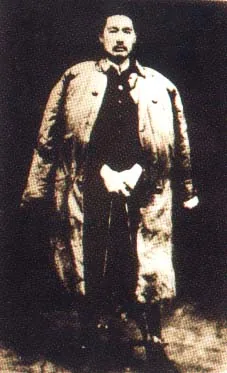
Fang Zhimin in shackles at the Kuomintang Military Law Department in Nanchang, 1935
I. The Evidence Chain: The Abduction and Execution of the Stams
The “John and Betty Stam Incident” is a historical event supported by a closed loop of evidence, where Chinese Communist records, Kuomintang (KMT) reports, and Western missionary archives align with high precision.
1. The Fall of Jingde and the Capture of Foreign Nationals
On December 6, 1934, the 19th Division of the Red Army—acting as the vanguard for the “Northward Anti-Japanese Advance”—launched a surprise assault on Jingde County, Anhui. Among those detained were John Cornelius Stam (27), his wife Elisabeth Scott Stam (28), and their two-month-old daughter, Helen. The Stams, members of the China Inland Mission, had been in the city for only two weeks.
Following the capture, the division followed the standard guerrilla protocol of the era: “fundraising” through the detention of local gentry and foreign nationals. A ransom of 20,000 silver dollars was demanded from the mission.
2. The Pencil-Written Note
While being marched toward captivity, John Stam managed to write a brief note in pencil addressed to the China Inland Mission headquarters and the American Consulate in Wuhu:
“My wife, baby and myself are today in the hands of the Communists in the city of Tsingteh. Their demand is twenty thousand dollars… The messenger is waiting for this letter, so I must close. I know the Mission has no such funds, and I do not know what the outcome will be.”
This original note remains preserved in missionary archives. Its publication by the Associated Press and the Shen Bao at the time provided the primary evidence of the Red Army’s use of foreign captives for military financing.
3. Execution at Miaoshou and the “Miracle Baby”
On December 7, the Red Army retreated toward the town of Miaoshou as KMT pursuit forces (the 49th Division) closed in. On the morning of December 8, with the sound of KMT gunfire audible from the north, the Red Army vanguard executed the Stams on a small hill in Miaoshou.
Their infant daughter, Helen, was left behind in a local house. She was later rescued by a Chinese Christian, Lo Ke-chow, who hid her and eventually smuggled her to the Wuhu General Hospital. The incident sparked an international outcry, becoming a central pillar of the KMT’s diplomatic campaign against the “Communist bandits.”
II. Deconstructing the Command Chain: Where was Fang Zhimin?
Online revisionist narratives often simplify the tragedy into a direct accusation: “Fang Zhimin ordered the kidnapping and execution to raise funds.” However, an analysis of the military command structure and geographical coordinates reveals a significant disconnect.
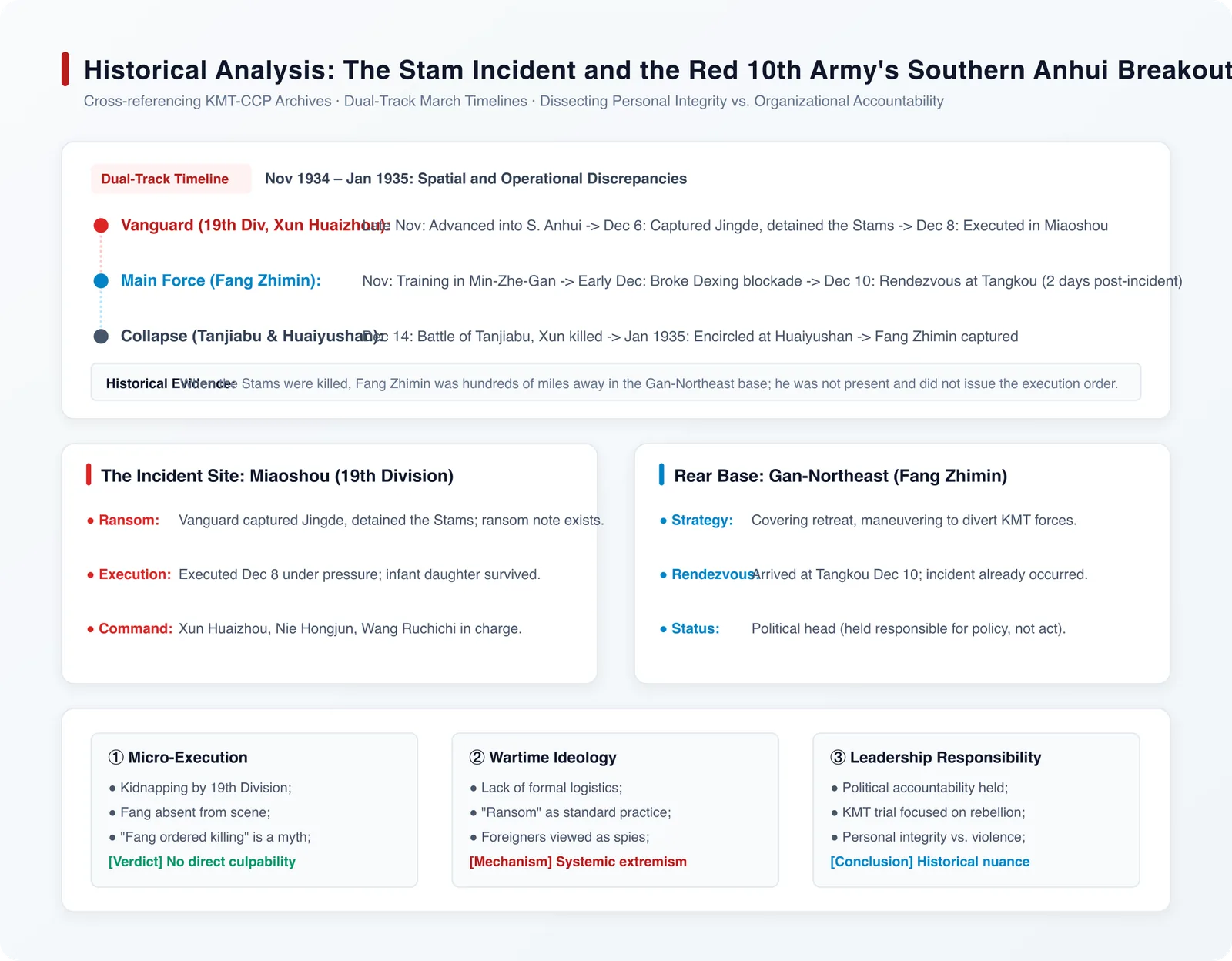
Timeline of the Red 10th Army Group’s breakout and the Stam Incident command chain
1. Organizational Structure and Power Dynamics
To understand the decision-making process, one must look at the merger of forces in November 1934:
- The Merger: The Red 7th Army Group (led by Xun Huaizhou and Le Shaohua) joined Fang Zhimin’s Red 10th Army to form the Red 10th Army Group.
- The Leadership: Fang Zhimin was appointed Chairman of the Military-Political Committee, Liu Chouxi was the Commander, and Le Shaohua was the Political Commissar.
- The Tactical Units: The former Red 7th Army became the 19th Division, led by the 22-year-old Xun Huaizhou. This was the unit that captured Jingde.
2. Spatial and Temporal Separation
The Red 10th Army Group operated in split columns to evade encirclement. The march logs show a clear physical separation:
| Unit | Key Commanders | Location: Dec 6–8, 1934 | Relation to the Incident |
|---|---|---|---|
| Vanguard (19th Division) | Xun Huaizhou, Wang Ruchi | Deep in Southern Anhui; captured Jingde (Dec 6); executed Stams at Miaoshou (Dec 8). | Direct Execution: The decision to detain, ransom, and execute was made by the frontline division command. |
| Main Force (Army HQ & 20th Div) | Fang Zhimin, Liu Chouxi | Mobilizing in Northeast Jiangxi; crossing the Le’an River; breaking through the Dexing blockade. | Absent: Hundreds of miles away across mountainous terrain; radio communication was severely restricted. |
According to both Red Army logs and KMT battle reports, Fang Zhimin and the main force did not rendezvous with the 19th Division at Tangkou (at the foot of Huangshan) until December 10.
By the time Fang met with the vanguard commanders, the Stams had been dead for two days. Within a week, the Red 10th Army Group would be decimated at the Battle of Tanjiaqiao, where Xun Huaizhou was killed. Fang Zhimin was eventually captured in January 1935.
III. Systemic Logic: The Mechanics of “Warfare Finance”
Attributing the tragedy solely to the “cruelty” of individual commanders obscures the institutional logic at play. The Stam incident was a byproduct of the “Warfare Finance” system that sustained guerrilla survival during the Land Revolution.
1. The Inertia of “Fundraising”
Under the KMT’s “Blockhouse Strategy” and economic embargo, the Communist base areas were severed from modern financial systems. Guerrilla units had no tax base and no supply lines. Ammunition, salt, and medicine had to be procured in “enemy-occupied” zones.
The practice of “striking the local gentry for funds” (detaining wealthy individuals for ransom) was a survival necessity. This was not a rogue action by the 19th Division; it was a widespread tactical feature. As explored in our Institutional Evolution Reports, moralizing individual actions without accounting for systemic constraints fails to explain the reality of wartime decision-making.
2. The Ideological Framing of Missionaries
In the 1930s Communist paradigm, the China Inland Mission was not viewed as a neutral charity. Missionaries were defined as “cultural imperialists” and “reactionary spies” using religion to gather intelligence. Under this framework, ransoming a foreign missionary was seen by frontline political officers not as a crime, but as a legitimate blow against imperialism that simultaneously solved the unit’s supply crisis.
3. Tactical Desperation and the Collapse of Civilian Protection
The immediate trigger for the execution was the tactical pressure of the retreat.
- Mobility vs. Captives: In a mountain retreat where the enemy is only miles behind, carrying two non-Chinese speakers and a nursing infant is a massive tactical liability.
- The Ransom Failure: When the ransom failed to materialize quickly and the KMT encirclement tightened, the frontline command chose execution over the risk of the captives slowing them down or revealing their position.
From the perspective of modern international humanitarian law, the execution of non-combatants is an indefensible violation of civilizational norms. It was a systemic tragedy where ideological fervor and tactical desperation overrode human instinct.
IV. The Legal Record: Why was Fang Zhimin Executed?
A common misconception suggests that the KMT executed Fang Zhimin specifically for the Stam murder. The archives of the Nanchang Military Law Department tell a different story.
1. Charges of Political Rebellion
Fang was tried under the “Provisional Law on Counter-Revolutionary Crimes” (1928) and wartime martial law.
- The Indictment: Organizing illegal armed forces, subverting the government, and implementing violent land reform.
- The Strategy: Chiang Kai-shek initially sought Fang’s defection. High-ranking Whampoa generals were sent to persuade him to “return to the fold” as a political trophy.
- The Verdict: Following Fang’s refusal to defect, he was sentenced as a “primary insurgent” and executed on August 6, 1935. The Stam incident was not the primary legal basis for his death sentence in the official verdict.
2. The Burden of Command Responsibility
While the legal focus was on political rebellion, the KMT utilized the Stam incident for maximum diplomatic leverage. As the Chairman of the Military-Political Committee, Fang Zhimin held nominal and political command responsibility. In the logic of institutional accountability, the supreme leader is responsible for the conduct of his subordinate divisions, regardless of physical presence. This is why Western missionary accounts and historical documents often lay the “blood debt” at Fang’s door.
V. Conclusion: The Two Facets of a Revolutionary
The essay Poverty, taught in Chinese schools, was written in a Nanchang prison cell on May 26, 1935. How do we reconcile the ascetic saint of the textbook with the commander of a unit that committed a war crime?
1. The Reality of Personal Integrity
Fang’s claims in Poverty were not mere propaganda.
“I have been engaged in revolutionary struggle for over ten years… I have always lived a simple life. I have handled millions of dollars, but every cent was used for the revolution. On my person, there is nothing but a watch and a pen.”
Historical records of his capture confirm this. KMT soldiers were reportedly disappointed to find no hidden gold or wealth on him. His personal asceticism and devotion to his cause were objective facts.
2. Integrity Cannot Offset Systemic Violence
The tragedy of 20th-century radical politics lies in this: Individual moral discipline does not guarantee institutional humanity.
Driven by the meta-narrative of “Class Struggle,” individual empathy is easily crushed by the war machine. To raise 20,000 dollars for the cause, a vanguard unit could treat a young family as a bargaining chip; in a moment of tactical crisis, they could execute them in the street.
To understand this history, one must move beyond the binary of “Saint” vs. “Bandit”:
- To deny the Stam incident is to disrespect the victims and obscure the reality of the war.
- To reduce the incident to Fang’s personal “kidnapping” is to ignore the micro-realities of military command and march timelines.
The real Fang Zhimin was both: the resolute believer writing Beloved China in heavy shackles, and the political head of a desperate army group that, in its final throes, committed a profound humanitarian tragedy. This is the complete, and far more sobering, face of history.
Related Research & Topics
Tello Mobile eSIM
SafetyWing Nomad Insurance
* Disclosure: This post contains affiliate links. If you make a purchase through these links, V-G Journal may earn a small commission at no additional cost to you. We only recommend services we independently evaluate and trust.
FIRE and Golf:自由旅居之路
专注于为追求 FIRE 与品质生活的人群提供特惠打球权益与候鸟微度假。不持一砖一瓦,运营品质生活。