The Ledger of 'At All Costs': Load Shedding, Crisis Accounting, and the Conservation of Loss
Crises can be temporarily averted through technical and administrative maneuvers, but real-world costs never evaporate. In the macro-ledger of distributed load shedding, every 'resolved' crisis is simply fragmented and redistributed as an invisible tax on the public.

Executive Summary:
In the sandboxes of modern governance, macro-regulation, and industrial management, one often hears the thundering resolve to “resolve the crisis at all costs.”But the first laws of physics and accounting are cold and indifferent: Debits must equal credits, and costs are always conserved. There is no such thing as a crisis that vanishes into thin air, nor a feast without a bill. What we call a “successfully resolved crisis” is usually just a loss that has been renamed on a balance sheet and pushed into a corner where the victims have the quietest voices. Given “whatever it takes,” any problem can find a technical solution in the short term. However, the public remains the ultimate bearer of that “all costs” price tag.
I. Hard Constraints on the Construction Site: Engineering Has No Magic
In large-scale international infrastructure or heavy industrial projects, the phrase front-line engineers fear most is a management decree: “Ensure delivery on schedule, at all costs.”
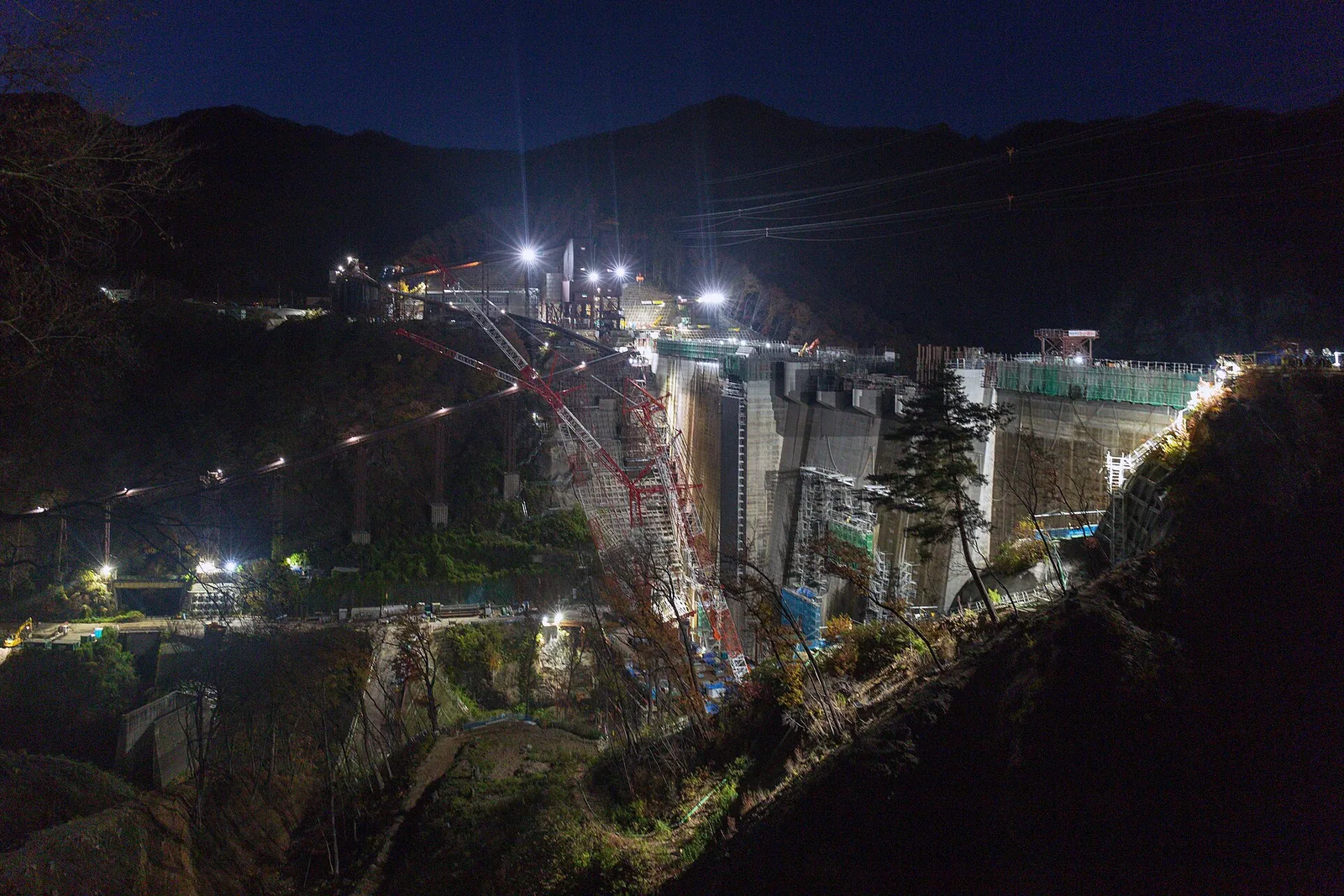 Figure: Late-night construction at a massive hydraulic engineering site. There is no magic in engineering mechanics; the reality of compressed schedules and “delivery at all costs” is a cycle of 24/7 heavy machinery operation, the erosion of safety margins, and the physical exhaustion of the workforce.
Anyone who has managed a site or a crew knows that natural laws do not bend to willpower:
- The Iron Law of Physics: If a schedule is forced forward by three months, concrete does not hydrate or cure faster because of a corporate memo.
- The Mechanics of Delivery: The only way to meet the deadline is to run heavy machinery until it breaks, implement grueling triple-shift rotations, and compress safety redundancies to their absolute limit.
- The Transfer of Cash Flow: Financial “success” is often achieved by indefinitely delaying payments to subcontractors and equipment suppliers, masking the project’s true liabilities as “contributed capital” from the supply chain.
In press releases and mobilization rallies, “at all costs” is a phrase of immense gravity and perceived nobility. It suggests decisive leadership and a commitment to the greater good.
On the ground, however, that phrase translates into the literal sweat, shortened lifespans, and financial ruin of specific individuals.
II. The First Law of Accounting: Crises are Transferred, Not Extinguished
When we shift our gaze from the construction site to the macro-economic and financial systems, the logic remains airtight.
In the strategic toolkits of top-tier policymakers, the options for offsetting a crisis are seemingly endless:
- The Shuffling of Toxic Assets: Moving bad debts off the balance sheets of core commercial banks and into Asset Management Companies (AMCs) or Special Purpose Vehicles (SPVs).
- The Extension of Debt Cycles: When principal and interest cannot be met, initiating “extend and pretend” arrangements—rolling over three-year debts for another three.
- Precision Liquidity Injections: Using targeted re-lending, special financial bonds, and unconventional liquidity facilities to backstop the interbank market the moment it runs dry.
- Exchange Rate Rebalancing: Adjusting float ranges and offshore liquidity pools to absorb exogenous shocks when the current or capital accounts are under pressure.
 Figure: The historic trading floor of a modern financial exchange. In the sterile reports of financial engineering, debt stripping and extensions are elegantly termed “smoothing the cycle” or “trading time for space.” But balance sheets do not destroy loss; debits must always equal credits.
In the sterile language of financial engineering and macroeconomics, these maneuvers are elegantly summarized as “smoothing the cycle” or “trading time for space.”
But this does not change the cold accounting reality: Losses do not evaporate in a vacuum.
Every “successfully resolved” crisis is essentially a loss that has been rebranded and moved to deeper waters—areas where the perception is duller, the reaction cycle is longer, and the capacity to resist is weaker.
III. The Invisible Market: Inflation Slices, Welfare Contraction, and the Hidden Ledger
The simulations of financial engineering rarely account for the price of vegetables at a morning market or the monthly ledger of an average household.
The holes “smoothed over” at the macro level eventually travel through the capillaries of the economic body, manifesting as precise increases in the cost of living for the individual:
- Hidden Inflation on the Shelves: Diluted currency liquidity quietly erodes the purchasing power of household savings. Manufacturers, afraid to raise prices directly, resort to “shrinkflation”—reducing package weights to pass on upstream costs.
- Marginal Compression of Public Spending: To maintain the stability of core institutional balance sheets, local budgets must carve out massive space for debt servicing. This translates directly into “minor” adjustments in medical insurance co-pays and the slashing of public service headcounts and budgets.
- Pressure Transfer in the Labor Market: To cope with delayed payments and cash flow pressure from upstream, corporations transfer costs to employees. This manifests as the “35-year-old age wall” in hiring, the normalization of unpaid overtime, and the pervasive shift toward outsourcing and the “gigification” of the workforce.
Bad debts are wiped clean on the macro ledger, but in the micro-reality of daily life, every family pays the interest on those “resolved” crises through higher grocery bills, more expensive healthcare, and a more precarious job market.
IV. The Cold Logic of Distributed Systems: Load Shedding and Edge Node Disconnection
If we examine this logic through the lens of modern distributed computing and high-concurrency network architecture, the mechanism reveals a chilling engineering certainty.
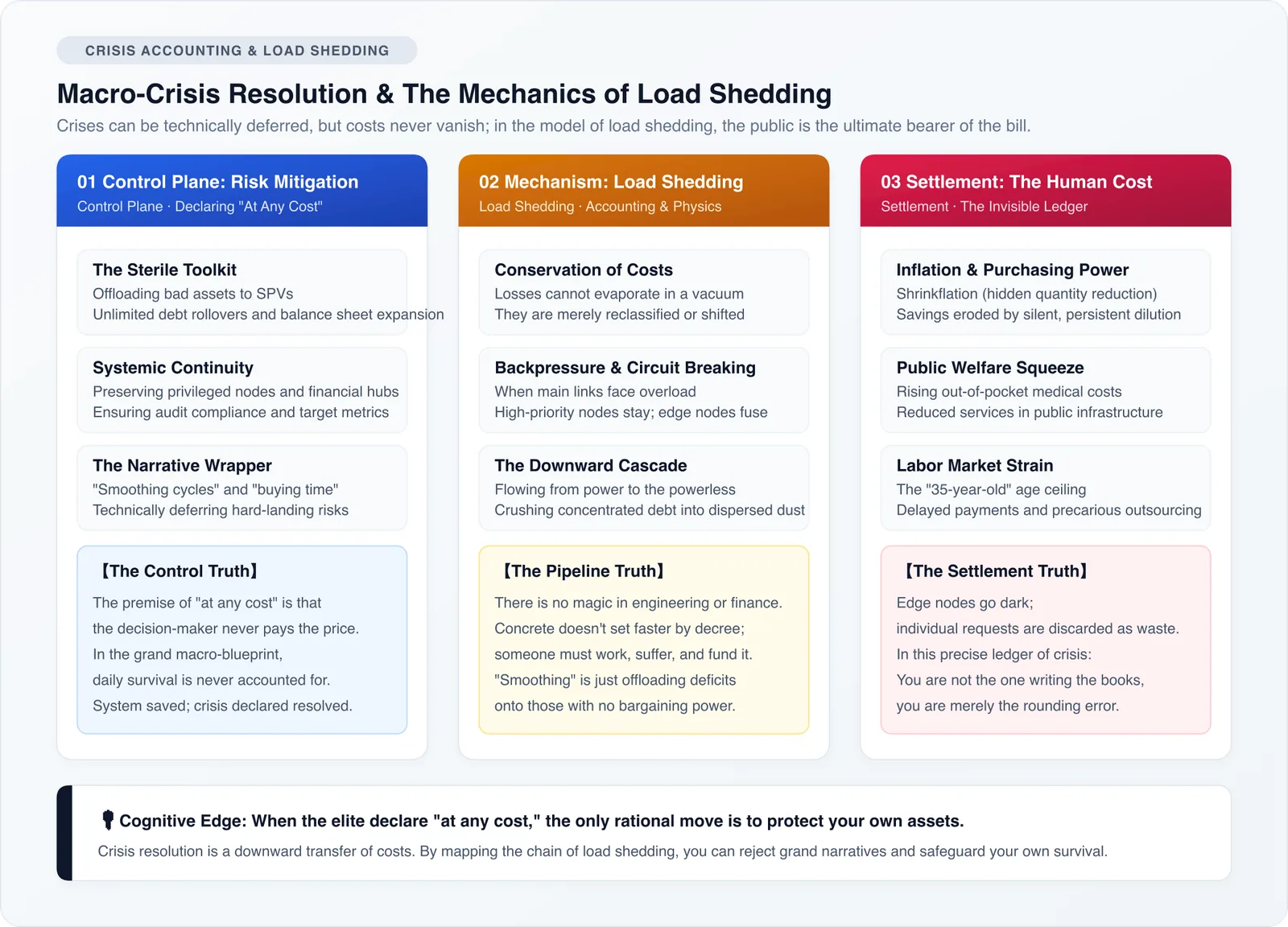 Figure: The closed loop of macro-crisis resolution and the underlying load-shedding mechanism. Technical scheduling prevents a “hard landing” for the system, but the conserved costs flow downward along the ladders of power and capital. Edge nodes become silent consumables.
When a massive distributed system encounters a sudden surge in traffic, any architect knows that a Single Point of Failure (SPOF) can trigger a total network collapse.
To ensure the survival of the core cluster, the system is designed with a deterministic defense mechanism: Load Shedding.
 Figure: A modern hyperscale distributed data center. In the face of extreme overload, the system’s only survival mechanism is Load Shedding—the high-priority core nodes are protected by layers of redundancy, while edge routers and ordinary requests are ruthlessly dropped.
Under this mechanism, resources and priorities are strictly tiered:
- The Privileged Zone: Core databases, backbone switches, and critical settlement nodes are guarded by redundant power grids and dedicated bandwidth. They are not allowed to fail, regardless of the surge.
- The Marginal Zone: External gateways, edge proxies, and standard user request queues are configured as “disposable assets” the moment an overload occurs.
- Circuit Breaking: Massive numbers of connections are simply dropped or timed out. The system sacrifices peripheral responsiveness to ensure the absolute safety of the central metrics.
The system does not crash.
The market indices stabilize, the “five nines” (99.99%) of system availability are met, and management can present a beautiful year-end audit.
The only catch is that the edge nodes have gone dark. The requests of ordinary users were silently discarded.
V. The Final Audit: You are the Rounding Error
Every decision to act “at all costs” is predicated on the fact that the decision-maker is not the one paying the price.
When a leader plays this card with a look of steely resolve, the rational instinct of the observer should not be to cheer, but to check their own pockets.
In the precise ledger of crisis accounting:
The Core Law of Liquidation:
A crisis can be delayed or transformed through administrative power and financial engineering, but the material consumption and sunk costs never vanish.You are never the macro-accountant sitting at the console balancing the books. In the grand scheme of “at all costs” load shedding, you—like millions of other edge nodes—are merely the insignificant rounding error being quietly erased to make the final sum work.
Related Research & Topics
Tello Mobile eSIM
SafetyWing Nomad Insurance
* Disclosure: This post contains affiliate links. If you make a purchase through these links, V-G Journal may earn a small commission at no additional cost to you. We only recommend services we independently evaluate and trust.
FIRE and Golf:自由旅居之路
专注于为追求 FIRE 与品质生活的人群提供特惠打球权益与候鸟微度假。不持一砖一瓦,运营品质生活。