Space Burials & Controlled Deorbit: Orbital End-of-Life Planning and Terrestrial Economics
Launch, circumnavigate, slip away, vaporize. While conventional end-of-life protocols trap individuals in the slow depreciation of ICU interventions and twenty-year cemetery leases, entrusting one's biological conclusion to celestial mechanics resolves three ultimate bucket-list milestones before closing the loop in hypersonic plasma. A cold-eyed examination of the engineering, the economics, and the terrestrial legal chains holding it back.

Executive Summary:
For the vast majority of human beings, the standard end-of-life protocol is a protracted, unceremonious exercise in physical and financial depreciation: invasive pump-and-valve plumbing to sustain marginal vital signs, rib-fracturing chest compressions in windowless intensive care units, and a twenty-year municipal lease on a predatory concrete square in a suburban cemetery.If a commercial spaceflight provider were to list an orbital exit package on its manifest—launch to Low Earth Orbit, a ninety-minute planetary circumnavigation, normobaric nitrogen induction, and a targeted deorbit burn into atmospheric incineration—I would book the ticket immediately.
This is neither romantic science fiction nor macabre indulgence. At the convergence of orbital mechanics and fluid dynamics, the concept liquidates three of humanity’s most elusive lifetime ambitions in a single stroke, achieving physical and atomic closure of uncompromising dignity. What prevents this service from coming to market has never been propellant mass or hypersonic aerothermodynamics; it is the tangled bureaucracy and institutional inertia of the terrestrial order.
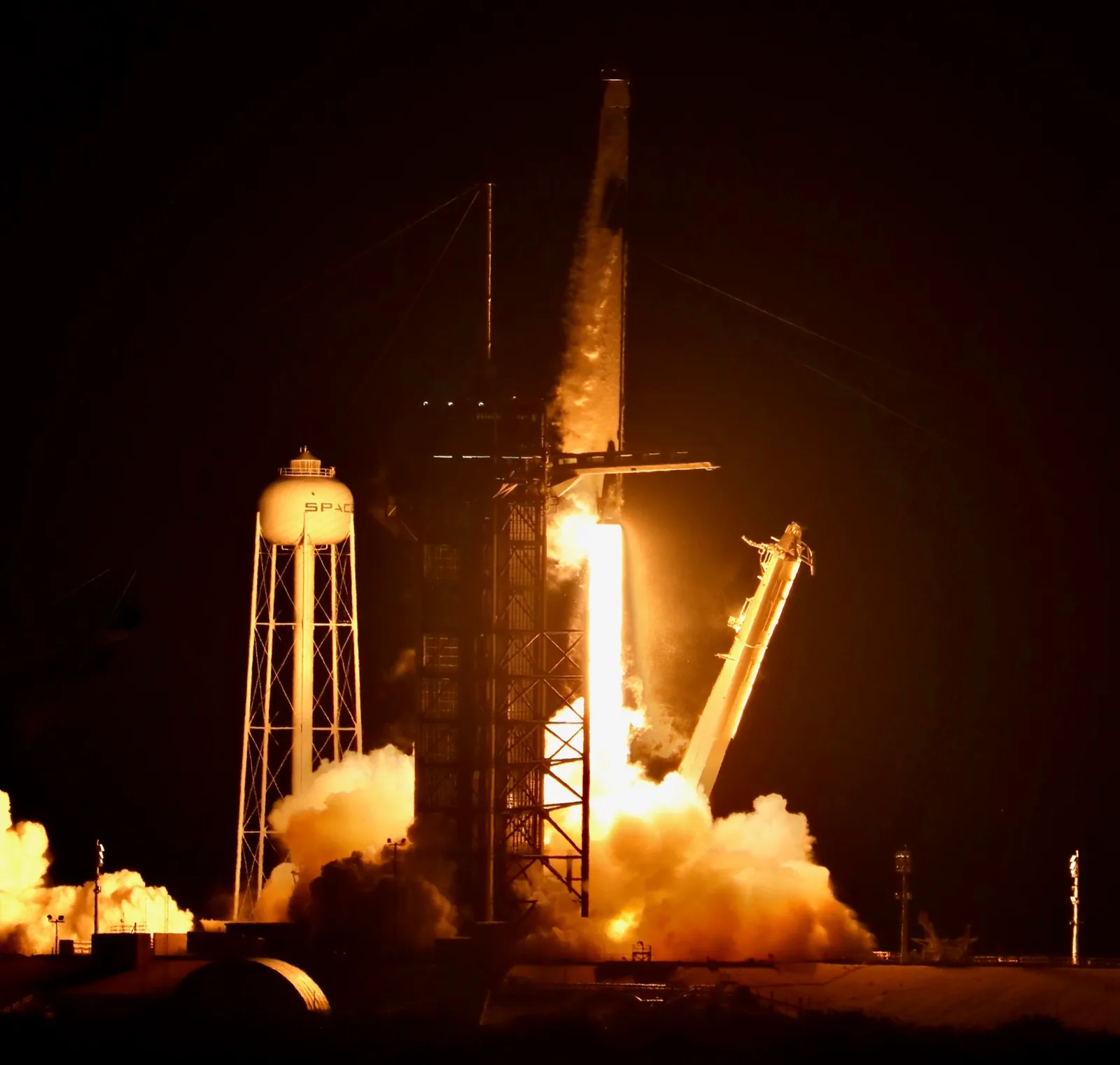 Figure: Nighttime launch of a SpaceX Falcon 9. While commercial launch economics have compressed the cost of orbital insertion to historic lows, licensed human spaceflight remains legally tethered to exhaustive escape redundancies and non-negotiable life-support systems.
Introduction: Substituting Terrestrial Depreciation with Celestial Mechanics
Across modern medical infrastructures and conventional mortuary supply chains, the departure of a carbon-based life is partitioned into two protracted, extractive phases:
- Antemortem Passive Depreciation: Confined to windowless tertiary-hospital ICUs, central venous catheters, mechanical ventilators, and vasopressor drips sustain paper waveforms. Resuscitation algorithms—designed primarily to hedge against malpractice litigation and procedural scrutiny—routinely involve fractured sternums, emergency tracheostomies, and multiorgan cascade failure. The patient forfeits complete agency over their physical vessel, exhausting family reserves and personal dignity in acute biological distress.
- Postmortem Real Estate Tenancy: The biological remains are ferried to a suburban crematorium, subjected to an hour under 850°C to 1000°C diesel burners, manually pulverized to crush uncalcified bone fragments, and sealed into a masonry urn. Finally, the estate pays an exorbitant premium per square meter for a concrete niche held under a twenty-year lease, locking the surviving family into indefinite maintenance fees.
Set against this bureaucratic gauntlet, programming one’s biological conclusion directly into a spacecraft’s flight guidance computer is an act of clean, first-principles reductionism:
Launch, circumnavigate, slip away, vaporize.
This trajectory bypasses the social and clinical friction of modern dying while delivering, within a single ninety-minute orbital period, the three most difficult milestones on the human experiential checklist.
1. Ninety Minutes of Borderless Planetary Penetration
In everyday life, circumnavigating the planet is an exercise in high-friction logistics: consular visa approvals, customs declarations, flight delays, language barriers, and the neurochemical exhaustion of crossing consecutive time zones. Even those who allocate decades and millions of dollars to the endeavor typically access only heavily curated, commercialized terrestrial nodes.
From Low Earth Orbit (LEO), between 300 and 400 kilometers altitude, terrestrial borders and sovereign jurisdictions cease to exist as physical constraints.
Governed by Keplerian orbital mechanics, a payload moving at first cosmic velocity—approximately 7.8 kilometers per second—completes a full revolution around the Earth in roughly ninety minutes:
Keplerian Orbital Deduction:
Orbital Period T ≈ 90 minutes ➔ Traversed at 7.8 km/s (First Cosmic Velocity) in microgravity, slicing cleanly through day and night hemispheres along a high-inclination great circle.
Within an hour and a half, the cabin viewport presents raw, unedited planetary geography:
- The deep, fathomless cobalt basins of the Pacific;
- Minutes later, the razor-sharp golden ridge lines and dry wadis of the Sahara;
- Followed immediately by the cloud-piercing snowpacks of the Tibetan Plateau and the thousands of kilometers of fractured Andean rock.
No customs stamps, no gate lounges, no terrestrial choke points. The human central nervous system receives the planet in its highest-order physical resolution, free of friction.
2. The Unfiltered Planet: The Overview Effect at the Edge of Retinal Limits
Terrestrial photography, regardless of dynamic range stacking or darkroom grading, cannot replicate the visceral cognitive disruption known as the Overview Effect.
 Figure: The planetary limb viewed from 400 kilometers aboard the International Space Station. A pale-blue atmospheric airglow and vivid green auroral curtains line the horizon against deep space, generating a visual dynamic unreachable by terrestrial optics.
Stripped of tropospheric particulate scattering and moisture, visual inputs push human optical limits:
- The Absolute Black of the Cosmic Canvas: Unlike ground-based night skies, polluted by artificial light and atmospheric backscatter, the deep space background outside the cabin is an uncompromising, light-swallowing void. Stars do not twinkle; they burn with dead, piercing geometric precision.
- The Slicing of the Terminator Line: The day-night boundary moves across continental landmasses and open oceans at hundreds of meters per second. The shift from blinding daylight to absolute planetary night unfolds across a razor-thin gradient in seconds.
- The Pale-Blue Atmospheric Airglow: The envelope sustaining the biosphere appears impossibly fragile. Measuring mere dozens of kilometers in thickness, it sits like a paper-thin, fluorescent membrane glowing faintly under solar irradiation and geomagnetic interaction.
- Auroral Sheets at High Latitudes: Over the magnetic poles, curtains of charged solar particles ionize the upper stratosphere, casting emerald and magenta light across hundreds of vertical kilometers beneath the spacecraft.
Among all physical observation points accessible to human perception, this vantage point offers the highest information density and the sharpest antidote to terrestrial self-absorption.
3. Pure Nitrogen Induction and Hypersonic Dematerialization
Once visual absorption and orbital transit reach their predetermined mission timestamp, the flight software executes two linked sequences: neurobiological termination and thermal dissolution.
Classical cultures often romanticized liberation from corporeal decay as an ascent into the ether. Modern aerospace medicine and aerothermodynamics execute this transition with mathematical neutrality:
1. Physiological Depower: Normobaric Inert Gas Replacement
The panic, hyperventilation, and agony associated with conventional suffocation are not triggered by an absence of oxygen. They are triggered by hypercapnia—the accumulation of carbon dioxide in the bloodstream, which activates the panic circuitry of the medulla oblongata.
At the designated orbital coordinate, the flight system isolates the cabin oxygen supply and floods the volume with medical-grade, high-purity nitrogen at one standard atmosphere:
- Residual oxygen in the pulmonary alveoli is washed out within two or three normal breaths;
- Arterial oxygen saturation plummets instantly while carbon dioxide continues to vent unimpeded, bypassing the respiratory distress reflex entirely;
- The individual experiences only a mild, warm disinhibition and gentle tunnel vision. The central nervous system powers down within thirty to forty seconds, slipping into deep coma. Cardiac and autonomous respiratory arrest follow painlessly in complete cellular hypoxia.
There are no screeching ICU monitor alarms, no invasive tubes, and no mechanical trauma. Vital signs settle to zero in a state of absolute physiological neutrality.
2. Physical Deconstruction: 7.8 km/s Hypersonic Shockwave Plasma
With biological cessation confirmed, the Orbital Maneuvering System (OMS) executes a retroburn, lowering orbital perigee below the critical eighty-kilometer atmospheric threshold.
The craft slams into the upper thermosphere at orbital velocity:
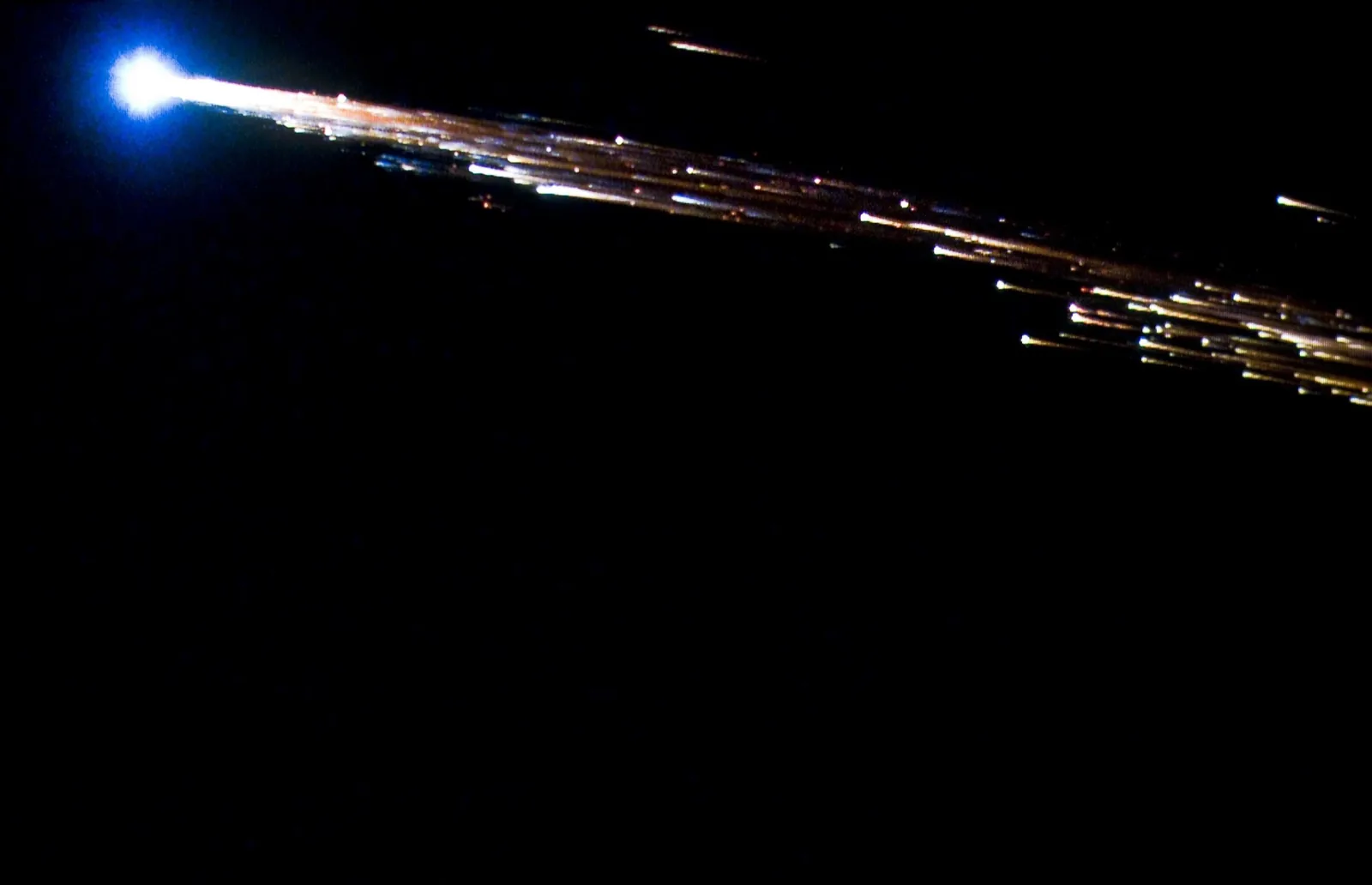 Figure: Controlled spacecraft breakup and vaporization during atmospheric reentry at ~7.8 km/s (NASA/ESA observational data). Hypersonic shock compression ignites a multi-thousand-degree plasma sheath, dissociating matter at millisecond timescales and returning base elements to planetary cycles.
Extreme aerodynamic shock compression ahead of the heat shield generates a bow shock measuring thousands of degrees, wrapping the structure in an incandescent plasma sheath:
- Hundreds of atmospheres of dynamic pressure and violent aerothermodynamic heating compromise the hull within seconds;
- The occupant’s organic tissue—composed of water, proteins, lipids, and hydrocarbons—is instantly shredded, ionized, and dissociated by the shockwave;
- This is elemental dissolution executed at an atomic scale. There are no diesel burners, no mechanical bone pulverizers, no toxic ash runoff, and zero residual orbital debris.
The physical matter transitions into a brilliant meteor across the upper stratosphere, dispersing carbon, hydrogen, and oxygen atoms back into the global geochemical cycle.
4. The Balance Sheet: Why Orbital Exit Is Economically Feasible
The default assumption is that orbital dematerialization is an indulgence reserved for billionaires. Yet an objective balance-sheet analysis reveals a counterintuitive parity.
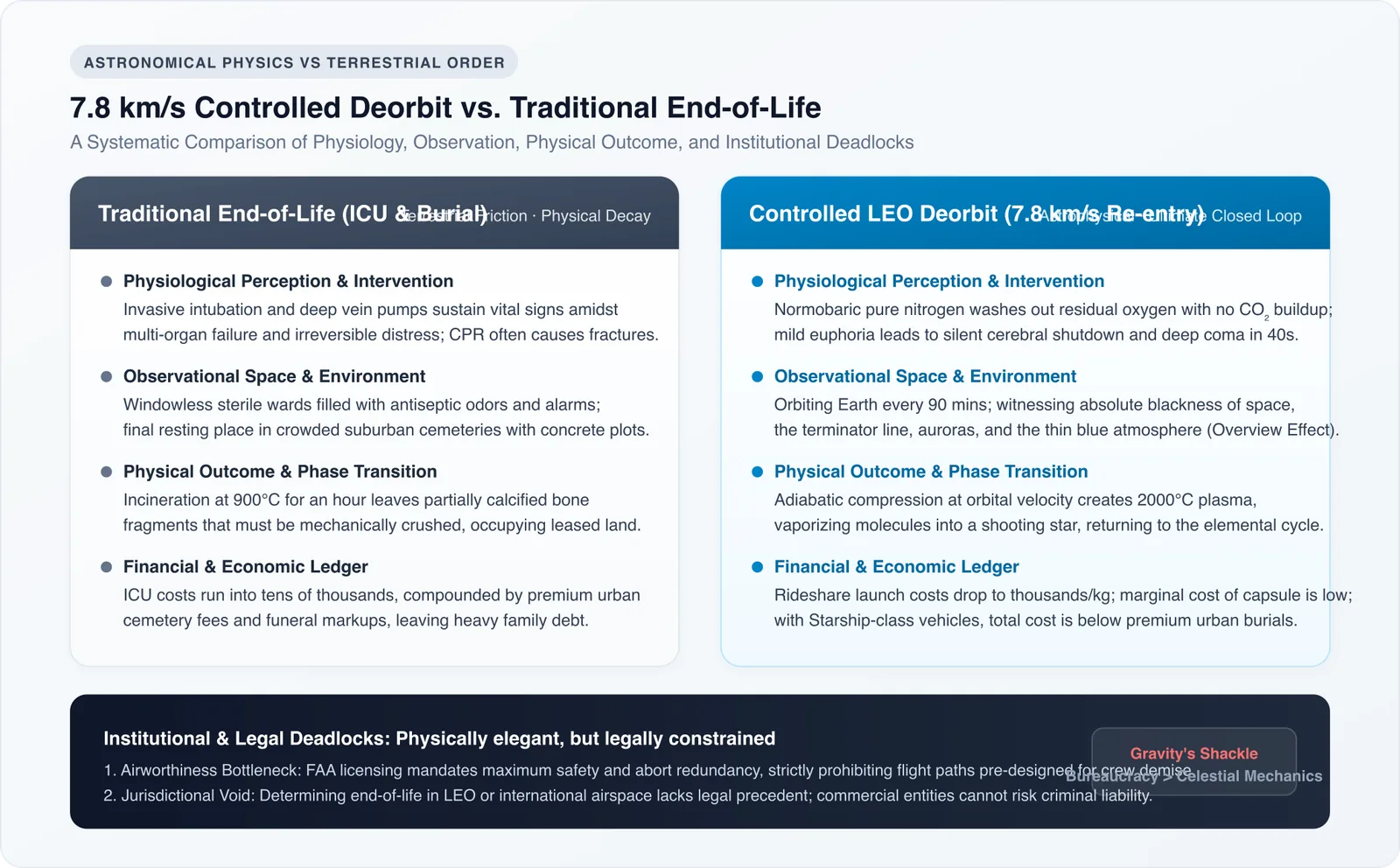 Figure: Comprehensive matrix comparing a 7.8 km/s orbital exit against terrestrial end-of-life protocols. While celestial mechanics deliver internal consistency across physiological experience, visual perception, and atomic resolution, terrestrial regulatory frameworks remain the intractable bottleneck.
1. The Hidden Liabilities of Terrestrial Decline
In high-tier metropolitan markets, the terminal phase of chronic illness carries catastrophic costs:
- Intensive Care Unit (ICU) Consumption: Daily private or unreimbursed ICU expenses routinely range from $1,500 to $3,000. Sustaining marginal vitals over weeks or months reliably drains family balances into the six figures;
- Cemetery Real Estate Cartels: Metropolitan burial plots often trade at $15,000 to $45,000 per square meter, subject to twenty-year lease renewals, perpetual maintenance assessments, and inflated stone masonry markups;
- Caregiver Depreciation: The financial, physical, and emotional burnout borne by families navigating defensive medical interventions represents a massive, unpriced liability.
2. The Collapse of Launch Economics
Driven by Falcon 9 first-stage recovery and commoditized smallsat rideshare missions (such as SpaceX’s Transporter series), the cost to insert mass into Low Earth Orbit has fallen toward the $5,000 to $6,000 per kilogram band:
- An average adult (70 kg) paired with a stripped-down, single-use deorbit capsule (150 kg) yields a total wet mass well under 250 kilograms;
- Within current rideshare architectures, the marginal hardware launch cost sits around $1.2 million to $1.5 million;
- As the SpaceX Starship architecture enters operational maturity with full reusability, payload-to-LEO costs are projected to fall toward low triple-digits per kilogram. At that scale, the marginal launch cost of a single-passenger orbital exit will fall below the comprehensive balance-sheet burn of a prolonged ICU admission coupled with prime urban cemetery plots.
From a purely actuarial perspective, this pathway has already cleared the threshold of technical feasibility.
5. Institutional Paralysis: Bureaucracy and the Gravitational Tether
If the physics, the physiology, and the unit economics are already solvent, why does no commercial launch operator offer this flight profile?
The answer is structural: The barrier is not orbital velocity; it is the regulatory seal and the jurisdictional vacuum on the ground.
1. The Redundancy Paradox of Airworthiness Licensing
Licensing frameworks maintained by the FAA’s Office of Commercial Space Transportation (AST), EASA, and other civil aviation authorities are predicated entirely on passenger survival and abort redundancy:
- Launch vehicles must carry launch escape systems (LES) or high-thrust abort motors;
- Thermal protection systems must be certified to survive atmospheric entry and deliver occupants safely to an ocean splashdown or landing zone;
- No civil servant will ever authorize a commercial flight plan whose profile explicitly includes deliberate passenger expiration and complete structural disintegration. Approving such a mission would expose both the agency and the launch provider to immediate criminal investigations for assisted suicide or reckless endangerment, followed by public litigation.
2. The Jurisdictional Desert Above the High Seas
Outer space is governed by the Outer Space Treaty (OST) and maritime legal precedent:
- A space object remains under the jurisdiction and control of its state of registry;
- Inducing unconsciousness and payload dematerialization in orbit occupies an uncharted legal perimeter;
- No publicly traded aerospace firm or defense prime will jeopardize sovereign defense contracts, risk international criminal liability, or trigger catastrophic ESG downgrades to capture a niche consumer market.
Conclusion: Celestial Freedom, Terrestrial Gravity
The conceptual appeal of an orbital exit lies in how directly it counters the most extractive, prolonged, and degrading rituals of modern life with the uncompromising clarity of physics.
It decouples the end of conscious experience from the smell of hospital disinfectants and the chirping of telemetry monitors, trading them for a ninety-minute planetary loop, an unmediated view of the abyss, and an atomic phase-change at orbital velocity.
In thermodynamic and mechanical terms, it is a clean, sovereign conclusion. But as long as human institutions govern the launchpads, the paperwork, liability matrices, and moral dogmas of the terrestrial surface will exert an acceleration far more unyielding than 1G. For the foreseeable future, the 7.8 km/s exit strategy remains an immaculate engineering sandbox—confined entirely to the drawer.
Related Research & Topics
Tello Mobile eSIM
SafetyWing Nomad Insurance
* Disclosure: This post contains affiliate links. If you make a purchase through these links, V-G Journal may earn a small commission at no additional cost to you. We only recommend services we independently evaluate and trust.
FIRE and Golf:自由旅居之路
专注于为追求 FIRE 与品质生活的人群提供特惠打球权益与候鸟微度假。不持一砖一瓦,运营品质生活。