The Architecture of Leisure: Social Load and the Divergent Holiday Mechanics of China and Japan
An analytical comparison of East Asian holiday systems, exploring the structural differences between statutory 'Happy Mondays' and administrative 'Tiaoxiu' adjustments. This essay dissects how different legal frameworks manage social infrastructure load and labor-capital dynamics.

Executive Summary: Whenever the schedules for spring and autumn long holidays are released, public discourse inevitably descends into a cyclical debate over holiday duration versus the exhaustion of “makeup workdays.” Moving beyond emotional grievances, a comparison with Japan reveals that the disparity between these two systems is not merely a matter of total days. Rather, it is a divergence in foundational legal logic, calendar reconstruction techniques, labor-capital bargaining power, and the strategic distribution of social infrastructure load.
Japan relies on the 16-day foundation of the Act on National Holidays, utilizing the “Happy Monday” system and statutory extensions to allow individuals and enterprises to absorb the costs of extended breaks at a micro-level. Conversely, China builds upon a 13-day statutory base, employing centralized administrative power to “borrow” weekends and create synchronized, high-intensity pulses of nationwide movement. The former protects individual physiological rhythms and public facility stability through “wave-like distribution,” while the latter uses “pulse-like extremes” to force the release of domestic demand and facilitate family reunions across a massive geographic radius.
I. Institutional Foundations and Legal Frameworks
The logic of holiday scheduling in both nations is rooted in distinct legal origins and modes of state administrative dispatch.
| Dimension | The Japan Model | The China Model |
|---|---|---|
| Core Legal Basis | Act on National Holidays (Enacted 1948, revised periodically) | Measures on Public Holidays for National Annual Festivals and Memorial Days (Revised late 2024, effective 2025) |
| Statutory Holiday Count | 16 Days (New Year’s, Coming of Age, Foundation Day, Equinoxes, Golden Week holidays, etc.) | 13 Days (New Year 1, Spring Festival 4, Qingming 1, Labor Day 2, Dragon Boat 1, Mid-Autumn 1, National Day 3) |
| Consecutive Break Rules | Extension & Statutory Alignment: Happy Monday system + Furikae Kyujitsu (Substitute Holiday) + Kokumin no Kyujitsu | Administrative Consolidation: Centralized deployment by the State Council, “borrowing” adjacent weekends to patch together long breaks |
| Makeup Workday Mechanism | Zero Makeup Days: If a holiday falls on a weekend, it is extended. The law never authorizes the seizure of subsequent rest days for work. | Bidirectional “Tiaoxiu”: Weekends before or after a long holiday are converted into workdays to compensate for the extended break. |
| Primary Long Holiday Forms | The Three Peaks: Golden Week (GW), Obon, Year-end/New Year | The Two Peaks + One Mid-Peak: Spring Festival (8 days), National Day (7 days), Labor Day (5 days) |
1. Japan: Fragmented Holidays + Spontaneous Meshing
The 16 days established by Japan’s Act on National Holidays were originally scattered across the 12 months as isolated days. To prevent single-day breaks from disrupting industrial production and office workflows, the Japanese Diet gradually introduced the “Happy Monday System” (ハッピーマンデー制度) starting in 2000.
This system amended the law to move four fixed-date holidays (Coming of Age Day, Marine Day, Respect for the Aged Day, and Sports Day) to the “nth Monday” of their respective months:
- Coming of Age Day: Second Monday of January;
- Marine Day: Third Monday of July;
- Respect for the Aged Day: Third Monday of September;
- Sports Day: Second Monday of October.
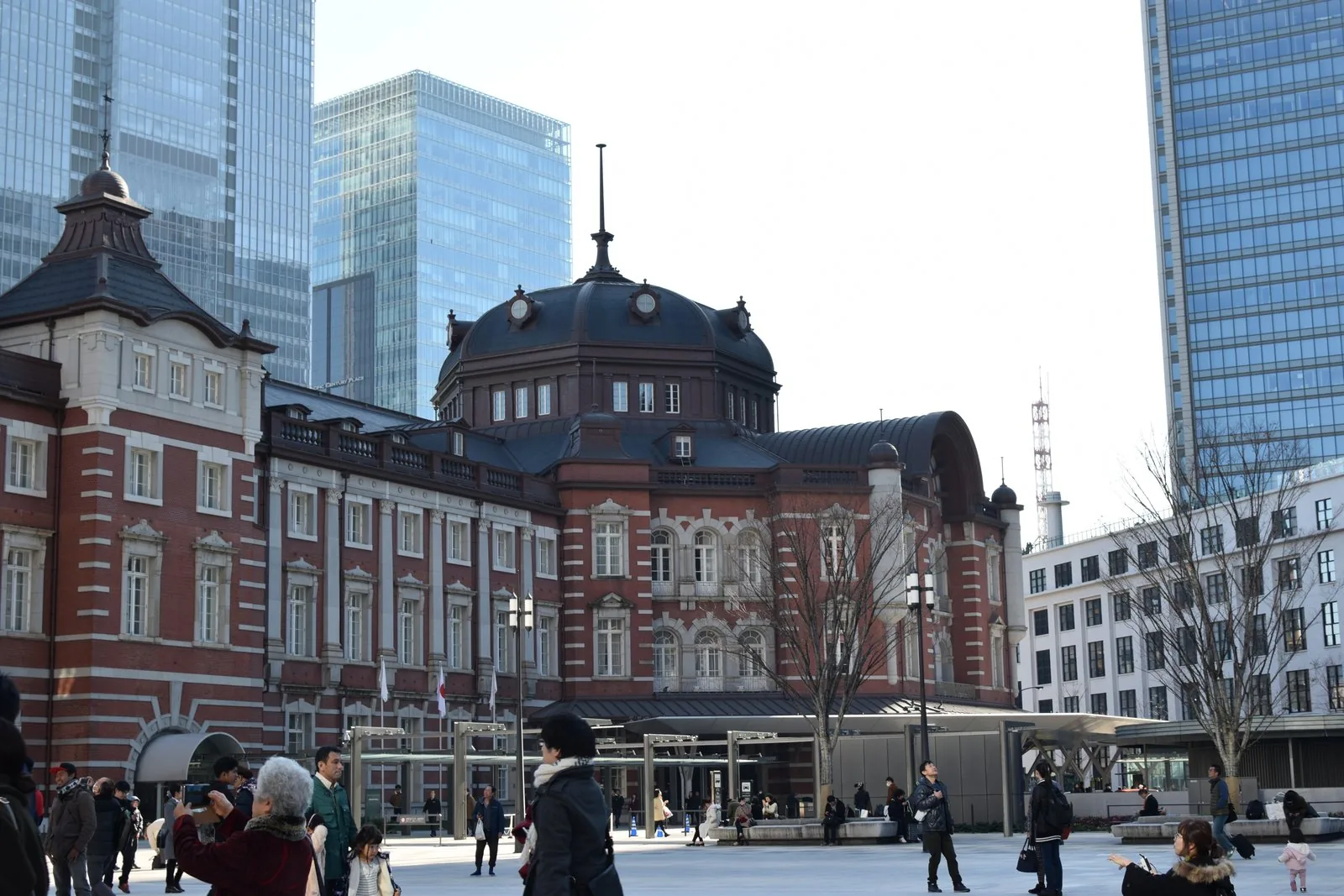
This technical adjustment legally locks in at least four “Saturday-Sunday-Monday” three-day weekends annually.
Beyond this, Japanese law sets two automatic “meshing” clauses:
- Furikae Kyujitsu (Substitute Holiday): If a statutory holiday falls on a Sunday, the following Monday automatically becomes a day off.
- Kokumin no Kyujitsu (Citizen’s Holiday): If a single working day is sandwiched between two statutory holidays, that day automatically becomes a public holiday.
The core philosophy of Japan’s system is extension and infill, strictly avoiding the “borrowing” of future time. The realization of a holiday never comes at the cost of stripping workers of their subsequent normal weekends.
2. China: Centralized Coordination + Periodic Pulse Focus
In contrast, China’s holiday arrangements are characterized by high-intensity centralized administrative coordination. Following the 2024 revision, the statutory count stands at 13 days (adding New Year’s Eve to the Spring Festival and May 2nd to Labor Day).
While the total count is near the East Asian average, China’s vast geography and massive migrant population create a rigid demand for “long-cycle continuous breaks.” Isolated 1-to-3-day holidays are insufficient for hundreds of millions of workers to complete round-trip family visits spanning thousands of kilometers.
Consequently, the current system employs the Administrative Weekend Borrowing mechanism:
- The central government publishes a unified schedule at the end of each year for the following year.
- Statutory days are “stitched” together with adjacent weekends.
- This creates an 8-day Spring Festival, a 7-day National Day, and a 5-day Labor Day.
All levels of enterprises, schools, and financial institutions follow this heartbeat, creating a highly synchronized social rhythm.
II. The Micro-Mechanics of Long Holidays
The specific paths through which long holidays are generated reflect different philosophies of social synergy: Is the time “packaged” top-down by the state, or “stitched” bottom-up by the market and labor-capital negotiation?
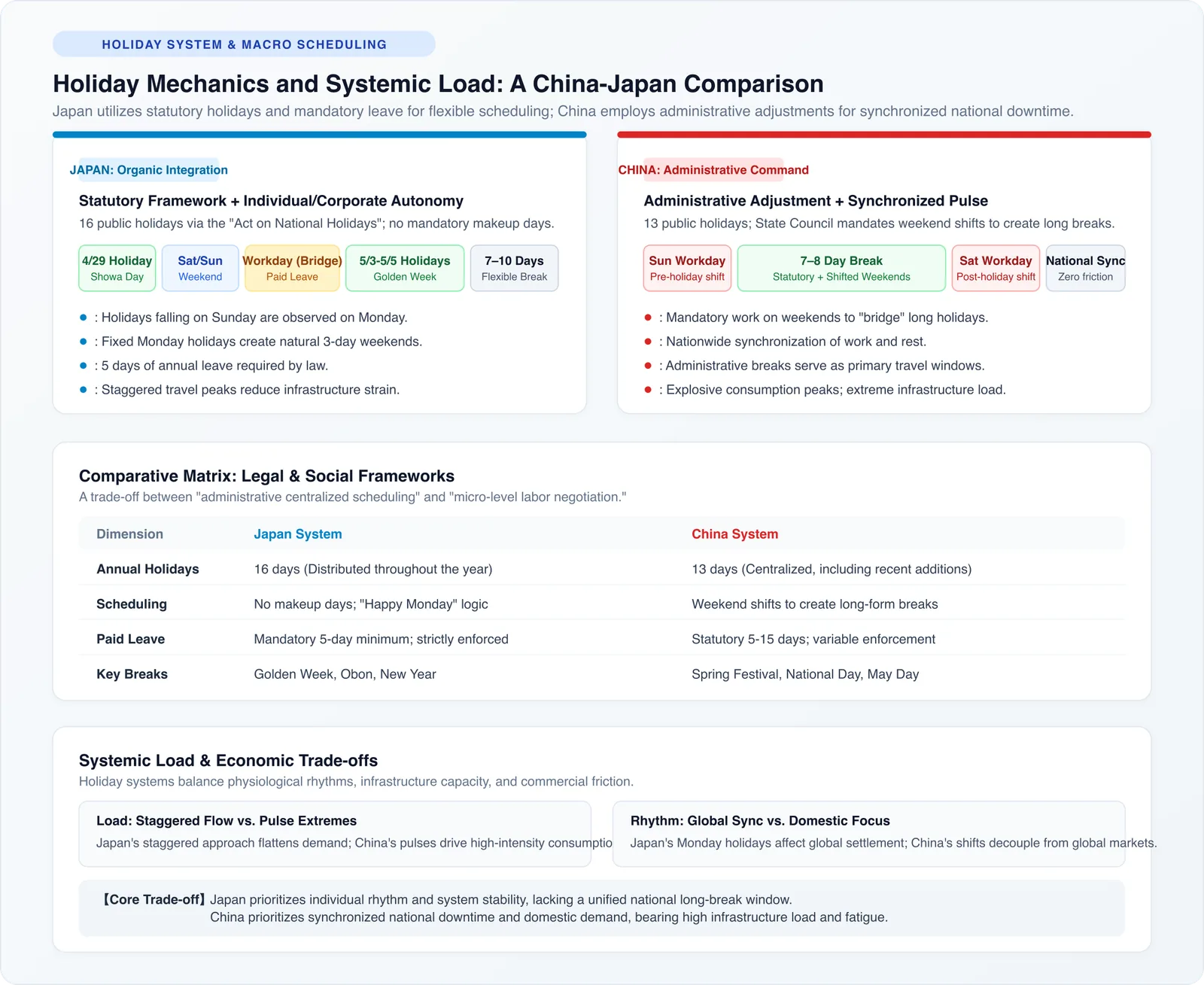
1. Japan’s Three Peaks: A Hybrid of Statute, Custom, and Paid Leave
Of Japan’s “Three Big Holidays,” only Golden Week (early May) is directly triggered by a high density of statutory holidays:
- April 29 (Showa Day)
- May 3 (Constitution Memorial Day)
- May 4 (Greenery Day)
- May 5 (Children’s Day)
In the Golden Week calendar, there are usually 1 or 2 working days sandwiched between these dates. The Japanese government does not issue an administrative order to convert these into holidays or demand weekend makeup work. Instead, the decision is returned to the micro-market:
- Corporate Unified Leave (Issei Yukyu): Large manufacturers (e.g., Toyota, Honda) often designate these gap days as paid holidays in their internal regulations to optimize the economics of shutting down blast furnaces and assembly lines, resulting in a 9–10 day factory closure.
- Individual Paid Leave (Yukyu Kyuka): White-collar workers independently apply for 1–2 days of paid leave to bridge the gaps, creating a 7–10 day break.
The other two peaks—Obon (mid-August) and Year-end/New Year (Dec 29–Jan 3)—are not entirely statutory for the private sector. While government and financial systems close by law for the New Year, most private firms follow industry custom and “summer heat leave” to create de facto shutdowns.
2. China’s Model: Administrative Mandates and Zero-Friction Cycles
China’s Spring Festival, National Day, and Labor Day have precise start and end dates. There is no “negotiation space” at the micro-level for enterprises or employees.
The price for these continuous breaks is the mandatory “makeup” weekend:
- Eliminating Macro-Transactional Friction: This centralized design ensures that upstream and downstream supply chains, logistics, financial clearing, and government approvals all “sleep” and “wake” simultaneously. It avoids the paralysis of cross-institutional coordination that occurs when some firms are open while others are closed.
- Individual Physiological Debt: The cost is borne by the individual. Working six consecutive days creates a significant physiological debt, leading to exhaustion both before and after the “rest” period.
III. Paid Leave Execution and Systemic Dependency
The design of a holiday system is, at its core, a choice between the state acting as an agent for the right to rest versus the micro-negotiation of that right between labor and capital.
1. Japan: Mandatory Leave as a Buffer
Under Article 39 of Japan’s Labor Standards Act, full-time employees are entitled to 10 days of paid leave after six months, increasing to 20 days with seniority. Historically, Japan suffered from a “culture of overwork” where employees were afraid to take leave.
The turning point was the 2019 Work Style Reform Act, which established the Mandatory 5-Day Leave Rule:
- Employer Obligation: For any worker entitled to 10+ days of leave, the employer must ensure they take at least 5 days annually.
- Strict Penalties: Failure to comply results in administrative fines of up to 300,000 JPY per employee.
This mechanism forces management to track leave. During Golden Week or Obon, HR departments actively encourage “bridge leave,” creating a micro-ecosystem of extended breaks supported by a legal floor.
2. China: The Dual Structure of Paid Leave
China’s Regulations on Paid Annual Leave for Employees grant 5 to 15 days based on tenure. However, in practice, the implementation follows a dual structure:
- In government agencies, state-owned enterprises (SOEs), and mature MNCs, leave is relatively well-implemented.
- In the vast landscape of SMEs, traditional manufacturing, and service industries, intense competition and cost sensitivity make “one person leaves, the post stays empty” a harsh reality. Workers face invisible barriers: fear of being replaced or loss of performance bonuses.
This dual structure leads to an extreme social dependency on administrative “Tiaoxiu”:
Core Mechanism Analysis:
If the state did not use its administrative power to “borrow” weekends and mandate shutdowns, a significant portion of the vulnerable workforce would never be able to secure 5–8 consecutive days of rest through individual negotiation.
Administrative adjustment serves as a redistributive safety net for the right to rest, using state intervention to guarantee a minimum window for cross-regional family reunions.
IV. Infrastructure Load and Macroeconomic Accounting
Holidays are not just about individual well-being; they are a feat of peak-load engineering for transport, energy, and public safety.
1. Flow Control: Wave-like Smoothing vs. Pulse-like Extremes
- The China Model (High-Intensity Pulse):
Over 1.4 billion people depart and return within the same 7–8 day window. Combined with toll-free highway policies for passenger cars, the rail, aviation, and tourism sectors face a vertical spike in demand.- Systemic Wear: Service quality at hubs and scenic spots plummets; safety margins narrow. Infrastructure built to handle these peaks often sits redundant or underutilized during off-peak periods.
- Paper Prosperity: The compressed timeframe creates an explosive surge in tourism and hospitality data, resulting in “dazzling” short-term revenue figures.
- The Japan Model (Sawtooth Smoothing):
The four “Happy Mondays” plus the three major peaks dilute cross-regional travel into 6–7 different batches throughout the year.- Systemic Wear: While the Shinkansen and airports are crowded during Golden Week, the 2–3 day variance in when different companies start their breaks creates a “sawtooth” staggered peak.
- Economic Rationality: Consumption is more stable, and public service investment does not need to be scaled solely to accommodate extreme, singular peaks.
2. Production Order vs. Physiological Rhythms
- China’s Friction with Global Business:
The 6-day makeup workweek disrupts the production rhythms of continuous-process manufacturing. In global finance and trade, it creates a calendar mismatch: China works on a Sunday while the world is closed, or the world is open while China is in a post-holiday “makeup” slump. The accumulated fatigue of workers also constitutes a form of “hidden labor depreciation.” - Japan’s Interruption of Financial Flows:
With 16 statutory holidays and frequent “Monday closures,” the Tokyo Stock Exchange and banking systems face regular interruptions. When interfacing with Western markets, Japanese institutions pay a “shutdown premium” in terms of position management, FX settlement windows, and real-time response cycles.
V. Conclusion: Evolution and Insights
The divergence in holiday design between China and Japan is rooted in their respective geographic scales, population structures, and labor market evolutions.
- The Japan Model: Relies on the rule of law and a rigid paid-leave floor. It adheres to the principles of “no makeup days, Monday-centric long weekends, and autonomous bridging.” It seeks to smooth systemic peaks and protect daily physiological rhythms, at the cost of lacking a unified, state-backed window for a truly universal long break.
- The China Model: Relies on centralized administrative dispatch and the “borrow-and-package” leverage. Given the reality of a vast territory and a massive migrant population, it uses a lower statutory day count to force a synchronized window for family reunions and domestic demand. The cost is a vertical shock to infrastructure and a periodic disruption of the labor-rest cycle.
These two models represent different choices in managing “wave-like distribution” versus “pulse-like release.” As China moves toward high-quality development and the legal protection of paid leave strengthens, the future of its holiday system will likely seek a more graceful equilibrium between administrative guarantees and micro-level flexibility.
Related Research & Topics
The Mirage of Japan’s Downturn Wealth: Structural Misalignments and the Reality of Balance Sheet Contraction
Estimating China's True Urban Housing Vacancy Rate: Trillions in Sunk Costs and Global Disposal Experiences
Tello Mobile eSIM
SafetyWing Nomad Insurance
* Disclosure: This post contains affiliate links. If you make a purchase through these links, V-G Journal may earn a small commission at no additional cost to you. We only recommend services we independently evaluate and trust.
FIRE and Golf:自由旅居之路
专注于为追求 FIRE 与品质生活的人群提供特惠打球权益与候鸟微度假。不持一砖一瓦,运营品质生活。