The Mirage of Japan’s Downturn Wealth: Structural Misalignments and the Reality of Balance Sheet Contraction
A structural breakdown of how Uniqlo, Don Quijote, and Wall Street scavengers profited during Japan's Lost Decades—and why transplanting these models into contemporary China ignores fatal disconnects in household balance sheets, algorithmic competition, and geopolitical realities.

Executive Summary: Whenever macroeconomic sentiment sours and asset prices face downward pressure, the narrative of “Japan’s Lost Decades” is invariably repackaged by business pundits as a counter-cyclical playbook. The ascension of Uniqlo, Don Quijote, and Nitori amidst Japanese deflation is cited as gospel—as if simply copying these value-focused retail models today guarantees a fortune in a down-market.
Yet, the cold iron law of economic history dictates that transplanting strategies stripped of their underlying wealth base, competitive ecosystem, and geopolitical backdrop is not a shortcut to prosperity, but an accelerated path to financial hemorrhaging. While China and Japan share undeniable parallels in consumer psychology and household atomization, vast structural fault lines separate them in wealth depth, supply chain positioning, and global arbitrage space. Dissecting these disconnects is the sole precondition for preserving capital and identifying genuine opportunities in an era of debt contraction.
I. Decoding Japan’s Downturn: Who Actually Made Money During the Great Stagnation?
After the bursting of Japan’s asset price bubble in 1990, the private sector pivoted abruptly from “profit maximization” to “debt minimization.” The entire society entered a multi-decade process of deep balance sheet repair. Throughout this long era of shrinking domestic demand, the commercial entities that achieved counter-cyclical wealth accumulation fell into four distinct categories:

Figure 1: Value retailer Uniqlo conquering Tokyo’s Ginza district, once the pinnacle of bubble-era extravagance.
1. Supply Chain Integrators and Extreme Cost-Performance (Industrialized Downgrading)
- Uniqlo (Fast Retailing): Tadashi Yanai dismantled Japan’s bloated, multi-tiered wholesale distribution system by implementing a rigid SPA (Specialty Store Retailer of Private Label Apparel) model. His decisive strategic move in the 1990s was transferring manufacturing capacity entirely to China to capture its booming reform-and-opening demographic dividend. Uniqlo manufactured high-quality basic apparel using cheap, disciplined labor, importing it back to Japan to decimate incumbent apparel brands at ¥1,900 price points.
- Don Quijote: Founder Takao Yasuda capitalized on the wave of corporate bankruptcies and liquidations following the bubble crash. Through extreme discount clearance, late-night operating hours, and compressed, treasure-hunt floor displays, Don Quijote targeted the thrill-seeking psychology of youth and low-income families, converting distress inventory liquidation into a permanent, highly lucrative retail format.
- Nitori and Saizeriya: Nitori built its own cross-border procurement and oceanic logistics network, capturing market share from traditional high-priced department stores with budget flat-pack furniture. Saizeriya industrialized Italian casual dining through centralized kitchens and standardized contract farming, bringing a plate of meat sauce pasta down to the cost of street fast food.

Figure 2: Tadashi Yanai, founder of Uniqlo, who became Japan’s wealthiest individual through cross-border supply chain arbitrage and hyper-efficient value retailing.
2. Scavengers of Distressed Assets and Pre-Owned Liquidity (Converting Dead Capital)
- Pre-Owned and Pawn Chains (Daikokuya, KOMEHYO): To service bank mortgages and margin calls after the crash, middle-class households and bankrupt elites flooded the market with Rolex watches, Hermès bags, golf club memberships, and fine jewelry acquired during the feverish 1980s. Chains like Daikokuya acted as liquidity valves, clearing secondary luxury assets to average consumers or inbound foreign tourists while capturing lucrative trade margins.
- Distressed Debt Funds: Wall Street private equity firms—epitomized by Lone Star Funds, Goldman Sachs, and Morgan Stanley—capitalized on the Japanese banking sector’s mountain of non-performing loans (NPLs). Acquiring bad debt, bankrupt resort hotels, and prime office buildings at 10 to 20 cents on the dollar, they restructured these assets and exited at the top of subsequent cycles.
3. Cross-Border Factor Arbitrage: “Rebuilding Japan Overseas” (GNP vs. GDP Divergence)
- Global Cheap Capital Arbitrage: As the Bank of Japan slashed interest rates to zero (and later negative territory), the Japanese Yen became the world’s primary carry-trade funding currency. Masayoshi Son utilized zero-interest yen loans to place massive bets on global internet assets (e.g., Yahoo, Alibaba). Sogo Shosha (general trading companies like Mitsubishi and Mitsui) bought up iron ore, copper, LNG, and core agricultural logistics channels globally.
- Domestic Deflation, Overseas Profits: While domestic wages and prices stagnated, Japanese multinationals saw offshore investment income surge. This created a massive “offshore Japan”—allowing capital back home to draw rich cash flows from high-growth global markets to reinforce domestic balance sheets.
4. Emotional Substitutes and Solitude Infrastructure
- Convenience Stores as Micro-Infrastructure: 7-Eleven, FamilyMart, and Lawson redesigned urban retail capillaries. By offering single-serve meals, small-pack groceries, and 24/7 utility bill payments, they integrated seamlessly into an increasingly single-person society.
- Low-Cost Dopamine: Nintendo, Sony, and Bandai Namco built gaming, anime, and collectible ecosystems that provided low-cost emotional refuge for a younger generation that had abandoned homeownership and marriage.
II. The Surface Parallels: Shared Micro-Sociological Dynamics
On the surface, current emerging trends—budget dining combos, discount snack stores, second-hand trading platforms, and single-person households—mirror Japan’s historical trajectory. Three underlying psychological and demographic mechanics are undeniably aligned:
1. Balance Sheet Contraction and the Demise of Status Premiums
When asset prices enter a multi-year decline, households shift from “seeking asset appreciation” to “minimizing debt and prioritizing cash safety.” Overpriced artisanal consumer goods, overpackaged gift sets, and status-signaling lifestyle brands collapse rapidly. They are replaced by pragmatic consumption focused strictly on utility, durability, and brand-agnostic value.
2. Household Atomization and the “Solitude Dividend”
Falling marriage rates, declining fertility, and high urban living costs accelerate household atomization. While replacement cycles for large durable goods elongate, single-person kitchen appliances, ready-to-eat meals, pet companionship, and micro-apartment living services systematically outperform the broader market.
3. Deferred Life Goals and the “Lipstick Effect”
When distant milestones like property ownership or family formation feel unattainable, consumer spending pivots to immediate, micro-satisfactions. The explosion of anime and pop-culture consumption in 1990s Japan shares the exact same psychological compensation mechanism as today’s surge in blind-box designer toys, short-form digital micro-dramas, budget camping, and low-cost travel.
III. The Fatal Disconnects: Why Direct Replication Is Strategy Suicide
Treating these surface similarities as a mandate to “replicate Uniqlo or Don Quijote” ignores four fundamental structural fault lines separating modern economic realities from 1990s Japan:
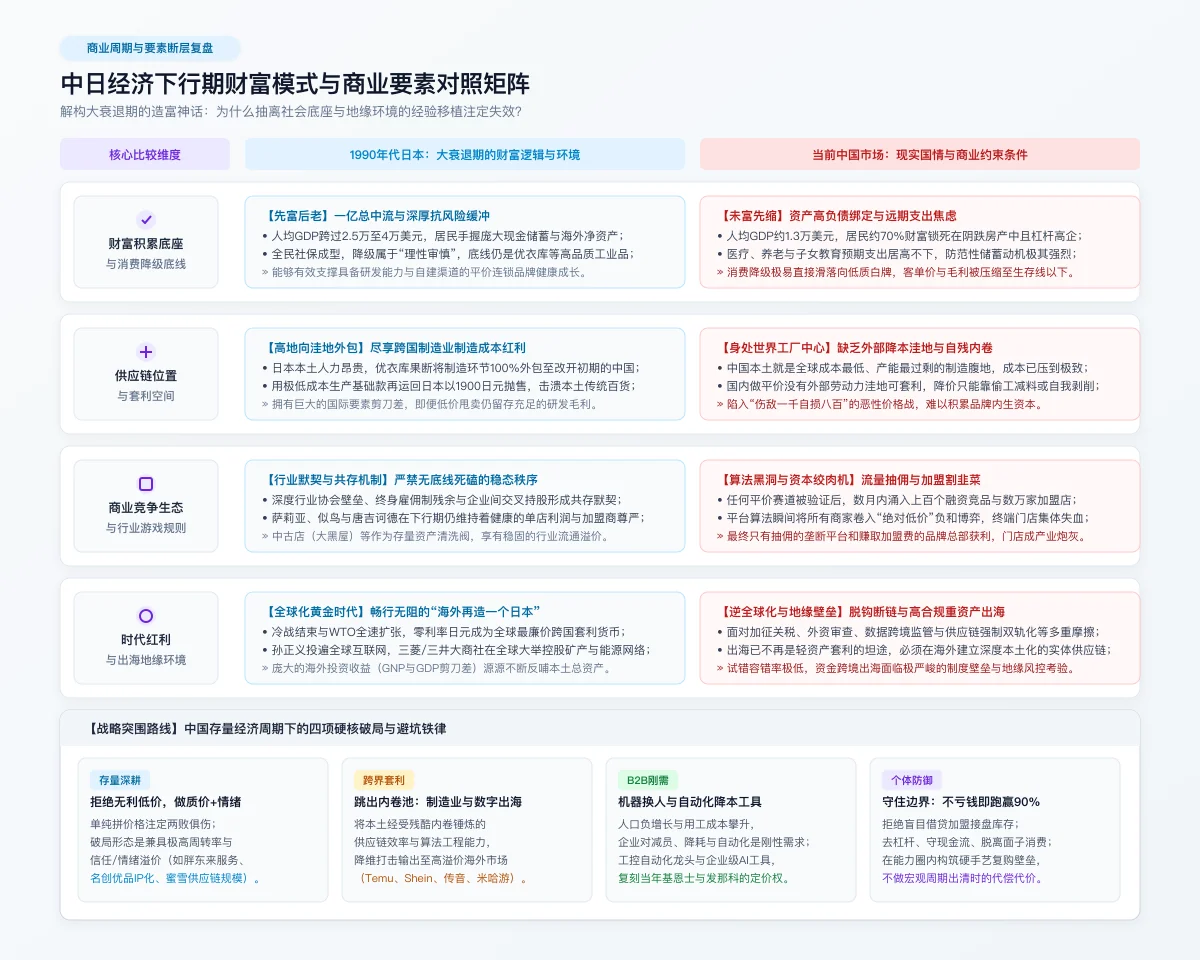
Figure 3: Matrix comparing macro wealth foundations, competitive dynamics, and external conditions between Japan’s downturn and contemporary market realities.
| Strategic Dimension | Japan’s Downturn Era (1990s–2000s) | Contemporary Market Realities | Strategic Implication |
|---|---|---|---|
| Per Capita Wealth Base | Rich before Old: Per capita GDP $25,000–$40,000; vast household savings and offshore assets. | Shrinking before Rich: Per capita GDP ~$13,000; ~70% household wealth locked in illiquid real estate. | Downward consumption shifts toward low-margin, unbranded goods rather than high-quality value brands. |
| Competitive Ecosystem | Tacit Coexistence: Strong trade associations, cross-shareholding, implicit price floors. | Algorithmic Hyper-Competition: VC-backed real-time price wars, instant margin erosion. | Margins are rapidly erased; platform channels and franchisors extract capital while operators bleed. |
| Global Macro Environment | Peak Globalization: Cold War end; frictionless access to WTO entry and cheap foreign labor pools. | Fractured Geopolitics: Tariff walls, supply chain decoupling, heightened cross-border scrutiny. | Cross-border expansion requires heavy, localized foreign assets rather than simple labor/cost arbitrage. |
| Distressed Asset Access | Market-Driven Restructuring: Foreign capital cleared NPLs and real estate at clear market clearing prices. | State-Sanctioned Gatekeeping: Core NPLs tied to municipal finance, local banks, and system stability. | Highly restricted institutional domain; unbacked private capital risks absorbing toxic systemic risk. |
1. The Asset Base Fault Line: “Getting Old After Rich” vs. “Shrinking Before Wealthy”
Japan’s asset bubble burst at its historical geopolitical zenith. Per capita GDP sat between $25,000 and $40,000—briefly eclipsing that of the United States. Japanese households entered the recession backed by deep cash savings, life insurance reserves, and net foreign assets, supported by a mature national pension and healthcare system.
Japan’s “low-desire society” was a disciplined deleveraging choice by a wealthy populace. When Japanese middle-class consumers downgraded, their minimum threshold remained brand-name reliability like Uniqlo or Saizeriya. These companies maintained sufficient gross margins to fund continuous product R&D and proprietary supply chain infrastructure.
By contrast, developing market context today sees per capita GDP hovering around $13,000. Crucially, roughly 70% of household wealth remains locked in illiquid, depreciating residential real estate tied to rigid, multi-decade mortgages. Facing inelastic future expenditures in healthcare, eldercare, and education, mass-market consumption does not simply downgrade to “respectable value brands”—it plummets directly to ultra-cheap, unbranded goods (baipai). Terminal retail prices and gross margins are compressed to near-zero, leaving insufficient profit to fund real product innovation or build sustainable channel networks.
2. The Competitive Ecosystem Fault Line: “Industry Coexistence” vs. “Algorithmic Meat Grinder”
1990s Japanese business culture operated under dense trade association protections, corporate cross-shareholdings, and an implicit culture of industry coexistence. Even within discount retail, competitors rarely engaged in irrational price wars designed to destroy baseline cost floors. Saizeriya slashed prices while still preserving reasonable margins for its franchisees and suppliers.
Modern digital commerce operates under algorithmic optimization and hyper-capitalization:
- Any micro-profitable category (e.g., budget snack chains, $1.50 coffees, value fast food) is flooded within months by hundreds of copycat brands funded by private equity.
- Platform algorithms evaluate merchant prices in real time, forcing vendors into automated, race-to-the-bottom pricing loops to retain search traffic.
- This hyper-competition does not build sustainable industrial brands; it results in systemic industry attrition. Only traffic platforms extracting commissions and franchisors collecting upfront equipment/licensing fees secure short-term liquidity, while thousands of street-level franchisees absorb the inventory write-offs.
3. The Global Era Fault Line: Peak Globalization vs. Fractured Geopolitics
Tadashi Yanai successfully brought high-quality wool sweaters to market for ¥1,900 because the post-Cold War era opened vast access to China’s massive, highly disciplined, and cost-effective manufacturing workforce. Similarly, Masayoshi Son’s global arbitrage relied on Western capital markets fully welcoming Japanese liquidity.
Contemporary cross-border expansion takes place against trade tariffs, national security reviews, cross-border data compliance, and forced supply chain decoupling. Going global is no longer a frictionless cost-arbitrage playbook. It is a capital-intensive, high-risk operational battle requiring deep local integration and local political hedging.
4. Institutional Access: The Protected Reserve of Distressed Assets
Observing how Wall Street vultures made billions buying up bankrupt Japanese real estate leads many to assume a similar opportunity exists during local property restructurings.
However, domestic non-performing loans (NPLs) and municipal debt pools are deeply intertwined with local fiscal accounts, regional judicial authorities, and broader financial stability mechanisms. This is not a frictionless market accessible via financial valuation models alone; it is a highly regulated, state-sanctioned domain. Private capital lacking structural political alignment that blindly enters this arena risks becoming the ultimate liquidity bagholder for systemic debt.
IV. The Balance Sheet Contraction Playbook: Strategic Realities for the Current Era
Attempting to build wealth in a demand-constrained environment simply by “racing to offer cheaper products” is a classic case of survivor bias. To navigate a prolonged balance sheet recession, capital and operators must pivot away from naive historical analogies toward four pragmatic imperatives:
1. Domestic Stock Optimization: Abandoning “Profitless Cheapness” for “Velocity + Emotional Premium”
Competing purely on absolute low price is a trap that degrades both manufacturing standards and retail unit economics. Operators who thrive in stagnant domestic markets typically possess one of two advantages:
- Extreme Supply Chain Scale and Velocity: Building proprietary, vertically integrated supply chains to convert scale into an impenetrable cost moat (e.g., Mixue Ice Cream & Tea’s end-to-end ingredient production).
- Deep Service Loyalty or Emotional Premiums: Securing irrational customer loyalty through radical operational culture (e.g., Pang Dong Lai’s legendary service standards) or transforming commodity items into high-margin emotional treats through IP licensing (e.g., Pop Mart).
2. Cross-Market Factor Arbitrage: Exporting Operational Efficiency to High-Margin Regions
The highest-ceiling strategy during a domestic contraction is escaping the localized price war by exporting hard-won operational capabilities. Companies that take agile manufacturing, hyper-efficient fulfillment systems, and algorithmically optimized user acquisition, and redeploy them into overseas markets with higher purchasing power and slower competitive cycles, execute the ultimate factor arbitrage.
3. Rigid B2B Value Drivers: Automation and Labor-Reduction Infrastructure
Regardless of retail consumer trends, structural demographic shifts and sticky labor costs force commercial enterprises to seek tools that reduce reliance on human headcount, minimize line waste, and increase per-capita output.
Industrial automation controls, high-precision sensors, machine vision systems, and enterprise workflow software retain strong pricing power and counter-cyclical resilience—mirroring the exact trajectory of Keyence and Fanuc during Japan’s downturn.
4. Individual Antifragility: Cash Flow Preservation Above All Else
Throughout Japan’s Lost Decades, the most effective wealth-preservation strategy for the average household was neither speculative shorting nor aggressive leveraged entrepreneurship. It was rapidly deleveraging, maintaining positive daily cash flow, and refusing to fund lifestyle creep or status symbols.
During liquidity-constrained cycles, capital preservation far outweighs speculative capital appreciation. Restraining the urge to over-leverage, protecting core baseline cash flows, and investing exclusively in defensible, real-world skills represent the ultimate strategy for weathering macroeconomic long waves.
Related Research & Topics
Tello Mobile eSIM
SafetyWing Nomad Insurance
* Disclosure: This post contains affiliate links. If you make a purchase through these links, V-G Journal may earn a small commission at no additional cost to you. We only recommend services we independently evaluate and trust.
FIRE and Golf:自由旅居之路
专注于为追求 FIRE 与品质生活的人群提供特惠打球权益与候鸟微度假。不持一砖一瓦,运营品质生活。