The Margin of Survival: PGA Tour Bubble Economics and B2B Capital at Cabo
Beyond the $6 million purse in Los Cabos lies a zero-sum battle for PGA Tour card retention. An analysis of the No. 125 FedExCup Fall threshold and how enterprise titan World Wide Technology uses offshore executive hospitality to secure multi-million-dollar infrastructure contracts.


Figure 1: The 2026 World Wide Technology Championship at Tiger Woods-designed El Cardonal at Diamante, marking the PGA Tour’s 20th anniversary in Mexico.
From November 5 to 8, 2026, the World Wide Technology Championship (WWT Championship) tee off at El Cardonal at Diamante in Los Cabos, Mexico, marking two decades of PGA Tour presence south of the border. Behind the polished veneer of a $6 million total purse and a $1.08 million winner’s check, this coastal layout—designed by Tiger Woods’ TGR Design—serves as a brutal triage unit for the 2026 FedExCup Fall. While the top 50 players from the regular season sit comfortably at home, having long secured their places in all eight $20 million Signature Events for the upcoming year, the 120-man field assembled in Cabo represents the tour’s vulnerable middle class. Positioned around the unforgiving No. 125 red line, these players are locked in a zero-sum attrition campaign for marginal strokes to avoid the catastrophic financial drop-off of losing full tour status.
I. Structural Stratification: The FedExCup Fall and the No. 125 Line
Under the PGA Tour’s revamped calendar, the FedExCup Fall acts as the final sorting mechanism across an eight-event stretch. For golf’s elite, the autumn schedule is an optional victory lap or rest period; for rank-and-file touring professionals, it is a binding career judgment.
This hierarchy is enforced through three distinct economic tiers:
- The Ruling Class (Top 50): Fully locked in prior to the August playoffs, these players hold guaranteed access to all eight $20 million, 700-point Signature Events, insulated from qualification reshuffles and backed by prime capital allocation.
- The Ascension Corridor (Aon Next 10, Nos. 51–60): Players finishing the fall stretch ranked 51st through 60th earn exemptions into early-season Signature Events (the AT&T Pebble Beach Pro-Am and The Genesis Invitational), offering a rare vehicle for upward mobility.
- The Bubble (No. 125): The top 125 players on the final points list earn full exemption status for the following season, granting them starting spots in full-field events. Falling to No. 126 triggers a rapid decline in career trajectory and financial solvency.
This asymmetric distribution of leverage is starkly visible even within a $6 million fall event. As explored in our economic teardown, Winning the Mexico Open: PGA Tour Survival Models and Purse Dynamics, the payout decay curve is razor-steep. The winner captures $1.08 million (18% of the purse) and 500 FedExCup points, securing a two-year tour exemption. Mid-tier finishers, by contrast, take home modest five-figure checks. Once unyielding operational expenses are deducted, their net marginal gain approaches zero.
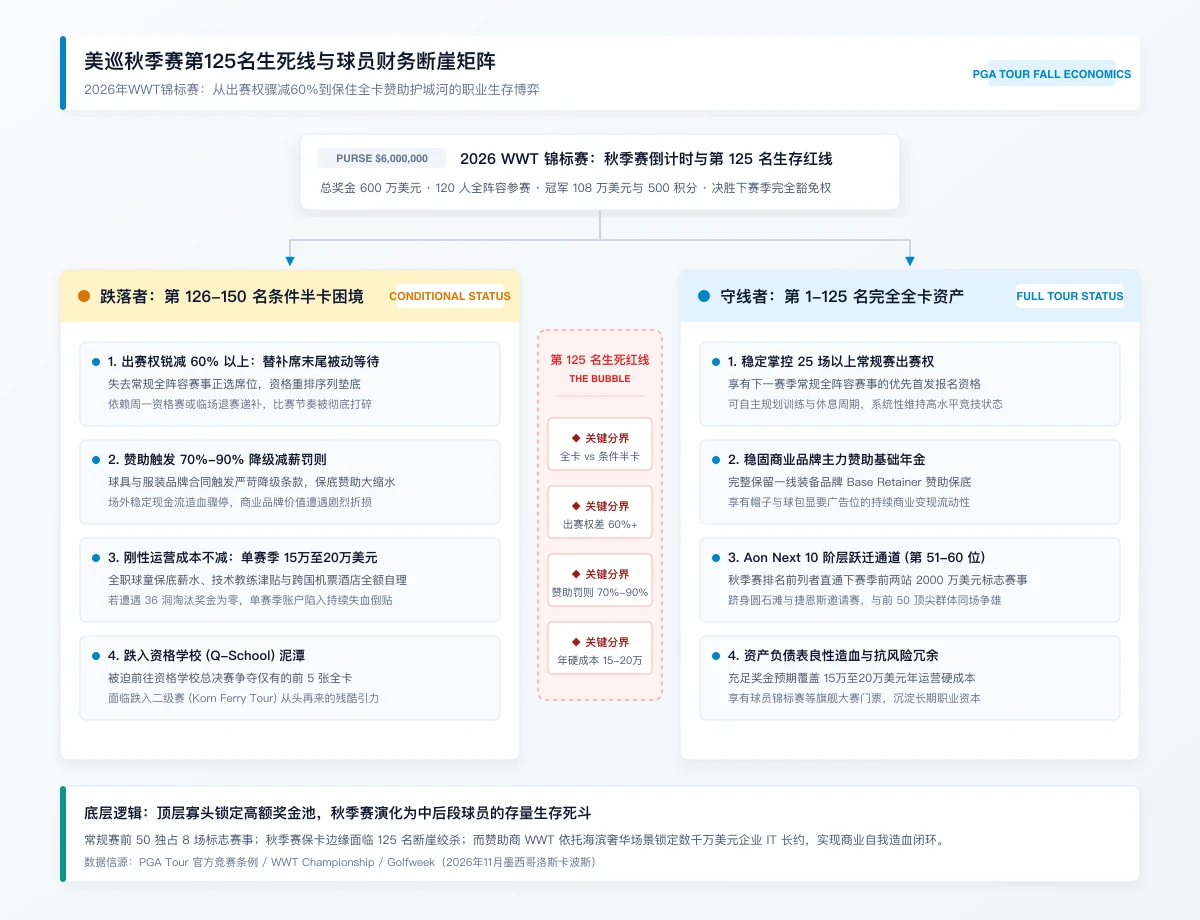
Figure 2: Financial exposure and exemption matrix surrounding the No. 125 FedExCup Fall threshold for the 2026 PGA Tour season.
II. Cash Flow Execution: The Domino Effect of Crossing No. 125
On the final points ledger, the difference between No. 125 and No. 126 might come down to a single missed putt on a Sunday afternoon. On a player’s balance sheet, however, it represents a structural divide.
Sliding into the 126–150 rank subjects a player to “Conditional Status.” This designation strips away full playing privileges and slashes annual tournament starts by more than 60%. Under the tour’s priority reshuffle system, conditional cardholders sit at the bottom of the alternate list for full-field events. Forced to wait on last-minute withdrawals, they often go weeks without competitive reps, destroying the rhythmic consistency required to perform at the highest level.
The deeper structural blow hits the revenue ledger. A professional golfer’s business model relies on two primary cash streams: tournament earnings and commercial endorsements. Most tier-one equipment and apparel OEMs insert aggressive demotion clauses into player contracts:
| Financial & Competitive Dimension | Nos. 1–125 (Full Status) | Nos. 126–150 (Conditional Status) | Structural Impact & Balance Sheet Reality |
|---|---|---|---|
| Field Access & Schedule Control | Guaranteed 25+ starts; complete calendar control | Starts cut by 60%+; dependent on alternate lists | Intermittent play destroys competitive rhythm and long-term planning |
| Retainer & Sponsor Base | Full base retainers intact | 70%–90% compensation clawbacks or termination | Off-course cash flow evaporates; corporate enterprise value plummets |
| Annual Fixed Operating Costs | $150k–$200k (Full-time caddie, coaches, travel) | $150k–$200k (Fixed travel, team, and logistics) | High cost base remains fixed; missed cuts create immediate cash burn |
| Path to Majors & High-Yield Events | Direct access to THE PLAYERS & full-field point races | Closed off; forced into PGA Tour Q-School Finals | Risk of demotion to Korn Ferry Tour or competitive obscurity |
A touring professional’s cost structure is notoriously rigid. A full-time caddie commands a weekly base fee of $1,500 to $2,500 plus purse cuts, while swing instructors, physical therapists, and cross-border travel logistics push non-negotiable overhead to between $150,000 and $200,000 annually. Fully exempt players offset these fixed costs through retainer checks and frequent start opportunities. For a player tumbling to No. 126, endorsement retainers collapse by 70% to 90% precisely when baseline operating expenses remain fixed, driving personal accounts into immediate monthly net deficit and forcing them to self-fund their way through Q-School.
III. Offshore Enclaves: The B2B Logic of WWT’s Golf Strategy
While consumer-facing brands sponsor sports properties to capture mass television impressions, title sponsor World Wide Technology operates on a radically different capital thesis.
Headquartered in St. Louis, Missouri, World Wide Technology is a $20 billion enterprise IT systems integrator founded by David Steward. Unlike consumer electronics or retail banking brands vying for broad domestic viewership, WWT sells no off-the-shelf hardware to individual consumers. Its core business centers on complex, multi-year infrastructure transformations: enterprise cloud migrations, AI data center design, cybersecurity architecture, and large-scale digital transformation for Fortune 500 corporations and federal agencies.
For a B2B technology powerhouse moving tens of billions in annual volume, anchoring a PGA Tour event in Los Cabos relies on a targeted high-yield hospitality model:
- Executive Hospitality and Extended Engagement: Situated far from mainland distraction, the Diamante resort enclave offers an ideal setting for high-level relationship building. During tournament week and the Pro-Am, WWT hosts Chief Information Officers (CIOs), Chief Technology Officers (CTOs), and senior leaders from core technology partners like Cisco, Dell, and NVIDIA. Four to five hours of uninterrupted golf provide a depth of executive access impossible to replicate in standard boardroom presentations.
- De-risking High-CapEx Enterprise Tech Contracts: Enterprise IT architecture deals routinely run from tens of millions to hundreds of millions of dollars. The sales cycles are long, and systemic tolerance for failure is near zero. Executing closed-door summits alongside elite golf lowers friction and accelerates the establishment of strategic trust.
- Nearshoring and Latin American Digital Infrastructure: As global supply chains pivot toward Mexican manufacturing and nearshoring networks, anchoring the PGA Tour’s footprint in Latin America gives WWT strategic positioning to capture emerging enterprise infrastructure spend across the region.
As detailed in our analysis of tour capital dynamics, Deconstructing LIV Golf: Capital Burn, Saudi PIF Realignment, and the Sovereign Wealth Playbook, sports properties lacking genuine corporate alignment eventually succumb to burn-rate friction. WWT’s continued commitment demonstrates that pairing high-end destination venues with targeted enterprise B2B hospitality forms an enduring economic model for modern sports sponsorships.
IV. Margin Management on the Dunes: Micro-Psychology at El Cardonal
On the turf, El Cardonal offers a specific strategic test. Designed by Tiger Woods, the par-72, 7,452-yard layout meanders through coastal desert dunes. It features wide fairways and multiple tactical angles into greens, but penalizes aggressive miscalculations when coastal winds sweep across its undulating Paspalum surfaces.
During the 2025 iteration, champion Ben Griffin posted a tournament-record 29-under-par (259), demonstrating the course’s vulnerability when conditions are calm. Yet for players straddling the No. 125 survival line, the risk-reward calculus is inverted compared to those pursuing a win with complete job security.
Contenders at the top of the leaderboard can afford to take aggressive lines to attack flags. Players fighting for their careers experience every shot under intense psychological strain. A single over-aggressive approach that misses into native desert waste areas can result in a missed cut, forfeiting critical fall points and triggering a loss of full playing privileges for the following year.
This high-stakes environment underscores the core strategic framework outlined in Golf as an Imperfect Game: Ben Hogan’s Strategy of ‘Good Misses’: in high-pressure competition, long-term survival is rarely determined by miraculous recovery shots. Instead, it relies on disciplined management of acceptable errors. On the wide expanses of El Cardonal, bubble players must suppress high-risk instincts, target the wide centers of greens, and rely on controlled two-putt pars to safeguard their baseline score.
As the field tees off under the Baja sun, every stroke recorded on the leaderboard represents more than an effort to lift a trophy. It is a real-time negotiation over tour starts, corporate enterprise contracts, and financial survival on the edge of professional golf’s divide.
Related Research & Topics
Tello Mobile eSIM
SafetyWing Nomad Insurance
* Disclosure: This post contains affiliate links. If you make a purchase through these links, V-G Journal may earn a small commission at no additional cost to you. We only recommend services we independently evaluate and trust.
FIRE and Golf:自由旅居之路
专注于为追求 FIRE 与品质生活的人群提供特惠打球权益与候鸟微度假。不持一砖一瓦,运营品质生活。