Ding Wenyi’s T7 Start in Abu Dhabi: The New Pathway Premium and the Six-Figure Cost of Global Card-Chasing
At the opening round of the Abu Dhabi Championship, 21-year-old Chinese rising star Ding Wenyi fired a bogey-free 67 to secure a T7 start, cementing his DP World Tour card via the Global Amateur Pathway. Against the backdrop of the PGA Tour tightening its 2026 card thresholds to the top 100 and six-figure annual travel and team overheads, his journey underscores the ruthless financial and systemic reality facing a new generation of cross-continental players.

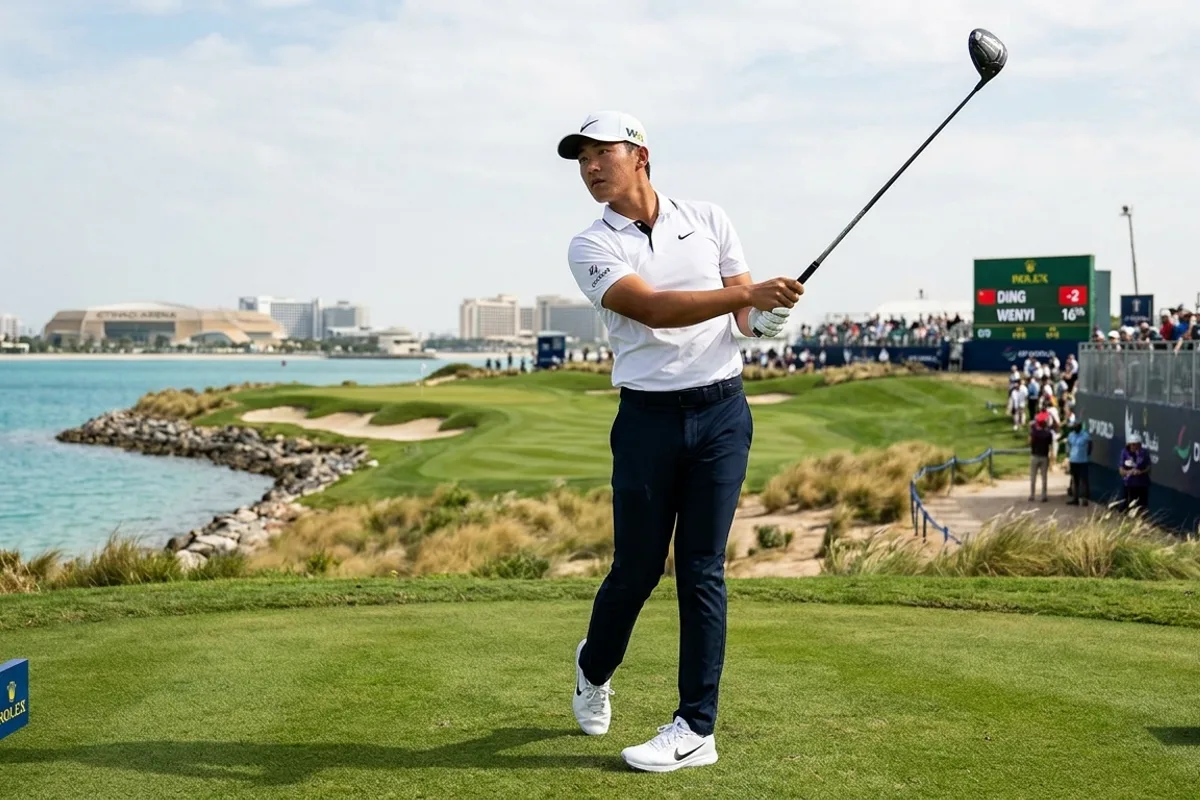
Figure 1: China’s young phenom Ding Wenyi tees off at Yas Links in Abu Dhabi, opening with a bogey-free 67 to position himself near the top of the leaderboard.
At the inaugural Rolex Series event of the 2026 DP World Tour Playoffs—the Abu Dhabi Championship—21-year-old Chinese standout Ding Wenyi carded a flawless 5-under 67 (five birdies, zero bogeys) at Yas Links, seizing a tie for 7th (T7) to announce his arrival among the game’s elite. Domestic flash reports routinely lump his performance together with Li Haotong (71, T88) and Dou Zecheng (72, T96), who competed across the Atlantic on the PGA Tour the same week. Yet, beneath these two oceans lie fundamentally divergent card-chasing mechanics. While Ding bypassed the grueling traditional Q-School gauntlet by leveraging the Global Amateur Pathway (GAP) to secure a full DP World Tour card, the harsh reality of tightening PGA Tour entry barriers and six-figure annual travel and team expenses lays bare the true, self-funded balance sheet of China’s next-generation professionals.
The Facts on the Ground: Zero Bogeys at Yas Links and Cognitive Biases Across Oceans
The most common analytical error in media commentary is the clumsy juxtaposition of two fundamentally different international professional tournaments.
Ding’s battleground was the Abu Dhabi Championship in the United Arab Emirates. As the opening playoff event of the DP World Tour boasting a $9M purse, Yas Links demands relentless precision off the tee and disciplined distance control against shifting Gulf winds. Ding delivered a masterclass in risk mitigation: two birdies on the front nine for a 34, followed by three more on the back for a 33. His bogey-free 67 placed him firmly in the T7 tier alongside major champions and seasoned winners.
Conversely, half a world away at El Cardonal at Diamante in Los Cabos, Mexico, the PGA Tour was staging the World Wide Technology Championship—a critical stop in the FedExCup Fall bubble economics for tour card retention. Playing on a sponsor exemption, Li Haotong carded an opening 71 (-1, T88) while Dou Zecheng fought for points with a level-par 72 (T96).
Though competing on elite overseas tours during the same calendar week, these Chinese players occupy entirely distinct systemic coordinates. Li and Dou are bogged down in the mud of the PGA Tour Fall reshuffle, fighting for survival crumbs. Ding, by contrast, enters high-tier playoff fields as a protected rookie holding a full European card earned via structural innovation.
| Dimension | Ding Wenyi (Abu Dhabi Championship) | Li Haotong / Dou Zecheng (WWT Championship) |
|---|---|---|
| Tour Ecosystem | DP World Tour Playoffs (Rolex Series) | PGA Tour (Fall Series) |
| Venue & Course | Yas Links, Abu Dhabi, UAE | El Cardonal at Diamante, Los Cabos, Mexico |
| Opening Round | 67 (-5, 5 birdies, 0 bogeys, T7) | Li: 71 (-1, T88) / Dou: 72 (E, T96) |
| Qualification Basis | Inaugural Global Amateur Pathway (GAP) No. 1 | Sponsor Exemption / Fall Series Priority Ranking |
| Strategic Objective | Accumulate Race to Dubai points, secure direct PGA Tour promotion | Fight for PGA Tour exemption or conditional status |
Structural Arbitrage: The Global Amateur Pathway and the European Springboard
Ding’s ability to bypass the brutal meat grinder of traditional Q-School is the direct result of a structural shift introduced to professional golf over the last two years: the Global Amateur Pathway (GAP).
Historically, an elite amateur prospect from Asia turning professional faced a punishing binary choice: either self-fund a grueling pilgrimage through the U.S. qualifying circuit—risking swing degradation and financial depletion—or grind out World Ranking points on regional developmental tours while begging for sporadic sponsor exemptions.
Jointly launched by the DP World Tour, the PGA Tour, and the R&A, the GAP rewrote this pipeline. Anchored directly to the World Amateur Golf Ranking (WAGR), it establishes a dedicated qualification tier for elite amateurs outside the U.S. collegiate system. After capturing the 15th Asia-Pacific Amateur Championship (AAC) in dominant fashion and accumulating ranking points through international starts, Ding topped the inaugural GAP standings.
The dividend of topping the GAP was instantaneous: Category 12 full-card exemption status on the 2025 DP World Tour. More importantly, the strategic alliance forged between the PGA Tour and DP World Tour beginning in 2023 provides a direct conduit: the top 10 players on the final Race to Dubai points list who are not already exempt earn direct PGA Tour cards for the following season.
For Ding, the European circuit functions not merely as a lucrative standalone tour, but as an optimized springboard—bypassing the U.S. Korn Ferry Tour gauntlet entirely on the path to golf’s premier echelon.
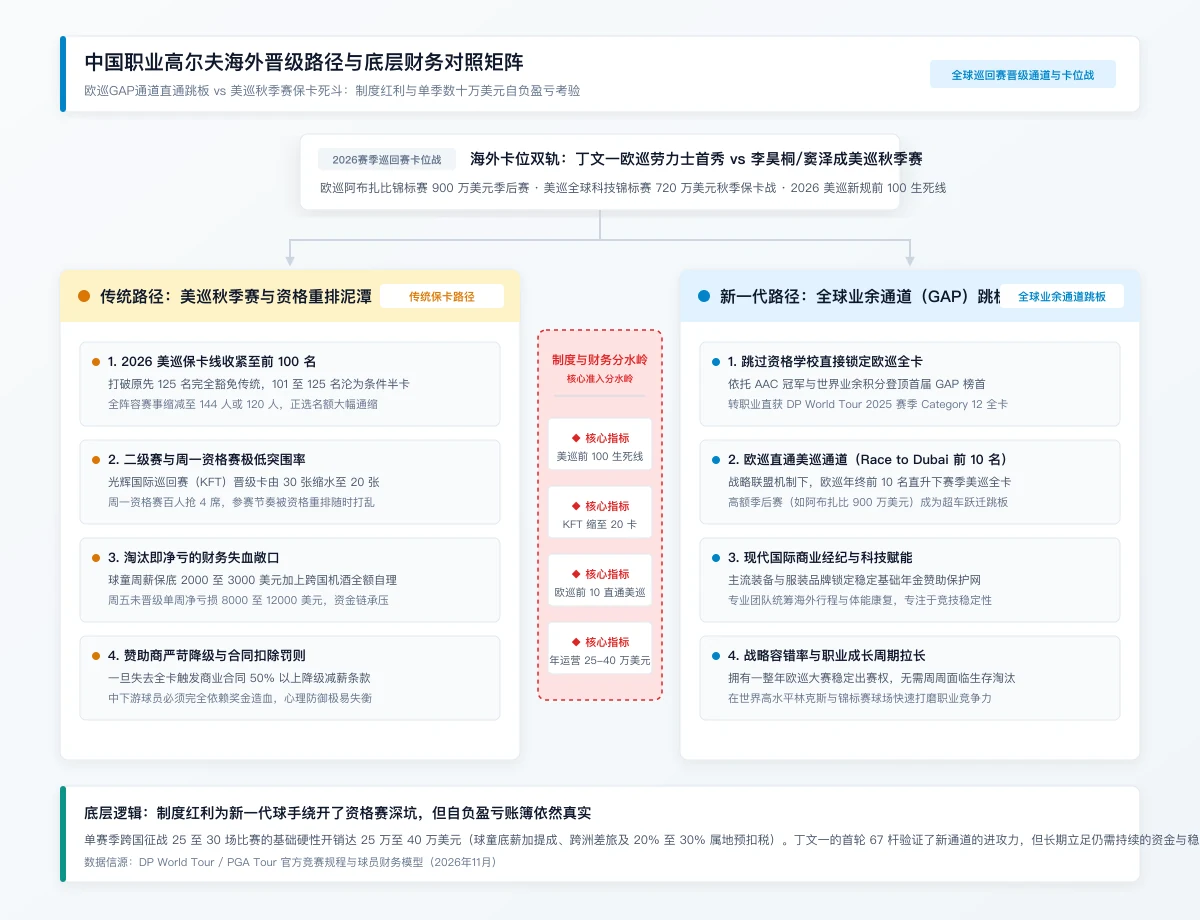
Figure 2: Multidimensional comparison matrix of overseas promotion pathways and underlying financial structures for Chinese professional golfers.
Constricting Access: How the 2026 PGA Tour Regulations Reshape the Thresholds
Even as superhighways like the GAP open up, the frontline gates of global professional golf are narrowing at an unprecedented rate.
The PGA Tour Policy Committee’s newly enacted 2026 regulations deliver a severe shock to players lingering on the periphery:
- The Exemption Cliff Narrows: The historic top-125 FedExCup safety net has been shattered. Fully exempt status is now restricted to the top 100 players. Those finishing 101st to 125th drop to conditional status, exposing them to volatile category reshuffles.
- Field Sizes Contract: To combat slow play and daylight constraints, full-field events have been trimmed from 156 players down to 144 or even 120. This contraction causes a cliff-like drop in Monday qualifier and sponsor exemption opportunities for mid-to-lower-tier players.
- Developmental Bottlenecks: PGA Tour cards awarded annually via the Korn Ferry Tour have been pruned from 30 down to 20.
Under this regime of structural deflation, attempting to break through via domestic U.S. developmental circuits carries prohibitive variance. Conversely, the DP World Tour’s top-10 Race to Dubai promotion zone remains the single most viable open pipeline. Every solid round Ding posts in Europe aggressively shortens his physical distance to a full PGA Tour card.
The Underlying Balance Sheet: The Six-Figure Self-Funded Reality
Behind the glossy T7 leaderboard sits an unforgiving, high-risk individual enterprise that demands rigorous cash-flow management.
As we mapped out in our analysis of PGA Tour survival economics and missed-cut burn rates, a professional traversing continents for 25 to 35 events a year faces hard baseline operating expenses ranging from $250,000 to $400,000 annually:
- Elite Caddie Overhead: Touring caddies operate on a guaranteed base weekly stipend (typically $2,000 to $3,000 to cover travel and lodging) plus a performance percentage. Standard cuts range from 5% to 10% of player earnings, scaling higher for contention and victories.
- Intercontinental Logistics & Coaching: With schedules spanning the Middle East, Europe, Africa, and Asia, continuous long-haul travel, premium lodging, and apportioned retainers for swing coaches and physiotherapists rack up thousands of dollars every single week.
- Source-Country Withholding Taxes: Cross-border earnings are subject to aggressive tax compliance, with local jurisdictions automatically withholding 20% to 30% of gross prize money at the source.
The most brutal exposure comes from missed cuts. Unlike team sports with guaranteed contracts (such as the NBA or Premier League), golf is pure output-based piecework. If a player fails to play the weekend, they earn zero prize money for the week. Once sponsorship subsidies are stripped away, a single missed cut results in an immediate net loss of $8,000 to $12,000. Three or four consecutive early exits can vaporize tens of thousands in liquid capital within a month.
For newly turned professionals, early equipment endorsements, apparel deals, and commercial backing are literal lifelines designed to absorb variance during the inevitable turbulence of transition.
Generational Shift: From Lone Wolves to International Agency Matrices
Ding’s T7 start at an elite Rolex Series event signals a generational evolution in how Chinese professional golf cultivates and deploys talent.
Looking back at the historical arc of Chinese men’s professional golf—from the pioneering struggles of Zhang Lianwei and Liang Wenchong, through Li Haotong’s multiple European victories—older generations largely relied on family capital and improvised overseas entries. Yet, as we explored in the commercial agency matrix and developmental models of Chinese tennis and golf stars, modern prodigies like Yin Ruoning and Ding Wenyi are integrated into globalized sports ecosystems from their junior days.
Backed by global talent agencies (such as WME-IMG), advanced biomechanical analytics, structured collegiate pipelines, and precise exploitation of amateur qualification pathways, they bypass decades of blind trial-and-error.
An opening 67 in Abu Dhabi is merely an auspicious starting grid position in a grueling marathon. Translating a single-round surge into four-day scoring consistency across the deep waters of professional competition—while mastering the financial discipline required to survive a six-year burn rate—will be the true test of Ding Wenyi and China’s new vanguard.
Related Research & Topics
Tello Mobile eSIM
SafetyWing Nomad Insurance
* Disclosure: This post contains affiliate links. If you make a purchase through these links, V-G Journal may earn a small commission at no additional cost to you. We only recommend services we independently evaluate and trust.
FIRE and Golf:自由旅居之路
专注于为追求 FIRE 与品质生活的人群提供特惠打球权益与候鸟微度假。不持一砖一瓦,运营品质生活。