The Enduring Resilience of the Houthis: Yemen's Civil War and Saudi Arabia's Asymmetric Predicament
The Houthis' tenacity stems not merely from weaponry, but from a millennium of Zaydi tradition, highland tribal mobilization, and the technological diffusion of Iran's 'Axis of Resistance.' This analysis dissects the deep logic of modern high-tech armies mired in asymmetric warfare through the lenses of sectarian history, the Saudi military's counter-coup vulnerabilities, and the fragmentation of Yemen's own forces.

Executive Summary: In the shallow currents of international discourse, the Houthi rebels of Yemen are often dismissed as mere irregulars fighting in sandals, leading to questions about whether the Saudi-led coalition and the Yemeni government forces are perpetually outmaneuvered due to inferior equipment. However, the true geopolitical chessboard of the Middle East is far more complex and brutal than a simple comparison of hardware suggests. The Houthis are not a sudden eruption of tribal power; they are interwoven with a thousand-year political memory of the Zaydi sect in Yemen’s northern highlands, formidable mountain tribal mobilization, and the mature technological diffusion of Iran’s “Axis of Resistance.” Simultaneously, the Saudi military, boasting one of the world’s top defense budgets, is constrained by the inherent weakness of Gulf monarchies’ “counter-coup over counter-invasion” military doctrine. The nominal Yemeni government forces, meanwhile, are fractured into warlords with competing agendas. This essay, from three perspectives—sectarian origins, military systemic ailments, and asymmetric attrition—deciphers the mechanism by which high-tech conventional armies become mired in mountain counter-insurgency quagmires.
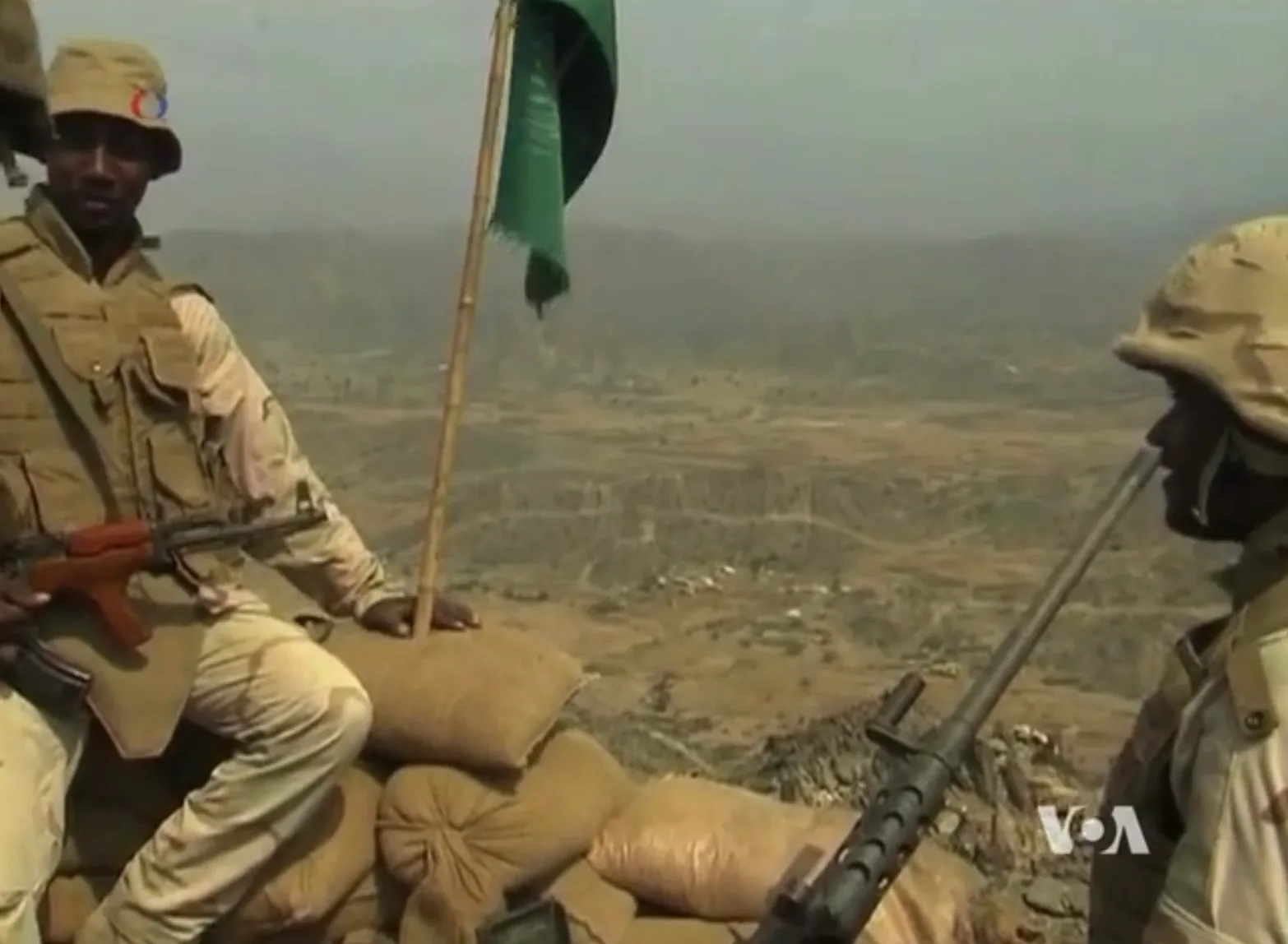
Figure 1: A high-ground observation post established by Saudi-led coalition soldiers on a front line in Yemen’s rugged northern highlands.
I. Who Are the Houthis? Forged in the Crucible of a Thousand-Year Highland Sect and the ‘Axis of Resistance’
The official name of the Houthi armed group is “Ansar Allah,” meaning “Supporters of God.” To view them merely as ordinary local militias that emerged after the Cold War is to completely disregard their thousand-year historical roots in the southern Arabian Peninsula.
1. A Millennium of Sectarian Tradition and Political Memory: The Martial Spirit of Zaydism
The core roots of the Houthi movement originate in Sa’dah province, nestled within the rugged mountains of northwestern Yemen. In terms of sectarian lineage, they belong to an ancient branch of Shia Islam—Zaydism (also known as the Five-Imam Shia).
Zaydism possesses a unique character within the Islamic world. Theologically and jurisprudentially, it is the closest to mainstream Sunni Islam, eschewing the metaphysical concepts of the Twelver Shia, such as the hidden Imam. However, on the level of political philosophy, Zaydism is exceptionally militant, emphasizing that a true Imam must rise up against unjust rule and championing the martial tradition of “resisting tyranny as a divine mandate.”
Beginning in 893 CE (9th century), Zaydi Imams established a hereditary theocratic state in the extremely remote highland regions of northern Yemen. This rule persisted for nearly 1,100 years until the outbreak of the North Yemen Civil War in 1962, when their regime was overthrown by republican army officers influenced by pan-Arab nationalist ideology. For the Houthi families of the Sa’dah region, they naturally saw themselves as the legitimate guardians of northern Yemen’s highland traditions, harboring a deep-seated distrust of central authority and external powers.
2. The Genesis of Their Rise: A Grassroots Cultural Movement Resisting Saudi Wahhabi Infiltration
The true fuse for Yemen’s modern civil war was lit in the 1980s and 1990s by the religious capital expansion of neighboring Saudi Arabia.
At that time, Saudi Arabia, awash in petrodollars, aggressively radiated its state religion—Wahhabism (an extremely conservative, Sunni fundamentalist branch)—to its neighbors. Saudi capital flowed across the border, heavily funding Wahhabi religious schools and mosques in Sa’dah province, the core Zaydi settlement area. They also subsidized clerics loyal to Riyadh, forcefully squeezing the living space and intergenerational identity of the indigenous Zaydi population.
To counter this cultural infiltration, perceived as “ideological aggression,” Hussein Badreddin al-Houthi, a religious leader from a prominent family in Sa’dah, founded the “Believing Youth” organization in the early 1990s. This movement initially took the form not of an armed militia, but of a youth education and community relief effort aimed at reviving Zaydi cultural heritage and protesting the central government’s marginalization of the northern border regions.

Figure 2: Abdul-Malik al-Houthi, the current supreme leader of the Houthi movement (Ansar Allah).
3. Radicalization and the Crucible of War: The Six Sa’dah Wars (2004–2010)
The turning point came with the 2003 US invasion of Iraq.
The Saleh regime, then ruling Yemen, sided with Washington and actively participated in the US “Global War on Terror.” This move ignited immense public outrage in the Sa’dah highlands. Hussein al-Houthi’s movement became thoroughly radicalized politically, openly chanting slogans against the US, Israel, and the pro-American Saleh regime (“God is greatest, death to America, death to Israel, curse the Jews, victory for Islam”).
In 2004, the Yemeni government deployed its regular army to suppress Sa’dah. In fierce fighting, Hussein al-Houthi was killed. However, the central government’s iron fist did not quell the situation; instead, it spurred the movement’s full militarization. Hussein’s brother, Abdul-Malik al-Houthi (the current supreme leader), took over leadership, and the movement officially became known as the “Houthis.”
Over the subsequent years, from 2004 to 2010, the Houthis engaged in six brutal “Sa’dah Wars” in the treacherous mountains against the Yemeni regular army and Saudi border troops. Through repeated encirclements, blockades, and airstrikes by heavy weaponry, the Houthis were not annihilated. Instead, they shattered old tribal divisions, forged an extremely resilient network of underground tunnels, developed dispersed guerrilla tactics, and instilled iron discipline. Their combat effectiveness surged geometrically through the crucible of real combat.
4. The 2014 Seizure of Sana’a and Full Integration into the ‘Axis of Resistance’
The “Arab Spring” wave swept across the Middle East in 2011, forcing Yemen’s strongman Ali Abdullah Saleh to cede power to Vice President Hadi. However, the Hadi government lacked the financial resources for grassroots governance and could not suppress the various tribal warlords, leading to a rapid vacuum in Yemen’s central authority.
In September 2014, the Houthi movement, hardened by years of warfare, launched a major offensive southward, capturing the capital Sana’a. They subsequently placed President Hadi under house arrest and forced his departure, effectively controlling the core territory of northwestern Yemen. While this region constitutes only about one-third of Yemen’s landmass, it concentrates 70% to 80% of the country’s dense population, prime agricultural land, and key urban industrial networks.
At this critical juncture, the Houthis seamlessly integrated into the Iran-led “Axis of Resistance.” Iran’s Islamic Revolutionary Guard Corps (IRGC) Quds Force and Hezbollah began systematically supplying the Houthis with core components for missile and drone technology, theater coordination communication systems, and advanced tactical instructors. This transformed the Houthis from a purely mountain light infantry force into a quasi-state regional armed entity capable of beyond-visual-range precision strikes, anti-ship ballistic missile defenses, and drone swarm attacks.
This approach, leveraging asymmetric leverage, is a hallmark of Tehran’s geopolitical paradigm. Similar to the infiltration logic displayed in the Power Structure of the Azerbaijan-Iran Region, Iran has always excelled at establishing difficult-to-eradicate defensive depths in its adversaries’ hinterlands and flanks through low-cost technology diffusion and proxy networks. The Houthis are arguably the most formidable and sharpest chess piece in this asymmetric system.
II. Is Saudi Military Strength Lacking? Why Did They Become the ‘Desert Transport Captains’?
When readers encounter reports from the Yemen conflict, the biggest question is often: Saudi Arabia, with its inexhaustible oil dollars and years of acquiring the world’s most luxurious Western weaponry, why could they not achieve a swift victory in Yemen, and instead repeatedly found themselves outmaneuvered by guerrillas, even earning the moniker “Desert Transport Captains” from netizens?
Saudi Arabia’s annual defense budget consistently ranks among the top five globally (averaging $50 billion to $70 billion per year), and its equipment configuration is luxurious:
- The Air Force operates hundreds of American F-15S/SA fighter-bombers and European “Typhoon” and “Tornado” jets.
- The Army’s main force includes American M1A2S “Abrams” main battle tanks, M2 “Bradley” infantry fighting vehicles, and AH-64D/E “Apache” heavy attack helicopters.
- The air defense network is dense with “Patriot” PAC-2/PAC-3 surface-to-air missile systems and “THAAD” missile defense systems.
However, this seemingly impregnable high-tech conventional military system has revealed fatal systemic weaknesses and structural shortcomings in actual combat:
1. “Counter-Coup Over Counter-Invasion”: The Systemic Ailment of Gulf Monarchies’ Armies
The core security logic of Gulf monarchies has always prioritized the survival of the royal family and the prevention of military coups above all else, with defending against external enemies coming second.
In modern Middle Eastern history, monarchies in Egypt, Iraq, Libya, and Syria were all overthrown by coups staged by their own professional military factions. To prevent the armed forces from forming independent political power bases, the Saudi royal family has implemented extremely meticulous checks and balances and fragmentation within its system:
- The nation’s armed forces are rigidly divided into the Defense Forces, the National Guard (SANG, firmly controlled by different royal branches to counterbalance the regular army), and the Royal Guard, among other parallel systems that do not coordinate.
- Deep-seated political suspicion and information barriers exist between military branches, leading to sluggish responses in joint operations due to unintegrated command and communication systems.
- Officer selection and promotion prioritize absolute political loyalty to the royal family and family lineage over professional military competence and achievements in combined arms command. The senior officer corps generally lacks the real-time decision-making capability for modern multi-branch joint operations.
2. Lack of Combat Will Among “Prince Soldiers” and Aversion to Casualties
Saudi soldiers enjoy extremely high national welfare and generous salaries. In the social hierarchy, they are essentially “high-salaried civil servants with military ranks,” generally lacking the psychological preparedness for brutal, bloody, and arduous combat.
In the complex and treacherous hills and valleys of the Yemeni border, when Saudi armored convoys encounter hidden ambushes by Houthi anti-tank guided missiles (ATGMs) or improvised explosive devices (IEDs), frontline soldiers are prone to losing their will to resist. Incidents of abandoning vehicles and fleeing in disarray are common. Numerous almost brand-new M1A2 tanks and mine-resistant ambush-protected vehicles, fully armed, were captured intact by the Houthis or calmly destroyed by fire, becoming propaganda trophies widely publicized by Houthi media on social media, giving rise to the “Desert Transport Captains” moniker.
3. Heavy Reliance on Outsourcing and Foreign Mercenaries
To minimize potential domestic political backlash from Saudi troop casualties, the Saudi-led coalition adopted a highly distorted “outsourcing model” for ground offensives:
- Saudi Arabia paid heavily to recruit tens of thousands of Sudanese government troops and Janjaweed militias to serve as frontline shock troops.
- Simultaneously, they bribed various tribal militias, local paramilitary groups, and even radical militias in southern Yemen to act as cannon fodder.
- The maintenance of high-tech equipment (such as fighter jet avionics and air defense radar maintenance) is heavily reliant on technical teams from Western defense contractors.
This coalition, pieced together with money, lacks a unified political ideal and the discipline to fight to the death. When the tide is favorable, various factions vie for territory for the sake of military pay; when the tide turns, the mercenaries quickly scatter. Once they encounter the Houthis’ fearless mountain infiltration tactics, the entire ground defense line instantly becomes riddled with holes.
4. The High-Altitude Advantage of Modern Air Forces Meets the Quagmire of Mountain Tunnel Warfare
The immutable physical laws of modern mountain warfare are laid bare here. From the geopolitical struggles in the “graveyard of empires” in the Hindu Kush mountains where several superpowers met their end, to the Sa’dah plateau in northern Yemen, the effectiveness of expensive standoff airstrikes faces insurmountable limitations against extremely rugged mountainous terrain and highly dispersed guerrilla forces.
Although the Saudi-led coalition possesses overwhelming air superiority, with dozens of advanced fighter jets conducting precision bombing daily, the Houthis are intimately familiar with the terrain of the Sa’dah highlands. They have buried their command centers, weapons workshops, and ammunition depots deep within natural caves and underground tunnel networks. Facing highly dispersed, well-camouflaged light infantry, high-altitude reconnaissance and precision-guided munitions are like using a sledgehammer to swat a fly. Meanwhile, if Saudi heavy mechanized forces attempt to advance into mountain valleys for ground encirclement, their cumbersome heavy equipment inevitably becomes vulnerable to being isolated and annihilated by guerrilla squads in narrow passes.
III. Why Are the Yemeni Government Forces So Disunited? Fragmented Proxies and ‘Ghost Units’
After clarifying the weaknesses of the Saudi military, another common question arises: Why are the “Yemeni government forces,” as the indigenous owners of the land, equally ineffective?
The harsh reality is that there is no unified, loyal, and modern state-mobilized regular army in Yemen today. The nominal legitimate government has long become a hollow shell, torn apart by internal geopolitical proxies with competing agendas.
1. The ‘Hotel Government’ in Exile in Riyadh and the Collapse of Legitimacy
Following the fall of the capital Sana’a in 2014, the internationally recognized Hadi government and its cabinet members have been long-term exiles in Riyadh, the Saudi capital. Among the Yemeni populace, these politicians are widely derided as a “five-star hotel government” detached from the suffering of the common people.
They are unable to establish a stable tax collection system within Yemen or provide basic public services like water and electricity. Their financial budget relies entirely on cash injections from the Saudi royal family, and their political legitimacy and popular mobilization have completely collapsed.
2. Internal Discord and Armed Conflict Within the Anti-Houthi Coalition
The so-called “anti-Houthi coalition” is internally a fragmented quagmire of proxies:
- Hadi Faction and the Presidential Leadership Council: Bearing the colors of the Sunni Islah Party (with Muslim Brotherhood ties), they are considered the legitimate proxy by Saudi Arabia, which provides them with full support.
- Southern Transitional Council (STC): Fully funded and armed by the UAE. Their ultimate goal is not to recapture Sana’a in the north, but to completely restore the “independent state of South Yemen” that existed before the unification of North and South Yemen in 1990. In recent years, the STC and the northern Hadi government forces have engaged in fierce conventional clashes over control of the temporary capital Aden and its customs revenue.
- Remnants of the Saleh Family Forces: For example, Tareq Saleh, nephew of former President Saleh, commands the “National Resistance Forces” stationed on the outskirts of the Red Sea port city of Hodeidah, maintaining an extremely delicate and fragile cooperative relationship with the other two factions.
While nominally all opposing the Houthis, these warlords are secretly plotting how to carve out territories, seize oil field revenue, and monopolize border smuggling routes after the conflict. This internal infighting, with each faction pursuing its own agenda, prevents the coalition from achieving strategic synergy on the battlefield.
3. ‘Ghost Units’ and the Collapse of Grassroots Military Pay
On paper, the Yemeni government forces claim hundreds of thousands of troops. However, in actual combat, they frequently encounter “empty cities.” This is due to the deeply entrenched corruption of “Ghost Soldiers.”
Senior officers, in order to embezzle the substantial military aid and salaries disbursed by Saudi Arabia, inflate the troop roster with fictitious names of deceased soldiers or deserters. Meanwhile, the grassroots soldiers who are actually holding the front lines are consistently subjected to salary deductions, often not receiving any pay for four or five consecutive months, with severe shortages of basic rations and ammunition.
A ragged force that is hungry, unpaid, and unsure who they are fighting and dying for is naturally prone to collapse when facing surprise attacks from the fanatically motivated, rigidly disciplined, and locally experienced Houthi forces. Many have even surrendered en masse.
IV. Deconstructing Asymmetric Warfare: The Cost Trap for Modern High-Tech Armies
By connecting the geopolitical, sectarian, military, and economic factors described above, we can clearly construct a deep comparison of the capabilities and systemic qualities of the various combatants in the Yemen conflict:
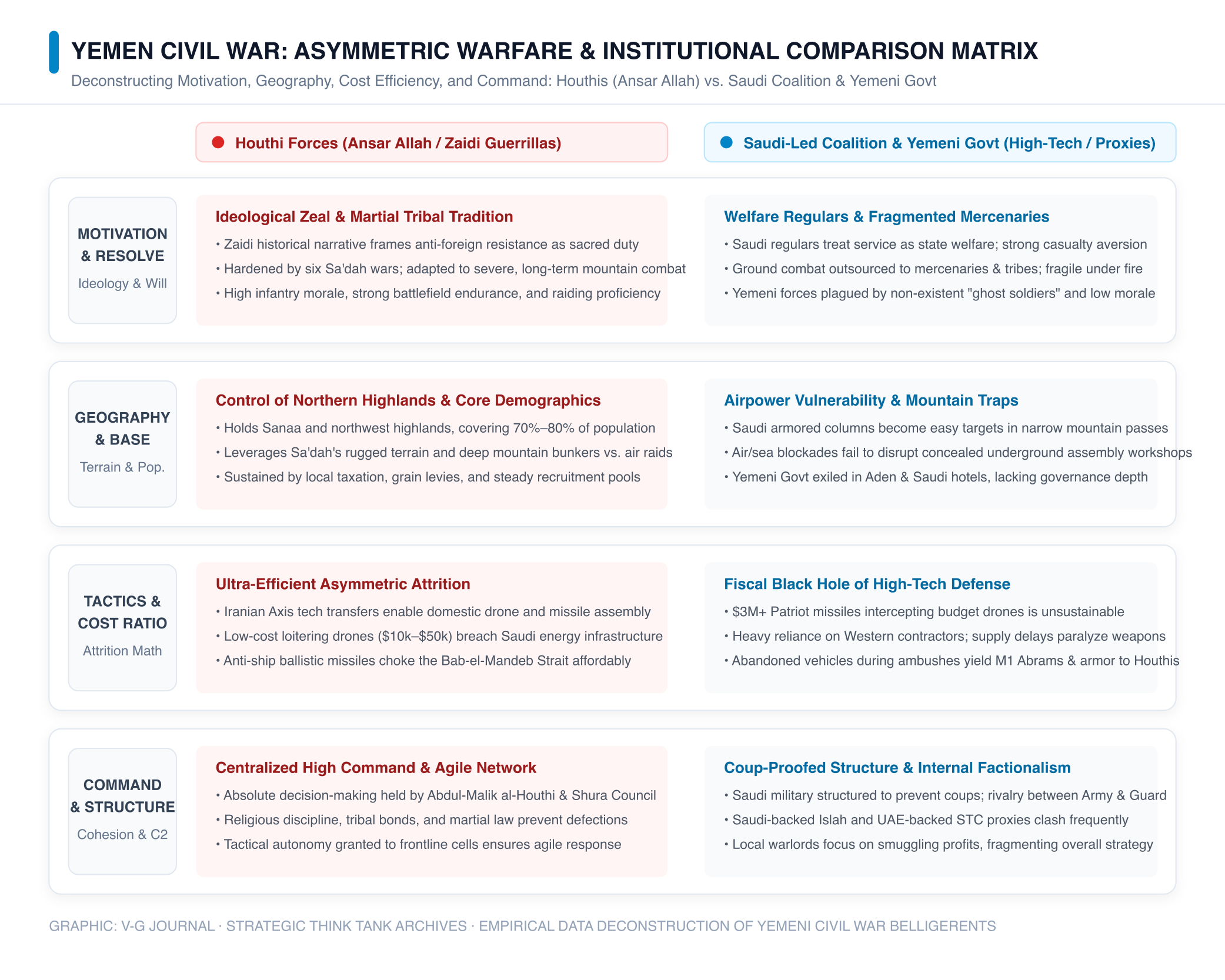
Figure 3: Comparison Matrix of Asymmetric Warfare Capabilities and Systemic Qualities of Various Combatants in the Yemen Civil War.
In battlefield engagements, the dimensions of confrontation between the two sides exhibit a stark asymmetry:
| Core Comparison Dimension | Yemen Houthi Movement (Ansar Allah) | Saudi-led Coalition & Yemeni Government Forces |
|---|---|---|
| Motivation and Will to Fight | Faith-driven and Tribal Ferocity: Rooted in Zaydi resistance tradition and tempered by six Sa’dah Wars; extremely resilient to hardship, with intense individual combat determination. | Systemic Welfare and Mercenary Patchwork: Saudi regular army views service as high-paying welfare; ground forces rely on foreign mercenaries and tribal militias; averse to casualties and fearful of losses. |
| Geography and Population Base | Possesses Highland Defenses and Core Population: Deeply entrenched in Sa’dah mountain underground bunkers; effectively controls 70%-80% of the core population areas, ensuring stable tax and troop recruitment. | High-altitude Bombing Fails to Damage Core: Mechanized units entering mountains are vulnerable to ambush and isolation; nominal government is confined to Aden and Saudi hotels, lacking grassroots social mobilization depth. |
| Tactics and Cost-Effectiveness | Low-Cost Asymmetric Attrition Warfare: Utilizes Iranian-supplied technology for low-cost suicide drones and anti-ship ballistic missiles; single attack costs only thousands to tens of thousands of dollars. | Economic Black Hole of Expensive Conventional Defense Systems: Each interception of a low-cost aerial threat can cost millions of dollars for a Patriot missile; financially and logistically unsustainable. |
| Organization and Command Structure | Highly Centralized Unitary Command: Houthi leadership and Shura Council hold absolute decision-making power; grassroots tactical units are highly autonomous and flexible; strict organizational discipline. | Fragmented and Proxy Infighting: Saudi military system is designed for counter-coup checks and balances; coalition factions, supported by Saudi Arabia and the UAE, frequently clash militarily. |
This asymmetric capability is magnified to its extreme in the strategic depth of Saudi Arabia and the Red Sea theater:
1. The ‘Financial Bankruptcy’ Black Hole of the Patriot Air Defense System
The “Samad-2/3” suicide drones and loitering munitions widely used by the Houthis are powered by commercially available two-stroke gasoline engines costing a few hundred dollars. Their bodies are made of low-cost fiberglass, with an entire unit costing only a few thousand to twenty thousand dollars to assemble.
However, when Saudi air defense forces or US Navy escort destroyers intercept these simple aerial vehicles, they deploy “Patriot-3” MSE or “Standard-2/6” surface-to-air missiles, each costing $2 million to $4 million. Even if Saudi Arabia’s interception success rate remains at a high 90%, in the long-term attrition warfare mathematical logic, this exchange ratio of spending millions to counter thousands is a path to irreversible financial suicide. The Houthis do not need to shoot down expensive fighter jets; by continuously launching low-cost loitering munitions to harass Saudi oil facilities, civilian airports, and desalination plants, they can force their adversary into a strategic bleed of their air defense missile stockpiles and foreign exchange reserves.
2. The Natural Geopolitical Noose of the Bab el-Mandeb Strait
The Houthis firmly control the highlands on the eastern shore of the Bab el-Mandeb Strait, the southern exit of the Red Sea.
The strait narrows to about 30 kilometers at its widest point and is a vital artery for about 12% of global trade shipping and the export of oil from the Persian Gulf. The Houthis do not need to build a multi-billion dollar modern surface fleet. With just a few mobile land-based anti-ship ballistic missiles, suicide remote-controlled speedboats, and simple naval mines deployed in mountain hideouts, they can pose a fatal threat to any merchant ship or warship passing through the strait. This strategy, deeply integrating a natural geopolitical choke point with distributed anti-access weapons, leaves even superpower navies, possessing the world’s largest blue-water fleets, in a passive and hesitant position.
V. Mechanism Convergence and Geopolitical Implications
The Yemen civil war and the decade-long Houthi struggle offer an extremely sobering dissection for modern military science and global geopolitics:
In the context of asymmetric warfare, the book price of weapon systems never equates to true battlefield advantage. What ultimately determines the outcome of a war is always the deep-seated efficiency of institutional mobilization, organizational resilience against attack, the depth of control over local terrain, and the mathematical reality of attrition ratios.
When a high-tech conventional army, equipped with luxurious gear but constrained by counter-coup suspicions, outsourced military functions, and aversion to casualties, encounters a local armed entity possessing deep millennial sectarian memory, formidable mountain tribal mobilization, highly centralized command, and access to cheap distributed long-range strike technology, traditional “high-tech conventional warfare thinking” will rapidly devolve into a protracted mountain counter-insurgency quagmire.
The Houthis’ inability to be defeated is not a miracle, but an inevitable fate forged by the convergence of systemic quality, geographical advantage, and technological diffusion in modern geopolitics.
Related Research & Topics
The Anatomy of Digital Predation: Inside the Syndicate Targeting the Elderly via Livestream Appraisal Scams
Starlink V4 and the Low-Earth Orbit Satellite Arms Race: How a 100,000-Node Optical Mesh Pierces the Submarine Cable Monopoly
Tello Mobile eSIM
SafetyWing Nomad Insurance
* Disclosure: This post contains affiliate links. If you make a purchase through these links, V-G Journal may earn a small commission at no additional cost to you. We only recommend services we independently evaluate and trust.
FIRE and Golf:自由旅居之路
专注于为追求 FIRE 与品质生活的人群提供特惠打球权益与候鸟微度假。不持一砖一瓦,运营品质生活。