The Wagah Theater vs. the Himalayan Melee: Two Protocols of Nuclear Border Control
An inquiry into why India’s western frontier features theatrical goose-stepping while its northern border relies on shield-and-baton combat—and how elevation, legal status, and nuclear game theory dictate border friction.

Executive Summary: The dramatic, boot-stomping retreat ceremony at the Indo-Pakistani Wagah-Attari border, inaugurated in 1959, functions as a highly orchestrated, theatrical relief valve along a fully settled 1947 international boundary. By contrast, the visceral, non-lethal melee clashes—involving shields, wooden batons, and stone-throwing—along the Sino-Indian Line of Actual Control (LAC) are not a performance. They are dictated by extreme physiological limits at 5,000 meters, zero-sum territorial drift, and a rigid, hard-coded nuclear circuit breaker established under Article VI of the 1993 and 1996 bilateral treaties, which explicitly bars the discharge of firearms within two kilometers of the LAC.
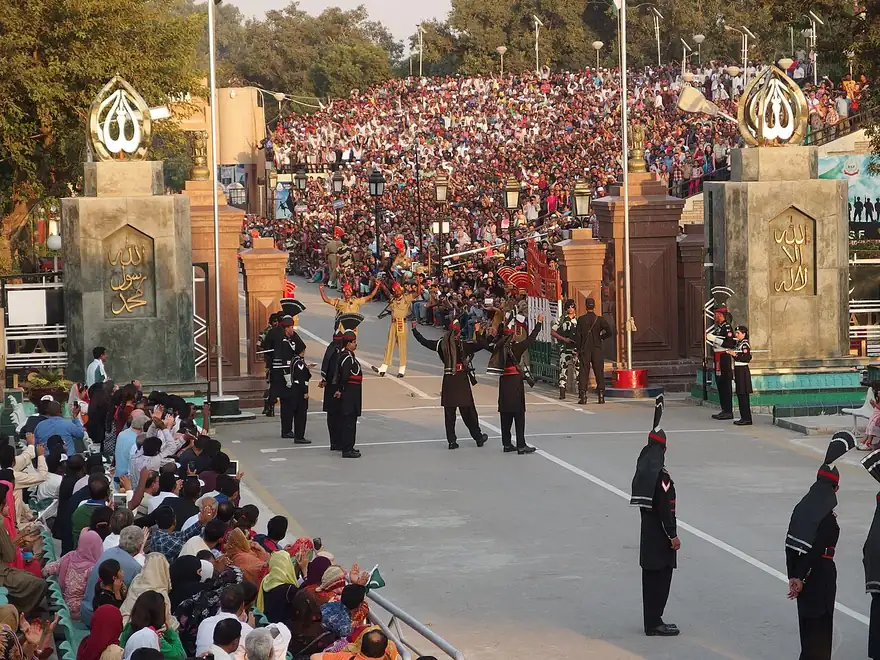
Figure 1: The daily flag-lowering spectacle at the Wagah-Attari border, featuring dual amphitheaters where troops perform choreographed confrontations before cheering crowds.
I. The Wagah Theater: A Co-Produced Valve for Nationalist Tension
When Western audiences encounter border operations in the Indian subcontinent, the most widely circulated imagery is often the theatrical posture at the Wagah-Attari crossing. Border guards adorned in towering fan-shaped crests (pagris) launch leather boots above their heads, chest-bump adversaries across a narrow line, glare through quivering moustaches, and stomp the tarmac in synchronized defiance. Yet within seconds of this thunderous display, both sides crisp-handshake, lower their respective national flags in tandem, and slide the heavy iron gates shut.
Formalized in 1959, this “Beating Retreat” ritual originated through a tacit understanding between the Indian Border Security Force (BSF) and the Pakistan Rangers. Over six decades, a routine daily gate closure evolved into a tightly choreographed exercise in competitive martial bravado.
Stripped of its surface hostility, Wagah is not an active military standoff; it is a co-produced, bi-national theater of kinetic performance:
- Stadium Infrastructure and Spectator Capital: Governments on both sides built multi-tiered, stadium-style grandstands capable of hosting thousands of spectators. Complete with public address conductors, nationalistic chanting, flag-waving tourists, and vendor stands, the crossing functions as an arena designed to consume and discharge domestic nationalistic fervor in controlled 45-minute installments.
- Off-Stage Synchronization: To ensure the spectacle remains dramatic without slipping into actual escalation, commanders from both outposts communicate frequently off-stage. They align march cadences, maximum kick heights, handshake durations, and seasonal uniform changes. When excessive boot-stomping caused widespread knee and meniscal injuries among veterans years ago, officers sat down and jointly agreed to tone down the impact force.
This raises an obvious question: Why has friction on the Sino-Indian border never adopted this ceremonial posture, evolving instead into brutal, physical engagements with wooden clubs, riot shields, and rocks? The answer lies in the tri-fold divergence of altitude, legal status, and nuclear risk management.
II. Atmospheric Reality: The Punjab Plains vs. High-Altitude Survival
Every military doctrine is fundamentally constrained by physical terrain and human biology.
The Wagah-Attari crossing sits on the fertile Punjab plain along the historic Grand Trunk Road connecting Amritsar and Lahore, at an elevation of roughly 200 meters. With oxygen-dense air, paved roads, and mild weather, soldiers can don starched ceremonial dress, march out for twenty minutes, and execute high kicks as an exercise in high-intensity cardio.
Conversely, friction points along the Sino-Indian Line of Actual Control—whether in the Galwan Valley, the north and south banks of Pangong Tso, or the western cold deserts—are situated in the Karakoram and Himalayan ranges at altitudes between 4,500 and 5,000 meters above sea level. As observed in the physical dynamics governing the Hindu Kush and Afghan mountain passes, extreme terrain imposes unforgiving costs on the human biology:
- Hypoxia and Rapid Edema: At 4,800 meters, atmospheric oxygen density drops to less than half of sea-level values, while winter ambient temperatures plummet below -30°C. Soldiers wearing tens of kilograms of cold-weather combat gear and anti-riot armor experience elevated heart rates (130–150 bpm) simply conducting routine foot patrols over scree and frozen riverbeds.
- The Fatal Cost of Unnecessary Exertion: In a oxygen-deprived environment, bodily resources are rationed for thermal regulation and basic mobility. Attempting high-kick drills or sustained vocal screaming at 5,000 meters rapidly induces hyperventilation, acute altitude sickness, or High Altitude Pulmonary Edema (HAPE), rendering a soldier incapacitated before an opponent even strikes.
High-altitude geography eliminates the physical leeway required for parade-ground theatricality.
III. Jurisprudential Divergence: Fixed International Borders vs. Dynamic Contestation
Beyond physical geography lies a fundamental distinction in international law and operational tolerance.
The structural foundation that enables the Wagah spectacle is simple: the sovereignty of the soil beneath the gate is entirely undisputed. The line at Wagah is part of the formal International Border (IB) drawn by Sir Cyril Radcliffe during the 1947 Partition and explicitly recognized by both Islamabad and New Delhi. Where India and Pakistan actively contest territory with kinetic firepower—hundreds of kilometers north along the undemarcated Line of Control (LoC) in Kashmir—troops do not perform ceremonial drills. Along the Siachen Glacier and Kashmir mountain posts, patrols engage with sniper fire, heavy mortars, and artillery strikes.
Wagah exists as a performance space precise because the boundary is fixed; shifting the gate by a meter changes no legal claims.
| Analytical Metric | Indo-Pak: Wagah-Attari (IB) | Indo-Pak: Kashmir Line of Control (LoC) | Sino-Indian: Line of Actual Control (LAC) |
|---|---|---|---|
| Legal Status | Settled International Border (1947 Radcliffe Line; mutually recognized) | 1972 Ceasefire Line (Sovereignty dispute; overlapping fire positions) | Undemarcated Border & Dynamic LAC (No mutual consensus; overlapping overlap zones) |
| Physical Environment | Punjab Plains (~200m elevation); mild climate, full infrastructure | Mountainous/Glacial (3,000–6,000m); high-altitude warfare | Karakoram/Himalayan Valleys (4,500–5,000m+); extreme cold and hypoxia |
| Dominant Friction Mode | Synchronized marching, high kicks, ceremonial gate closing | Sniper interdiction, heavy mortar barrages, artillery duels | Human-wall pushing, riot-shield shoves, non-firearm physical melee |
| Public Visibility | Ticketed stadium seating, televised coverage, high tourist presence | Closed military zone; operational updates restricted | Remote high-altitude wilderness; zero spectators, isolated documentation |
| Geopolitical Function | Domestic Tension Valve (Controlled release of nationalistic posture) | Attrition Warfare Zone (Active, low-intensity kinetic engagement) | High-Stakes Sovereign Boundary Negotiation under Nuclear Constraints |
On the Sino-Indian frontier, nearly 2,000 kilometers of border have never been formally demarcated by international treaty. Even the operational path of the Line of Actual Control (LAC) contains multiple overlapping “zones of differing perception” spanning several kilometers in sectors like Pangong Tso, Galwan, Hot Springs, and Demchok.
Along this line, there are no permanent iron gates, only a dynamic physical tug-of-war where micro-movements carry macro-implications:
- Tactical Advancement Creates Reality: Erecting a weather-resistant tent, grading a dirt access road, or extending a patrol route across a river bend establishes physical facts on the ground (fait accompli).
- Symbolic Concession Risks Physical Loss: Retreating from overlapping zones under ceremonial pretenses allows the opposing party to construct outposts, converting disputed claims into physical administrative control.
Consequently, encounters between border patrols along the LAC are direct tests of logistical capacity, physical endurance, and operational footprint. No spatial margin exists to convert these interactions into theater.

Figure 2: Comparative framework illustrating the operational logic of the Wagah performance model versus the non-firearm crisis management architecture along the LAC.
IV. Sticks and Stones: The Cold Logic of Nuclear Thermal Regulation
When global media outlets broadcast footage of border troops wielding anti-riot shields, wooden staves, steel rods, and stones high in the Himalayas, commentators frequently describe the scenes as a “Stone Age brawl in the nuclear era.” Viewed through strategic game theory, however, this non-lethal physical confrontation represents one of the most engineered crisis-management mechanisms in contemporary geopolitics.
This regime is anchored by two foundational bilateral treaties signed by Beijing and New Delhi:
- The 1993 Agreement on the Maintenance of Peace and Tranquility Along the Line of Actual Control: Formalized the baseline commitment to refrain from the threat or use of force.
- The 1996 Agreement on Confidence-Building Measures in the Military Field Along the LAC: Article VI explicitly establishes the operational threshold:
“With a view to preventing dangerous military activities along
Related Research & Topics
Tello Mobile eSIM
SafetyWing Nomad Insurance
* Disclosure: This post contains affiliate links. If you make a purchase through these links, V-G Journal may earn a small commission at no additional cost to you. We only recommend services we independently evaluate and trust.
FIRE and Golf:自由旅居之路
专注于为追求 FIRE 与品质生活的人群提供特惠打球权益与候鸟微度假。不持一砖一瓦,运营品质生活。