The Architecture of Myth: How Narrative Fiction Reconstructed the History of the Three Kingdoms
A deep dive into the divergence between Luo Guanzhong’s romanticized epic and Chen Shou’s cold historical records. We analyze the grafting of military merit, the demonization of pragmatists, and the macroeconomic realities of a century that saw an 80% population collapse.

Executive Summary: The Qing Dynasty historian Zhang Xuecheng famously remarked that the Romance of the Three Kingdoms is “seven parts fact and three parts fiction,” a ratio so potent it has effectively colonized the collective memory of the East. While the public is captivated by the novel’s Taoist sorcery, theatrical duels, and binary moral archetypes, they often overlook the reality recorded in Chen Shou’s Records of the Three Kingdoms. The true history was a cold, calculated era of institutional restructuring, fiscal exhaustion, and class struggle during the transition from the Han to the Wei. This essay deconstructs how narrative fiction systematically reassigned military merit, flattened complex political figures, and reduced the multidimensionality of ancient warfare to satisfy the psychological needs of later dynasties.
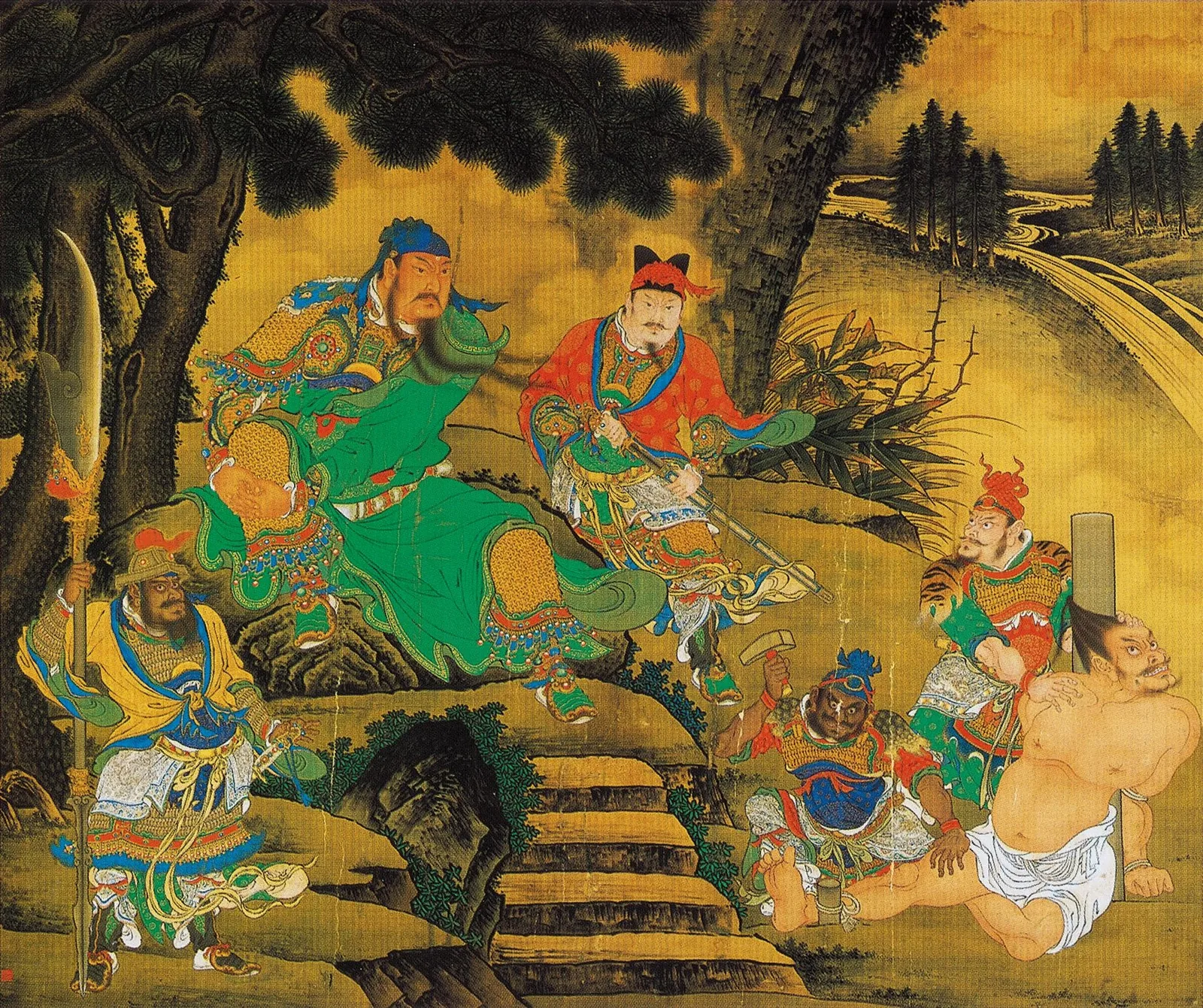
Figure 1: “Guan Yu Capturing an Enemy General” by Shang Xi (Palace Museum, Beijing). The depiction of Guan Yu seated on a rock with Zhou Cang holding the Green Dragon Crescent Blade reflects the visual solidification of the Romance narrative.
I. The Grafting of Merit: Narrative Consolidation
To establish the “Pro-Liu, Anti-Cao” narrative arc and amplify the heroic aura of its protagonists, the Romance performed large-scale “merit grafting”—transferring the strategic brilliance and battlefield victories of Eastern Wu and Cao Wei generals to the Shu-Han camp.
1. The Displacement of Historical Agency
Many of the most iconic “high-light” moments in the Three Kingdoms lore belong to entirely different historical actors than those celebrated in the novel:
-
The Slaying of Hua Xiong:
- The Romance: During the coalition against Dong Zhuo, Guan Yu, then a mere mounted archer, volunteers to take Hua Xiong’s head. He returns with the head before his cup of wine has even cooled.
- The Record: Hua Xiong was killed by Sun Jian, the “Tiger of Jiangdong.” During the Battle of Yangren, Sun Jian rallied his broken forces, counterattacked Dong Zhuo’s army, and decapitated the commander Hua Xiong (Records of the Three Kingdoms: Biography of Sun Jian). At that time, Liu Bei and Guan Yu were not even part of the main coalition offensive against Luoyang.
-
Borrowing Arrows with Straw Boats:
- The Romance: Zhuge Liang, facing an impossible deadline from a jealous Zhou Yu, uses twenty straw-covered boats in a thick fog to trick Cao Cao’s fleet into firing 100,000 arrows into them.
- The Record: The protagonist was actually Sun Quan, and the event occurred five years after the Battle of Red Cliffs in 213 AD. Sun Quan was scouting Cao Cao’s naval camp at Ruxu in a large ship. When Cao’s archers peppered the ship with arrows, causing it to list, Sun Quan ordered the ship turned around so the other side could take hits. Once balanced, he sailed away (Weilüe, cited by Pei Songzhi).
-
The Single-Sword Meeting:
- The Romance: Guan Yu attends a banquet hosted by Lu肅 (Lu Su) armed only with a single blade, intimidating the Wu generals with his sheer presence and taking Lu Su hostage to ensure a safe exit.
- The Record: The power dynamic was reversed. Lu Su, seeking to reclaim Jing Province, invited Guan Yu to a meeting where both sides agreed to keep their main forces a hundred paces back. Lu Su delivered a scathing, logical indictment of Liu Bei’s betrayal and refusal to return the territory. Guan Yu was left speechless by the moral and legal weight of Lu Su’s argument (Records: Biography of Lu Su).
-
The Empty City Stratagem:
- The Romance: After the fall of Jieting, Zhuge Liang sits atop the walls of Xicheng, playing a zither and burning incense, scaring off Sima Yi’s 150,000-strong army with the sheer aura of a perceived trap.
- The Record: This is geographically and chronologically impossible. During Zhuge Liang’s first northern expedition, Sima Yi was stationed in Wancheng (Nanyang), far from the front lines. The actual commanders opposing Shu were Cao Zhen and Zhang He. The “Empty Camp” tactic was historically used by Zhao Yun at the Han River and by Cao Cao much earlier against Lu Bu.
2. Comparative Matrix of Narrative Grafting
| Event | Literary Reconstruction (Romance) | Historical Record (Chen Shou / Pei Songzhi) | Actual Lead / Mechanism |
|---|---|---|---|
| Slaying Hua Xiong | Guan Yu kills him before the wine cools | Biography of Sun Jian | Sun Jian crushed Dong Zhuo’s forces at Yangren |
| Straw Boats | Zhuge Liang tricks Cao Cao in the fog | Weilüe | Sun Quan used the tactic for ship stability in 213 AD |
| Single-Sword Meeting | Guan Yu intimidates Lu Su | Biography of Lu Su | Lu Su rebuked Guan Yu; Guan Yu was speechless |
| Empty City | Zhuge Liang scares off Sima Yi | Biography of Zhuge Liang | Sima Yi was in Wancheng; Zhao Yun used it at Han River |
| Battle of Bowang | Zhuge Liang’s first brilliant victory | Biography of the First Lord | Liu Bei led the ambush in 202 AD; Kongming was still a hermit |
| Red Cliffs Strategy | Zhuge Liang summons the wind | Biography of Zhou Yu | Zhou Yu and Cheng Pu commanded; Huang Gai proposed the fire |
| Slaying Wen Chou | Guan Yu kills him in three bouts | Annals of Emperor Wu | Wen Chou died in a chaotic ambush led by Xun You’s logistics trap |
II. Character Reconstruction: The Demon, the Saint, and the Sorcerer
Lu Xun, in his Brief History of Chinese Fiction, offered a biting critique of Luo Guanzhong’s characterization: “Zhuge Liang’s wisdom is depicted as so great it borders on the demonic; Liu Bei’s kindness is so exaggerated it borders on hypocrisy.”
The novel adapted complex geopolitical actors into moral archetypes to suit the tastes of the urban merchant class.
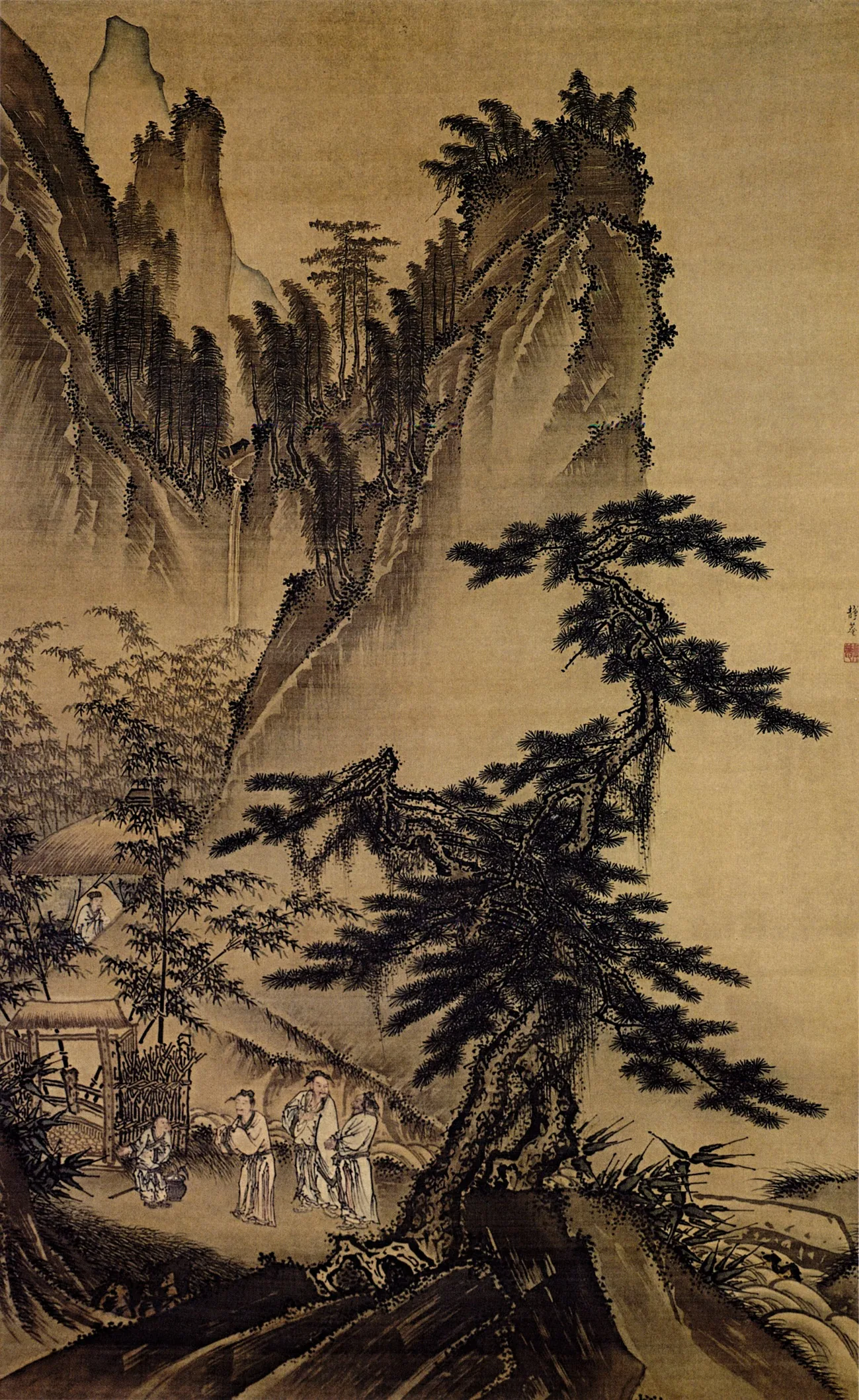
Figure 2: “Three Visits to the Thatched Cottage” by Dai Jin (Palace Museum, Beijing). A classic artistic rendering of the idealized bond between sovereign and minister.
1. Zhuge Liang: From “Grand Architect” to “Occultist”
In popular culture, Zhuge Liang is a master of Taoist magic and supernatural foresight. In reality, his “hardcore” identity was that of a top-tier institutional designer, fiscal genius, and logistics master.
Chen Shou’s assessment in the Records is restrained:
“As Chancellor, Zhuge Liang soothed the people, established standards, streamlined the bureaucracy, and was open and just… he was the equal of Guan Zhong or Xiao He. However, his annual mobilizations failed to achieve ultimate success; perhaps military improvisation was not his forte.”
Zhuge Liang’s true historical miracle was maintaining a continuous strategic offensive against the vastly superior Cao Wei (which had four times the population) from the isolated, mountainous corner of Shu:
- Rule of Law: He implemented the Shu Code, breaking the monopoly of local clans and ensuring “officials were free of corruption and the people were self-disciplined.”
- Fiscal Strategy: He established the “Brocade Office” to monopolize the production and export of Shu silk, using luxury trade to fund the war machine.
- Logistical Innovation: He developed the “Repeating Crossbow” (firing ten bolts) and the “Wooden Oxen and Flowing Horses” to solve the impossible logistics of the Qinling mountain passes.
The Romance stripped away these rigorous administrative achievements, vulgarizing a profound statesman into a stage magician.
2. Zhou Yu: From “Magnanimous Commander” to “Petty Rival”
The novel depicts Zhou Yu as a narrow-minded man consumed by jealousy of Zhuge Liang, eventually dying from rage after being “thrice provoked.”
In history, Zhou Yu was a broad-minded strategist with impeccable character:
- The veteran general Cheng Pu initially looked down on the young Zhou Yu, but was eventually won over by his grace, remarking: “Associating with Zhou Gongjin is like drinking fine wine; one becomes intoxicated without realizing it.”
- Liu Bei himself described Zhou Yu as “possessing great capacity.”
- He died of a sudden illness at age 36 while planning a grand strategic invasion of the west, having never had a personal feud with Zhuge Liang.
3. Cao Cao: From “Meritocratic Iconoclast” to “Ultimate Villain”
The novel’s Cao Cao is a paranoid tyrant who declares, “I would rather betray the world than let the world betray me.”
In the Records and related fragments:
- The quote (from Sun Sheng’s Zaji) was likely “I would rather betray others than have others betray me,” uttered in a moment of desperate self-defense during his flight from Luoyang, not as a premeditated manifesto of evil.
- The real Cao Cao broke the aristocratic monopoly on power by issuing three “Edicts for the Talented,” recruiting capable men regardless of their social standing or moral reputation.
- He implemented the Tuntian (state farming) system, restoring agricultural production in a North China that had been decimated by famine. He was a pragmatic Legalist and a titan of Jian’an literature.
III. The Mechanics of War: Piercing the “Duel” Filter
In the Romance, ancient warfare is reduced to two generals dueling on horseback while their armies watch. This is a trope of Song and Yuan Dynasty storytelling, violating every physical and organizational law of pre-modern combat.
| Feature | Romance Narrative (Fiction) | Historical Mechanism (Reality) |
|---|---|---|
| Combat Core | Single combat between generals | Formation, discipline, and logistics |
| Weaponry | Heavy polearms (Crescent Blades) | Lances (Shuo), Crossbows, and Sabers |
| Troop Counts | Hundreds of thousands / Millions | Tens of thousands (limited by grain) |
| Command | General leads the charge | General commands from the center |
Figure 3: The divergence between theatrical narrative and institutional reality.
1. Formations vs. Duels
In the Han and Three Kingdoms periods, victory relied on unit cohesion, combined arms (crossbowmen, heavy halberdiers, shock cavalry), and signal flags:
- A commander stayed in the center to manage the flow of battle. If a general charged out to duel, the chain of command would instantly collapse.
- The rare historical instance of “slaying a general in the ranks” was Guan Yu killing Yan Liang. This was not a duel; it was a surgical cavalry strike where Guan Yu spotted Yan Liang’s banner and pierced through the formation before the enemy could react.
2. Anachronistic Weaponry
The “82-pound Green Dragon Crescent Blade” did not exist in the Han Dynasty. It appeared in the Song Dynasty, primarily as a training tool or ceremonial piece.
- The standard weapon for cavalry and generals was the Lance (Shuo) or Halberd (Ji).
- Chen Shou’s record states Guan Yu “pierced” (ci) Yan Liang. This verb confirms the use of a thrusting weapon like a lance, not a slashing weapon like a heavy blade.
3. The Macroeconomic Reality of Population Collapse
The novel’s claims of Cao Cao leading “830,000 men” to Red Cliffs are mathematically impossible given the demographic catastrophe of the era:
- The Great Collapse: In 157 AD, the Han population was roughly 56 million. By 263 AD, the combined population of the Three Kingdoms was only 8.2 million. Over 80% of the population had vanished due to war and famine.
- Real Scale: At the Battle of Red Cliffs, Cao Cao likely had 150,000 to 200,000 men, with only about 100,000 available for the front line. The Sun-Liu alliance had roughly 50,000.
- Shu’s Limits: When Shu surrendered in 263 AD, its total population was only 940,000, with an army of 102,000. Zhuge Liang’s expeditions usually involved only 30,000 to 50,000 combatants; anything more would have caused an immediate logistical collapse in the Qinling mountains.
IV. The Dynamics of Myth-Making: Why History Was Rewritten
The transformation of the Records into the Romance was not a random act of fiction. It was driven by centuries of ethnic trauma, Neo-Confucianism, and urban consumerism.
1. The Psychological Refuge of the Southern Song
During the Tang Dynasty, Cao Wei was often seen as the legitimate successor to the Han because it held the Central Plains. However, this shifted during the Song Dynasty:
- After the “Jingkang Incident,” the Song lost North China to the Jin and retreated south.
- This historical trauma mirrored the Shu-Han experience: a “legitimate” Han regime holding a corner of the south, dreaming of reclaiming the lost northern heartland.
- Zhuge Liang became a psychological anchor for a displaced Han identity. The Neo-Confucian philosopher Zhu Xi officially codified Shu-Han as the “legitimate” line, turning “Pro-Liu, Anti-Cao” from a preference into a moral imperative.
2. The Reductionism of the Marketplace
The Romance evolved from oral storytelling in the tea houses of the Song and Yuan Dynasties:
- An urban audience could not grasp the nuances of land-tax reform or the logistics of grain transport.
- They demanded moral clarity: the hero must be flawless, the villain must be treacherous, and the strategist must be a prophet.
- Luo Guanzhong kept the skeleton of history but filled it with the flesh of theatrical drama to satisfy this mass-market demand for narrative satisfaction.
V. Conclusion: The Record and the Temple
Chen Shou’s Records of the Three Kingdoms is a cold, austere political ledger. It records the brutal reality of warlordism, the land grabs of the gentry, and the desperate institutional survival of states in a depopulated wasteland.
Luo Guanzhong’s Romance of the Three Kingdoms is a heroic temple, built over a thousand years of collective yearning. It distilled the chaos of a dying empire into eternal themes of loyalty, wisdom, and the tragic beauty of “knowing something is impossible yet doing it anyway.”
To understand the fiction is to appreciate the power of art; to understand the history is to appreciate the resilience of the human institution. By deconstructing the myth, we do not diminish the novel; rather, we finally see the true, terrifying, and magnificent scale of the era that inspired it.
Related Research & Topics
Tello Mobile eSIM
SafetyWing Nomad Insurance
* Disclosure: This post contains affiliate links. If you make a purchase through these links, V-G Journal may earn a small commission at no additional cost to you. We only recommend services we independently evaluate and trust.
FIRE and Golf:自由旅居之路
专注于为追求 FIRE 与品质生活的人群提供特惠打球权益与候鸟微度假。不持一砖一瓦,运营品质生活。