The Global Governance of Telecom Fraud: Shifting Liability to Banks and Telcos
Why is telecom fraud perceived as an Asian phenomenon? This analysis deconstructs the global black-market ecosystem, the structural failure of payment infrastructure, and the emerging legal shift toward mandatory institutional liability in the UK, Singapore, and China.

Curator’s Foreword: Public perception often frames telecom and network fraud as a localized pathology of East and Southeast Asia, while Western nations are viewed as largely immune. This is a dangerous misconception. The global black-market map is far more integrated. Western societies are not immune; they suffer tens of billions of dollars in annual losses from Business Email Compromise (BEC), sophisticated social engineering, and crypto-based “pig butchering” scams. The discrepancy in perception stems from the physical nature of these crimes and the generational divide between credit-card-based chargeback protections and the “instant-settlement” reality of modern mobile banking. Crucially, regardless of the lure, all fraud relies on two modern infrastructures: telecommunications and banking. For too long, institutions have reaped the efficiency dividends of digital connectivity while externalizing the costs of social engineering onto the individual. As the marginal utility of consumer education declines, global governance is undergoing a profound shift: moving away from victim-blaming toward legally mandated joint liability for banks and telecom operators.

Figure 1: Multinational tech agencies and law enforcement tracking offshore communication links and illicit fund nodes. Modern telecom fraud has evolved into an industrialized, transcontinental criminal chain.
I. Correcting the Bias: The Generational Mismatch of Fraud and Finance
To dismantle the myth that “telecom fraud is rare in the West,” one must calibrate against hard empirical data.
According to the U.S. Federal Trade Commission (FTC) and the FBI’s Internet Crime Complaint Center (IC3), American victims lose tens of billions annually to telecom and network fraud. From “pig butchering” crypto-investment scams to BEC attacks targeting corporate finance departments, the North American middle class and institutional sectors are under constant siege. In the UK, the Office for National Statistics (ONS) has identified fraud as the single most prevalent crime, accounting for over 40% of all recorded offenses.
If the scale of loss is comparable, why does the perception persist that fraud is an “Asian problem”? This cognitive dissonance arises from three structural factors:
1. Physical Manifestation: Violent Enclaves vs. Offshore Light-Asset Infiltration
In Asia, particularly in border regions like Myanmar, Cambodia, and Laos, fraud has evolved into “heavy-asset” violent enclaves. These groups operate in legal vacuums, tethering cyber-fraud to human trafficking and physical detention. The brutality of these operations creates high-impact media narratives, causing the public to equate “telecom fraud” with these specific geographic coordinates.
Conversely, fraud targeting the West relies on “light-asset” offshore infiltration:
- Call centers in South Asia masquerading as Microsoft or Amazon support;
- “419” variants and romance scams operating from hidden apartments in West Africa or Eastern Europe;
- Even within Southeast Asian enclaves, “Western-facing” teams operate via remote, contactless digital channels.
Because these lack the visceral imagery of physical prison camps, the damage is perceived as a “silent bleed” rather than a dramatic criminal crisis.
2. Infrastructure Mismatch: Chargebacks vs. Instant-Settlement Holes
The underlying payment architecture dictates the victim’s pain threshold. Western systems have long relied on credit cards, which feature robust chargeback mechanisms and “Zero Liability” policies. In traditional fraud, the burden of loss is often absorbed by the merchant or the bank.
In contrast, many Asian markets bypassed the credit card era, leaping directly to mobile and instant bank transfers. While this accelerated commerce, it created a vacuum for money laundering. Once a victim authorizes a transfer, funds are fragmented into thousands of micro-transactions across “mule” accounts within seconds, eventually settling into offshore crypto-wallets. The window for judicial intervention is effectively zero.
However, as Zelle, Venmo, and UK Faster Payments have introduced instant P2P transfers to the West, the Authorized Push Payment (APP) fraud epidemic has exploded. When consumers are manipulated into authorizing their own transfers, the traditional credit-card-style protection vanishes, leaving Western victims in a similar state of institutional abandonment.
3. Digital Maturity and Psychological Targeting
In Asia, the rapid adoption of digital tools often outpaced the development of digital literacy, making populations vulnerable to “authoritative” scripts (e.g., impersonating police or tax officials). Western scams, meanwhile, exploit local institutional vulnerabilities: IRS tax scares, Social Security number freezes, or supply-chain invoice fraud. The scripts differ, but the exploitation of information asymmetry remains constant.
II. The Infrastructure Paradox: Externalizing Risk
In the lifecycle of a scam, the criminal must utilize two non-negotiable channels: the telecom network (for contact) and the banking system (for fund extraction). Institutions have long enjoyed the dividends of digital efficiency while treating security as an “external” cost to be borne by the user.
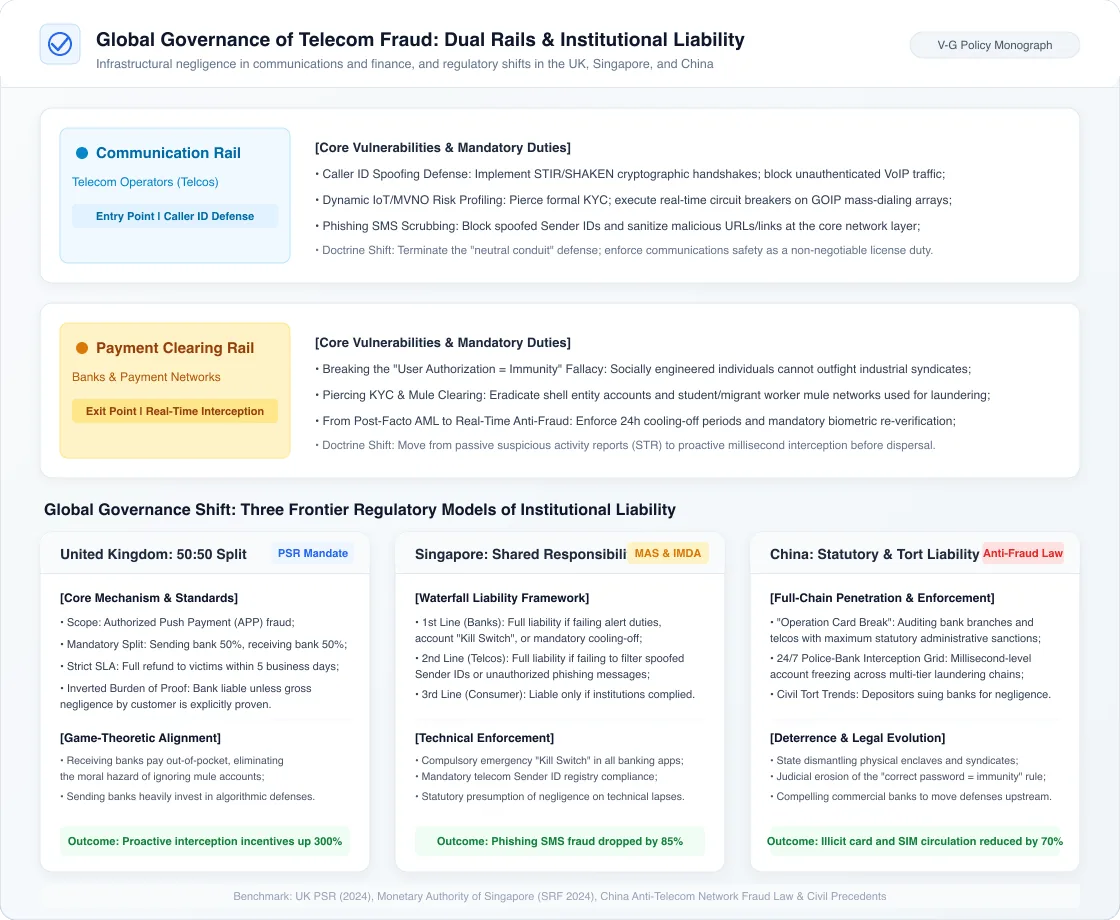
Figure 2: Global Telecom and Network Fraud Governance: Dual-Rail Infrastructural Vulnerabilities and Statutory Liability Paradigms in the UK, Singapore, and China.
1. The Telecom Failure
Telecom operators often hide behind the “neutral conduit” defense. Yet, they possess the technical capacity to prevent fraud:
- Caller ID Spoofing: The lack of mandatory STIR/SHAKEN-style digital signature protocols allows criminals to spoof official bank or police numbers.
- IoT/Virtual Number Abuse: Operators often prioritize volume over security, allowing “GoIP” (centralized calling) devices to operate on virtual numbers that should be flagged by behavioral models.
- Phishing SMS Gateway Scrubbing: Failure to block unauthorized Sender IDs and sanitize malicious URLs at the core network level allows smishing campaigns to penetrate consumer devices unchecked.
2. The Banking Failure
Banks are the final gatekeepers. Their primary defense—“the customer authorized the transaction”—is increasingly obsolete in the face of sophisticated social engineering.
- The KYC Gap: Banks often prioritize account opening KPIs, allowing shell companies and “mule” accounts to proliferate.
- AML vs. Real-Time Fraud: Traditional Anti-Money Laundering (AML) is a post-facto compliance exercise. Modern banking requires a real-time fraud engine capable of triggering “cooling-off periods” or mandatory biometric re-verification when transaction patterns deviate from the norm.
III. Global Governance: From Education to Mandatory Liability
The era of relying on “victim education” is over. We are seeing a shift toward forcing institutions to internalize the costs of their security failures.
1. The UK: The 50:50 Liability Split
The UK’s Payment Systems Regulator (PSR) has introduced a landmark rule: in APP fraud cases, the sending bank and the receiving bank must split the liability 50:50. This forces the receiving bank—which previously had no incentive to police its own accounts—to aggressively monitor for illicit inflows.
2. Singapore: The Shared Responsibility Framework (SRF)
Singapore has implemented a tiered liability model. If a bank fails to provide mandatory security features (like a “Kill Switch” or transaction alerts), it bears full liability. If the bank is compliant, the burden shifts to the telecom operator if they failed to block unauthorized phishing messages. Only if both institutions are fully compliant does the burden fall on the individual.
3. China: Administrative and Judicial Penetration
China has adopted a “whole-chain” approach. Through the Anti-Telecom Network Fraud Law, authorities conduct “one case, two investigations”—auditing not just the criminal, but the bank branch and telecom operator that facilitated the account or line. Judicial practice is also evolving, with courts increasingly holding banks liable for failing to exercise “reasonable care” during suspicious large-value transfers.
Conclusion: Ending the Era of Institutional Immunity
Telecom fraud is not a moral failing of the individual; it is a systemic byproduct of digital economic acceleration.
The ultimate turning point in governance is not found in better public awareness campaigns, but in the re-alignment of economic incentives. Only when the cost of legal liability and mandatory compensation significantly outweighs the cost of upgrading security infrastructure will banks and telecom operators finally close the loopholes that allow industrialized crime to flourish. The era of institutions reaping the efficiency dividends of connectivity while offloading the risks onto the public is coming to an end.
Related Research & Topics
The Anatomy of Digital Predation: Inside the Syndicate Targeting the Elderly via Livestream Appraisal Scams
Starlink V4 and the Low-Earth Orbit Satellite Arms Race: How a 100,000-Node Optical Mesh Pierces the Submarine Cable Monopoly
Tello Mobile eSIM
SafetyWing Nomad Insurance
* Disclosure: This post contains affiliate links. If you make a purchase through these links, V-G Journal may earn a small commission at no additional cost to you. We only recommend services we independently evaluate and trust.
FIRE and Golf:自由旅居之路
专注于为追求 FIRE 与品质生活的人群提供特惠打球权益与候鸟微度假。不持一砖一瓦,运营品质生活。