Starship Flight 14: From Suborbital Prototype to Orbital Utility
Debunking the misinformation surrounding the Starship S14 launch window while analyzing the mission's pivot toward stable orbital operations, V3 Starlink deployment, and long-duration deep-space endurance.

Executive Summary: Rumors circulating on September 23, 2026, regarding an immediate “SpaceX Starship S14 launch” are the result of a misunderstanding of ground operations at Starbase, Texas. Current activity involving Super Heavy Booster 21 (B21) and Ship 41 (S41) at Pad 2 constitutes static integration and ground system rehearsals. The official launch window is scheduled for No Earlier Than (NET) September 28, 2026.
As the most powerful launch system in human history, Integrated Flight Test 14 (IFT-14) represents a paradigm shift: moving away from trans-atmospheric suborbital trajectories toward a stable 275km closed circular orbit. The mission will validate the deployment of 26 next-generation Starlink V3 satellites and test Raptor engine re-ignition after a grueling 10-hour deep-space “cold soak.”
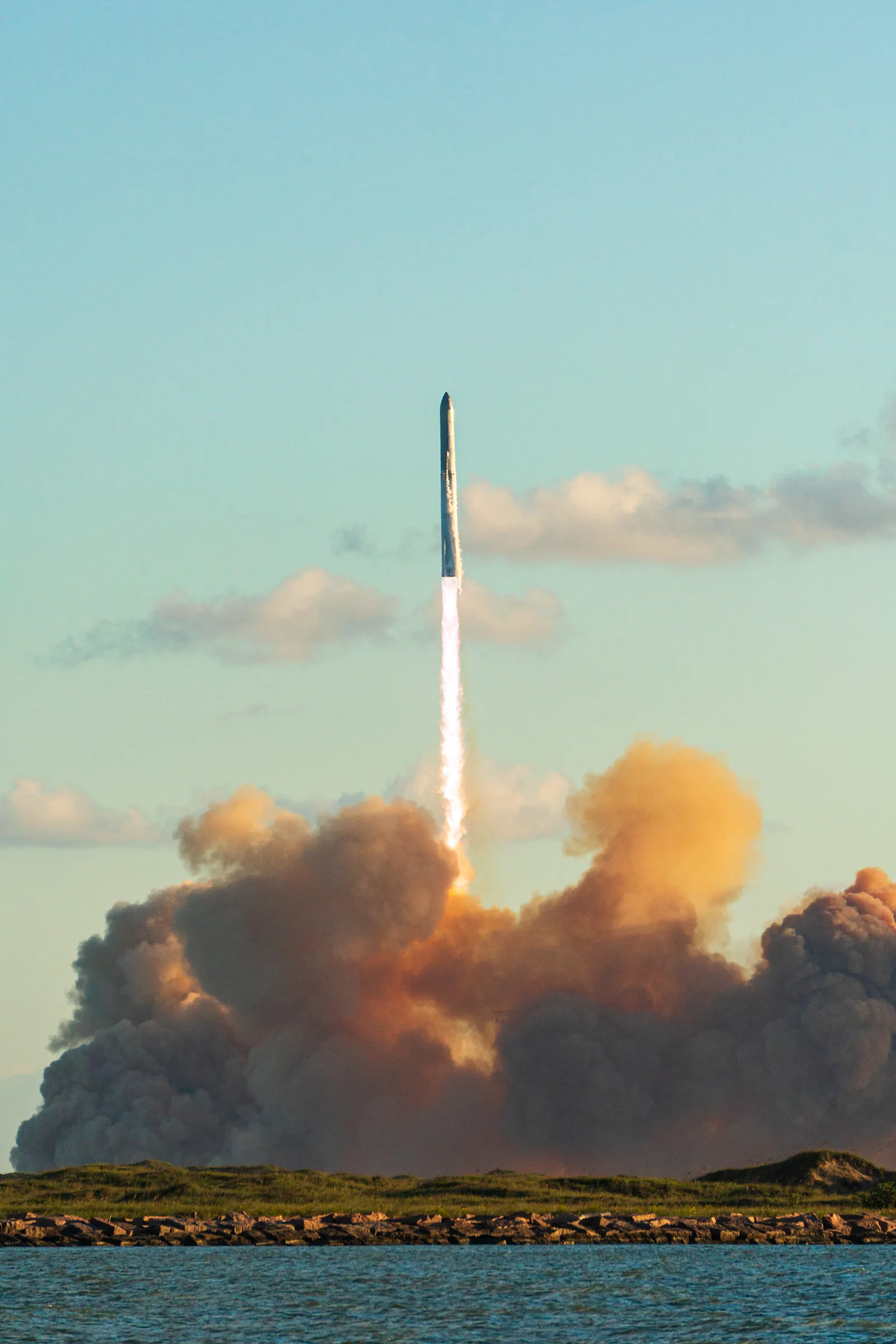
Figure 1: SpaceX Starship ignition at Starbase. Every full-stack integration and test flight fundamentally reshapes the marginal cost of access to Low Earth Orbit (LEO).
I. Reality Check: Ground Rehearsal, Not Ignition
In an era of high-frequency commercial space iteration, public perception is often skewed by the feverish pace of social media countdowns. Cross-referencing official notices with on-site telemetry confirms the following status for the rumored “September 23 launch”:
1. Current Site Status: Transport and Integration
The core operations at Starbase today involve the transport, lifting, and mechanical mating of Booster 21 (B21) and Ship 41 (S41) at Launch Pad 2. Teams are currently performing electrical interface matching, cryogenic propellant line purging, and pad-to-vehicle synchronization. The mission has not yet entered the full propellant loading phase or the final pre-launch terminal countdown.
2. The Actual Launch Window: NET September 28
According to SpaceX’s latest airspace closure filings and flight plans:
- Target Launch Date: No Earlier Than (NET) Monday, September 28, 2026.
- Launch Window: Expected to open at 07:15 AM Central Time (12:15 UTC).
- Regulatory Status: The mission is pending the final Launch License Modification from the Federal Aviation Administration (FAA) specifically for Flight 14.
Until the official Notices to Airmen (NOTAM) and Notices to Mariners (NOTMAR) are active, any claims equating ground stacking with an imminent launch confuse engineering preparation with operational execution.
II. Mission Profile: The Leap to Closed Orbit
While the public often refers to the vehicle as “S14,” the official designation is Starship Integrated Flight Test 14 (IFT-14), utilizing the B21 + S41 configuration.
Flight 14 marks a milestone transition in orbital design:
| Parameter | Specification | Strategic Objective |
|---|---|---|
| Orbit Type | 275km Circular | Transition to Stable Orbital Insertion |
| Mission Duration | ~10 Hours | Deep Space “Cold Soak” Validation |
| Payload | 26x Starlink V3 | Commercial Logistics Proof-of-Concept |
| Booster Recovery | Controlled Gulf Splashdown | B21 Structural & Vectoring Data |
| Ship Recovery | South Pacific Re-entry | High-Energy Thermal Protection Testing |
1. Orbital Altitude and Duration
- Altitude: Following hot-stage separation, the Ship’s six Raptor engines will push the vehicle into a stable 275km circular orbit.
- Duration: Breaking the previous precedent of sub-two-hour trans-atmospheric coasts, S41 will remain in orbit for approximately 10 hours, completing six full revolutions around Earth.
2. Disposal and Controlled Re-entry
- Booster (B21): After the boostback burn, B21 will execute a controlled landing burn in a designated zone in the Gulf of Mexico to gather data on heavy-structure water landings.
- Ship (S41): Following payload deployment and orbital testing, S41 will perform a deorbit burn over the South Pacific (west of Chile). A backup contingency trajectory toward the Indian Ocean remains in place should orbital insertion variances occur.
III. Five Strategic Pillars of Flight 14
If Flights 1 through 13 were aggressive physical experiments to solve atmospheric penetration and hot-staging, Flight 14 is Starship’s “coming of age” as a commercial heavy-lift workhorse.
1. The Historical Shift: Stable Orbital Insertion
Prior to Flight 14, all Starship trajectories were “trans-atmospheric suborbital”—meaning the perigee (lowest point of orbit) remained within the dense atmosphere. This ensured that even if the engines failed to re-ignite, the ship would naturally burn up within one revolution, mitigating the risk of uncontrolled space debris.
Flight 14 is the first time a 50-meter-tall, 9-meter-diameter spacecraft will enter a truly closed orbit. This transition moves Starship from the “prototype” category into the realm of functional, persistent spacecraft.
2. Commercial Utility: Starlink V3 Deployment
For the first time, the payload bay will not carry inert ballast. Instead, it is loaded with 26 next-generation Starlink V3 satellites (Group 31-1):
- The “Pez” Dispenser: Starlink V3 satellites are significantly larger than their predecessors, exceeding the volume capacity of the Falcon 9 fairing. Flight 14 will test the microgravity ejection mechanism required to deploy these massive arrays.
- Economic Throughput: Validating this mechanism is critical for SpaceX to bypass the Falcon 9 capacity bottleneck and accelerate the deployment of the “Direct to Cell” constellation.
3. The “Cold Soak” and Vacuum Re-ignition
A 10-hour orbital duration introduces severe engineering stressors:
- Cryogenic Management: Liquid Methane (-161°C) and Liquid Oxygen (-183°C) must be managed through 10 hours of alternating solar radiation and deep-space shadow. The propellant settling systems must ensure a pure liquid phase at the engine inlets for the deorbit burn.
- Raptor Reliability: Re-igniting a Raptor engine after hours of extreme thermal soaking is a high-stakes maneuver. Failure to ignite for the deorbit burn would leave a massive steel structure as uncontrolled orbital debris, a legal and safety red line in modern spaceflight.
4. Heat Shield Refurbishment and Reuse
On the windward side of S41, the engineering team has installed several Thermal Protection System (TPS) tiles that were recovered, inspected, and refurbished from previous flights:
- This tests the durability of recycled tiles under the intense plasma scrubbing of orbital re-entry.
- For Starship to achieve Musk’s vision of “multi-launch per day” operations, the manual replacement of tens of thousands of tiles must be replaced by an industrial refurbishment cycle.
5. B21 Hardware Iteration: Filtration and Parallel Logic
Following telemetry from Flight 13, which showed minor pressure anomalies during the boostback phase, B21 features targeted upgrades:
- High-Flow Filtration: New physical filters at the Raptor propellant inlets to isolate metallic micro-particles or slag generated by high-vibration environments.
- Flight Control Redundancy: Reconfigured algorithms for parallel engine clusters. The system can now compensate for thrust perturbations in individual combustion chambers with millisecond response times, ensuring absolute fault tolerance during heavy-load ascent.
IV. Conclusion: The Quiet Before the Ascent
Aerospace engineering offers no shortcuts. The activity at Starbase on September 23 is not the roar of ignition, but the silent, meticulous synchronization of thousands of valves, sensors, and lines.
For those tracking the evolution of industrial capacity and the commercialization of space, the focus remains on the September 28 window. When B21 and S41 finally depart the pad, Starship will attempt to prove it is no longer a testbed, but the world’s first 100-ton-class orbital utility vehicle.
Related Research & Topics
Starlink V4 and the Low-Earth Orbit Satellite Arms Race: How a 100,000-Node Optical Mesh Pierces the Submarine Cable Monopoly
The 0.81-Second Threshold: Deconstructing the Physics of the Tesla Roadster’s SpaceX Package
Tello Mobile eSIM
SafetyWing Nomad Insurance
* Disclosure: This post contains affiliate links. If you make a purchase through these links, V-G Journal may earn a small commission at no additional cost to you. We only recommend services we independently evaluate and trust.
FIRE and Golf:自由旅居之路
专注于为追求 FIRE 与品质生活的人群提供特惠打球权益与候鸟微度假。不持一砖一瓦,运营品质生活。