Fact-Checking the Solana Shanghai Rumor: Regulatory Crackdown and the Illusion of Local Backing
Amid social media speculation claiming Solana had officially established a presence in Shanghai with local backing, the People's Bank of China shut down the event and launched an investigation, reaffirming that all crypto promotions remain strictly illegal.

Figure 1: Solana’s official brand identity. A high-profile offline promotional campaign organized by domestic proxies was abruptly shut down by regulators.
A viral rumor claiming that the prominent public blockchain Solana was making a high-profile push into Shanghai’s Lujiazui financial district with tacit local government support recently triggered speculative frenzy across crypto communities and secondary markets. However, the real-world script was rewritten by regulators before the event even opened its doors: the People’s Bank of China (PBOC), alongside Shanghai’s local financial regulatory bureau, public security, and market administration, swiftly intervened to shut down the so-called “Solana Accelerate China 2026” offline symposium and launched an formal investigation into the domestic entities involved. Relevant PBOC departments explicitly reiterated that SOL is, by definition, a virtual currency, and any domestic promotion or trading support constitutes illegal financial activity, shattering market illusions of official compliance.
I. Landmark Billboards and National Tours: A Carefully Engineered Illusion of “Official Backing”
The genesis of this controversy was highly theatrical. Outside the Citigroup Tower in Shanghai’s core Lujiazui financial hub, massive exterior LED screens suddenly lit up with Solana branding. This was paired with recruitment for an offline tour called “Solana Accelerate China 2026,” with promotional materials indicating plans to hit core cities including Shanghai, Hangzhou, Shenzhen, and Beijing.
Amplified by crypto influencers and social media echo chambers, what was fundamentally a paid commercial advertising campaign was rapidly spun as a “major macroeconomic pivot.” Speculators took to group chats to tout absurd narratives—such as “public blockchains breaking the ice in Shanghai” or “local governments offering FTZ (Free Trade Zone) compliance sandboxes”—deliberately bundling ordinary advertising with administrative endorsement to lure retail investors lacking regulatory literacy into chasing token prices.
Regulators, however, moved decisively. Before the Shanghai event could officially commence, enforcement officers from the PBOC, local financial authorities, public security, and market regulation arrived on-site and immediately ordered the gathering halted. Ironically, even after enforcement intervention, the organizers’ public statements attempted to cover up the truth, claiming the event was postponed “due to registration numbers far exceeding venue capacity.” This narrative collapsed under the weight of subsequent regulatory investigations and official communiqués.
II. Legal Boundaries and Penetrating Oversight: The Rigid Defense Line of Regulatory Warnings
Faced with concept-driven speculation exploiting informational asymmetry, financial regulators quickly delivered clear definitions and legal grounding.
Officials from the relevant PBOC departments explicitly stated via state media that SOL tokens are fundamentally virtual currencies. Furthermore, the Solana platform provides underlying technical infrastructure for the issuance and circulation of various mainstream stablecoins within its ecosystem. Under current national financial regulations, any behavior involving the public promotion of virtual currencies within domestic borders, the provision of traffic redirection services, or the facilitation of matchmaking constitutes explicitly prohibited illegal financial activity.
From the 2021 Circular on Further Preventing and Disposing of Speculative Risks in Virtual Currency Trading (Yinfa [2021] No. 237), jointly issued by the PBOC and ten other ministries, to the upgraded 2026 guidelines targeting emerging forms such as stablecoins and asset tokenization (Yinfa [2026] No. 42), China’s regulatory baseline for virtual currencies remains entirely consistent:
| Key Dimension | Crypto Community Narrative | Regulatory Facts & Official Findings | Fact-Check Verdict |
|---|---|---|---|
| Nature of Landmark Ads | Lujiazui billboard display implies local regulatory approval | Pure commercial ad placement; suspected of illegal promotion of crypto platforms and unauthorized tokens | Misleading rebranding; suspected of illegal financial advertising and customer acquisition |
| Shutdown of Offline Event | Postponed voluntarily due to overwhelming registration turnout | PBOC, local finance, police, and market regulators shut down the event on-site | False statement; regulators have initiated formal investigations into entities and individuals involved |
| Blockchain Compliance Space | Claims of breakthroughs in China exploring domestic compliance channels | SOL is fundamentally a virtual currency; all promotional activities are illegal | Pure fabrication; zero room for policy breakthroughs under current financial frameworks |
| Targeted Enforcement | Pushed as “merely academic and developer technical exchanges” | Penetrating crackdown on domestic brokers and local affiliates of offshore platforms | Rigid penetration; cutting off offline acquisition and funding channels for illegal financial activities |
Regulators emphasized that due to their anonymous and borderless nature, virtual currencies fail to meet the strict Customer Due Diligence (CDD) and Anti-Money Laundering (AML) standards required by modern financial infrastructure, rendering them breeding grounds for illegal fundraising, telecom fraud, and cross-border money laundering. For the domestic agencies, event planners, and responsible parties involved in this incident, formal investigations are underway. Authorities have designated all “agents” and “affiliates” of offshore crypto exchanges and public chain ecosystems operating domestically as prime targets for routine, systematic crackdowns.
III. Information Asymmetry and Hidden Intermediaries: Domestic Proxy Shells and Retail Exit Traps
Analyzing the deeper logic behind the Solana Shanghai fiasco reveals a classic playbook: offshore crypto ecosystems attempting underground customer acquisition via domestic “proxy shell” operations.
In these operational chains, offshore project teams or affiliated foundations rarely establish onshore entities directly. Instead, they commission or authorize domestic PR firms and blockchain incubators to register applications under the guise of “technical salons,” “developer summits,” or “frontier innovation forums.” During execution, the organizing team purchases high-end landmark billboards in major cities to project an illusion of “official tacit approval.” Combined with algorithmic pushing across social media, an ordinary marketing campaign is dressed up as a “national compliance inflection point.”
The primary victims of this model are inevitably retail investors lacking professional discernment. By deliberately blurring the line on basic commerce—namely, that anyone who pays can buy an ad space—and exploiting public ignorance of administrative approval processes, operators artificially manufacture secondary-market FOMO. Reflecting on the deeper turbulence exposed during market liquidity shocks, investors have already witnessed the fundamental fragility of offshore trading ecosystems wrapped in decentralized rhetoric, as analyzed in Binance Security Breaches and Crypto Liquidity Shocks.
For individuals operating across multi-chain ecosystems, establishing robust isolation mechanisms is non-negotiable. As outlined in the Digital Nomad Anti-Phishing Defense & Asset Isolation Guide, blindly trusting unverified claims of “domestic compliance pilots” is often the gateway to catastrophic asset loss and phishing scams.
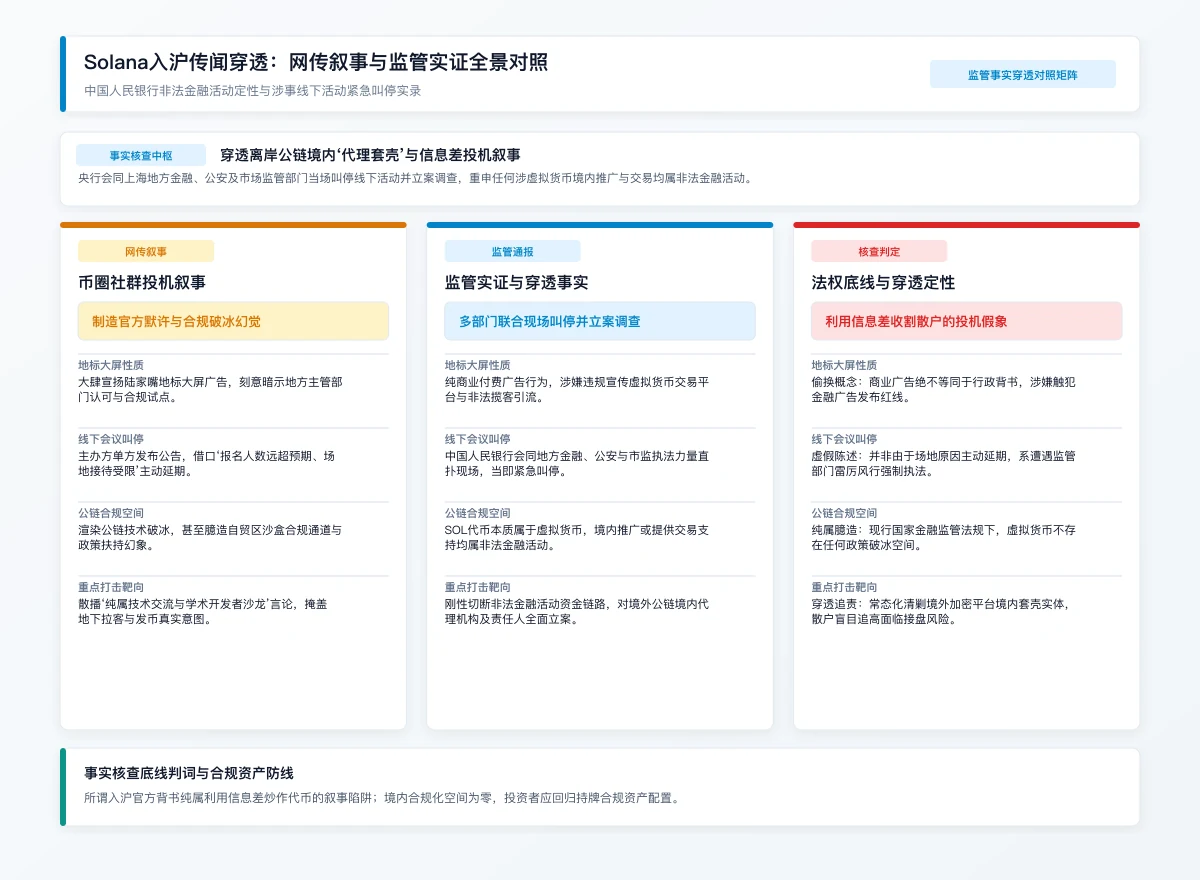
Figure 2: Penetrating the Solana Shanghai Rumor: A panoramic comparison of online narratives versus regulatory reality.
IV. Rethinking Global Asset Defense: Moving From Gray-Market Illusions to Deterministic Compliance
The decisive shutdown and investigation by regulators not only shattered fraudulent narratives surrounding public chains entering Shanghai but also served as a stark wake-up call for investors pursuing global asset allocation.
Many retail investors fall prey to false narratives about “China gradually opening up crypto trading” because of a cognitive bias regarding compliant cross-border pathways. Some cling to the illusion of finding a gray middle ground—somewhere they can remain domestically protected while freely participating in high-volatility offshore speculation. Yet from a legal standpoint, China’s stance against virtual currency trading remains absolute and unyielding. Any attempt to legitimize virtual currency transactions domestically is built on quicksand.
Within mature global asset allocation frameworks, genuine institutional protection relies on clear tax residency and strictly regulated custodial architectures. For investors seeking compliant offshore diversification—a pathway mapped out in Interactive Brokers, CRS Data Sharing, and Account Verification Rules—defense-in-depth can only be built within licensed brokerages and regulated banking systems characterized by sound rule of law and structural transparency.
When the noise fades, the speculative illusions spun under the spotlight are swiftly reduced to dust by regulatory intervention. Any attempt to package illegal financial activities with marketing buzzwords under strict oversight will inevitably run into the rigid constraints of the rule of law.
Related Research & Topics
Tello Mobile eSIM
SafetyWing Nomad Insurance
* Disclosure: This post contains affiliate links. If you make a purchase through these links, V-G Journal may earn a small commission at no additional cost to you. We only recommend services we independently evaluate and trust.
FIRE and Golf:自由旅居之路
专注于为追求 FIRE 与品质生活的人群提供特惠打球权益与候鸟微度假。不持一砖一瓦,运营品质生活。