The Auditor’s Reckoning: PwC, Evergrande, and the End of Institutional Impunity
A systemic deconstruction of the unprecedented penalties levied against PwC for the Evergrande fraud, alongside an analysis of the 'look-through' accountability logic now facing the financial institutions that fueled the collapse.

Executive Summary: The collapse of China Evergrande Group, burdened by over 2.4 trillion RMB in debt, did more than just signal the end of the high-leverage era in Chinese real estate. It shattered the credibility of the capital market’s “gatekeepers” and the financial institutions that funded the expansion. As regulators hand down a record 441 million RMB fine to PwC Zhong Tian, suspend its operations for six months, and revoke its Guangzhou branch, a parallel wave of “look-through” accountability is hitting the financial sector. From criminal charges for illegal lending to performance clawbacks, the era of institutional impunity is being dismantled.
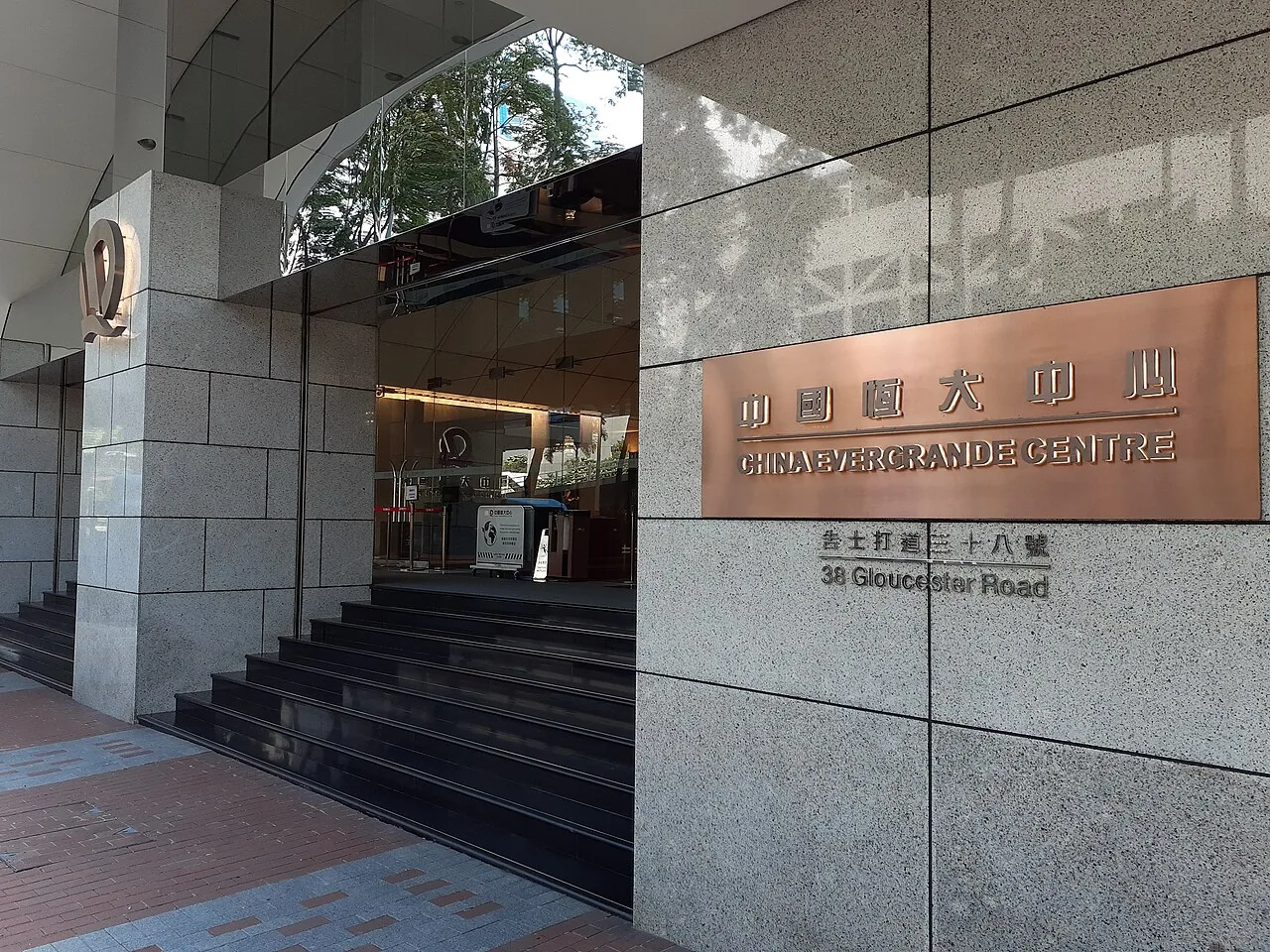
Figure 1: The entrance to the China Evergrande Centre in Wan Chai, Hong Kong. During its 14-year tenure as Evergrande's independent auditor, PwC collected massive fees while the developer's balance sheet spiraled.
I. The Ledger of a 14-Year Tenure: PwC’s Evergrande Revenue
The partnership between PwC (practicing as PwC Hong Kong and PwC Zhong Tian in the mainland) and China Evergrande began with the developer’s 2009 listing on the Hong Kong Stock Exchange. This symbiotic relationship lasted 14 years, ending only in January 2023 when Evergrande, already paralyzed by a liquidity crunch, announced the firm’s resignation.
Throughout these 14 years, PwC’s “unqualified” audit opinions served as the ultimate credit endorsement, allowing Evergrande to issue offshore bonds, secure domestic financing, and aggressively inflate its balance sheet.
1. The Scale of Cumulative Audit Compensation
A review of Evergrande’s audited annual reports reveals that the fees paid to PwC ballooned in lockstep with the developer’s asset expansion:
- The Initial Phase (2009–2012): With assets in the tens of billions, annual audit fees ranged from several million to ten million HKD.
- The Hyper-Expansion Phase (2013–2017): As Evergrande aggressively hoarded land in lower-tier cities, annual fees surged past the 20 million HKD mark.
- The Peak Fraud Period (2018–2020): During the years later identified by regulators as periods of systemic financial fabrication, Evergrande paid PwC approximately 45 million HKD and 54 million HKD annually.
- The 14-Year Total: Between 2009 and 2022, China Evergrande paid PwC a cumulative total of approximately 270 million to 300 million HKD (roughly 250 million to 280 million RMB) for audit and specialized consulting services.
2. Illegal Gains Identified by Regulators
The joint investigation by the China Securities Regulatory Commission (CSRC) and the Ministry of Finance (MOF) focused on the 2019 and 2020 annual reports—the most egregious instances of fraud:
- Investigations confirmed that Evergrande Real Estate inflated its revenue by over 560 billion RMB and profits by over 91 billion RMB during these two years.
- PwC Zhong Tian issued unqualified audit reports containing false statements. Consequently, regulators identified 54.74 million RMB as illegal business income (the MOF confiscated 27 million RMB, while the CSRC confiscated 27.74 million RMB).
This data highlights a grim reality: the tens of millions in fees PwC collected from these specific projects facilitated a systemic catastrophe that vaporized hundreds of billions in market value.
II. The Anatomy of a Regulatory Shock
The “top-tier” penalties imposed by the MOF and CSRC represent a watershed moment in the history of Chinese accounting regulation. They effectively dismantle the myth that “Big Four” firms are “too big to fail” or possess a “golden shield” against liability.
The deterrent effect operates across three dimensions:
1. Maximum Financial Penalties and Operational Paralysis
- Record-Breaking Fines: Total penalties reached 441 million RMB. The CSRC’s 325 million RMB fine alone equals the sum of all penalties levied against non-compliant intermediaries over the previous three years.
- Six-Month Operational “Shock”: The firm was ordered to suspend operations for six months. In the business cycle of an accounting firm, the second half of the year and the beginning of the next are critical windows for listed companies to select auditors and finalize contracts. This “execution freeze” effectively locks PwC out of the current market cycle.
- Revocation of Key Branches: The Guangzhou branch, which was deeply involved in the Evergrande audits, was formally revoked.
- Professional “Capital Punishment”: The four lead signing auditors for Evergrande’s 2018–2020 reports had their licenses revoked and were slapped with lifetime bans from the securities market.
2. The “Stampede” of Client Exodus
The secondary effects of the administrative penalty far outweigh the 441 million RMB fine. Because large domestic and international enterprises are hyper-sensitive to the compliance and risk ratings of their auditors, the penalty triggered a massive wave of contract terminations:
- The Departure of SOEs and Financial Giants: Dozens of heavyweight clients—including Bank of China, China Life, PICC, PetroChina, China Railway, and China Merchants Bank—announced they would replace PwC with EY, KPMG, or Deloitte within months.
- Revenue Collapse: Industry estimates suggest the loss of annual audit business exceeds several billion RMB, striking at the cash flow foundation that supports PwC’s massive partnership structure.
- Brain Drain: Lacking sufficient audit volume, core partners in the financial and real estate sectors have begun migrating with their teams to rival firms, causing the most significant loss of institutional vitality in the firm’s decades-long history in the mainland.
3. Civil Litigation and Astronomical Damage Risks
Beyond administrative fines lies the more lethal threat of cross-border judicial pursuit and joint civil liability:
- Hong Kong Liquidators’ Lawsuit: Evergrande’s court-appointed liquidators in Hong Kong have initiated legal proceedings against PwC and its global network, seeking damages exceeding 57 billion RMB (approx. 62 billion HKD) for professional negligence and assisting in the concealment of liabilities.
- Hong Kong Regulatory Pressure: The Accounting and Financial Reporting Council (AFRC) is conducting its own investigation, while the HK SFC is pushing for a substantial investor compensation scheme.
- The “Look-Through” Standard: This case establishes a precedent where “Big Four” firms no longer enjoy institutional protection if they issue misleading opinions. They are now held to a standard of joint liability for investor losses resulting from failed oversight.
III. The Accountability of Lending Institutions
The question is no longer if the financial institutions that funded Evergrande will be punished, but how deeply the accountability will penetrate.
Of Evergrande’s 2.4 trillion RMB debt, over half originated from commercial bank loans, trust channels, off-balance-sheet wealth management, and various credit facilities. Regulators and judicial authorities are now categorizing institutional accountability into three distinct tiers:
| Accountability Tier | Behavioral Characteristics | Enforcement & Legal Basis | Representative Cases |
|---|---|---|---|
| Tier 1: Criminal Complicity | Manipulation of financial entities, bribery of officials, illegal self-financing to siphon credit/insurance funds. | Charges of “Illegal Granting of Loans” and “Entity Bribery”; prison sentences; lifetime industry bans; institutional takeover. | Shengjing Bank’s 100bn RMB self-financing; Evergrande Life’s illegal investments; purge of senior credit officers. |
| Tier 2: Gross Negligence & Regulatory Breach | Superficial due diligence; failure of risk controls; misappropriation of escrow funds; illegal issuance of working capital loans. | NFRA administrative fines; confiscation of gains; removal of branch managers and senior executives. | Major joint-stock banks and trusts fined tens of millions for “imprudent credit management.” |
| Tier 3: Compliant Default | Proper documentation and collateral; loss caused by systemic developer default rather than misconduct. | No administrative or criminal penalties; commercial loss absorption. | Full impairment provisioning; Performance salary clawbacks (malus) for deal teams and management. |
1. Deep Involvement: Criminal Convictions and Takeovers
In the “deep water” zone of the Evergrande case, certain financial institutions ceased to be neutral intermediaries and were instead hollowed out into “corporate ATMs” for Evergrande:
- Criminal Reciprocity: Judicial charges against Evergrande executives now explicitly include “Illegal Granting of Loans” and “Entity Bribery.” In legal logic, these are “reciprocal crimes”—if Evergrande bribed to secure credit, there must be individuals within the financial system who knowingly signed off on fraudulent projects.
- The Dismantling of Shengjing Bank: Evergrande once held a controlling stake in Shengjing Bank, using it to siphon over 100 billion RMB through related-party transactions and off-balance-sheet trusts. Following the risk exposure, Shenyang state-owned assets took over, purged Evergrande’s equity, and initiated legal recovery of over 30 billion RMB.
- The End of Evergrande Life: Used as a channel to collect premiums and funnel liquidity into real estate, Evergrande Life has been absorbed by the state-established Haigang Life, with personnel involved in illegal investments referred to the judiciary.
2. Escrow Failures: The Administrative Crackdown
For institutions not involved in criminal conspiracy but guilty of severe negligence, the National Financial Regulatory Administration (NFRA) has issued a steady stream of penalties:
- Misappropriation of Escrow Funds: Several commercial bank branches were fined for allowing Evergrande to illegally withdraw funds from pre-sale escrow accounts, leading to stalled projects and “rotting” buildings.
- Concealing Non-Performing Loans (NPLs): Leading joint-stock banks and trust companies have been hit with massive fines for “illegal flow of credit into real estate” and using asset management plans to provide illicit off-balance-sheet financing.
3. The New Normal: Performance Clawbacks (Malus)
Even for loans that followed legal procedures but ultimately turned into bad debt due to Evergrande’s collapse:
- Commercial Loss Absorption: Institutions must provision for these losses, directly impacting net profits and, in some cases, leading to reported losses.
- The “Clawback” Mechanism: Per MOF and NFRA guidelines on financial compensation, banks and trusts have triggered performance salary clawback mechanisms. Even if a loan officer committed no crime, the sheer scale of the Evergrande NPLs has resulted in the forced return of past bonuses and the cancellation of deferred compensation.
IV. Conclusion: The End of the “License Premium”
The PwC-Evergrande saga and the subsequent “look-through” accountability of lenders mark a historical pivot in the governance of the Chinese capital market:
- The Death of Passive Auditing: The era where an accounting firm could collect massive fees while turning a blind eye to systemic fraud is over. “Gatekeepers” now face not just reputational risk, but institutional extinction and bankruptcy-level civil liability.
- The End of “Scale at All Costs”: The financial system’s impulse to inflate balance sheets through massive lending—assuming that responsibility evaporates once the officer leaves the post—has been checked. Lifetime accountability and salary clawbacks force a return to the first principles of credit.
- Truth as the Only Anchor: Whether in micro-level auditing or macro-level credit expansion, the prosperity built on fabricated revenue and inflated collateral is ultimately a bubble. Navigating the cycles of a balance sheet requires, above all, a fundamental reverence for real cash flow.
Related Research & Topics
Beyond the Territorial Refuge: Costa Rica’s 15% Foreign Income Tax and the Financial Trajectory of Nomadic Capital
The Anatomy of Digital Predation: Inside the Syndicate Targeting the Elderly via Livestream Appraisal Scams
Tello Mobile eSIM
SafetyWing Nomad Insurance
* Disclosure: This post contains affiliate links. If you make a purchase through these links, V-G Journal may earn a small commission at no additional cost to you. We only recommend services we independently evaluate and trust.
FIRE and Golf:自由旅居之路
专注于为追求 FIRE 与品质生活的人群提供特惠打球权益与候鸟微度假。不持一砖一瓦,运营品质生活。