The Marginal Cost of Virtue: Scarcity, Class Power, and the Anatomy of Morality
A deconstruction of the Chinese adage 'poverty breeds cunning, wealth fosters conscience.' Exploring cognitive bandwidth exhaustion, asymmetric compliance costs, and reputational capital, this essay analyzes how material scarcity bends human ethics—and how dominant classes institutionalize moral prejudice.

Core Thesis: The popular Chinese adage “Poverty breeds cunning, while wealth fosters a conscience” is not ancient scripture. Its most defining modern canonization emerged from the 1945 opera The White-Haired Girl, uttered by a predatory landlord’s bailiff while enforcing debt slavery. The maxim endures because it captures a grim behavioral reality: the stark divergence in the marginal cost of moral compliance between resource-starved and resource-saturated actors. Yet treating this survival mechanism as a moral hierarchy plays directly into an ideological trap—one that pathologizes desperation as innate malice while sanctifying the pocket-change benevolence of structural exploiters.
1. Philological Origins: From the Yan’an Stage to Pre-Qin Statecraft
In casual street parlance and vernacular storytelling, “Poverty breeds cunning, while wealth fosters a conscience” (qiong sheng jian ji, fu zhang liang xin) is frequently invoked as ancient folk wisdom. A rigorous archival review, however, reveals no record of this eight-character formulation across the classical Chinese canon or early educational anthologies like Zengguang Xianwen. Its definitive entry into the collective consciousness occurred through a pivotal work of twentieth-century political theater.
The Defining Scene: The 1945 Opera The White-Haired Girl
In April 1945, on the eve of the Seventh National Congress of the Chinese Communist Party, the Yan’an Lu Xun Arts Academy premiered The White-Haired Girl. On Lunar New Year’s Eve, Mu Renzhi, the bailiff of the despotic landlord Huang Shiren, storms the dilapidated cottage of the impoverished tenant farmer Yang Bailao to seize his daughter, Xi’er, as settlement for usurious debts. Pressing the contract, Mu delivers the chilling line:
“As the old saying goes: poverty breeds cunning, while wealth fosters a conscience…”

Figure 1: Archival production still from The White-Haired Girl. Bailiff Mu Renzhi coerces Yang Bailao into indenturing his daughter.
The dramatists named the bailiff Mu Renzhi as an intentional homophone for “lacking human wisdom” (mei ren zhi). Placing this folk aphorism in the mouth of a predatory enforcer laid bare the psychological defense mechanism of the extracting class: by framing the subaltern’s instinct for survival as treacherous cunning, the oppressor rationalizes coercion, absolves systemic violence, and claims moral supremacy.
Folk Mutation Versus Classical Statecraft
Linguistically, the phrase evolved from northern urban vernacular, often paired with sayings like “a starved horse grows long hair; a destitute man loses his ambition.” Yet the underlying inquiry—the interplay between material surplus and civic virtue—was analyzed systematically by pre-Qin philosophers over two millennia ago:
- Guan Zhong on Material Foundations: The Guanzi established the economic baseline for governance: “When the granaries are full, the people understand decorum; when food and clothing are sufficient, they know honor and shame.” Guan Zhong argued that sovereign authority must guarantee basic subsistence before demanding civic virtue and ritual observance.
- Sima Qian on Pragmatic Realism: In the Records of the Grand Historian (Shiji: Biographies of the Money-makers), Sima Qian observed: “Civic rites arise from abundance and perish in privation. When a gentleman is wealthy, he delights in practicing virtue; when a commoner is wealthy, he applies his labor in harmony. As deep waters breed fish and dense forests attract beasts, so virtue and righteousness adhere to the prosperous.” Ethics, to Sima Qian, were not floating ideals but social contracts anchored in material reserves.
- Mencius on the Cadence of Property: In Teng Wen Gong I, Mencius noted: “The way of the common people is this: those with secure livelihoods possess steadfast hearts; those without secure livelihoods lack steadfast hearts. Lacking steadfast hearts, there is nothing they will not do in terms of license, depravity, and excess.” Those stripped of structural security will inevitably violate legal and ethical boundaries when pushed to the edge.
The ancient philosophers engaged this dynamic at the level of macro-statecraft, warning rulers to build universal economic floors. Folk parlance, by contrast, flattened structural governance into an individualizing, stigmatizing indictment of the poor.
2. The Mechanics: Scarcity Psychology and the Cost of Virtue
Class rhetoric aside, the enduring resonance of the phrase stems from its alignment with the physical and behavioral boundaries of human psychology under duress.
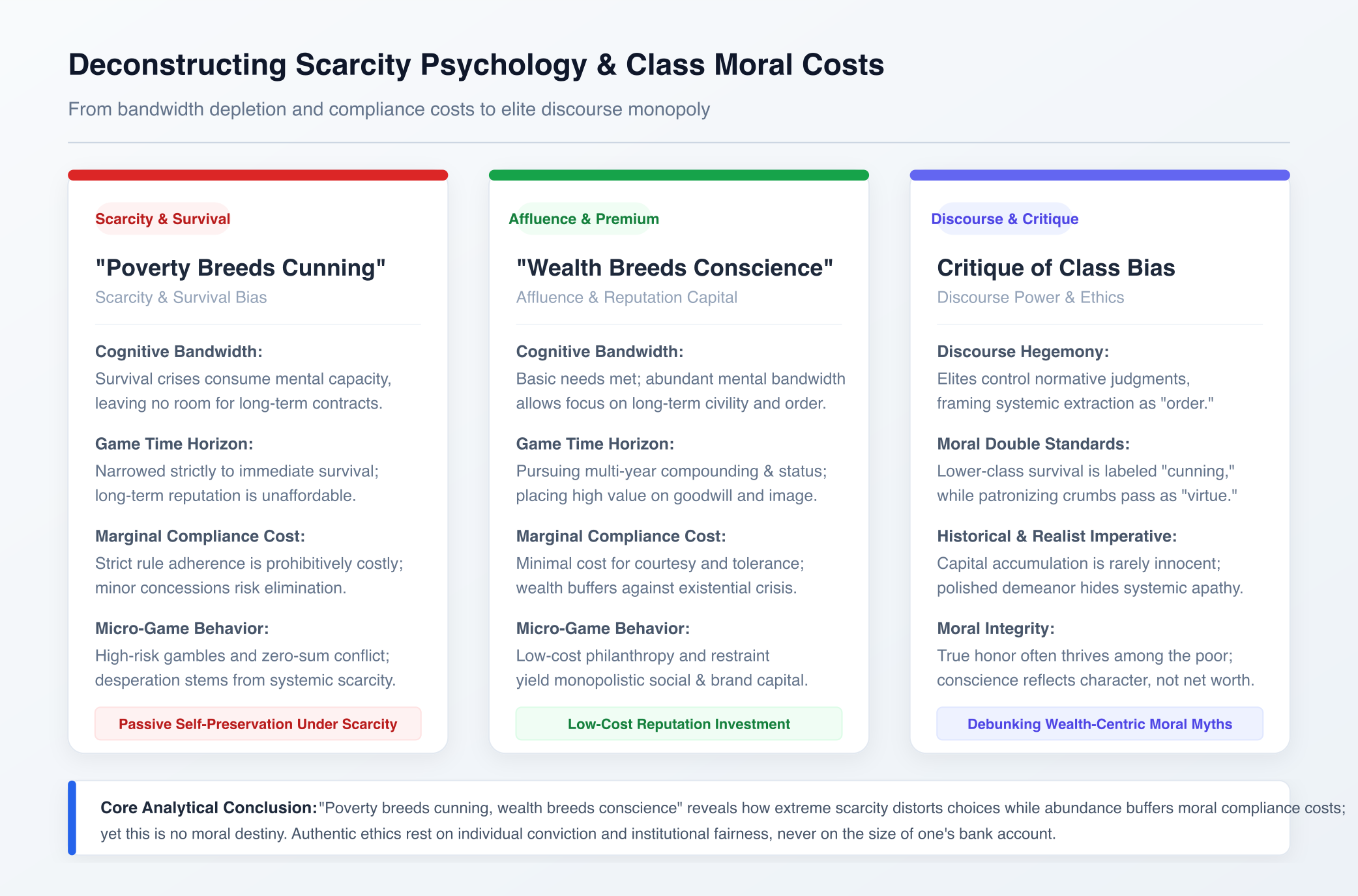
Figure 2: Analytical matrix mapping scarcity mechanics, moral compliance costs, and the asymmetric monopoly on ethical framing.
“Poverty Breeds Cunning”: Bandwidth Depletion and the Zero-Sum Trap
In Scarcity: Why Having Too Little Means So Much, behavioral economist Sendhil Mullainathan and cognitive psychologist Eldar Shafir outline the concept of cognitive bandwidth:
- Bandwidth Exhaustion and Tunneling: Under severe scarcity—looming debts, empty larders, physical peril—the human brain dedicates its computational capacity exclusively to short-term crises. This triggers severe “tunnel vision.” The individual’s focus contracts to the immediate hours ahead, leaving no psychic bandwidth for long-term payoffs, civic etiquette, or abstract contracts.
- Hyperbolic Discounting: At the brink of survival, the future value of personal reputation approaches zero. If adhering to standard rules means physical ruin, corner-cutting, default, and hyper-vigilant opportunism become the only mathematically viable survival strategies. When institutional safety nets are absent, acute deprivation systematically forces human behavior to mutate from iterative collaboration into zero-sum skirmishes.
“Wealth Fosters a Conscience”: Zero Marginal Cost and Reputational Arbitrage
In stark contrast to the crippling compliance costs borne by the dispossessed, the affluent enjoy a pronounced “surplus subsidy” on moral presentation:
- The Trivial Cost of Decorum: A person with capital reserves never has to barter over pennies, scuffle over scrap, or break the law for sustenance. Maintaining an even temper, observing civil decorum, and honoring commitments incurs virtually zero marginal cost. As the mother in Bong Joon-ho’s Parasite observed: “Money is an iron; it irons out all the creases.” What passes for the innate decency of the upper class is often just capital shielding them from circumstances that erode basic dignity.
- Ethics as a Yield-Generating Asset: Across modern commercial and social networks, a pristine reputation functions as liquid collateral. Honoring contracts, practicing philanthropy, and exhibiting civic leadership yield outsized returns: reduced transaction frictions, elite networking access, and regulatory insulation. Here, “conscience” ceases to be an act of altruistic sacrifice; it operates as high-yield, low-cost defensive capital.
3. Deconstruction: Discursive Monopoly and Class-Based Bias
A purely mechanical reading of cognitive bandwidth risks collapsing into a cynical Social Darwinism where net worth dictates character. The underlying power asymmetries behind ethical definitions must be examined.
Who Controls the Lexicon of “Cunning” and “Conscience”?
In hierarchical societies, the dominant class controls not merely the means of production, but the linguistic authority to define moral categories:
- Systemic Extraction Rebranded as “Order”: The creditor class relies on legal frameworks, credit mechanisms, and state-backed contracts to extract surplus value down to the margin. Their conduct remains “civilized
Related Research & Topics
Tello Mobile eSIM
SafetyWing Nomad Insurance
* Disclosure: This post contains affiliate links. If you make a purchase through these links, V-G Journal may earn a small commission at no additional cost to you. We only recommend services we independently evaluate and trust.
FIRE and Golf:自由旅居之路
专注于为追求 FIRE 与品质生活的人群提供特惠打球权益与候鸟微度假。不持一砖一瓦,运营品质生活。