Airborne Quantum Links vs. Space-Based Backbones: Deconstructing NASA’s Tactical QKD Test and the Micius Generational Divide
Viral narratives framing NASA's airborne quantum key distribution test as a leap past China's Micius satellite mistake tactical low-altitude links for intercontinental space infrastructure. Transmitting single photons through turbulent tropospheric boundary layers differs fundamentally from leveraging vacuum-dominated 500 km orbital channels.

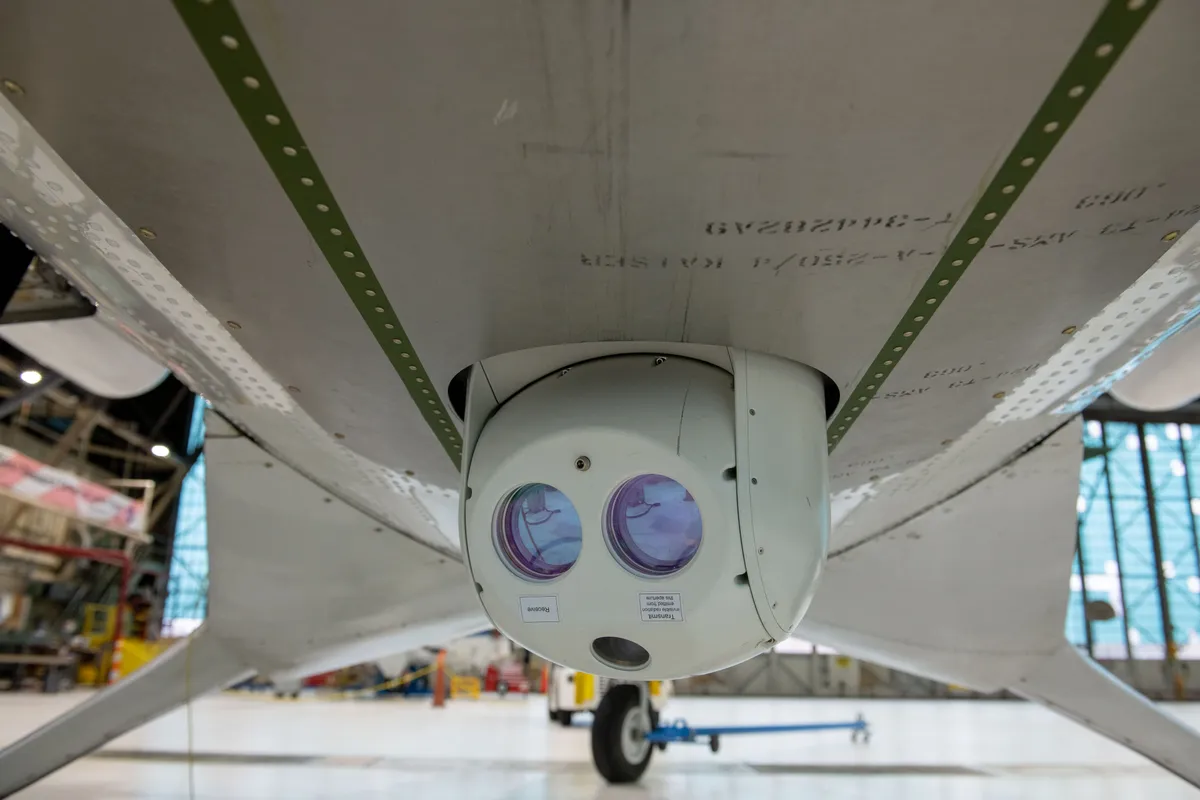
Figure 1: The electro-optical quantum communication pod mounted on the belly of NASA’s Twin Otter research aircraft (Photo: NASA / Jef Janis)
Recent viral headlines across social media declared that NASA had “made history by establishing the first US air-to-ground quantum link,” with commentary framing the milestone as an outright reversal of China’s lead in space-based quantum networks. A technical examination of the underlying project reveals a far more nuanced reality.
The test—conducted under NASA’s QTech initiative in partnership with the US Air Force Research Laboratory (AFRL)—was designed to solve a specific tactical problem: distributing anti-jamming encryption keys to low-altitude unmanned aircraft operating within contested electromagnetic environments. Mobile airborne quantum key distribution (QKD) has extensive international precedent. More fundamentally, comparing a short-range, tactical low-altitude link to a 500-kilometer orbital backbone represents a failure to distinguish between edge-level tactical nodes and space-based strategic infrastructure.
Piercing the Viral Narrative: Why a Tactical Anti-Jamming Test Was Rebranded as Strategic Supremacy
Online commentary surrounding the flight test relied heavily on a simplified narrative: America connects an aircraft via quantum light, shattering China’s space-quantum mythos. Shifting focus from press headlines to technical documentation from NASA’s Glenn, Ames, and Langley centers reveals the project’s actual scope.
The flight test was conducted under the Quantum Technology (QTech) project within NASA’s Transformative Aeronautics Concepts Program (TACP). Executed jointly by NASA Glenn, NASA Ames, the AFRL Information Directorate, and industry partner IJK Controls, the team mounted a high-precision dual-axis electro-optical tracking gimbal and single-photon detector pod onto the belly of a Twin Otter research aircraft.
The primary objective of QTech was not to compete for control of a wide-area space backbone, but rather to address vulnerabilities in congested civilian airspace and uncrewed aircraft system (UAS) networks. Modern airspace experiences severe radio-frequency (RF) congestion and intentional electronic warfare (EW) interference. The QTech team utilized free-space optical (FSO) links powered by QKD to negotiate mathematically unhackable symmetric keys between an airborne platform and a ground control station.
This mechanism—establishing intercept-proof communications under severe electronic countermeasures—mirrors the broader imperative among sovereign entities seeking mathematically absolute data defense, a structural dynamic analyzed in Snowden and the Panama Papers in the AI Era.
Furthermore, labeling airborne air-to-ground quantum links an unprecedented historical breakthrough overlooks prior physics milestones. In 2013, a joint team from Ludwig Maximilian University of Munich (LMU) and the German Aerospace Center (DLR) demonstrated single-photon polarization-encoded QKD from a Dornier 228 aircraft traveling at over 200 km/h across a 20-kilometer slant path. In 2017, the Institute for Quantum Computing (IQC) at the University of Waterloo, alongside Canada’s National Research Council, successfully flight-tested an airborne quantum receiver payload aboard a Twin Otter. NASA’s flight test represents a vital engineering integration milestone for US defense and civil aviation, but it is an incremental advancement in tactical optics rather than a foundational physics breakthrough.

Figure 2: Architectural and physical channel comparison between tactical low-altitude mobile links and space-ground quantum backbones.
The Physics of Channels: Tropospheric Turbulence vs. Space Vacuum
Equating a low-altitude aircraft’s quantum link to China’s Micius satellite (launched in 2016) conflates two fundamentally different physical channels. While both involve beaming light between the sky and the ground, the optical propagation media and channel loss profiles belong to separate operational regimes.
Aircraft cruise in the lower troposphere. When a laser beam travels horizontal or slant distances of dozens of kilometers between an aircraft pod and a ground station, the photons pass entirely through the thickest, most turbulent boundary layer of Earth’s atmosphere. This layer contains high concentrations of atmospheric aerosols, dust, severe thermal gradients, and wind shear. Rapid temperature fluctuations cause stochastic variations in the air’s refractive index, driving severe beam wandering, wavefront distortion, and optical scintillation. The resulting photon loss over an all-atmospheric path increases exponentially, which explains why horizontal un-amplified free-space optical links rarely exceed 100 kilometers on Earth.
By contrast, the Micius satellite operates in a Sun-synchronous Low Earth Orbit (LEO) at an altitude of approximately 500 kilometers. Atmospheric density decreases exponentially with altitude; Earth’s effective atmospheric scale height is only about 8 to 10 kilometers. When Micius emits single photons or entangled photon pairs toward a ground receiver, the light travels roughly 98% of its 1,000+ kilometer path through the ultra-high vacuum of space, devoid of gaseous molecules or atmospheric scattering. The photons encounter dense atmospheric resistance only during the final 10 kilometers of descent.
| Dimension | Tactical Airborne Link (e.g., NASA QTech) | Space-Ground Strategic Backbone (e.g., Micius) |
|---|---|---|
| Operational Altitude | Low-altitude Troposphere (~1–3 km) | Low Earth Orbit (~500 km) |
| Channel Physics | 100% Dense, Turbulent Boundary Layer | ~98% Ultra-High Vacuum, ~2% Thin Atmosphere |
| Primary Attenuation Mechanism | Aerosol Scattering, Thermal Scintillation, Beam Wandering | Free-space Diffraction, Pointing Loss |
| Relative Target Dynamics | Slow Angular Velocity, Engine Vibration Noise | Extreme Velocity (7.6 km/s), Rapid Angular Tracking |
| Pointing & Tracking Precision | ~10–50 microradians (Stabilized Gimbal / FSM) | Sub-microradian (~0.5 microradians) |
| Strategic Function | Tactical Anti-Jamming Edge Node | Intercontinental Sovereign Backbone Network |
From a channel attenuation perspective, a low-orbit satellite’s “equivalent atmospheric thickness” is comparable to vertical penetration through a thin ten-kilometer shell. Its photon transmittance and signal-to-noise ratio are orders of magnitude superior to an airborne link trying to punch through dozens of kilometers of murky lower atmosphere. Airborne QKD operates in a high-loss medium for short-range tactical security; space-ground QKD leverages the vacuum of space to bypass atmospheric loss entirely for long-range strategic reach.
The Limits of Dynamic Tracking: Sub-Microradian Pointing at 7.6 km/s
Space-to-ground quantum communications trade atmospheric attenuation for extreme optical and mechanical tracking challenges, governed by the Acquisition, Tracking, and Pointing (ATP) system.
In low-altitude aircraft tests, platforms fly at speeds of a few hundred kilometers per hour. Relative angular velocities between the aircraft and ground receivers remain low. The primary engineering challenge is suppressing high-frequency mechanical vibrations caused by turboprop engines and aerodynamic buffeting, which can be compensated for using internal gyro-stabilized platforms and Fast-Steering Mirrors (FSMs).
A LEO satellite at an altitude of 500 kilometers travels at approximately 7.6 kilometers per second (over 27,000 km/h). As the satellite passes overhead, the viable communication window lasts only a few minutes, during which azimuth and elevation angles change rapidly. To maintain single-photon link closure across distances of over 1,000 kilometers, Micius must maintain an optical pointing precision of roughly 0.5 microradians. This is equivalent to tracking a single human hair from kilometers away while mounted on a high-speed bullet train.
Using this ultra-precise dynamic tracking platform, the Chinese team achieved high-speed satellite-to-ground QKD over 1,200 kilometers in 2016, yielding secret key rates orders of magnitude higher than equivalent fiber-optic links. The team subsequently performed space-to-ground entanglement distribution between Delingha and Lijiang (separated by 1,203 kilometers) to test Bell’s inequality under strict locality conditions. By 2017, using ground relays, Micius enabled intercontinental quantum-secured communications across a 7,600-kilometer baseline between Beijing and Vienna. This scale of physical validation operates in a different domain than local tactical key exchange.
Figure 3: Schematic representation of space-to-ground intercontinental quantum communication topology.
Integrated Topologies: Strategic Space Backbones and Tactical Edge Nodes
Mobile quantum communication research on airborne and floating platforms served as an early development step for China’s quantum program. Between 2013 and 2014, prior to launching Micius, Chinese researchers conducted extensive air-to-ground QKD trials using high-altitude balloons and Y-12 aircraft over Qinghai Lake. These early trials collected critical empirical data on atmospheric turbulence and system dynamics to refine the ATP servo algorithms later deployed in orbit.
Following the operational validation of Micius, China’s spatial quantum roadmap shifted toward scalable, low-cost micro-nano satellite constellations. In July 2022, the 100-kilogram Jinan-1 micro-nano quantum key distribution satellite was launched into orbit. Jinan-1 significantly reduced payload mass and volume while increasing key generation rates relative to Micius, while proving ground-to-satellite QKD feasibility under daytime solar noise conditions.
In a fully realized global space-ground communications architecture, satellite constellations serve as the strategic backbone, spanning continents and oceans. This aligns directly with the multi-layered network models detailed in Reconstructing the 5G Commercial Narrative: From Industrial IoT Bubbles to Satellite Communications and 6G Evolution. Drones and tactical aircraft act as mobile edge nodes within this structure, securing localized data links over battlefields or contested maritime regions.
NASA’s airborne QKD test represents a solid engineering step forward in securing tactical aircraft against electronic warfare, reflecting advanced optomechanical payload integration. However, framing a low-altitude tactical test as an operational leap past space-based quantum backbones conflates edge-level connectivity with core orbital infrastructure.
Related Research & Topics
Tello Mobile eSIM
SafetyWing Nomad Insurance
* Disclosure: This post contains affiliate links. If you make a purchase through these links, V-G Journal may earn a small commission at no additional cost to you. We only recommend services we independently evaluate and trust.
FIRE and Golf:自由旅居之路
专注于为追求 FIRE 与品质生活的人群提供特惠打球权益与候鸟微度假。不持一砖一瓦,运营品质生活。