The $170G Compute Squeeze: Why Microsoft’s 60,000-Person Buyout Isn't About Loafing
Microsoft's voluntary exit program for 60,000 employees, paired with viral videos of remote tech perks, triggered a global debate. Beneath the moral panic over corporate loafing lies a hard economic reality: hyperscalers are systematically defunding human overhead to finance $170 billion in annual AI compute.

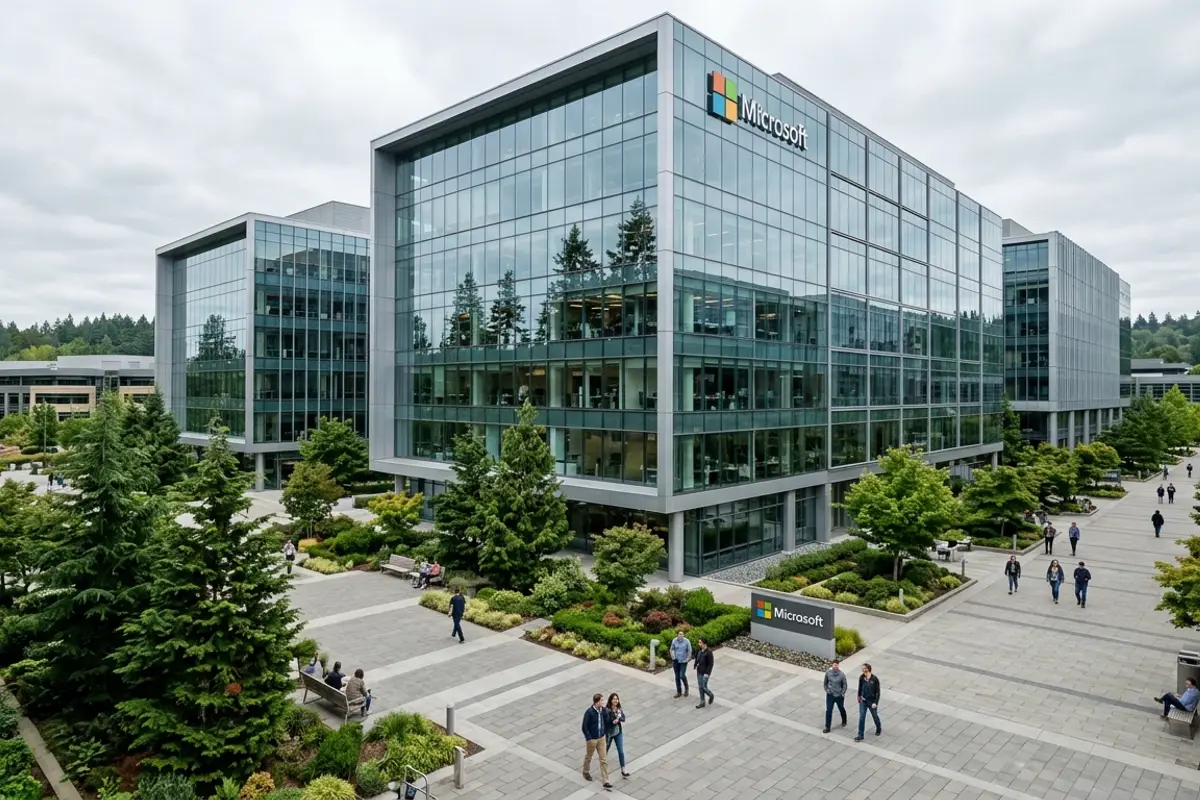
Figure 1: The austere modern corporate facade of Microsoft’s Redmond campus. Amidst a wave of computational capital restructuring, tech giants are undergoing deep organizational and cost governance transformations.
In late October 2026, Microsoft Chief People Officer Amy Coleman announced an internal Voluntary Exit Offer (VEO) targeting select teams across the US, Canada, UK, and India, affecting roughly 60,000 employees up to the Level 70 Vice President tier. Almost simultaneously, a viral vlog shot by an Indian-origin employee at an overseas branch—showcasing gym workouts, lavish complimentary buffets, and a casual three-to-four-hour workday—ignited a massive online controversy. Observers universally pinned the blame on corporate perk inflation and slacking off.
Yet, looking past the viral outrage to examine Microsoft’s balance sheet—where quarterly revenues hit $452 billion in annualized operating metrics and a staggering $170 billion is earmarked for annual AI capital expenditure (CapEx)—reveals a different reality. This crisis is not a moral crackdown on idleness. It is a rigid, capital-driven squeeze on operating expenses (OPEX) executed by a multinational giant desperate to fund its relentless GPU compute clusters.
The Short-Form Video Trap: Misreading Structural Shifts as Slacking
Underneath a trending discussion board thread with over 1.86 million interactions, public commentary devolved into a collective indictment of Big Tech workplace culture. The catalyst was a short-form video recorded by an employee at Microsoft’s Hyderabad campus: arriving lazily at 9:00 AM for a gym shower, enjoying a gourmet complimentary breakfast at 10:00, followed by fresh smoothies, snack breaks, and ping-pong socialization. Spectators estimated the actual time spent writing code or handling business at a mere three to four hours before clocking out at 4:20 PM.
Faced with subsequent news of a buyout program potentially touching over 26% of the global workforce, the public quickly forged a simplistic, moralistic causal link: “They spend all day eating and loafing around, no wonder the company is laying people off.”
This narrative neatly catered to the psychological frustrations of professionals trapped in hyper-competitive work environments, but it commits severe analytical errors, blinded by short-form video filters. First, content creators naturally optimize for selective editing showcasing leisure and privilege; few document the late-night firefighting, the failed code deployments, or the grueling cross-timezone alignments hidden within seconds of spliced footage. Second, reducing a multinational enterprise’s trillion-dollar resource reallocation to an attendance check completely ignores the brutal financial scrutiny Wall Street has imposed on tech business models over the past two years.
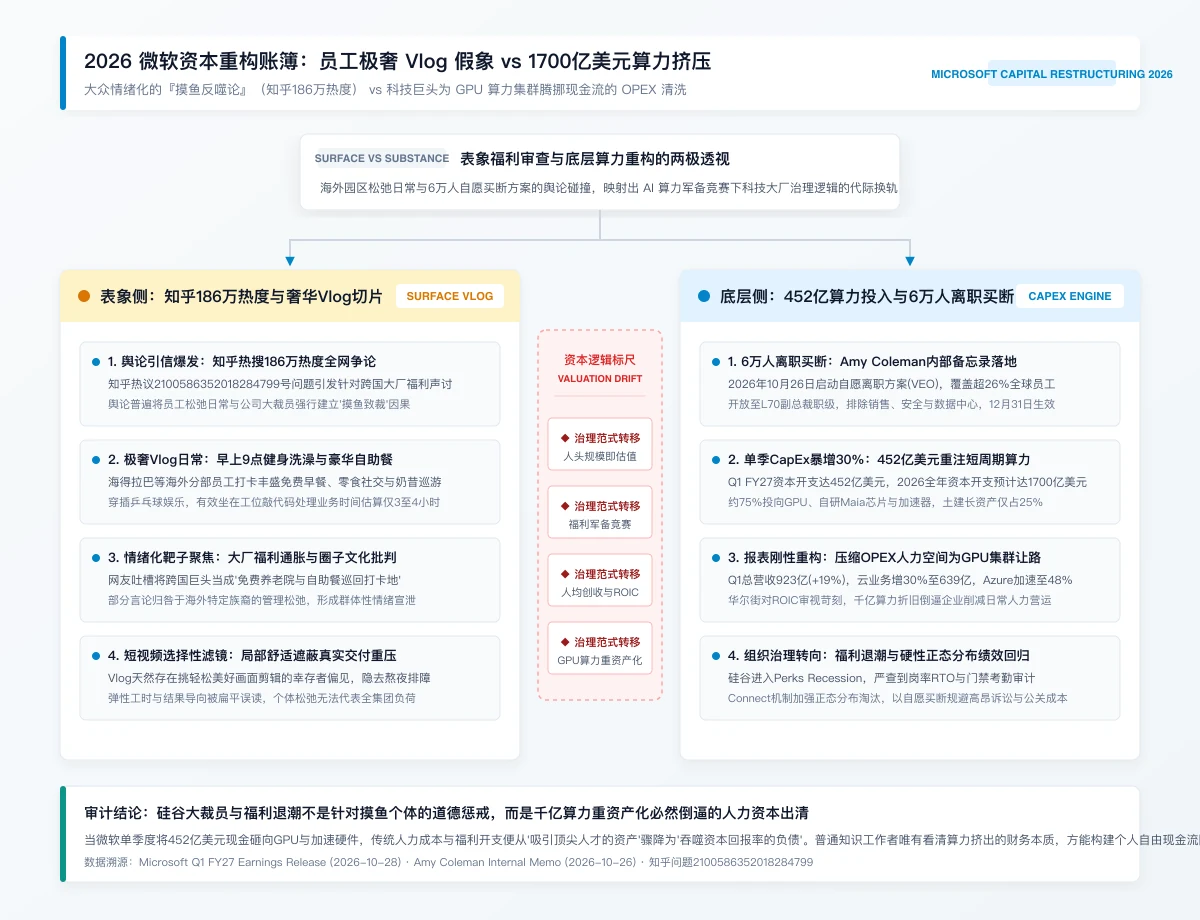
Figure 2: The 2026 Microsoft Capital Restructuring Ledger: The illusion of luxury vlogs vs. the $170B compute squeeze. Tech giants are systematically surrendering operating capital to short-lifecycle GPU compute clusters.
The $452 Billion Compute Devouring: From “Headcount Premiums” to “Asset Swaps”
To understand Microsoft’s moves—and those of the wider Silicon Valley ecosystem—one must examine the financial statements released on October 28, 2026, for Q1 FY27.
Microsoft posted total revenue of $92.3 billion (a 19% year-over-year increase), with Microsoft Cloud revenue surpassing $63.9 billion (up 30%), and Azure and other cloud services surging 48%. Quarterly free cash flow remained a robust $18.6 billion. This is categorically not a failing enterprise on the brink of collapse, desperately slashing headcount to survive.
The true epicentre of the shift lies within the capital expenditure line items:
- CapEx Surges 30% QoQ: Q1 capital expenditures spiked to $452 billion (compared to $34.9 billion in the same period last year), with calendar-year 2026 total CapEx projected to hit $170 billion.
- Ultra-Short Asset Lifecycles: Of that $452 billion outlay, roughly 75% flowed directly into short-lifecycle assets—Nvidia accelerator cards, Microsoft’s custom Maia silicon, high-bandwidth memory networking, and high-density storage servers. Long-lifecycle real estate, data center construction, and land acquisition accounted for the remaining 25%.
As observed during our analysis of Amazon’s $220 Billion AI CapEx Gamble, tech giants are undergoing an aggressive metamorphosis from asset-light software firms to capital-heavy, silicon-bound conglomerates. Every cluster of tens of thousands of GPUs consumes profits from the second it is powered on, operating under a brutal 3-to-5-year depreciation cycle. Coupled with the unforgiving economic realities of Large Language Model inference and computational cost ledgers, as infrastructure depreciation and power bills swell exponentially, the breathing room for Operating Expenses (OPEX) in corporate ledgers contracts sharply.
In the era of zero interest rates, Silicon Valley worshipped the gospel of “headcount expansion as valuation.” Tech giants built moats by over-hiring engineering talent and stacking lavish perks. In the era of front-loaded, hundred-billion-dollar compute builds, Wall Street’s valuation metric has flipped entirely toward “revenue per employee” and Return on Invested Capital (ROIC). Every dollar spent on non-core labor and lifestyle perks is now viewed as an unauthorized diversion of funds from the GPU pool.
| Core Audit Dimension | Social Media Narrative (Public Perception) | Financial Disclosures & Official Realities |
|---|---|---|
| Event Catalyst | Overseas branch luxury employee vlogs go viral (1.86M views) | Internal memo issued by Chief People Officer Amy Coleman (Oct 26, 2026) |
| Adjustment Mechanism | Rumored “angry purge” targeting slackers | Voluntary Exit Offer (VEO), extended up to Level 70 Vice President tier |
| Scope of Impact | Emotionally framed as a “total workforce purge” | Affects approx. 60,000 workers across US, CA, UK, IN (over 26% of global headcount) |
| Capital Drivers | Punishing perk inflation and corporate bloat | Q1 CapEx hits $452B (+30%), full-year projected at $170B |
| Hardware Allocation | Ignoring underlying infrastructural shifts | 75% of capital directed to short-lifecycle GPUs/accelerators; long-term civil works at 25% |
| Exemptions | Assumed to be a blanket, indiscriminate cut | Explicitly excludes Sales, Marketing, Cybersecurity, and Core Data Center Engineering |
Perks Recession and Governance Isolation: Who Swims, Who Sinks
This capital restructuring manifests organizationally as ruthless “governance isolation.”
Amy Coleman’s all-hands memo outlined clear boundaries for the buyouts: while the VEO program extended unprecedentedly to Level 70 executives (including General Managers and VPs), it explicitly walled off Sales, Marketing, Cybersecurity, and Core Data Center Engineering teams.
This targeted exemption list exposes management’s true calculus:
- Core Revenue and Compute Lifelines Protected: Sales teams capable of moving Azure enterprise contracts, security teams preserving enterprise compliance, and data center engineers keeping clusters running 24/7 are insulated from the cuts. In fact, they are receiving higher resource allocations.
- Edge Support and Legacy Software Squeezed: Traditional maintenance, middle-office coordination, and non-core cross-regional support teams—sustained for years by the inertia of legacy products—are seeing their marginal value plummet under the twin pressures of internal AI coding assistants and cost-reduction mandates.
This dynamic marks a systemic retreat from “Perks Inflation” back to a “Perks Recession” across Silicon Valley. Free laundry, physical therapy massages, endless gourmet dessert bars, and hyper-flexible remote arrangements are being systematically replaced by strict badge-swipe audits, mandatory Return-to-Office (RTO) quotas, and ruthless forced-distribution performance curves (Connect evaluations).
Rather than weathering protracted litigation and PR friction from forced layoffs, enterprises are using voluntary buyouts to offer a dignified financial exit to non-core operations and mid-tier managers, redirecting long-term payroll liabilities into cash for silicon compute.
The Knowledge Worker’s Defense Line: From Corporate Vassal to Independent Cash Flow
Microsoft’s capital restructuring serves as a cold business lesson for every knowledge worker: in the path of the CapEx bulldozer, any illusion of “workplace slack” wrapped in corporate perks is a fragile illusion.
In an era where tech valuations depended on headcount scale, employees served as corporate window dressing. In an era where valuations depend on compute efficiency, redundant human labor transforms from an asset into a balance-sheet liability. Facing this generational asset swap, professionals must establish deep personal defenses:
- Beware the Psychological Numbing of Perks: Free catering and cozy campuses are never gifts; they are designed to lock high-margin talent into an all-encompassing corporate loop using minimal sunk costs.
- Decouple Personal Balance Sheets from Corporate Branding: As emphasized in our breakdown of Workplace Depreciation and Career Exit Mechanics, workers must continuously audit their own skill depreciation curves rather than mistaking a tech giant’s platform halo for true personal pricing power.
- Build Multi-Track Cash Flows and Liquidity Buffers: In an era where corporations divert capital toward silicon infrastructure, the sole antidote for individuals is to untether income structures from absolute reliance on single-employer labor hours—accumulating hard-asset safety nets before systemic purges arrive.
The Silicon Valley perk myth has ended. In its place stands a cold calculation of output per capita and capital efficiency. Seeing through the restructuring logic behind the compute ledger is every modern knowledge worker’s first line of defense.
Related Research & Topics
The Anatomy of Digital Predation: Inside the Syndicate Targeting the Elderly via Livestream Appraisal Scams
Starlink V4 and the Low-Earth Orbit Satellite Arms Race: How a 100,000-Node Optical Mesh Pierces the Submarine Cable Monopoly
Tello Mobile eSIM
SafetyWing Nomad Insurance
* Disclosure: This post contains affiliate links. If you make a purchase through these links, V-G Journal may earn a small commission at no additional cost to you. We only recommend services we independently evaluate and trust.
FIRE and Golf:自由旅居之路
专注于为追求 FIRE 与品质生活的人群提供特惠打球权益与候鸟微度假。不持一砖一瓦,运营品质生活。