The LIV Golf Collapse: Saudi Withdrawal and the $5 Billion Liquidation
Following the cessation of over $5 billion in funding from the Saudi Public Investment Fund (PIF), LIV Golf filed for Chapter 11 bankruptcy in September 2026. This analysis examines the systemic failure of the league’s 'gold-rush' business model and the ensuing legal fallout as star athletes scramble to recover unpaid contracts.

Executive Summary: On September 8, 2026, LIV Golf, crippled by mounting debt, filed for Chapter 11 bankruptcy in a New Jersey court, reporting liabilities between $500 million and $1 billion. This marks the ignominious end of a four-year, $5 billion experiment funded by the Saudi Public Investment Fund (PIF). By October 2026, marquee stars like Dustin Johnson, once recipients of astronomical signing bonuses, had retained legal counsel to claw back over $100 million in unpaid guaranteed contracts—only to be met with a restructuring offer of two cents on the dollar. The most aggressive disruptor in modern golf history did not achieve the anticipated “merger of the century”; it simply ran out of blood, revealing a fatal inability to generate its own.

Figure 1: Dustin Johnson at the LIV Boston event. Four years later, he leads a group of stars seeking over $100 million in unpaid contractual obligations.
I. From Infinite Checks to Bankruptcy Court: The Failure of the “Closed Loop”
The last four years have been the most profligate in the history of professional golf. Since its 2022 inception, LIV Golf relied on the bottomless coffers of the Saudi PIF to forcibly fracture the sport’s century-old ecosystem. With $200 million for Phil Mickelson, $125 million for Dustin Johnson, and over $300 million for Jon Rahm—coupled with $25 million purses, no-cut formats, and guaranteed payouts—the league attempted to bulldoze the PGA Tour’s established barriers to entry.
However, the prosperity of this artificial construct lasted only as long as the Saudi checks cleared. When the sovereign capital gates closed in 2026, the underlying financial reality was exposed:
- The Vacuum of Viewership and Sponsorship: LIV failed to secure a foothold on major broadcast networks (CBS, NBC, Sky Sports), languishing on the CW network with Sunday final-round ratings often hovering between 0.1% and 0.2%—frequently outperformed by reruns of secondary PGA Tour events. Global blue-chip brands (Rolex, FedEx, BMW) shunned the league due to reputational risk.
- The Franchise Bubble: Greg Norman’s vision of “F1-style franchise valuations” proved to be a mirage. Without a loyal, organic audience, there was zero appetite from global capital markets to acquire these “artificial teams,” leaving their touted multi-billion dollar valuations effectively at zero.
- The $5 Billion Black Hole: Lacking significant broadcast rights or commercial sponsorship, the league’s operations—logistics, venue rentals, and player guarantees—were entirely dependent on PIF subsidies. With annual net losses in the hundreds of millions, the model was never sustainable.
The core of professional sports economics is a virtuous cycle: Audience Attention × Broadcast Premium × Brand Endorsement. As we have observed in the commercial deconstruction of tennis and golf, long-term credibility must be rooted in the unpredictability of competition and the weight of legacy. When prize money is guaranteed regardless of performance, the tension of the sport evaporates, leaving behind little more than a high-priced, sparsely watched vacation for golfers.
II. The Saudi Pivot: From “Buying Legitimacy” to Fiscal Retrenchment
The death knell for LIV Golf was not the PGA Tour’s resistance, but the restructuring of the PIF’s own balance sheet.
In April 2026, the PIF confirmed it would cease all direct funding to LIV Golf following the 2026 season. This decision reflects a profound shift in Saudi Arabia’s post-oil transition strategy:
| Strategic Dimension | 2022–2024: The “Gold Rush” | 2026: Sovereign Retrenchment |
|---|---|---|
| Macro Fiscal State | High oil prices provided surplus; need for global visibility | Oil price normalization; domestic project funding gaps |
| Capital Priorities | Overseas sports “trophy hunting” | Domestic focus: NEOM, Expo 2030, 2034 World Cup |
| Political Utility | Breaking the Western sports monopoly | Diminishing returns; antitrust hurdles persist |
| Management | Full autonomy for Greg Norman | Management purge; divestment of operational risk |
For Saudi Arabia, the strategic goal of 2022—establishing a presence on the international stage and forcing the PGA Tour to the negotiating table—was largely achieved by June 2023. By 2026, with the massive capital requirements of the 2034 World Cup infrastructure and the Riyadh Expo, continuing to subsidize a loss-making golf tour became a liability that the PIF’s risk committee could no longer justify.
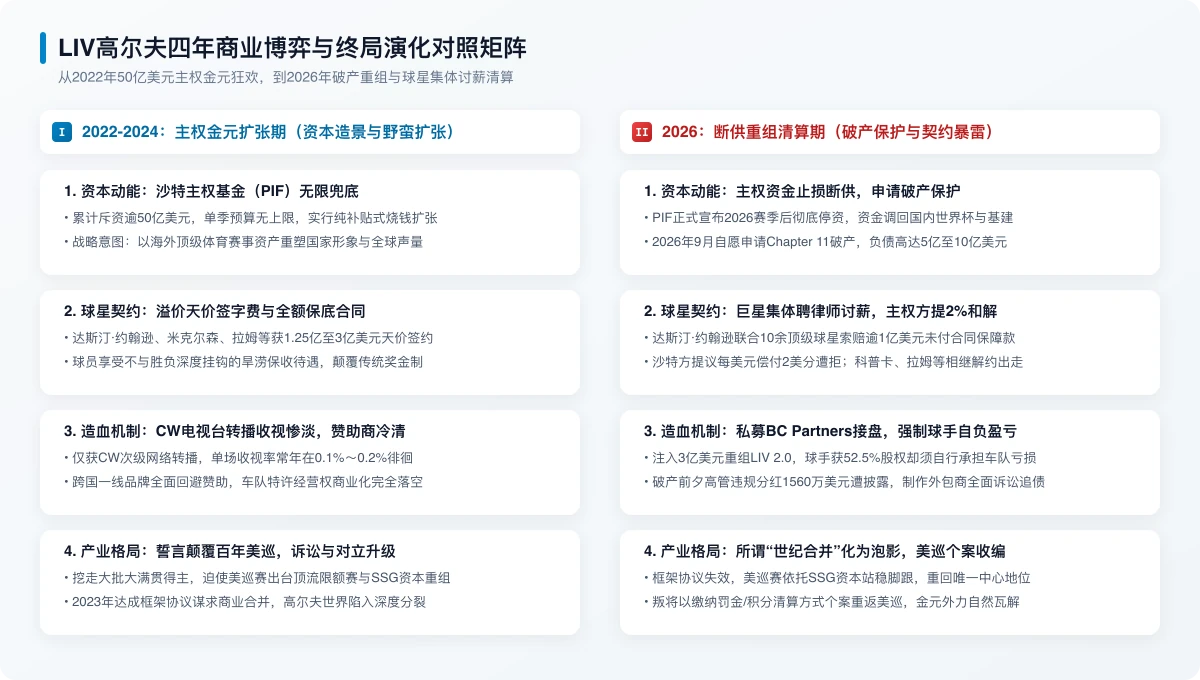
Figure 2: The commercial evolution and eventual collapse of the LIV Golf model.
III. The Courtroom Spectacle: Executive Bonuses and Star-Studded Litigation
The cessation of capital triggered a domino effect. On September 8, 2026, the filing of Chapter 11 documents revealed a governance structure defined by dysfunction:
1. The “Retention Bonus” Scandal
Court filings revealed that months before the collapse, the board approved $15.6 million in “retention bonuses” for executives, with CEO Scott O’Neil receiving $6.375 million. Meanwhile, the league defaulted on payments to the production crews and technical vendors who kept the broadcasts running, triggering a wave of lawsuits from small-business creditors.
2. The Stars as Unsecured Creditors
The most ironic turn involved the players themselves. The stars who defected to escape the “exploitative” PGA Tour found themselves at the bottom of the bankruptcy hierarchy as “unsecured creditors.” Dustin Johnson, Jon Rahm, and Bryson DeChambeau are among those owed tens of millions. In October 2026, they retained high-profile sports attorney David Cornwell to sue the PIF, only to be offered a settlement of two cents on the dollar.
3. The Private Equity “Rescue”
A $300 million rescue plan by BC Partners Credit proposed a “LIV 2.0,” but the terms were draconian: players would hold 52.5% of the equity but would be forced to cover all operational costs—travel, logistics, and team expenses—that were previously subsidized by the Saudis. Most stars, accustomed to risk-free, guaranteed income, rejected the proposal, with many seeking to return to the traditional tour.
IV. The Collapse of an Artificial Myth
LIV Golf serves as a high-cost lesson in sports history: Money can buy a professional’s time, but it cannot buy cultural resonance or audience loyalty.
The Fragility Triangle of Artificial Sports
- Alienated Contracts: Mercenary models lack loyalty; funding cuts trigger immediate collapse.
- Zero Competitive Tension: No-cut formats kill suspense, preventing emotional investment.
- Commercial Paralysis: Low viewership fails to attract brands, leaving the league tethered to a single source of capital.
The PGA and DP World Tours are not merely schedules; they are ecosystems—amateur pipelines, developmental tours, global sponsorships, and club cultures. Even in its most conservative moments, the PGA Tour offers the raw, visceral drama of players fighting to keep their tour cards. LIV Golf, by contrast, was a “sportswashing” performance piece that failed to answer the most basic question: Why should a fan care about a 54-hole exhibition where the outcome has no consequence?
As the tide of Saudi capital recedes, golf returns to its original gravitational laws. There was no “merger of the century,” only the dry, legalistic reality of bankruptcy court and the quiet re-absorption of players back into the established order. The disruption is over; the sport remains.
Related Research & Topics
Tello Mobile eSIM
SafetyWing Nomad Insurance
* Disclosure: This post contains affiliate links. If you make a purchase through these links, V-G Journal may earn a small commission at no additional cost to you. We only recommend services we independently evaluate and trust.
FIRE and Golf:自由旅居之路
专注于为追求 FIRE 与品质生活的人群提供特惠打球权益与候鸟微度假。不持一砖一瓦,运营品质生活。