Deconstructing IBKR Lite vs. Pro: Optimizing Transaction Costs for the Global Investor
Many global investors are swayed by the superficial allure of 'commission-free' trading. This essay dissects the underlying order routing mechanisms of Interactive Brokers' IBKR Lite and Pro accounts, exposing the true cost of PFOF spread erosion. It then outlines practical strategies—tiered pricing, order consolidation, and interest arbitrage—for astute investors to systematically minimize their trading and holding costs.

Curator’s Note: In the pursuit of global asset allocation and long-term investing, transaction fees and friction costs often fall prey to dichotomous misconceptions. One class of investors remains utterly desensitized to commissions, their returns silently eroded by minimum commission thresholds on frequent, fractional trades. Another develops an almost dogmatic fixation on “zero commissions,” blindly flocking to fee-free platforms, yet overlooking the heavier tax levied by dark pool market makers through bid-ask spreads.
Interactive Brokers (IBKR), a leading comprehensive broker with the broadest product line and strongest clearing capabilities globally, offers a dual-track account system: Lite and Pro. This has long been a subject of extensive discussion. Many only notice the prominent “commission-free US stocks” advertised on Lite’s promotional pages, yet overlook a fundamental structural arrangement: non-U.S. tax residents (including individual investors opening accounts from mainland China, Hong Kong, Singapore, and other overseas jurisdictions) are, by regulatory default, exclusively matched with an IBKR Pro account.
Crucially, there’s no free lunch on Wall Street. Lite’s “commission-free” model monetizes by selling order flow (PFOF) to market makers, while Pro’s paid routing ensures optimal execution through transparent competitive bidding. For the vast majority of cross-border investors, who are destined to use a Pro account, the core question is not “how to access Lite,” but rather “how to leverage tiered pricing, order consolidation, and idle interest arbitrage to compress Pro account friction costs to their mathematical minimum.”
I. Regulatory Boundaries & Dual-Track Comparison: Why Non-U.S. Residents Need Not Dwell on Lite
Before delving into specific fee details, it’s imperative to first clarify the access boundaries and underlying business logic of both account types.
1. Legal Redlines for Investor Access
IBKR Lite is a retail product specifically designed for U.S. tax residents (those with a U.S. Social Security Number, meeting domestic taxpayer criteria). Its purpose is to directly counter the commission-free price wars waged by domestic competitors like Robinhood and Charles Schwab.
All non-U.S. residents opening accounts outside the U.S. (including clients from mainland China, Hong Kong, Singapore, Europe, and other overseas entities) are, upon submitting their W-8BEN tax form, automatically and exclusively matched with an IBKR Pro account. This means:
- Overseas investors cannot actively apply for or switch to IBKR Lite.
- Any attempt to open a Lite account by fabricating proof of U.S. residency will directly trigger tax compliance audits and account freezing.
- Non-U.S. investors need not expend effort seeking a Lite pathway; focusing on the meticulous management of a Pro account is the only viable strategy.
2. A Panoramic Comparison of Lite vs. Pro
The superficial difference between the two lies in the presence or absence of explicit commissions. However, they diverge fundamentally in order routing, capital interest, and derivatives support:
| Assessment Dimension | IBKR Lite (Retail Commission-Free) | IBKR Pro (Professional/Institutional) |
|---|---|---|
| Target Clientele | Exclusively U.S. Tax Residents (requires SSN) | Open to Global Investors (sole legal channel for non-U.S. residents) |
| US Stocks / ETFs | $0 commission (on designated US-listed stocks) | Fixed: approx. $0.005/share; Tiered: as low as $0.0005/share |
| Order Routing Mechanism | PFOF (Payment for Order Flow), routed to market makers | IB SmartRouting, direct connection to major exchanges |
| Dark Pools & Spread Slippage | Orders internalized by market makers, incurring implicit bid-ask spread erosion | Algorithm scans all bids/asks, aiming for genuine Price Improvement |
| Idle Cash Annual Interest Rate | Lower (typically 1.5% below Pro’s benchmark rate) | Top-tier market rates (eligible for full central bank benchmark transmission with sufficient net assets) |
| Margin Loan Interest Rate | Higher (approx. 1.5%–2.5% above benchmark) | Highly competitive (approx. 0.5%–1.5% above benchmark, among the lowest in the industry) |
| US Options Fees | Fixed contract rate (approx. $0.65/contract) | Tiered and variable (as low as $0.15–$0.65/contract, cheaper for higher volume) |
| Global Futures & Forex | Fixed rates / wider spreads | Extremely tight interbank spreads (0.08–0.20 bps), low tiered commissions |
| Trading Software Access | Limited to simplified Client Portal & mobile app | Full access to flagship desktop terminal TWS, comprehensive API, and algorithmic trading |
Figure 1: Official brand identity of Interactive Brokers. As a benchmark comprehensive broker for global clearing and cross-border asset allocation, IBKR offers dual-track Pro and Lite mechanisms for investors in different jurisdictions.
II. Dissecting Hidden Costs: Why “Commission-Free” Isn’t “Truly Free”
The public is often acutely sensitive to visible fees, yet numb to invisible slippage. Understanding the fundamental dividing line between Lite and Pro requires seeing through the profit mechanisms of Wall Street market makers.
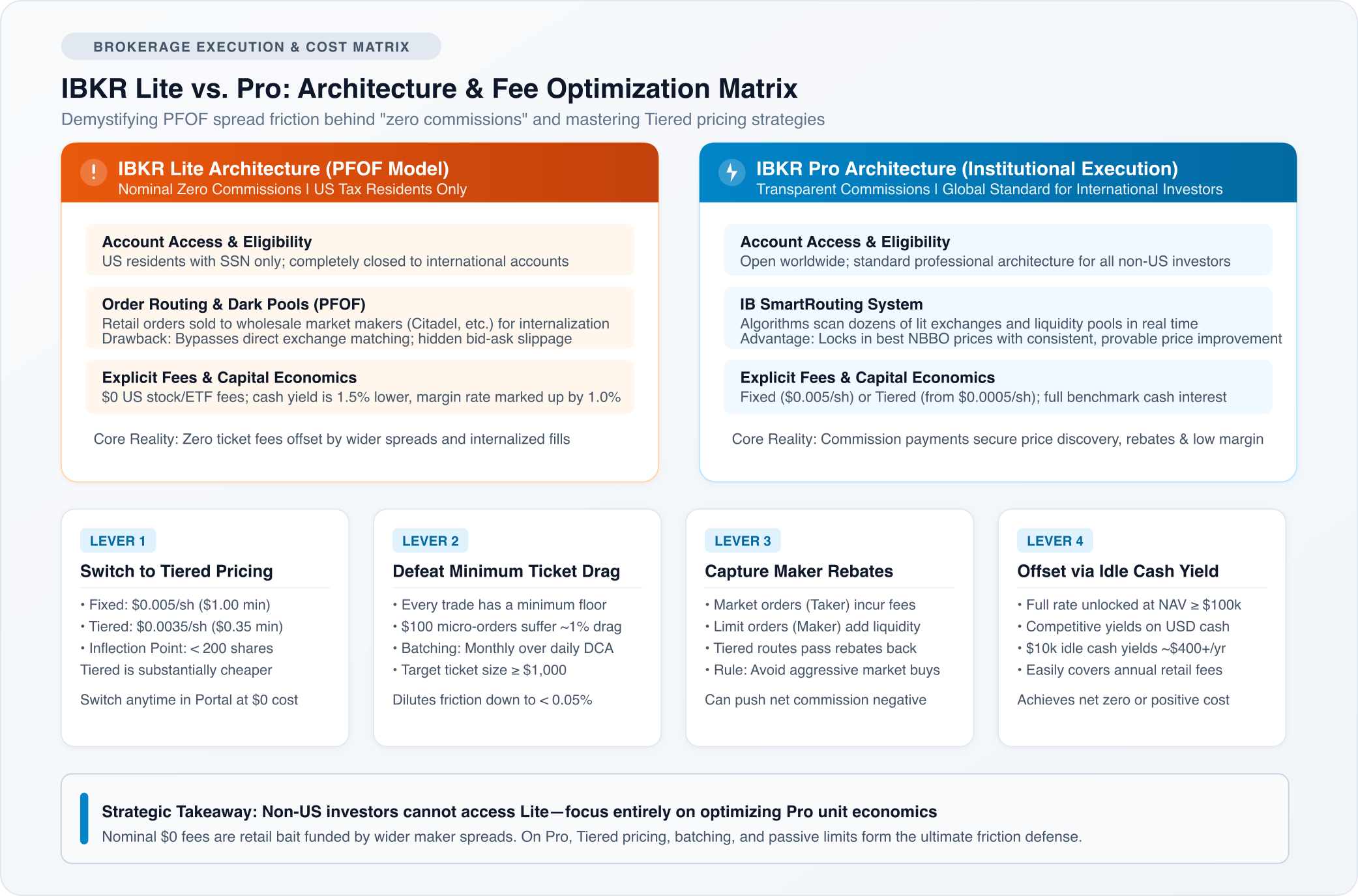
Figure 2: A comparison of IBKR Lite and Pro's dual-track execution mechanisms, alongside a matrix of four practical levers for retail investors to reduce Pro account trading friction.
1. PFOF: Monetizing Order Flow in Dark Pools
Under the IBKR Lite model, the broker charges no explicit commission for stock trades. Instead, it bundles user buy and sell orders and sells them to high-frequency market makers (such as Citadel Securities, Virtu Financial, etc.).
Market makers are willing to pay substantial sums for retail order flow because ordinary retail trades are often “uninformed flow”—carrying extremely low risk. Market makers can then directly act as the counterparty within their internal dark pools, executing buy orders a few cents higher and sell orders a few cents lower, thereby securely capturing the bid-ask spread.
2. The Arithmetic of Spread Slippage
Consider an investor wishing to buy 1,000 shares of a mid-cap U.S. stock:
- With a Pro account (SmartRouting mode): The order enters the public bidding pool directly. The algorithm scans over a dozen markets, including Nasdaq and NYSE, for the most advantageous quote. If executed at $50.00, the explicit commission is $3.50, totaling $50,003.50.
- With a Lite account (PFOF mode): While the explicit commission is $0, the order is sent to a market maker’s dark pool. Due to the lack of competitive bidding, the final average execution price is $50.01. The investor’s total expenditure is $50,010.00.
Superficially, Lite saved $3.50 in commission, but in reality, the investor paid an additional $10.00 due to a $0.01 spread slippage.
For investors making larger trades or dealing with less liquid assets (e.g., small-to-mid cap stocks, niche options contracts), PFOF’s implicit slippage erosion often reverberates against capital with an intensity several times that of explicit commissions. This is precisely why professional investment institutions prefer to pay transparent commissions and unequivocally avoid zero-commission channels.
III. Four Practical Levers for Reducing IBKR Pro Fees
Since non-U.S. investors must use IBKR Pro, and Pro inherently offers superior execution, how can one minimize actual trading costs? Through the following four precise optimizations, an ordinary investor’s total fee expenditure can be reduced by 50% to over 80%.
Lever 1: Switch to Tiered Pricing, Breaking the Fixed-Rate Floor
IBKR Pro offers users two distinct commission calculation logics: Fixed and Tiered.
Most newly opened accounts default to Fixed pricing, which is a primary reason many new users complain about high fees.
Deconstructing Fixed vs. Tiered Fee Models
- Fixed: U.S. stocks are charged a flat $0.005 per share, but each order has a minimum threshold of $1.00, capped at 1% of the trade value. This fee bundles all exchange and regulatory charges.
- Tiered: The broker’s base commission drops to $0.0035 per share, with a minimum broker commission of just $0.35 per order. Third-party fees (exchange fees, clearing fees, regulatory fees) are itemized separately based on actual flow.
Mathematical Inflection Point Analysis
For most retail investors, the majority of single trades involve fewer than 200 shares:
[Trade Cost Comparison for < 200 Shares]
- Buying 50 shares of AAPL: Fixed pricing costs $1.00; Tiered pricing (commission $0.35 + approx. $0.03 exchange fees) totals only about $0.38, a direct saving of 62% per trade.
- The fee inflection point between Tiered and Fixed is approximately 200-250 shares per trade. As long as the single trade volume does not exceed this threshold, Tiered pricing offers an absolute advantage.
Backend Switching Path
Log in to the IBKR web portal (Client Portal) ➔ Click on your avatar in the top right corner ➔ Account Settings ➔ Account Configuration ➔ Find IBKR Pricing Plan ➔ Change “Stocks/ETFs” from Fixed to Tiered. This change will take effect the next day.
Lever 2: Consolidate Order Granularity, Eliminate Minimum Commission Erosion
Even with tiered pricing, each order still has a minimum threshold of approximately $0.35 (or $1.00 for Fixed). If an investor adopts a “high-frequency fractional order” strategy, small amounts will be severely penalized by these minimum commissions.
- High-Frequency Fractional Order Trap: Daily dollar-cost averaging $50 to buy 0.2 shares of a U.S. stock, paying the minimum $0.35 per trade, results in an effective fee rate as high as 0.7%.
- Consolidate Capital Pool: Combine daily deductions into a monthly, centralized dollar-cost average, consolidating the single execution amount to over $1,000. Paying the same approximate $0.38 in total fees, the actual commission percentage is instantly diluted to 0.038% (3.8 basis points).
Extending the dollar-cost averaging interval and consolidating buy actions into larger single trades is the most direct weapon against minimum threshold friction.
Lever 3: Leverage Limit Orders to Capture Exchange Liquidity Rebates
Under IBKR Pro’s tiered pricing mechanism, exchange pass-through fees are not fixed costs but rather dynamic and bidirectional:
- Market Order (Taker): Directly consumes existing orders on the order book, acting as a “liquidity taker.” Major exchanges typically levy an additional liquidity removal fee (approx. $0.003 per share) on takers.
- Limit Order (Maker): Places an order at a specified price to wait for execution at the bid or ask, acting as a “liquidity provider.” Major exchanges (e.g., BATS, ARCA, EDGX) pay liquidity rebates to makers.
In tiered pricing settlements, the Maker Rebate provided by exchanges directly offsets the user’s commission bill. When a limit order is executed and receives a rebate, the net effective commission can be driven down to mere cents per trade.
Retail investors should resolutely abandon the impulsive habit of “aggressively hitting market orders.” For routine position building, consistently use Limit Orders for order matching.
Lever 4: Utilize Idle Cash Interest to Arbitrage Trading Costs
The highest echelon of friction cost control isn’t merely reducing expenditure, but rather allowing passive income generated within the account to cover trading expenses.
IBKR Pro boasts robust institutional-grade cash management advantages. For uninvested idle USD cash in an account, provided certain net asset thresholds are met, the broker accrues interest daily and pays monthly at market-leading rates:
- Full Interest Rate Threshold: If the total net asset value (including portfolio holdings) reaches over $100,000, idle USD cash exceeding $10,000 in the account will fully enjoy top-tier annual interest rates for demand deposits (closely tracking the effective federal funds rate, currently maintaining a high range of 4%–4.8%).
- Pro-rata Rule: If the account’s net asset value is below $100,000, interest is reduced proportionally.
[Interest Coverage Calculation] If you consistently maintain $10,000 in your account as defensive dry powder or liquidity buffer:
- At the full interest rate, monthly cash interest income would be approximately $30–$35.
- A typical long-term investor making 2–4 tiered U.S. stock trades per month would incur total commissions usually not exceeding $2.
- The cash interest generated by the account is over 15 times the monthly trading friction, thereby achieving “full positive cash flow coverage” at the account level.
IV. Actual Tiered Fee Reference for Common Asset Classes
To facilitate a systematic cost expectation, here’s a summary of the true fee structure for core asset classes under IBKR Pro’s tiered model for ordinary investors:
| Asset Class | Tiered Base Commission | Third-Party Fees & Notes | Practical Cost-Saving Advice for Retail Investors |
|---|---|---|---|
| US Stocks / ETFs | $0.0035/share (min $0.35/trade) | Plus SEC fee (sell orders only), FINRA trading fee, exchange pass-through fees | Keep single trades > $1,000; use Limit Orders (Maker) for rebates |
| US Standard Options | $0.15–$0.65/contract | Deep out-of-the-money options with premiums < $0.10 have base commission reduced to $0.25/contract | Avoid high-frequency small-lot single-leg openings; prioritize multi-leg orders to avoid repeated minimums |
| HK Stocks | 0.08% (min HKD 18/trade) | Plus Hong Kong government stamp duty 0.1% (policy changes like bilateral to unilateral sell-side exemption are subject to official announcements), transaction levy 0.0027%, SEHK fee 0.00565% | HK stock fees are rigidly constrained by stamp duty; avoid micro-fractional trades, single trades advised > HKD 20,000 |
| Micro US Futures | $0.25/contract (e.g., MES, MNQ) | Plus CME exchange fees approx. $0.25–$0.35/contract, total approx. $0.50–$0.60/contract | Micro contracts offer low capital entry and transparent fees, suitable as an alternative to some high-leverage derivatives |
| Global Multi-Currency Forex | 0.20 bps (0.002%, min $2.00/trade) | Direct access to interbank real-time rates, extremely tight spreads, no hidden high exchange markups from retail banks | Avoid frequent small-amount currency conversions; consolidate into large single exchanges to dilute the $2 minimum fee to its limit |
V. Conclusion: Building a Low-Friction Global Asset Moat
In capital markets rife with randomness and cyclical volatility, macro cycles, geopolitical shifts, and individual stock movements are beyond individual control. The only elements with 100% certainty, entirely within an investor’s control, are the institutional design of the trading channel and the management of friction costs.
For individual investors embarking on global allocation, there’s no need to lament the inability to access Lite’s “commission-free” halo. By seeing through the market maker’s spread predation behind the PFOF mechanism, and by leveraging an IBKR Pro account with its institutional-grade execution backbone:
- First Step: Log into the backend and cost-free switch to Tiered Pricing.
- Second Step: Consolidate capital rhythm, extend dollar-cost averaging cycles, and avoid minimum threshold erosion.
- Third Step: Use Limit Orders when trading to capture exchange liquidity rebates.
- Fourth Step: Prudently allocate idle cash, using interest income to fully arbitrage explicit fees.
Leveraging institutional rules to their absolute maximum, ensuring every unit of capital is deployed into productive assets with compounding value—this is the most rigorous foundational discipline for the long-term investor.
Related Research & Topics
Tello Mobile eSIM
SafetyWing Nomad Insurance
* Disclosure: This post contains affiliate links. If you make a purchase through these links, V-G Journal may earn a small commission at no additional cost to you. We only recommend services we independently evaluate and trust.
FIRE and Golf:自由旅居之路
专注于为追求 FIRE 与品质生活的人群提供特惠打球权益与候鸟微度假。不持一砖一瓦,运营品质生活。