The Architecture of Offshore Custody: Interactive Brokers, CRS Data Sharing, and the Four-Step Verification of US Brokerage Accounts
Deconstructing persistent market rumors regarding IBKR's tax reporting to Chinese authorities. An institutional analysis of OECD CRS versus US FATCA jurisdiction, operational legal entities, and a four-step framework to audit account custody.

Executive Summary: Recurrent market anxieties alleging that Interactive Brokers (IBKR) engages in bulk transmission of retail account and transactional records to Chinese fiscal or regulatory authorities misread the mechanics of international tax enforcement. Retail allocators routinely conflate administrative W-8BEN renewals, the mandatory Common Reporting Standard (CRS) reporting of Hong Kong-domiciled entities, and mainland cross-border banking surveillance. Regulatory oversight and cross-border financial surveillance do not adhere to consolidated commercial branding. Instead, they are governed strictly by the corporate contracting entity of the trading account and the jurisdictional scope of prevailing international tax frameworks (OECD CRS versus US FATCA). This paper deconstructs the legal boundaries of cross-border data exchange and delivers a deterministic four-step audit framework to verify custody jurisdiction.

Figure 1: The physical global headquarters of Interactive Brokers LLC at One Pickwick Plaza, Greenwich, Connecticut—the statutory registered address appearing on US-regulated activity statements.
I. The Jurisdictional Realities: Does IBKR Report Client Portfolios via CRS to China?
Determining whether Interactive Brokers transmits financial records to Chinese tax authorities requires identifying which distinct legal entity within the corporate group acts as custodian and counterparty to the trading account.
Interactive Brokers is not a monolithic corporate entity. It is a multi-tier group controlled by Interactive Brokers Group, Inc. (NASDAQ: IBKR), operating through separate regional subsidiaries incorporated across disparate legal jurisdictions. Each subsidiary reports exclusively to its domestic financial regulator and is bound by distinct international tax compliance treaties:
| Legal Contracting Entity | Regulatory Body & Governing Jurisdiction | Participant in OECD CRS? | Bulk Automated Exchange with China’s SAT? |
|---|---|---|---|
| Interactive Brokers LLC (IB LLC) | US SEC / FINRA / CFTC (United States) | ❌ Non-Participant (US opted out of CRS) | No (No statutory mandate, treaty mechanism, or data pipeline) |
| Interactive Brokers Hong Kong Ltd (IBHK) | Securities and Futures Commission (SFC, Hong Kong) | ✅ Participant (Hong Kong is a CRS signatory) | Yes (Annual automated reporting for declared mainland tax residents) |
| Interactive Brokers Singapore Pte. Ltd (IBSG) | Monetary Authority of Singapore (MAS, Singapore) | ✅ Participant (Singapore is a CRS signatory) | Yes (Automated transmission via CRS/AEOI bilateral activation) |
| Interactive Brokers Ireland / U.K. (IBIE / IBUK) | Central Bank of Ireland (CBI) / FCA (United Kingdom) | ✅ Participant (EU & UK enforce CRS) | Yes (Automated annual exchange for non-resident accounts) |
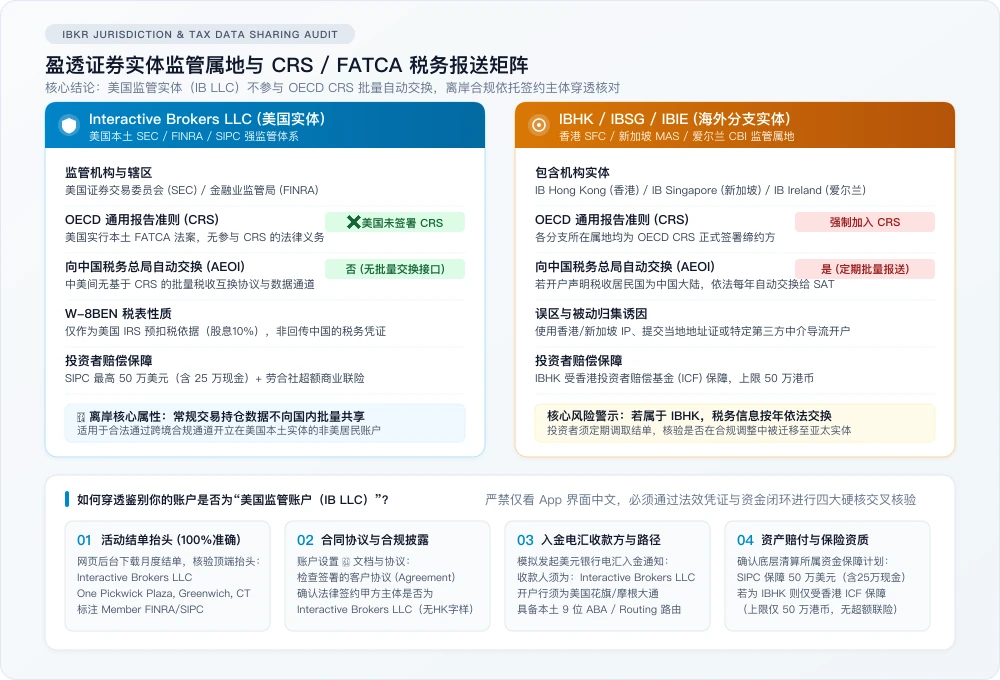
Figure 2: Regulatory jurisdictions and tax information exchange regimes (CRS vs. FATCA) across core Interactive Brokers entities.
1. The Legal Exemption of US-Regulated Financial Intermediaries
The Automatic Exchange of Financial Account Information (AEOI), executed via the OECD’s Common Reporting Standard (CRS), was constructed to dismantle multilateral offshore tax avoidance. Over 100 sovereign states and non-sovereign territories currently participate in the framework.
The United States never joined the OECD CRS regime. Washington constructed its own unilateral framework: the Foreign Account Tax Compliance Act (FATCA). FATCA compels non-US financial institutions globally to transmit account data on US persons directly to the Internal Revenue Service (IRS). Conversely, reciprocal reporting by US-based financial institutions to foreign sovereigns remains tightly restricted in scope. Crucially, the US and China maintain no operational multilateral or bilateral AEOI pipeline for automated retail tax data exchange.
Consequently, Interactive Brokers LLC (the US domestic entity)—governed by the US Securities and Exchange Commission (SEC), the Financial Industry Regulatory Authority (FINRA), and the Commodity Futures Trading Commission (CFTC)—possesses neither the statutory obligation, the legal standing, nor the digital infrastructure to feed account balances, security positions, or capital gains to China’s State Taxation Administration (SAT).
2. Deconstructing the Market’s Primary Cognitive Errors
Community anxieties regarding automated data handovers stem from two pervasive procedural misinterpretations:
- Error 1: Conflating the Contracting Entity (IBHK / IBSG vs. IB LLC)
Many mainland investors routed their original applications through regional access points, funded their portfolios through Hong Kong retail banks, or onboarded via regional marketing funnels. In doing so, their accounts were legally routed to Interactive Brokers Hong Kong Limited (IBHK) or Interactive Brokers Singapore Pte. Ltd (IBSG). Because both Hong Kong and Singapore enforce the CRS framework, declaring Chinese tax residency (by supplying a mainland Taxpayer Identification Number) triggers an automated annual data export to the SAT under standard local reporting laws. - Error 2: Mistaking W-8BEN Certification for a CRS Filing
Under the US Internal Revenue Code, non-US individuals trading US financial instruments must execute Form W-8BEN (Certificate of Foreign Status of Beneficial Owner for United States Tax Withholding and Reporting), renewable every three calendar years. The Foreign Tax Identifying Number (FTIN)—typically a national identity number—is collected for one statutory reason: validating eligibility for the reduced 10% dividend withholding rate under the US-China bilateral tax treaty (bypassing the statutory 30% default penalty rate). This form is retained by the broker as a withholding agent and made available to the IRS upon request. It operates entirely as an internal, unilateral US tax document, not an outbound CRS data transmission sent to domestic home-country tax offices.
II. Forensic Audit: A Four-Step Framework to Verify US Custody (IB LLC)
Mobile interfaces, local language wrappers, and customer support desks serve client acquisition; they possess no statutory significance. Establishing whether a brokerage account is insulated within the US domestic regulatory perimeter requires examining legal settlement records and clearing conduits.
As documented in our previous institutional audit of IBKR commission mechanics and smart order routing, non-US accounts are assigned distinct clearing pathways. The four-step framework below isolates and validates your account’s true legal jurisdiction:
Step 1: Examine the Activity Statement Corporate Letterhead
The monthly Activity Statement is the ultimate legal artifact recognized by maritime arbitrations, sovereign courts, and bankruptcy liquidators:
- Log into the IBKR Web Client Portal;
- Navigate via the primary menu to Performance & Reports ➔ Statements;
- Select any completed monthly Activity Statement and open the HTML or PDF view;
- Review the legal entity and corporate headquarters in the upper-left corner:
- US-Regulated Entity (IB LLC): The statement must read:
Interactive Brokers LLC, One Pickwick Plaza, Greenwich, CT 06830, USA
Accompanied explicitly by:Member FINRA/SIPC. - Hong Kong Subsidiary (IBHK): The header displays:
Interactive Brokers Hong Kong Limited, Suite 1512, Two Pacific Place, 88 Queensway, Admiralty, Hong Kong
Declaring direct regulatory supervision by the Hong Kong SFC. - Singapore Subsidiary (IBSG): The statement states direct oversight by the Monetary Authority of Singapore (MAS).
- US-Regulated Entity (IB LLC): The statement must read:
A statement headed by Interactive Brokers LLC at One Pickwick Plaza, Greenwich, CT, backed by FINRA and SIPC disclosures, confirms that the custody chain falls exclusively under US federal jurisdiction and SEC statutory authority.
Step 2: Audit Counterparty Designations in the Customer Agreement
Electronic customer agreements executed during onboarding hold definitive legal force:
- Open the Client Portal, click the user profile icon in the upper right, and select Settings;
- Scroll down to Account Configuration ➔ Agreements & Disclosures;
- Open the operative Customer Agreement and Margin Agreement;
- Review the primary party definitions: Confirm that the contracting counterparty is Interactive Brokers LLC, free of regional modifiers such as “Hong Kong Limited” or “Singapore Pte.”
Step 3: Trace Inbound USD Wire Clearing Paths and Beneficiary Details
Capital movements reveal the broker’s underlying banking rails:
- Navigate to Transfer & Pay ➔ Deposit Funds, then select Bank Wire (USD);
- Generate the official wiring instructions:
- IB LLC Accounts: The designated beneficiary must be
Interactive Brokers LLC. The clearing bank is typically Citibank N.A. New York or JPMorgan Chase Bank, identified by a standard US nine-digit ABA Routing Transit Number; - IBHK Accounts: The beneficiary is registered as
Interactive Brokers Hong Kong Limited, directing funds to local settlement institutions such as Citibank Hong Kong or HSBC Hong Kong.
- IB LLC Accounts: The designated beneficiary must be
When capital terminates at a US-domiciled settlement bank under the corporate title of an American legal entity, funds reside in an onshore, segregated client omnibus structure.
Step 4: Validate Investor Protection Schemes (SIPC vs. HK ICF)
Insolvency protections reveal the regulatory framework governing the account:
- IB LLC Structure: Accounts are backstopped by the Securities Investor Protection Corporation (SIPC). In the event of brokerage insolvency combined with the unauthorized hypothecation of client assets, SIPC protection covers up to $500,000 (including a cash limit of $250,000). IBKR maintains additional commercial excess policies through Lloyd’s of London syndicates;
- IBHK Structure: Protection falls back onto Hong Kong’s Investor Compensation Fund (ICF). Coverage is capped at HK$500,000 per individual across all claims, and applies solely to products traded on the Stock Exchange of Hong Kong (SEHK) or the Hong Kong Futures Exchange (HKFE). It offers no statutory protection for direct US equity custody.
III. Structural Realities and Regulatory Blindspots
Confirming an account is domiciled with Interactive Brokers LLC (and outside the reach of automated CRS reporting) does not grant total financial invisibility. Modern financial surveillance operates across multiple layers:
1. Bank-Side Cross-Border Payment Logging
Private wealth allocators often attribute domestic tax audits to broker-side disclosures, when the true vector is commercial banking telemetry.
Whether executing individual foreign exchange quotas or remitting capital inbound, onshore banking systems integrate directly with the State Administration of Foreign Exchange (SAFE) and the Anti-Money Laundering Monitoring and Analysis Center. Outbound cross-border remittances exceeding statutory thresholds (e.g., $50,000 aggregate annual limits) or those flagged by pattern-recognition heuristics create an immutable evidentiary trail long before capital reaches an offshore brokerage.
Domestic fiscal authorities audit cross-border capital allocations by unwinding the transaction logs of domestic clearing banks, requiring zero assistance from overseas brokerages.
2. The Threat of Passive Jurisdictional Re-domiciliation
As international anti-money laundering (AML) and cross-border licensing rules tighten, legacy accounts risk silent operational re-segmentation:
- An account originally established with IB LLC may trigger internal flags if the client subsequently submits a Hong Kong identity card, a Hong Kong residential utility bill, or non-mainland tax documentation;
- Institutional and trading accounts requesting access to specific local Asian exchanges may be prompted to execute subsidiary documentation;
- Protective Action: Run a semi-annual audit of your monthly Activity Statement header to ensure the account has not been reassigned to IBHK or another regional entity during silent internal compliance adjustments.
3. Judicial Assistance Treaties (MLAT) vs. Automated Administrative Sweeps
A strict legal boundary exists between civil administrative bulk tax data exchanges (CRS) and targeted Mutual Legal Assistance Treaties (MLAT) in criminal matters:
CRS is an indiscriminate, scheduled, dragnet-style data pipeline operating without probable cause or active litigation. An IB LLC account remains immune to this process. However, if an account holder is targeted in a criminal proceeding involving money laundering, high-level corruption, or cross-border fraud, state prosecutors can deploy formal bi-jurisdictional frameworks. These include the Sino-US Mutual Legal Assistance Agreement or international Financial Intelligence Unit (FIU) coordination under Egmont Group protocols.
IV. Defensive Structuring for Global Portfolios
Deploying capital across borders requires legal precision, rigorous documentation, and structural transparency.
When assessing regulatory exposure, panic and unverified rumors are equally destructive:
- Rely on Institutional Proof: Audit the monthly statement header, the formal contracting agreement, inbound wire routing, and SIPC status to confirm your legal counterparty;
- Respect Legal Boundaries: Recognize the operational wall separating US FATCA from OECD CRS. Never confuse standard US withholding tax documentation (W-8BEN) with outbound domestic tax reporting;
- Audit the Entire Capital Pipeline: Maintain verifiable, transparent audit trails at the banking level. Structural certainty, not algorithmic opacity, is the only durable defense against macro shifts.
Related Research & Topics
Tello Mobile eSIM
SafetyWing Nomad Insurance
* Disclosure: This post contains affiliate links. If you make a purchase through these links, V-G Journal may earn a small commission at no additional cost to you. We only recommend services we independently evaluate and trust.
FIRE and Golf:自由旅居之路
专注于为追求 FIRE 与品质生活的人群提供特惠打球权益与候鸟微度假。不持一砖一瓦,运营品质生活。