Borrowed Time and Intertemporal Ledgers: The Economic Mechanics and Systemic Friction of Holiday Adjustments
Holiday adjustment is essentially an administrative 'time bridge financing.' By restructuring temporal slices, it replaces dispersed daily consumption with high-ticket cross-regional mobility. Based on the Permanent Income Hypothesis, this essay calculates the true net stimulus versus the structural friction of the system.

Executive Summary: The “holiday adjustment” mechanism (working weekends to create long breaks) ignites public outcry every spring and autumn. While public focus remains on the physical exhaustion of “makeup workdays,” a deeper look through the lenses of macro-policy evolution and micro-commercial supply reveals that this is not a simple labor welfare issue. It is a precision-engineered mechanism for intertemporal consumption leverage and centralized traffic dispatch.
By forcibly dismantling the naturally distributed rest rights of the weekend and assembling them into long-radius time windows, the system injects liquidity into two “rigid toll booths”: long-distance transportation and inter-city accommodation. However, based on the Permanent Income Hypothesis and systems engineering metrics, the true annualized net stimulus multiplier of these adjustments is a mere 0.15 to 0.25. Behind the ledger’s superficial prosperity lies the friction of extreme supply-side peaks and valleys, alongside the real depreciation borne by the real economy and the individual.
I. The Entry Point: A Hotel Management System’s Pricing Curve
In the backend of a boutique hotel chain in a second-tier tourist city in East China, the Property Management System (PMS) pre-loads a specific revenue management table at the start of every year.
On a regular Wednesday in April, the base rate for a standard king room is 218 RMB, with an average occupancy (OCC) hovering around 58% and a Revenue Per Available Room (RevPAR) of approximately 126 RMB. However, the moment the system detects the start of a “Labor Day” holiday—cobbled together through adjustments—the price for that same room, without any renovation or service upgrade, is instantly algorithmically pushed to 888 RMB. Furthermore, the system locks in a “minimum two-night stay” rule. Then, on the Sunday following the holiday—a day “borrowed” to make up for the time off—the price collapses back to 198 RMB, and occupancy plummets below 30%.

This violent, oscillating line—with its towering peaks and deep troughs—is not a natural equilibrium of market supply and demand. It is the physical projection of administrative power performing a secondary tailoring of society’s time.
Economically, the holiday adjustment mechanism is an administrative “time bridge financing.” It forcibly dismantles the evenly distributed weekend rest rights of workers to assemble a continuous window of time. Its core motive is not to provide a physiological recovery cycle for the individual, but to widen the spatial displacement radius, directionally activating long-distance transport, inter-city lodging, and centralized scenic consumption.
II. Historical Context: A Fiscal Substitute for Deflation and Domestic Demand
To understand the underlying drivers of holiday adjustments, one must look back at the macroeconomic fundamentals when the system was established.
In May 1995, China officially implemented the five-day work week. However, it was the 1999 revision of the National Annual Leave and Memorial Day Holiday Measures that institutionalized the “borrowing of weekends to patch together long holidays.” At that time, statutory holidays were increased from 7 to 10 days, and by borrowing weekends, the “Golden Weeks” for Spring Festival, Labor Day, and National Day were created.
This system carried a clear macroeconomic mission in 1999:
- External Shocks and Weak Domestic Demand: Following the 1997 Asian Financial Crisis, exports faced severe external pressure, domestic price indices lingered at lows, and effective demand was significantly insufficient.
- High Savings vs. Low Consumption Propensity: With high levels of precautionary savings, the macro-economy needed a lever to trigger high-frequency capital circulation without direct fiscal cash subsidies.
- The Birth of the “Holiday Economy”: By creating centralized travel scenarios, the “holiday economy” emerged as a tool to drive investment in the tertiary sector and stimulate domestic demand.
While the 2007 revision canceled the Labor Day Golden Week in favor of traditional festivals like Qingming and Dragon Boat, the underlying logic of “borrowing weekends to create mini-long breaks” was fully inherited and persists today.
Statutory leave is a legal welfare of society; holiday adjustment is the securitization, packaging, and centralized underwriting of that welfare through administrative means.
III. Empirical Measurement: Penetrating the Ledger of Stimulus
Does holiday adjustment truly create a massive net increase in total consumption? By crossing spatial constraint models of consumer behavior with macroeconomic data, we can reconstruct the actual flow of capital.
1. Nonlinear Jumps in Geographic Radius and Ticket Price
The reliance on adjustments persists because the monetization efficiency of cultural tourism is nonlinearly linked to the length of continuous time. In the physical world, a worker’s consumption is constrained by time and spatial radii:
| Holiday Format | Activity Radius | Typical Consumption Pattern | Median Marginal Daily Spend |
|---|---|---|---|
| Single Day / Isolated Holiday | < 50 km | Local dining, groceries, cinema (Maintenance) | ¥80–150 |
| Standard Weekend (2 Days) | 100–200 km | Suburban camping, agritourism, short drives (Light Leisure) | ¥300–500 |
| Adjusted 3-Day Break | 300–600 km | Inter-city rail, 2 nights in budget chains, scenic tickets | ¥800–1500 |
| Adjusted 5–7 Day Break | > 1000 km | Airfare, mid-to-high-end hotels, cross-province/overseas travel | ¥2500–6000 |
The key to jumping from a hundred-yuan daily spend to a thousand-yuan spend lies in crossing the threshold of transportation and accommodation decisions.
- Isolated Days: The radius is anchored to the place of residence; spending is largely routine with minimal marginal gain.
- Adjusted Breaks: Once the threshold crosses 48 or 72 hours, travelers must purchase long-distance tickets and generate rigid, consecutive hotel stays.
The institutional leverage of holiday adjustment lies in using administrative scheduling to compress and replace routine local maintenance spending with cross-regional heavy consumption, where the ticket price is several times higher. Long-distance transport (rail and air) and inter-city lodging (hotels and B&Bs) constitute the most important reservoirs for holiday economy cash flow.
2. “Intertemporal Shifting” and the Net Increase Test
According to data from the Ministry of Culture and Tourism, using 2023 as an example, domestic tourism revenue reached 4.91 trillion RMB. Of this, the four major holidays (Spring Festival, Labor Day, Dragon Boat, and National Day) accounted for over 1.8 trillion RMB—more than 36% of the annual total.
On the surface, these nodes contribute over a third of the industry’s revenue. However, under the framework of Friedman’s Permanent Income Hypothesis, we must apply a deeper test:
Core Conclusion: A household’s total annual consumption expenditure ultimately depends on its total annual disposable income and expectations of long-term stable income, not on how the calendar is fragmented.
When an employee pays an 8,000 RMB bill for a family trip during the 5-day Labor Day break, that family will inevitably compress their budget for clothing, electronics, local dining, and entertainment over the following two to three months.
For total social retail sales, holiday adjustments do not significantly increase the overall consumption capacity of the household sector. Instead, they produce three structural replacements:
- Spatial Transfer: Moving routine consumption from the place of residence to the ledgers of tourist destinations.
- Category Replacement: Swapping durable goods and general retail for rail tickets, hotel rooms, and entrance fees.
- Intertemporal Concentration: Taking liquidity that would have been evenly distributed over 52 weeks and damming it up to be released in three or four specific pulses.
Economic Model: If one excludes the rigid dining and living expenses that would have occurred anyway, the annualized real net stimulus multiplier of holiday adjustments on total social consumption is only 0.15 to 0.25. Most of the ledger’s prosperity is merely an artificial reorganization of consumption timestamps.
IV. The Back of the Ledger: Systemic Friction and Negative Externalities
Any system that relies on administrative intervention to force short-term traffic pulses inevitably pays a high price in physical friction. While macro cash flows are repeatedly tallied in briefings, the hidden depreciation imposed on infrastructure, micro-enterprises, and the workforce is systematically ignored.
1. Supply-Side Mismatch and Asset Vacancy
Modern industry and services thrive on steady capacity utilization. The artificial “super-pulses” created by adjustments are a destructive stress test for infrastructure:
- Over-provisioning and Idle Assets: To carry the surge during long holidays, rail departments must run extra “night trains,” airlines must deploy backup capacity, and scenic spots must build thousands of temporary parking spaces. During holidays, facilities run at 120% or 150% load, squeezing safety margins and degrading service quality. Once the holiday ends, these massive fixed assets fall into months of idle depreciation.
- Aggressive Short-term Pricing: For hotel and B&B operators, to recover annual rent and fixed costs during the only 20-30 peak days of the year, they are forced into extreme, predatory pricing. This directly exacerbates price gouging, service disputes, and regulatory friction.
A commercial system that oscillates violently between 30% and 300% load has a total lifecycle operating cost far higher than a healthy system stabilized at a 70% mean load.
2. Production-Side Organizational Wear and Labor Depreciation
The most visible cost of holiday adjustment is the disruption of industrial production and corporate collaboration:
- Physiological Depreciation of Anti-Biological Cycles: To patch together a long break, employees often face schedules like “6 days on, 3 days off, 6 days on.” According to organizational behavior and ergonomics, after the 5th consecutive workday, focus, decision quality, and innovative output show a steep marginal decline.
- Efficiency Vacuums: Because holidays are sandwiched between long makeup periods, a “pre-holiday slump” and “post-holiday recovery” state becomes prevalent. Effective man-hours do not increase due to makeup days; they are instead consumed in low-efficiency idling.
- Institutional Hedging Costs for Manufacturing: For enterprises that must run 365 days a year—such as steel furnaces, semiconductor fabs, or chemical plants—administrative adjustments do not stop production. Instead, they force companies to pay high statutory overtime (300% for holidays, 200% for adjusted rest days), substantially increasing the compliance costs for real-sector manufacturing.
V. Systems Engineering: Batch Processing vs. Distributed Scheduling
If we view the operation of society as a large-scale distributed computing system, the current holiday adjustment system is a classic Centralized Batch Processing architecture.
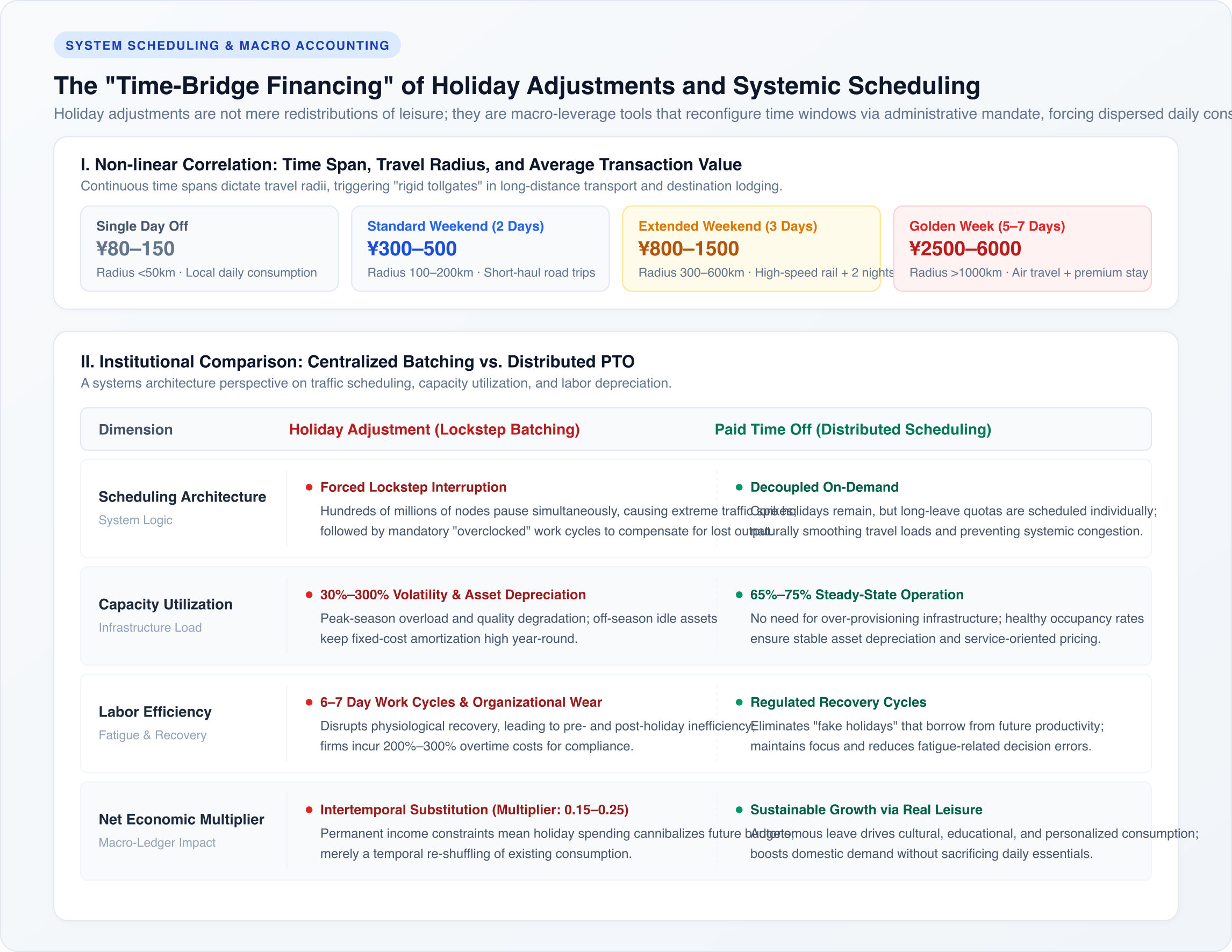
The logic of a centralized scheduler assumes that the schedules of hundreds of millions of nodes must remain in Lockstep:
- Unified Interrupt: To execute a cross-regional consumption task, the scheduler sends a unified interrupt signal to all nodes, halting daily production at the same millisecond.
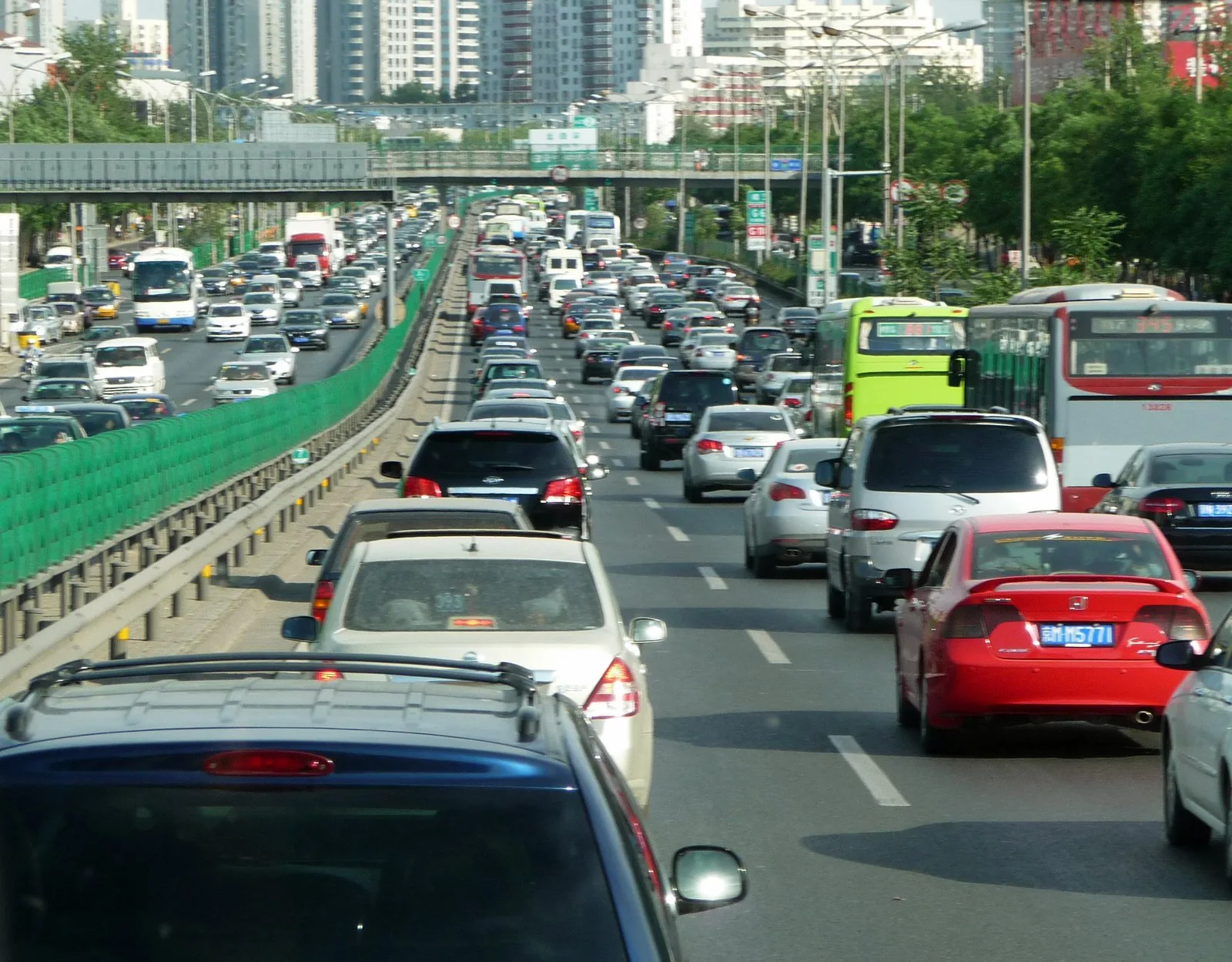
- Traffic Overload: Instantaneous concurrency leads to bandwidth spikes and server overloads—mapped in reality as paralyzed transport networks, capped scenic spot entries, and hotel runs.
- Overclocking Compensation: To make up for the downtime, the scheduler commands all nodes to enter “overclocking mode” (6–7 consecutive workdays).
In contrast, mature economies generally adopt a Distributed Scheduling architecture, primarily through Paid Time Off (PTO):
- Node Decoupling: The state retains core cultural statutory holidays (New Year, National Day, etc.) for public ritual, while the remaining holiday quota (10–25 days) is decoupled for employees to arrange independently.
- Smoothing the Load Curve: Employees choose travel windows based on family cycles and off-peak preferences. The tourism industry no longer sees extreme peaks; transport and lodging maintain healthy baseline occupancy year-round, and pricing mechanisms return to being quality-oriented.
- Eliminating Makeup Friction: Leave is no longer taken as an advance on future workdays. The workforce recovers at the threshold of fatigue, maintaining stable productivity.
Why is the more rational distributed mechanism so difficult to implement? The root cause lies in the micro-level game of labor costs:
- Explicit Costs of PTO: Rigidly implementing paid leave requires companies to build real personnel redundancy, directly pushing up the explicit labor costs for SMEs.
- Low-Resistance Substitute: The adjustment scheme, deployed uniformly by administrative power, allows companies to avoid the appearance of new paid leave costs while delivering a “concentrated consumption” report to the macro-ledger with the least institutional resistance.
VI. Conclusion: Facing the Physical Limits of Time Scheduling
In the jurisprudence of modern labor law, the core attribute of the right to rest is the reproduction of life functions. It is the basic physical defensive line that ensures labor maintains stable productivity.
When the primary consideration of a holiday system shifts from “labor recovery” to “consumption intake,” and when the right to rest must be paid for with the sacrifice of life patterns and the advancement of future physical energy as “bridge interest,” the marginal utility of stimulating the economy is destined to decrease as marginal costs climb.
The macro-ledger of society cannot merely calculate the ticket revenue spat out by scenic spot turnstiles; it must account for machine wear, organizational idling, and the physiological depreciation of hundreds of millions of exhausted people. As the cobbled-together “long breaks” fail to mask the heavy price of the grueling makeup days that surround them, this twenty-year-old time-scheduling mechanism has reached its objective physical limit.
Related Research & Topics
Tello Mobile eSIM
SafetyWing Nomad Insurance
* Disclosure: This post contains affiliate links. If you make a purchase through these links, V-G Journal may earn a small commission at no additional cost to you. We only recommend services we independently evaluate and trust.
FIRE and Golf:自由旅居之路
专注于为追求 FIRE 与品质生活的人群提供特惠打球权益与候鸟微度假。不持一砖一瓦,运营品质生活。