In-Flight Breakup over Florida: Airworthiness Blind Spots in Aging Jets and the Corporate Trust Firewall
The November 2026 in-flight breakup of a Learjet 60 in Florida, which claimed the lives of a prominent tech founder and his family, pierces the polished veneer of private aviation. Behind Bombardier's discontinuation and a 22-year-old airframe lie Delaware single-asset shells and Part 135 operational loopholes that insulate capital while stranding passengers in extreme weather risk.


Figure 1: Portrait of the late tech founder Adam Robinson. On November 1, 2026, the Bombardier Learjet 60 carrying his entire family suffered a catastrophic midair breakup and crashed in Greenacres, Florida.
At noon on November 1, 2026, a Bombardier Learjet 60 flying from Austin, Texas, to the Bahamas suffered a catastrophic loss of control over Greenacres, Palm Beach County, Florida. Plunging into a vertical dive at speeds exceeding 30,000 feet per minute, the aircraft disintegrated in midair, killing all nine people on board, including 45-year-old unicorn tech founder Adam Robinson and his immediate family of four. This disaster was far from a random meteorological anomaly. Instead, it brutally dragged the systemic fault lines of private aviation into the courtroom: the crumbling supply chain of aging aircraft fleets, a cliff-like decline in co-pilot qualifications, and the absolute liability isolation afforded by Delaware commercial trusts.
The Final Minute: Stratospheric Clear-Ice, Over-Speed Dive, and Midair Breakup
Registered as N722BD, the Bombardier Learjet 60 took off that morning from Austin-Bergstrom International Airport, carrying tech entrepreneur Adam Robinson—who had just completed a major commercial milestone—his wife Helen Sharp, their two young children (aged 4 and 2), a nanny, and two friends bound for a Bahamas vacation.
Around 12:50 PM, the aircraft was cruising near the edge of the stratosphere at 35,000 feet. Southern Florida was then blanketed by severe convective storm systems, with severe turbulence and heavy precipitation choking the airway. The final radio transcripts between the cockpit and air traffic control indicate the crew reported encountering clear-ice icing and moderate turbulence, requesting a climb to 37,000 feet to top the weather.
Moments after air traffic control issued the routing instruction, flight telemetry recorded by the transponder suffered a catastrophic vertical collapse. The aircraft departed its cruise altitude and entered a rapidly deteriorating dive. ADS-B telemetry showed that in roughly one minute, the aircraft’s altitude plummeted from 35,250 feet to below 8,750 feet, with its vertical descent rate accelerating from 10,000 feet per minute to over 30,000 feet per minute.
[Key Timeline of N722BD Prior to Crash]
- 12:49 EST: Cruising at FL350; crew reports clear-ice icing and moderate turbulence, requesting a climb to FL370.
- 12:50 EST: Sudden loss of control leading to a dive; cockpit issues a desperate Mayday call reporting an over-speed emergency.
- 12:50:45 EST: Vertical descent rate breaches 30,000 feet per minute; telemetry altitude plunges from 35,250 to 8,750 feet.
- 12:51 EST: Radar transponder signal lost over Greenacres, FL; high-altitude aerodynamic overload shears wings and empennage structures.
Amid howling wind shear and cockpit warnings, the pilot broadcast a desperate Mayday call to Miami ATC, shouting, “We are in an overspeed… we’re going down.” Seconds later, ground witnesses saw the fuselage trailing shattered debris as it slammed vertically into the ground near a residential area in Greenacres, triggering a massive explosion, leaving a deep impact crater, and forcing the emergency evacuation of roughly 600 residents from a nearby mobile home community while injuring one person on the ground.
National Transportation Safety Board (NTSB) board member Tom Chapman and lead investigator Timothy Monville deployed a 20-person expert team directly to the scene. At its initial press briefing, the NTSB confirmed that because debris was scattered over a wide area along the flight path, major airframe components had separated before impact—strongly indicating the aircraft experienced structural disintegration in flight prior to hitting the ground.
| Investigation Dimension | Official Verified Facts and Judicial Records | Evidence Tier and Adjudication Standard |
|---|---|---|
| Aircraft Model & Age | Bombardier Learjet 60 (Manufactured 2004, Serial Number 271, 22 years old) | Tier-1 (FAA Aircraft Registry Records) |
| Casualties & Demographics | 9 fatalities total (7 passengers including a family of four, 2 flight crew) | Tier-1 (NTSB Accident Site Verification Briefing) |
| Sudden Descent Rate | Vertical descent rate surged from 10,000 fpm to over 30,000 fpm | Tier-1 (ADS-B Telemetry & Miami ATC Audio) |
| In-Flight Breakup | High-altitude aerodynamic overload and severe flutter sheared major components pre-impact | Tier-1 (NTSB Official Investigative Briefing) |
| Commercial Operation | Affiliated with Aurora Aviation, Inc. (operating as Upper Jets under Part 135) | Tier-1 (FAA Part 135 Operator Directory) |
The “Lemon Market” Trap: A 22-Year-Old Out-of-Production Jet and Maintenance Cliffs
The core shockwave this tragedy sent through the business community stems from a profound cognitive dissonance high-net-worth individuals hold regarding private charter flights.
The public routinely equates private business jets with “ultimate safety, elite luxury, and bespoke service.” Yet, opening the FAA airworthiness ledger for this Learjet 60 (N722BD) reveals a manufacturing date of 2004—making the airframe a full 22 years old.
What does a 22-year-old metal airframe mean in modern commercial aviation? Bombardier officially terminated production of the entire Learjet lineup in 2021, signaling the definitive retirement of a six-decade-old small jet dynasty. When an original equipment manufacturer (OEM) stops production and support, it triggers a step-function degradation in engineering technical support, an evaporating spare-parts supply chain, and an inevitable reliance on used, salvaged-part ecosystems for aging airframes.
Unlike mainline commercial airliners operating under rigorous, round-the-clock airworthiness management, private charter assets are highly fragmented. As we explored when auditing the heavy asset depreciation books of major commercial airlines, modern civil aviation maintains astonishingly low accident rates thanks to heavy capital investments in round-the-clock maintenance engineering systems—detailed in our deep-dive audit of Big Three Airline CapEx and Depreciation Cycles. Conversely, aging business jets tucked under small charter brokerages typically rely on third-party MRO (Maintenance, Repair, and Overhaul) shops whose inspection standards and technician competency vary wildly.
For high-performance, thin-wing jets like the Learjet 60, designed for high-speed cruising, any degradation, delay, or pneumatic failure in wing-root de-icing boots or engine nacelle anti-ice systems proves fatal. Encountering high-altitude clear-ice zones deforms the wing’s leading edge, destroying lift and inducing severe aerodynamic stall and flow separation. In older airframes lacking modern digital avionics and automated stall-recovery systems, an uncommanded spiral dive rapidly pushes the airframe past its Maximum Operating Mach Number. Aging aluminum wing spars and tail attachments cannot withstand the dynamic flutter and gravity loads, tearing apart under violent aerodynamic forces.
Charter platforms present polished leather seats, temperature-controlled champagne, and pristine ground handling on mobile apps. Beneath the aluminum skin, however, lies an aging machine running on discontinued OEM parts with razor-thin safety margins in extreme weather. This is the profound information asymmetry and “lemon market” trap lurking within the private aviation industry.
Regulatory Generation Gaps: Part 135 Qualifications and Extreme Discretionary Thresholds
If hardware aging formed the physical vulnerability, the regulatory double standards embedded in Federal Aviation Regulations amplified the disaster’s momentum.
Civil aviation draws a hard line between major airlines operating under the rigorous FAR Part 121 rules, and commercial charter operators flying under the more flexible, lenient FAR Part 135 framework. An unbridgeable generational safety chasm divides the two.
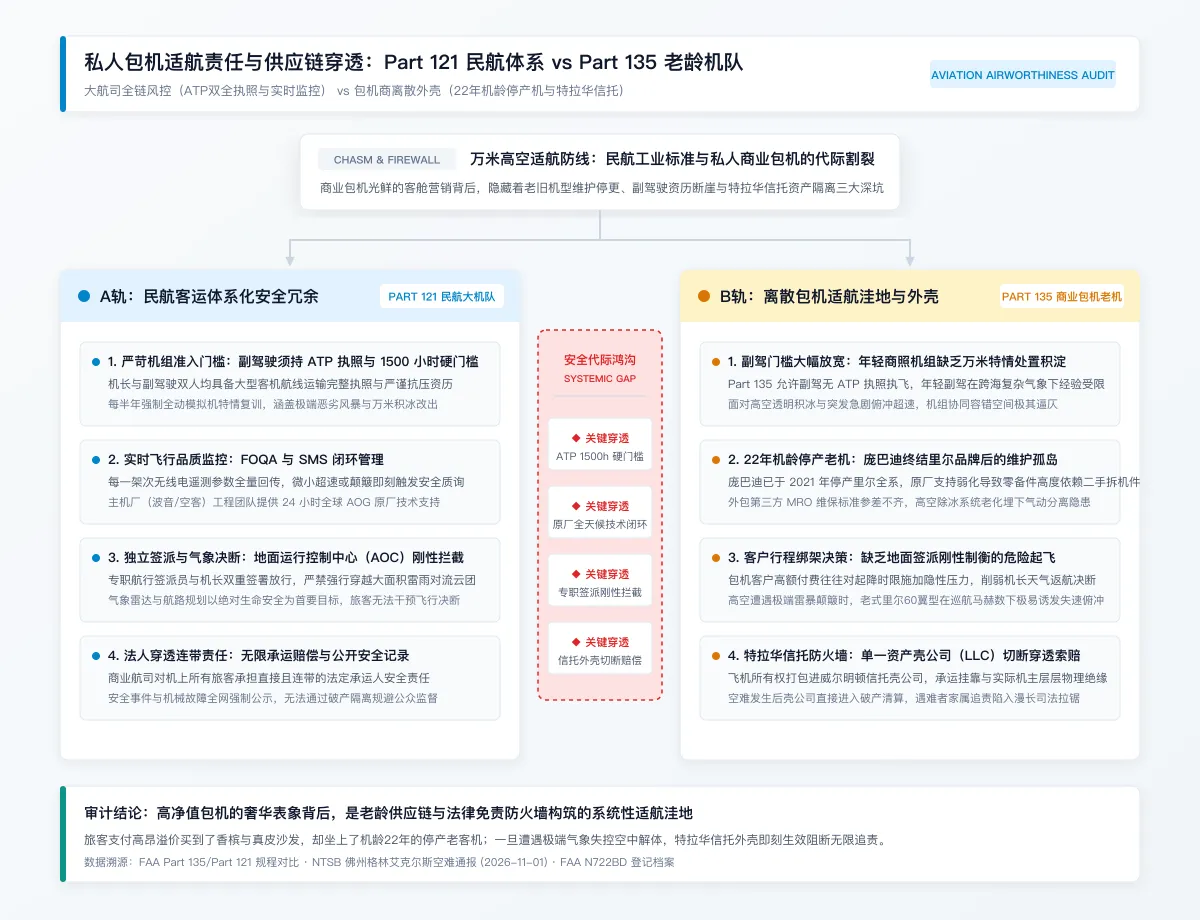
Figure 2: Generational comparison of crew qualifications, maintenance ecosystems, and legal liabilities between FAA Part 121 commercial carriers and Part 135 charter operators.
First are pilot qualification thresholds. Under Part 121 airline systems, both captains and first officers must hold Airline Transport Pilot (ATP) certificates, with first officers crossing a strict 1,500-hour flight time barrier and undergoing grueling semi-annual simulator checks for wind shear and deep-stall recovery. Under Part 135 frameworks, first officer entry requirements are vastly relaxed. Young pilots in their early twenties holding basic commercial licenses frequently occupy the right seat.
In the cockpit of the crashed Learjet 60, the left seat was occupied by 55-year-old veteran captain Jeff Gregory, while the right seat was held by 20-year-old first officer Nathalia Filgueiras. While attributing the accident solely to any individual crew member’s capability is an oversimplification, aviation physiology and engineering realities show that when a high-speed aging jet encounters severe clear-ice, violent storm turbulence, and a sudden overspeed dive simultaneously at 35,000 feet, survival rests entirely on the captain’s individual physical limits. If the first officer lacks deep muscle memory in high-altitude, adverse-weather maneuvering and high-angle-of-attack recovery, crew resource management collapses within seconds.
Even more fatal is the external distortion of operational authority. Major commercial airlines maintain robust Dispatch Operation Centers (DOC), where licensed dispatchers hold veto power over flight releases using live weather radar. When facing massive storm cells, captains can freely detour or return to base. We previously examined the jurisdictional boundaries of flight decision-making in severe weather during our analysis of Light Aircraft Extreme Emergency Responses.
In private commercial chartering, however, ground-based dispatch loops are often weak or absent. Clients pay exorbitant sums for bespoke itineraries, locking in rigid expectations for arrival times. When thunderstorms block the route, pilots face intense psychological friction between “maintaining client satisfaction” and “respecting weather minimums.” Pressured by commercial imperatives, risky decisions to skirt the edges of severe weather routinely become lethal traps.
The Delaware Trust Labyrinth: Single-Asset LLCs, Legal Firewalls, and Piercing Liability
When the roar of the crash faded, the wreckage scattered across Florida’s swamps and neighborhoods pushed grieving families into an even more brutal institutional maze: the liability-shielding firewalls built by commercial trusts and legal shells.
According to FAA registry archives, the legal owner of N722BD was not the charter platform nor the passengers who paid for the flight, but an entity named LR60271 LLC. The entity’s registered address is 1209 North Orange Street, Wilmington, Delaware—the nation’s most notorious Corporation Trust Center, harboring thousands of multinational trusts and shell companies.
Meanwhile, the firm actively soliciting clients and executing flights under commercial branding was Aurora Aviation, Inc. (operating under the trade name Upper Jets).
This structure, treated as standard operating procedure across the business jet industry, erects a meticulously engineered three-tier insulation defense:
- Capital & Brokerage Tier: Clients pay massive fees to the charter broker platform (such as Upper Jets), signing standard brokerage service agreements.
- Licensing & Compliance Tier: The broker offloads transport capacity to a certificated FAA Part 135 operating carrier (Aurora Aviation, Inc.), which assigns the flight crew.
- Asset & Title Tier: The physical aircraft asset is parked inside a Delaware single-asset limited liability company (LR60271 LLC), separating core business operations from the underlying capital via dry-lease or management agreements.
Through this Single-Asset LLC, the aircraft owner achieved physical insulation. Aside from a 22-year-old jet, the shell company held zero operational staff and minimal liquid capital. The moment a fatal crash occurs, the core asset vanishes, and the shell company immediately files for bankruptcy protection—walling off the owner’s massive personal wealth and parent corporate interests from tort litigation.
Simultaneously, the operating carrier frames itself merely as a provider of management and flight technical services. When grieving families attempt to pursue judicial accountability, they collide with a brick wall of dry-lease contracts, wet-lease clauses, broker disclaimer terms, and layered insurance policies designed to pass the buck and stall jurisdictional claims.
In complex disaster investigations and legal claims, onboard telemetry and flight recorders are the vital fulcrums needed to pierce this legal labyrinth. As we noted in our technical analysis of accident categorization and liability determination, the objective integrity of black-box telemetry serves as the statutory anchor required to break accountability vacuums—see the technical verification standards in Car Crash Telemetry and Judicial Liability Determinations. Yet, facing the bankruptcy-isolation walls erected by Delaware trusts, even if the NTSB confirms maintenance failures or crew mismanagement, victims’ families attempting to pierce the corporate veil to secure full compensation must cross a grueling judicial trench warfare.
The Baseline of Life Defense: Physical Airworthiness Hedging in High-Net-Worth Portfolios
In an uncertain world, the ultimate purpose of wealth accumulation is building a moat to protect life against fragility and disaster. Yet, this lethal midair disintegration over Florida delivers a sobering wake-up call to all business travelers: without a rigorous grasp of physical airworthiness fundamentals, self-proclaimed elite luxury consumption can easily become the most fatal vulnerability in your personal defense chain.
Faced with dazzling commercial marketing and one-click app bookings, truly prudent life defenders must establish four rigid self-inspection rules:
First, strictly audit age floors and penetrate airworthiness records. Before boarding, verify the aircraft’s tail registration number (N-Number) against official FAA public databases to confirm its actual manufacturing date and airframe age. Refuse to fly on aging small-to-medium business jets older than 15 years, particularly those whose manufacturers have discontinued parts support and production. Never subsidize worn-out legacy airframes.
Second, verify crew credentials and reject novice pairings. Require charter operators to disclose pilot qualification records explicitly. Ensure both left- and right-seat crew members hold full ATP certificates with substantial flight hours in that specific aircraft class. Refuse to entrust your life in complex high-altitude weather to inexperienced co-pilots.
Third, respect weather red lines and strip away itinerary fixations. During high-convection seasons, reject any pressure placed on pilots to fly driven by urgent business schedules. Grant flight crews the uncompromised autonomy to return or cancel flights, refusing to challenge widespread clear-ice and thunderstorms.
Fourth, pierce operating entities and verify liability insurance. Clarify whether the actual operating carrier holds complete, independent FAR Part 135 certificates. Confirm coverage limits and policy holders to avoid stepping aboard high-risk flights wrapped in layers of subcontracts, shell affiliations, and inadequate commercial insurance.
The sky bears no allegiance to the myths of wealth. Aerodynamics and metal fatigue obey only the cold laws of nature. Stripping away polished commercial packaging and legal havens to return to a baseline understanding of mechanical engineering, meteorological respect, and system redundancy forms the ultimate foundation for defending human life.
Related Research & Topics
The Anatomy of Digital Predation: Inside the Syndicate Targeting the Elderly via Livestream Appraisal Scams
Starlink V4 and the Low-Earth Orbit Satellite Arms Race: How a 100,000-Node Optical Mesh Pierces the Submarine Cable Monopoly
Tello Mobile eSIM
SafetyWing Nomad Insurance
* Disclosure: This post contains affiliate links. If you make a purchase through these links, V-G Journal may earn a small commission at no additional cost to you. We only recommend services we independently evaluate and trust.
FIRE and Golf:自由旅居之路
专注于为追求 FIRE 与品质生活的人群提供特惠打球权益与候鸟微度假。不持一砖一瓦,运营品质生活。