The Kinship Substrate of Clean Governance: How the Nuclear Family Built the Modern State
Conventional wisdom credits modern integrity to independent audits and sunshine laws, ignoring the micro-sociological bedrock beneath them. By examining the collapse of extended clan ties, this essay explores how the nuclear family broke the moral extortion of patronage and radically altered the game theory of corruption.

Executive Thesis: When explaining public sector integrity and administrative performance, modern narratives almost reflexively invoke institutional machinery: the separation of powers, judicial independence, financial disclosure laws, rigorous external audits, and an adversarial press. Yet institutional economics and political sociology point to a far quieter truth. If macro-institutions are the skyscrapers of modern governance, the nuclear family—and the profound atrophy of extended kinship networks—is the bedrock keeping those structures from collapsing under the weight of informal patronage. To understand why clean governance functions, one must first trace the hidden symbiosis among family structure, the radius of corrupt collusion, and the evolution of the state.
Comparative political science has long wrestled with an uncomfortable empirical reality: Why do so many developing nations adopt Western constitutional texts, anti-corruption bureaus, independent audits, and competitive multiparty elections, only to remain paralyzed by systemic graft and patrimonialism?
Superficial critiques attribute this failure to “immature civic culture” or “a lack of political will.” The deeper structural bottleneck lies elsewhere: the foundational operating premise of modern Weberian bureaucracy is the strict dichotomy between the public role and private interest. Public power must be completely severed from blood obligations and affective ties.
When an administrative apparatus designed for an atomized, nuclear society is mechanically transplanted onto an ecosystem dominated by extended lineages, tribal affiliations, and what sociologist Fei Xiaotong described as the “differential mode of association” (chaxu geju), formal institutions are swiftly hollowed out by subterranean kinship networks.
The relative administrative integrity achieved by Western polities was not merely an engineering triumph of legal transparency. It was the downstream product of a radical, centuries-long transformation of domestic life and kinship ethics.
I. Divergent Moral Imperatives: From Clan Obligation to Individual Autonomy
In societies structured around powerful clans, tribes, or corporate lineages, the exercise of authority is inextricably tangled with the moral economy of blood. The boundary between public and private is not merely blurred; it is morally inverted.
Kinship Models and the Ethics of Power
- Extended Clan Societies ➔ Collective liability ➔ Moral extortion and familial rent-seeking ➔ Embezzlement is reframed as filial piety; procedural impartiality is condemned as ruthless betrayal.
- Nuclear Family Societies ➔ Individual balance sheets ➔ Weak collateral claims and strict interpersonal boundaries ➔ Refusing familial demands is legally and socially legitimate; zero moral debt to extended kin.
1. Clan Extortion and the Moral Duty of Graft
Within an extended lineage, individual advancement is rarely seen as an isolated accomplishment. It is viewed as an investment return realized on the collective social capital of the clan. Once a member secures bureaucratic authority—whether discretionary permits, public procurement oversight, or municipal budgets—the extended network of cousins, uncles, and in-laws descends with claims.
In this cultural matrix, the public official faces a perverse ethical dilemma:
- Distribute public spoils to the kinship group: Far from being ostracized as corrupt, the official is celebrated by their primary social group as a paragon of loyalty, ancestral duty, and communal protection.
- Uphold institutional integrity: Denying favors to relatives and strictly following protocol gets the official branded as cold-blooded, ungrateful, and fundamentally immoral. Within their immediate reference community, their social capital drops to zero.
The lineage operates as an informal, shadow tribunal that exerts intense moral and social pressure on the bureaucrat to extract rents from the state.
2. The Nuclear Family as an Ethical Firewall
In societies organized around the isolated nuclear family, the fundamental accounting unit of social life shrinks to parents and dependent offspring.
Between adult siblings—and especially among cousins, aunts, and uncles—neither legal mandate nor cultural convention demands mutual financial underwriting. Relations are bounded and transactional.
- When an extended relative asks a public official to bend a regulatory rule, the official can cite administrative code and professional ethics to flatly refuse. This response is not only legally bulletproof; it is socially normative and completely acceptable to peers.
- The official carries no ancestral debt to the periphery of their family tree. There is no collective expectation that one person’s public promotion should bankroll the extended household.
By circumscribing the scope of familial duty, the nuclear structure starves the extended patronage network of moral momentum, allowing civil servants to manage state power unencumbered by a chorus of blood claimants.
II. The Radius of Collusion and the Transaction Costs of Corruption
In the language of institutional economics, illicit rent-seeking is an extralegal, black-market contract that cannot be enforced in a public court of law.
Parties to corrupt transactions face steep information asymmetries and immense counterparty risk. How do you guarantee that an official delivers after pocketing the bribe? How do you keep a co-conspirator from turning state’s evidence if an investigation opens? How do you launder and distribute proceeds without them being expropriated by partners?
Consequently, high-stakes political corruption relies on a scarce and delicate currency: closed, particularistic trust.
| Dimension | Extended Lineage / Clan Society | Nuclear / Atomized Modern Society |
|---|---|---|
| Substrate of Collusion | Blood relations (fathers, brothers, maternal uncles) | Restricted to the immediate core; no extended biological guarantee |
| Information Security | Ancestral shame, lineage ostracism; defection carries catastrophic social cost | Low external constraints; immense risk of secret recordings and whistleblowing |
| Typical Rent Architecture | Official signs permit ➔ cousin opens shell supplier ➔ assets held abroad | Must partner with unrelated commercial brokers; vulnerable intermediaries |
| Network Morphology | Resilient, interconnected, highly protected “family syndicates” | Fragmented, transactional, fragile point-to-point operations |
| Transaction Costs of Graft | Extremely low (high intrinsic trust, rapid alignment) | Exponentially high (defensive costs rise with every added participant) |
1. Kinship as a Native Firewall and Laundering Conduit
Where familial loyalties supersede civic duties, blood serves as a natural security protocol. Classical rent-seeking in clan-based polities tends to run on a closed loop:
- The patron controls discretionary approvals and creates artificial regulatory bottlenecks.
- A brother or brother-in-law operates the front-facing intermediary or holds equity in the favored vendor.
- Spouses or direct descendants park the yield in offshore vehicles and high-end property.
Because every node in this network is bound by shared blood and pooled intergenerational wealth, the moral and practical penalty for betrayal is ruinous. The result is a robust, resilient syndicate uniquely equipped to withstand administrative inquiries.
2. Atomization and the Exponential Costs of Collusion
In an atomized society where extended family bonds are weak or transactional, an official’s radius of absolute trust shrinks to their immediate domestic circle.
Beyond that boundary lies a landscape of strangers. If an official wishes to monetize public office, they must deal with external business figures, lobbyists, or political middlemen:
- Lacking a blood guarantee, every co-conspirator is a liability—capable of flipping for leniency, recording meetings, or absconding with the proceeds.
- The probability of detection and the costs of risk mitigation scale exponentially with every additional actor brought into the conspiracy.
A social structure built on interpersonal distance and bounded kinship acts as an invisible, punishing tax on private rent-seeking, making coordinated, sprawling graft operations remarkably difficult to assemble and sustain.
III. Historical Origins: The Church’s War on Germanic Lineages
The Western nuclear family is not an innate biological default. In antiquity, the Mediterranean and the Germanic tribes that overran the Western Roman Empire were deeply clan-oriented, reliant on blood feuds, ancestral land tenure, and powerful corporate lineages.
As Harvard anthropologist Joseph Henrich documents in The WEIRDest People in the World, Western kinship networks dissolved largely as a byproduct of a deliberate, protracted campaign launched by the Western Church.
The Institutional Lineage of Western Bureaucracy
- Early Catholic Canons ➔ Strict marital prohibitions (banning cousin marriage, levirate, adoption)
- ➔ Clan Dissolution ➔ Breakup of corporate clan estates; proliferation of independent, neolocal households
- ➔ Generalized Trust ➔ Individuals forced to cooperate with non-kin via chartered guilds, universities, and common law
- ➔ Weberian Bureaucracy ➔ Separation of public office from private estate; impersonality becomes the bedrock of state capacity
1. The Marriage and Family Program (MFP)
Beginning in the early Middle Ages, the Latin Church sought to dismantle secular aristocratic dynasties to assert ecclesiastical authority and expand its own property inheritance. It introduced what historians call the Marriage and Family Program (MFP):
- Prohibitions on Consanguinity: Marrying cousins—eventually extended out to the sixth and seventh degrees of relation—was strictly outlawed.
- Bans on Corporate Succession Tools: Adoption, concubinage, polygyny, and the levirate (forcing a widow to marry her deceased husband’s brother) were banned.
Over several centuries, these edicts made it nearly impossible for traditional lineages to keep property within corporate clans through strategic in-marriage. The sprawling, agnatic kin networks of Western Europe fractured into independent, single-couple, neolocal households.
2. From Particularized to Generalized Trust
Stripped of the protective canopy of the lineage, Europeans facing commercial, agricultural, or security risks had no choice but to build relationships with strangers.
This structural upheaval triggered the institutional innovations that set the West on its divergent path:
- People built voluntary, rules-based corporate entities: self-governing merchant guilds, monastic orders, chartered universities, and free imperial cities.
- Social coordination shifted from status (who you are related to) to contract (what you agreed to in writing).
- Social capital migrated from closed, particularized trust among kin to open, generalized trust in external rules and common standards.
The defining condition of Weberian bureaucracy—that public office is not private property, and that administration must be conducted on an impersonal, rules-based footing (sine ira et studio)—could only take root in a society where the clan had already been dismantled.
IV. The European Natural Experiment: The Hajnal Line vs. The Mediterranean
One does not need to look across continents to see that family structures govern political culture. Europe itself preserves the results of a centuries-long natural experiment.
The European Union unites Northwestern and Southern Europe under a single regulatory umbrella, common market directives, and identical democratic principles. Yet indices of administrative integrity and state capacity diverge sharply between the two regions.
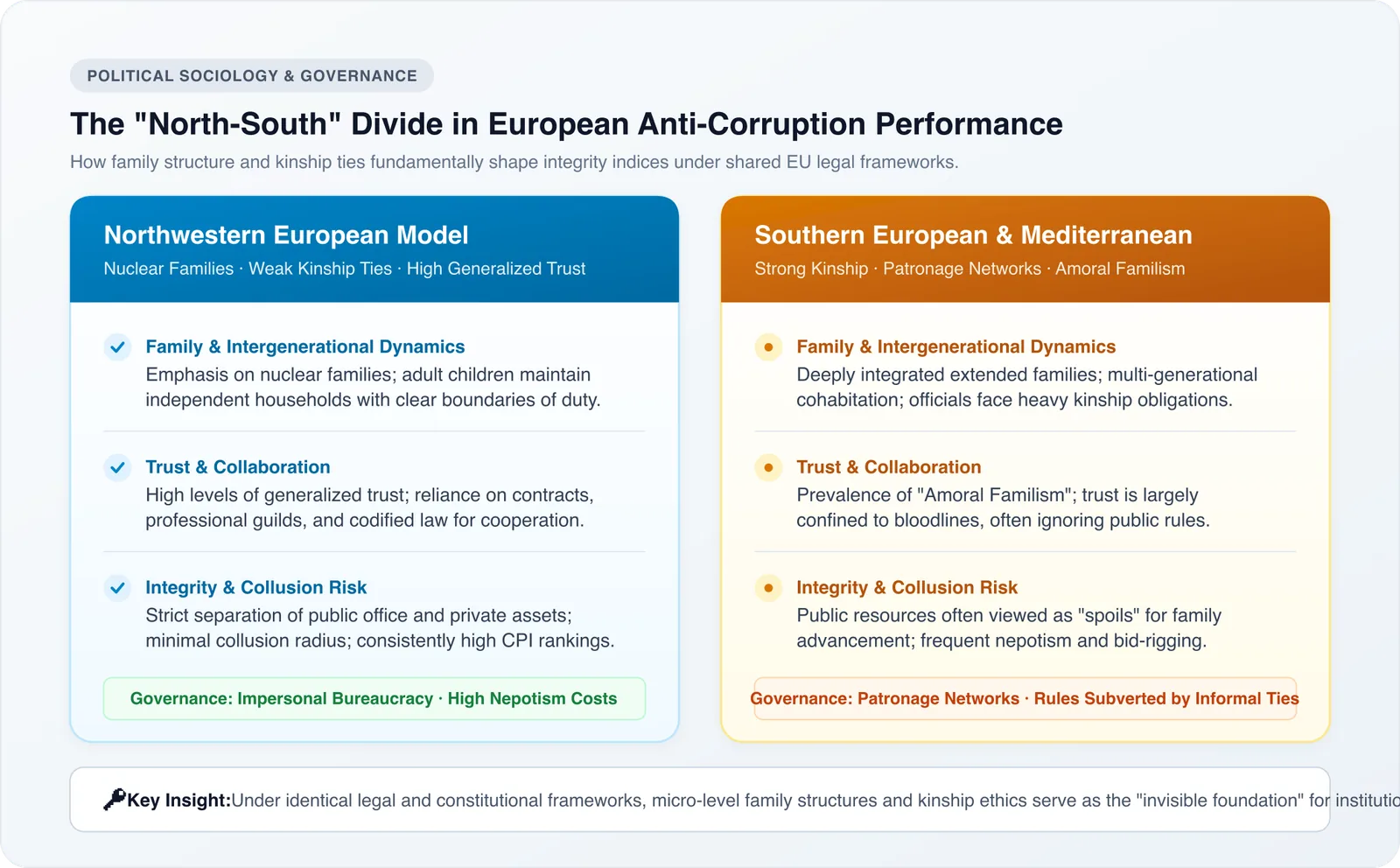
1. Northwestern Europe: Radical Independence and High Generalized Trust
North and west of the historic “Hajnal Line”—running roughly from Saint Petersburg to Trieste—societies embraced the European Marriage Pattern (EMP) for centuries. Marriage occurred late, households were strictly neolocal, and adult children left home early to work as wage laborers or servants before forming their own nuclear units. Elders relied on community funds or parish networks, not extended clan compounds.
This deep individual autonomy produced high generalized trust and negligible extended kinship safety nets. In Transparency International’s Corruption Perceptions Index (CPI), Denmark, Finland, Sweden, New Zealand, and the Netherlands routinely secure top-tier placements.
2. Southern Europe and “Amoral Familism”
South of the Alps and the Pyrenees, extended co-residence, dense familial networks, and patronage systems retained far deeper roots.
In his landmark study of Southern Italian poverty, The Moral Basis of a Backward Society, political scientist Edward Banfield coined a term that remains central to political economy: “Amoral Familism.”
He summarized its governing maxim simply:
“Maximize the material, short-run advantage of the nuclear family; assume that all others will do likewise.”
Under this social equilibrium:
- The public sphere is seen as an unowned territory to be raided for family survival.
- Following rules for their own sake is seen as foolish; exploiting public positions for the benefit of kin is viewed as basic competence.
- Classical nepotism (nepotismo—originally the practice of popes distributing secular fiefdoms to their maternal nephews or illegitimate sons) is not an aberration; it is a structural reflex with ancient roots.
Even inside the single market, Southern European administrations struggle far more than their northern counterparts with public sector payroll padding, structural tax evasion, anti-competitive public procurement, and hiring based on patronage rather than merit. The difference is not statutory; it is sociological.
V. A Sober Counterweight: The Institutional Shift of Elite Self-Interest
Analyzing the benefits of the nuclear family requires intellectual rigor, not romanticized institutional triumphalism.
The nuclear family and the decline of extended lineages did not eliminate human greed; they simply killed off crude, horizontal, clan-level rent distribution (petty bribery, cash envelopes, and physical patronage). Elite self-interest did not disappear. It became concentrated, legalized, and institutionalized.
As social structures shifted, the elite instinct moved away from spreading spoils horizontally across a wide cousinhood. Instead, it focused on maximizing the vertical, intergenerational reproduction of capital for their immediate heirs.
From Crude Nepotism to Institutionalized Advantage
- Traditional Low-Tier Corruption: Bribes, rigged contracts, ghost-payroll jobs for cousins ➔ High legal risk, highly visible, vulnerable to prosecution
- Modern Elite Rent-Seeking: Endowed admissions ➔ Discretionary family trusts ➔ The revolving door ➔ K Street lobbying and campaign finance ➔ Fully compliant, procedurally legal, insulated from public outrage
Western elites preserve advantage through sophisticated, institutionalized mechanisms:
- Legacy Admissions and Educational Monopolies: Top-tier universities openly prioritize the offspring of alumni and major donors. This seamlessly converts parental financial and social capital into elite credentials for children, avoiding the legal hazards of behind-the-scenes administrative tampering.
- Discretionary Family Trusts and Wealth Shelters: Sophisticated legal trusts and offshore entities shield generational wealth from estate taxation, preserving vast fortunes across generations in full compliance with statutory codes.
- The Revolving Door: Regulators and senior civil servants uphold impeccable procedural standards while in office, declining illicit cash. Upon leaving government, they join corporate boards, elite law firms, or strategic advisory groups, capturing deferred rents through astronomical, entirely legal retainers and speaking fees.
- Institutionalized Lobbying and Campaign Finance: Corporate interests direct policy, regulatory capture, and state procurement through legal campaign donations, political action committees (Super PACs), and specialized lobbying shops. This transforms informal, dark-room influence into a legitimate industry.
The nuclear model did not elevate human morality. It stripped away the messy, visible machinery of clan-based spoil-sharing, forcing the transfer of privilege into refined, procedural, and systemic channels of institutional reproduction.
VI. Strategic Takeaways: The Soil Beneath the State
Re-examining the institutional architecture of clean governance yields three structural insights:
- Macro-Institutions Are Simply the Superstructure: Independent judiciaries, sunshine laws, public asset declarations, and a free press are vital enforcement mechanisms, but they are downstream reflections, not root causes.
- Kinship Structure Is the Soil: The nuclear family and the breakdown of clan loyalties relieved civil servants of the moral duty to engage in familial rent-seeking. Simultaneously, it drastically shrank the trust radius required for illicit coordination, turning high-level corruption into a high-risk game with non-relatives.
- The Evolution of Rent-Seeking: Modernity did not make institutions saintly; it changed how elites play for stakes. Clean governance successfully suppressed tribal nepotism and crude administrative shakedowns. Yet every advanced society still struggles with the subtle, legal strategies that elites use to lock in generational privilege.
For anyone analyzing state capacity, institutional reform, or organizational design, evaluating legal codes without understanding the underlying kinship structure is like building a castle on shifting sand. You cannot understand the resilience of an institution without understanding the private obligations of the individuals who inhabit it.
Related Research & Topics
Tello Mobile eSIM
SafetyWing Nomad Insurance
* Disclosure: This post contains affiliate links. If you make a purchase through these links, V-G Journal may earn a small commission at no additional cost to you. We only recommend services we independently evaluate and trust.
FIRE and Golf:自由旅居之路
专注于为追求 FIRE 与品质生活的人群提供特惠打球权益与候鸟微度假。不持一砖一瓦,运营品质生活。