Of Cows and Consumables: Clarkson’s Farm and the Depreciation Paradox of Modern Labor
Why do sheep in the Cotswolds receive overnight obstetric care while delivery riders burn out against an algorithmic clock? An economic post-mortem of Clarkson's Farm, fixed asset depreciation, and the hidden mechanics of European green protectionism.

Executive Summary: In the globally acclaimed documentary series Clarkson’s Farm, former Top Gear presenter Jeremy Clarkson attempts to manage his 1,000-acre estate, Diddly Squat, nestled in the rolling hills of the Oxfordshire Cotswolds. The portrait of modern European agriculture captured on screen has disrupted the assumptions of millions across the developing world. Here, ewes graze on expansive pastures under strict rotational regimens, accompanied overnight by licensed veterinarians during difficult births. Cattle must inhabit non-slip, high-clearance barns built strictly to Red Tractor standards, while farrowing crates for sows are outlawed outright. Before slaughter, animals pass through elaborate humane stunning protocols; a farmer who works a beast to exhaustion or neglects a subclinical infection faces immediate criminal sanction. This rigorous framework of animal welfare has sparked a bitter collective realization on social media: why do livestock in Western Europe enjoy an institutional safety net and baseline dignity denied to white-collar workers and gig couriers who cynically brand themselves beasts of burden? Stripping away sentimental ethics reveals this is not mere humanitarian benevolence. It is a precise economic calculation born of capital ownership structures, surplus-value extraction, and green trade barriers.
1. The Cold Balance Sheet: Fixed Capital Assets vs. Disposable Operating Costs
When an urban professional navigating intense working hours, algorithmic delivery countdowns, and chronic stress observes Clarkson paying thousands of pounds out of pocket for a specialist veterinary team because a lamb developed a chest cough, an existential paradox inevitably surfaces. Yet once emotional grievance gives way to classical political economy and corporate balance-sheet mechanics, a stark structural reality emerges:
On a farm’s ledger, a cow or sheep constitutes a sacred, titled Fixed Capital Asset. In the profit-and-loss statements of the modern platform and industrial economy, the human worker is merely an off-balance-sheet, instantly expensed Variable Cost.
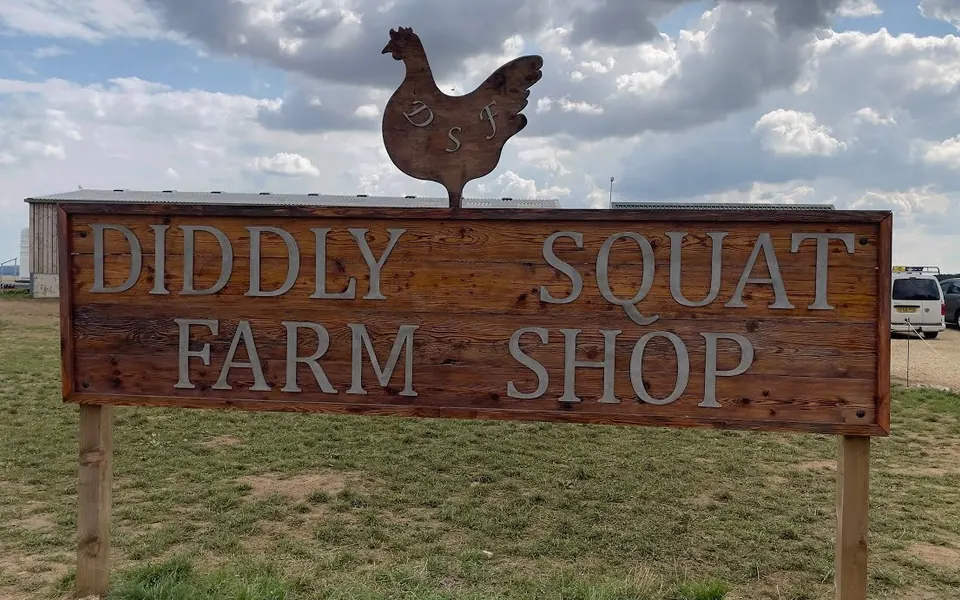
Figure 1: The Diddly Squat Farm sign. The absurd, razor-thin operating margins documented on screen expose the true price of European regulatory compliance and its associated welfare premiums.
Asset Preservation: Why Capitalists Steward Their Livestock
Purchasing a herd of Hereford cattle requires Clarkson to commit thousands of pounds in liquid capital. A cow is direct means of production. Its survival, health, and weight fluctuations map directly to the net asset value of the enterprise:
- Outright Capital Evaporation: If poor ventilation, damp concrete, or unmitigated stress causes a cow to contract bovine tuberculosis (bTB) or severe foot rot, the farm incurs a 100% unrecoverable loss of invested principal.
- Depreciation and Residual Value: Permitting a flock to chew cud across low-density acreage, trimming their hooves seasonally, and providing mineral licks is simply minimizing abnormal depreciation while optimizing the terminal salvage value of a fixed asset.
The farmer’s attentive stewardship is anchored first and foremost in the defense of exclusive private property.
Zero Switching Costs: When Human Labor Becomes a Pure Consumable
Consider, by contrast, the dynamic between platform capital and surplus labor in hyper-dense urban service economies:
- Capital Does Not Own the Worker’s Full Life Cycle: A food delivery platform owns neither the courier’s e-bike nor their physical musculoskeletal integrity. It sets aside zero depreciation reserves for chronic joint degradation, cardiovascular stress, or aging.
- Infinite Replaceability Destroys the Protective Threshold: As examined in our critique of structural load and labor alienation under mandatory leave regimes, an oversupplied labor pool transforms the worker into an off-balance-sheet consumable. When a courier collapses from systemic exhaustion, dispatch algorithms onboard a replacement within seconds. Capital bears no cost for labor’s physical maintenance or generational reproduction; those externalities are absorbed entirely by the worker’s family, the public healthcare system, and the individual body.
Between a valuable asset that must be guarded from operational decay and a self-replenishing consumable requiring zero amortized overhead, rational economic systems will unfailingly allocate better daily physical protections to the asset.
2. The Regulatory Moat: Animal Welfare as Green Protectionism
Dismissing Europe’s exhaustive animal welfare apparatus as naive moralism misjudges the strategic design of mature capitalist economies. Throughout the series, land agent Charlie Ireland incessantly reminds Clarkson that every seemingly maddening regulation must be fulfilled to the letter. Failing an inspection does not merely risk a fine; it strips the farm of its baseline certification, rendering its output legally unsellable.
This hyper-regulated animal welfare complex functions globally as an immaculate non-tariff trade barrier—specifically, a Technical Barrier to Trade (TBT).
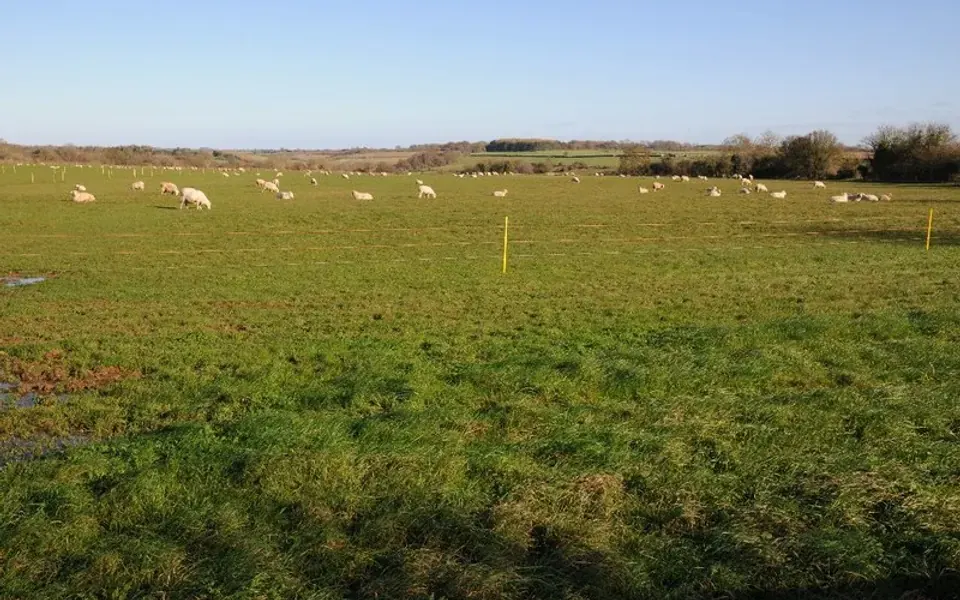
Figure 2: Expansive pastures in the Cotswolds. By legally mandating low stocking densities and humane handling protocols, Europe erects the world's highest regulatory barrier around its domestic agriculture.
| Production Variable | UK & EU Statutory Standard (e.g., Red Tractor / EU Acquis) | Conventional Intensive Farming (Developing Markets) | Strategic Trade Function |
|---|---|---|---|
| Spatial Density & Housing | Farrowing crates strictly banned; mandatory minimum square meterage per steer; straw bedding. | High-density battery cages and gestation crates designed to maximize meat yield per unit area. | Drives up unit production costs, allowing the bloc to exclude cheaper overseas meat on non-compliance grounds. |
| Antibiotics & Growth Promoters | Strict ban on prophylactic herd antibiotic treatments; absolute prohibition of beta-agonists (e.g., ractopamine). | Routine use of preventative antibiotics to prevent epidemics in dense pens; selective growth promoters. | Regulatory monopoly, using chemical residue and sanitary standards to establish exclusive market access. |
| Medical Protocol & Slaughter | Prescription veterinary oversight required; statutory, audited humane stunning prior to exsanguination. | Informal treatment of diseased stock; industrial throughput prioritized over handling ergonomics. | Monetizes moral superiority, branding local produce as ethically sound to capture domestic consumer surplus. |
By codifying these standards into binding market-entry requirements, Europe transforms historical structural disadvantages—fragmented arable land, exorbitant labor costs, and an unforgiving maritime climate—into an impenetrable defensive moat. Foreign agriculture may operate at half the cost, but without open-air pastures or enrichments for livestock, the resulting product is branded inhumane and barred by sanitary quotas or penalizing carbon tariffs.
The dignified existence of a Cotswold sheep is the ultimate seawall protecting native European farming from being hollowed out by industrialized megapens across the Americas and Asia.
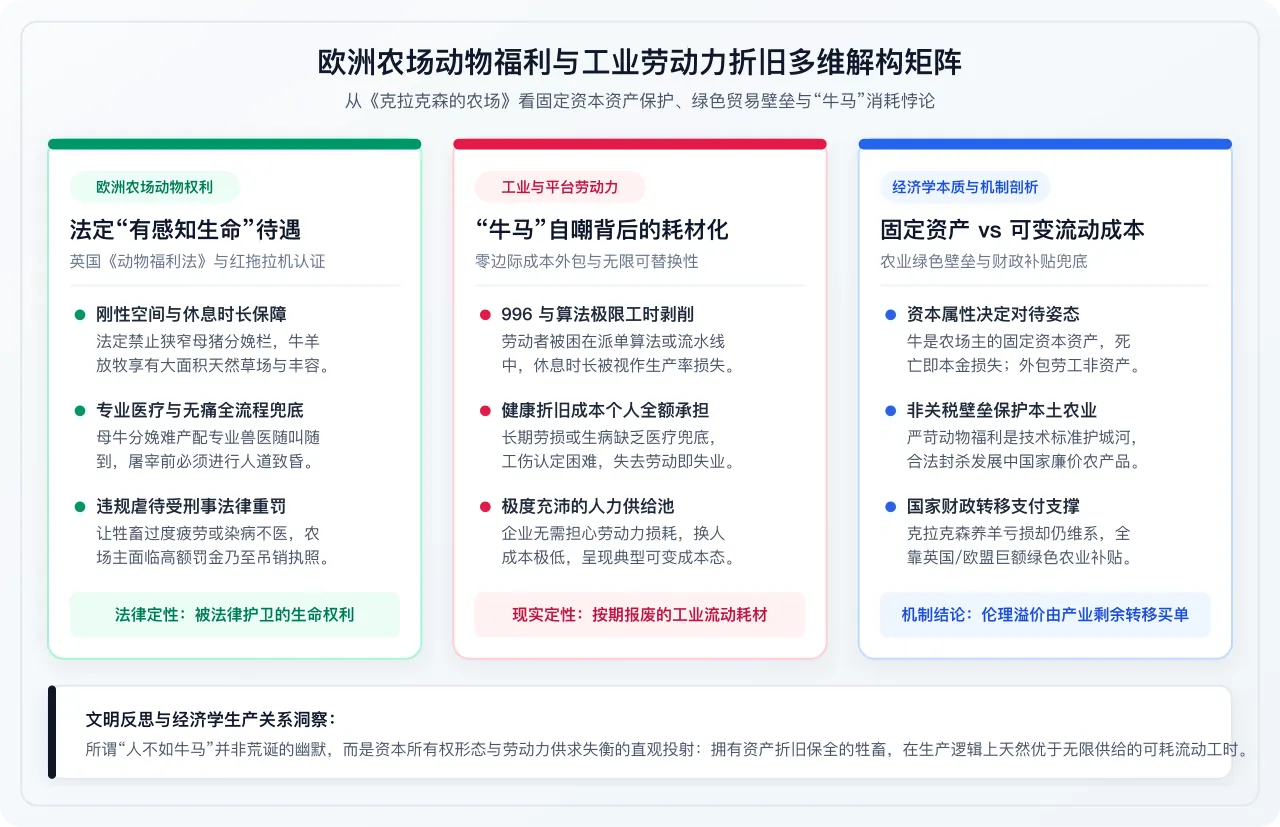
Figure 3: Analytical matrix contrasting institutional animal welfare, human labor depreciation, and capital classification.
3. Underwriting Dignity: The Truth Behind Clarkson’s £144 Annual Profit
If welfare regulations function as a commercial fortress, does the European farmer prosper within it? Hardly. The defining climax of the show’s debut season occurs when Clarkson, battered by seven-day workweeks, discovers his 1,000-acre estate yielded a net annual profit of exactly £144.
That figure shatters any pastoral romanticism. In an unfettered market, competing solely on raw commodity output, the vast majority of medium-sized family farms across the UK would face insolvency within three operational cycles.
Who, then, underwrites the dignified conditions that office workers view with envy?
Fiscal Rerouting: CAP and SFI Subsidies
European agriculture survives through extensive fiscal intervention: the European Union’s Common Agricultural Policy (CAP) and its post-Brexit British counterpart, the Sustainable Farming Incentive (SFI). The state pays farmers out of general taxation for land stewardship. Ireland regularly instructs Clarkson: preserve an uncultivated copse for wild birds, and claim a two-thousand-pound habitat grant; lower grazing densities, and collect an ecological stewardship dividend.
The humane treatment of European livestock is sustained by excess profits extracted by European industrial and financial capital at the high end of global supply chains, recycled downward through the sovereign tax apparatus.
The Moral Arbitrage of Post-Industrial Affluence
Only when a society has concluded primitive industrial accumulation and graduated to rentier status within global trade can its sphere of moral concern expand from sheer human survival to carbon sinks, open pastures, and the psychological wellbeing of poultry.
While industrial laborers in developing nations navigate healthcare out-of-pocket ratios, mortgage debt, and grueling hours, urban consumers in London and Paris pay a 40% retail markup for free-range, organic eggs. This is an asymmetry of historical accumulation: workers at the manufacturing base consume their own biological longevity to supply cheap goods, underwriting the affluence that allows post-industrial societies to indulge in moral self-congratulation.
As noted in our thesis on digital nomadism, passive income, and reclaiming human lifespan, self-deprecating memes about being treated worse than cattle accomplish nothing. Meaningful autonomy requires understanding how capital values productive assets, and systematically converting one’s finite energy from disposable operational labor into sovereign, defensible equity.
4. Coda: The Dark Comedy of Modernist Alienation
Jeremy Clarkson likely never intended his comic documentation of middle-aged rural exasperation to strike such a raw chord across the urban centers of the developing world.
At Diddly Squat, every carefully managed steer and sheep still meets an industrial end inside a vacuum-sealed plastic tray. Yet prior to that terminus, the institutional framework guarantees them protection from thirst, ambient terror, and sustained physical misery, granting them room to roam under open skies.
The bitter satire of late-stage industrial society is that humans—nominally the sovereign architects of the system—frequently surrender these basic freedoms inside cubicles and fulfilment corridors. We accommodate weeks of daylight deprivation, suppress bodily exhaustion against dynamic dispatch algorithms, and consume pain relievers to finish the quarter while ignoring clinical warning signs. At this structural juncture, human tolerance for systemic wear-and-tear far outstrips the physical stress permitted for an English steer quietly chewing cud in the Cotswolds.
Clarkson’s Farm holds up an inadvertent mirror to the modern economy. It does not reflect the nobility of European agriculture; it reveals the extent to which hyper-rationalized capital, in its relentless pursuit of yield, has treated the baseline physical dignity of human labor as an entirely negotiable cost.
Related Research & Topics
Tello Mobile eSIM
SafetyWing Nomad Insurance
* Disclosure: This post contains affiliate links. If you make a purchase through these links, V-G Journal may earn a small commission at no additional cost to you. We only recommend services we independently evaluate and trust.
FIRE and Golf:自由旅居之路
专注于为追求 FIRE 与品质生活的人群提供特惠打球权益与候鸟微度假。不持一砖一瓦,运营品质生活。