The Fall of Linguistic Friction: Autosomal DNA, Patrick Star, and the Cyber Babel on X
In mid-October 2026, a sudden cross-civilizational confrontation erupted on X between Chinese netizens and Turkish ultranationalists. Driven by Grok's real-time, zero-friction automated translation, an ideological border skirmish mutated into an asymmetric barrage of molecular genetics, memetic warfare, and imperial historiography—exposing the darker realities of algorithmic border collapse.

Executive Summary: The cross-border digital clash that erupted on X (formerly Twitter) in mid-October 2026 between Chinese users and Turkish ultranationalists began superficially as a dispute over coerced “Pan-Turkic kinship” with an ethnic Uyghur citizen. It rapidly metastasized into asymmetric memetic warfare, population genetics citations, and ancient historiography. At its root, however, the episode illustrates the violent restructuring of civilizational boundaries by artificial intelligence infrastructure. When X deployed friction-free, Grok-powered ambient translation across its algorithmic feed, language ceased to function as a shock absorber. The techno-utopian promise of a unified global village did not arrive; instead, historical grievances and geopolitical tensions collided in an open, unshielded arena.
Chapter 11 of Genesis records a foundational metaphor for human civilization: in the wake of the deluge, humanity spoke a single tongue and gathered on the plain of Shinar. Learning to bake brick and mortar, they set out to construct a tower reaching into the heavens—the Tower of Babel—to make a name for themselves and forestall dispersion across the earth. Observing that unified language fostered unbridled hubris and boundless expansionism, God confounded their speech. The grand project stalled, the tower fell into ruin, and humanity fractured into linguistic enclaves scattered across the globe.
For generations, techno-optimists viewed this parable as the inaugural tragedy of human history. Silicon Valley has long insisted that the language barrier is the primary engine of tribal prejudice, misunderstanding, and geopolitical friction. For decades, engineers labored to forge digital keys to break the curse of Babel: eradicate translation friction, the dogma went, and the world would flatten into an empathetic, borderless commons.
Yet in October 2026, a confrontation on X offered an ironic, darkly comedic rebuttal to this thesis. When large language models (LLMs) flattened linguistic friction overnight, humanity did not embrace in universal brotherhood. Instead, it stepped into an unbuffered, zero-latency digital battleground.

The collision mechanism: Grok-powered ambient translation driving cross-civilizational skirmishes in open algorithmic feeds.
I. Anatomy of the Clash: From Pan-Turkic Outreach to Asymmetric Retaliation
Tracing the trajectory of this confrontation requires analyzing how micro-level discourse on social media feeds into macro-narrative warfare across four distinct phases:
1. The Catalyst: Coerced Pan-Turkic Kinship (Mid-October)
The spark came from Turkish right-wing and Pan-Turkic accounts (most visibly @zonadilena), which shared an interaction with a young Uyghur woman from Xinjiang traveling in Turkey. Upon noticing cognates between her native Uyghur and Turkish, the creator adopted a didactic, paternalistic posture, invoking the grand Pan-Turkic meta-narrative: asserting that all Turkic-speaking peoples belong to a singular family and urging her to “reclaim her true Turkic patrimony.”
The traveler rejected the proposition outright. She explicitly affirmed her identity as a citizen of the People’s Republic of China, declining the uninvited political adoption.
Stung by the public rebuff, the creator aired his grievances on X. What began as wounded ego escalated into broadsides against Chinese territorial integrity and historical sovereignty. Ultranationalist Turkish users piled on, regurgitating well-worn tropes—including the assertion that imperial China constructed the Great Wall out of terror toward their nomadic “Turkic ancestors.”
2. The Chinese Counteroffensive: Memetics, Population Genetics, and Historiography
When X’s algorithmic feed cross-pollinated these provocations into Chinese-language timelines, it triggered an immediate, decentralized counterstrike. Unbound by the measured cadences of diplomatic protocol, veteran netizens dismantled the opposing narrative across three vectors:
- Visual Semiotics (The Patrick Star Flag): Rather than matching the sea of Turkish crescent-and-star flags with standard insults, Chinese users deployed a meme: a pink silhouette of Patrick Star from SpongeBob SquarePants, seen from behind, legs splayed mid-skydive. Geometrically, the negative space and silhouette mirrored the iconic crescent moon and five-pointed star with uncanny fidelity. Accompanied by the caption, “Did you model your national banner after Patrick Star skydiving?” the visual went viral, racking up tens of millions of impressions and puncturing the solemnity of the national symbol.
- Molecular Anthropology (Deconstructing the Anatolian Genome): When Turkish accounts appealed to pure, unconquerable nomadic bloodlines descending from the Xiongnu and Göktürks, Chinese users retaliated with peer-reviewed paleogenomic studies. Drawing from autosomal and Y-chromosome haplogroup sequencing, they cited genomic data showing that modern Anatolian Turks carry roughly 10% to 15% Central Asian Turkic steppe ancestry. The overwhelming balance of their genetic profile traces back to assimilated indigenous Anatolians, Greeks, and Armenians. The rebuttal was blunt: “You revere nomadic tribes crushed and driven west by the Han and Tang dynasties as your exclusive forefathers, yet your autosomal sequencing reveals you are genetically cousins to the Greeks across the Aegean.” Striking at the biological foundation of their racial mythology produced acute cognitive dissonance.
- Historiographical and Macro Realpolitik: Chinese users laid out historical timelines: Emperor Taizong of the Tang Dynasty shattered the Eastern Turkic Khaganate, escorted Illig Qaghan to Chang’an to dance before the imperial court, and was acclaimed by the northwestern nomadic confederations as Tian Kehan (Heavenly Khagan). They also pointed out that the foundational sections of the Great Wall preceded the historical emergence of the Göktürks by nearly eight centuries. Turning from antiquity to current affairs, users posted charts tracking the historical collapse of the Turkish lira against the US dollar and runaway domestic inflation: “Check the price of meat and butter in the Grand Bazaar and fix your currency before you rebuild an imaginary steppe empire.”
3. The Geopolitical Old Guard Joins: Multi-Front Attrition (Late October)
As engagement metrics surged, Greek users—Turkey’s historic regional rivals—entered the fray. A tacit coalition formed: Greek accounts flooded comment sections with the Byzantine double-headed eagle, revived memories of Constantinople, and amplified genomic comparison charts. Armenian, Kurdish, and Russian-language users joined the periphery. What began as a localized street-level exchange expanded into a multi-front audit of modern Pan-Turkist revisionism.
| Contested Dimension | The Provocation | Scientific and Historiographical Audit |
|---|---|---|
| Individual Identity & Sovereignty | Unilateral assertion that all Turkic speakers belong by default to a Pan-Turkic collective. | Linguistic categorization does not dictate modern political allegiance; the individual exercised self-determination as a PRC citizen. |
| National Symbology | Flooding timelines with the crescent and star as an instrument of nationalist intimidation. | Demystified through memetic subversion (the Patrick Star silhouette), converting a sacred geopolitical emblem into digital satire. |
| Lineage & Genetic Composition | Claims to pure, unbroken nomadic steppe ancestry descending from the Xiongnu and Göktürks. | Modern population genetics shows Central Asian steppe ancestry in Anatolian Turks averages ~10–15%, with the remainder derived from indigenous Anatolians, Greeks, and Armenians. |
| Historiography of the Great Wall | The assertion that the Great Wall was built entirely out of fear of modern Turkey’s direct forebears. | The Great Wall’s core networks were built during the Warring States, Qin, and Han eras—hundreds of years before the 6th-century emergence of the Göktürk Khaganates. |
| Macro Realpolitik & Leverage | Invocations of neo-Ottoman and Pan-Turkic hegemony as contemporary geopolitical leverage. | Hyperbolic imperial rhetoric is undermined by macroeconomic reality, including prolonged structural inflation and sustained currency depreciation. |
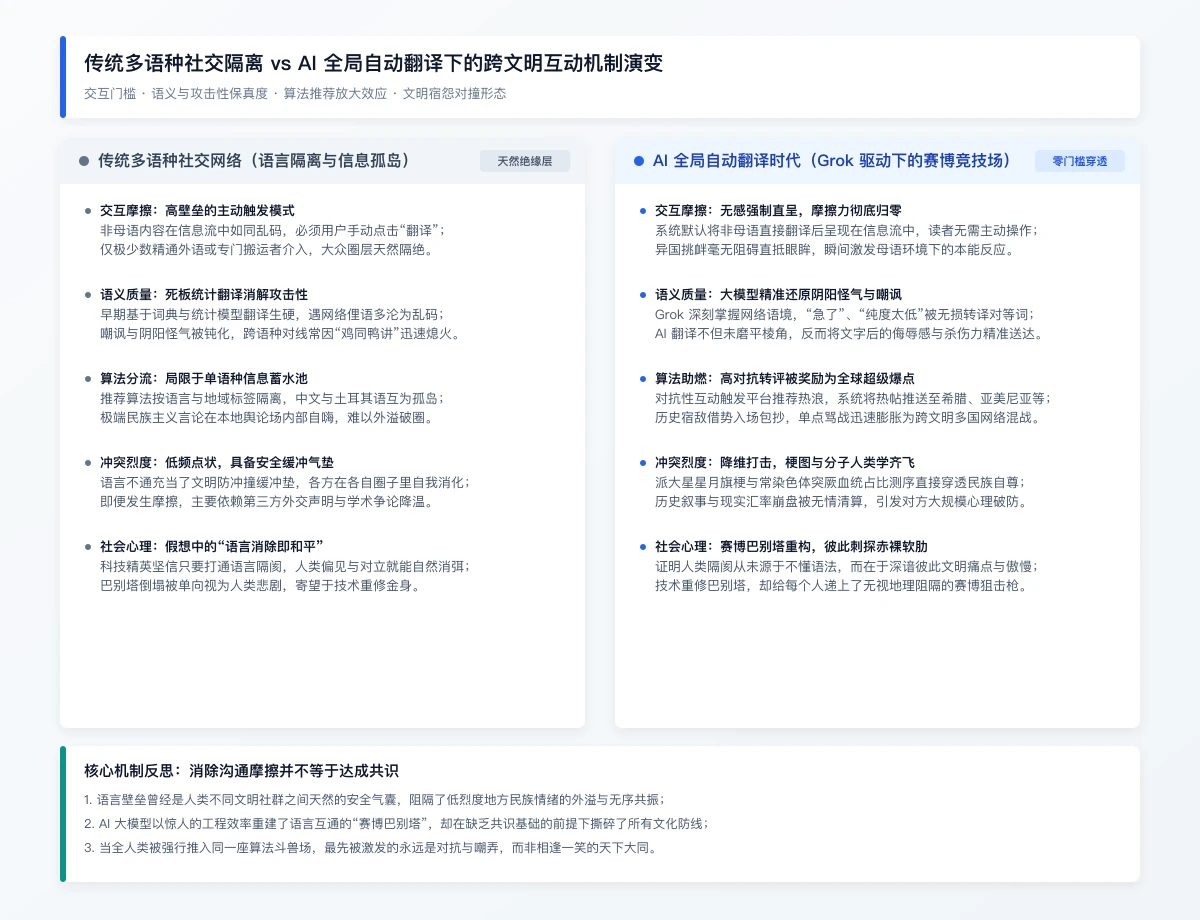
Evolutionary comparison: traditional linguistic firewalls versus the zero-friction arena of ambient AI auto-translation.
II. The Architecture of Escalation: The Role of Real-Time Translation on X
In dissecting this multi-front exchange, a core technical question emerges: Did the automated translation architecture of X act as the indispensable catalyst?
The evidence indicates that it did. Without X’s ambient, LLM-driven infrastructure, this dispute could not have scaled into an international incident. This was not a routine feature update; it represented a fundamental transformation in digital communication:
1. The Fall of the Linguistic Firewall: From Opt-in Ingestion to Involuntary Direct Exposure
Under the Web 2.0 architecture, language functioned as a natural shock absorber separating disparate cultural spheres. Turkish, an Altaic Turkic language, and Chinese, an independent Sino-Tibetan tongue, existed in mutually unintelligible digital silos. Even on the same platform, users occupied parallel universes.
Cross-linguistic engagement once required deliberate user action. Coming across an unfamiliar script, a user had to pause, register curiosity, and manually tap “Translate Post.” That minor friction filtered out more than 95% of passive exposure.
Following X’s platform-wide integration of real-time ambient translation, that barrier vanished. In algorithmic feeds like “For You,” foreign-language posts are rendered directly into the user’s native tongue by default.
Friction dropped to zero. A Chinese user did not need to seek out Turkish content; an antagonistic remark arrived pre-translated into fluent Chinese. Turkish users saw sharp Chinese rebuttals rendered in native Turkish prose on their own timelines. Cultural barriers no longer blunted incoming attacks.
2. Grok and the Preservation of Contempt
Early rule-based or statistical machine translation engines often failed to navigate subtext, flattening slang, irony, and cultural allusions into clumsy gibberish. Cross-border arguments typically fizzled out due to mutual confusion.
The large language model underlying X, Grok, was explicitly tuned to decode real-time internet vernacular, sarcasm, and high-context cultural discourse.
Consequently, idiomatic Chinese put-downs—phrases meant to mock unearned familiarity, highlight genetic contradictions, or ridicule bad-faith histrionics—were translated into Turkish with their edge intact. Rather than bridging gaps, the AI acted as a ballistic stabilizer, translating nuanced scorn across language barriers with minimal semantic decay.
3. The Economics of High-Entropy Hostility
The foundational incentives of X’s recommendation engine remain straightforward: dwell time and high-arousal engagement dictate distribution.
Once auto-translation eliminated the comprehension barrier, a contentious thread drawing thousands of rapid, hostile quote-tweets was flagged by the system as high-value engagement. The algorithm fed this fire directly into adjacent language ecosystems—bringing Greek, Middle Eastern, and Western users into the loop. Ambient translation laid the tracks, and the recommendation engine stoked the boiler, turning an isolated spat into an algorithmic spectacle.
III. Geopolitical Realism: Memetic Victory vs. Sovereign Statecraft
Analyzing this collision requires separating social media theater from geopolitical reality, avoiding the uncritical triumphalism that often clouds online discourse:
1. Distinguishing Online Skirmishes from Bilateral Diplomacy
Post-incident commentary on domestic platforms often framed the exchange as a decisive geopolitical victory, claiming Chinese netizens had “routed Turkey” on the digital battlefield. In the realm of international relations, this was a localized clash between individual platform users. It did not reflect official state policy, nor did it alter bilateral diplomacy, infrastructure initiatives under the Belt and Road framework, or trade and foreign direct investment flows between Beijing and Ankara.
2. The Complex Intersection of Paleogenomics and Modern Identity
The paleogenomic evidence deployed by Chinese netizens dismantled the romanticized claim that modern Anatolian Turks are direct, unmixed descendants of ancient Central Asian steppe nomads.
However, in anthropology and political science, modern national identity and biological lineage rarely match in simple, linear ways. The modern Turkish nation-state was forged from the collapse of the Ottoman Empire through Kemalist secular modernization and generations of cultural assimilation across Anatolia. While genetic data can puncture aggressive historical myths, it does not dissolve the complex political reality of modern national identity.
As observed in the dynamics of the Azerbaijan-Iran power structure, expansionist mythologies built on language and imagined shared ancestry often prove fragile when confronted with hard scientific and historical evidence.
IV. The Paradox of the Rebuilt Tower: Why Flattening Borders Deepens Fractures
Beyond the mechanics of the online dispute lies a broader philosophical question: If artificial intelligence has successfully reconstructed the Tower of Babel, why has it amplified hostility rather than harmony?
1. Language Was Never the Root of Conflict, but Its Shock Absorber
Techno-utopianism long suffered from a basic misunderstanding: the assumption that human conflict stems primarily from an inability to understand one another’s speech.
The Genesis narrative suggests otherwise: linguistic divergence was an intervention against human hubris, not the root of its discord. Human fractures stem from resource competition, geographic collisions, historical trauma, and incompatible worldviews.
For centuries, linguistic friction functioned as a protective buffer between civilizations. Extreme nationalism and parochial prejudices were largely contained within native-language ecosystems, where they churned, decayed, or burned out locally. They lacked the velocity to strike distant populations directly.
2. The Unshielded Arena: Confronting Grievance at Zero Latency
By deploying large language models to dissolve that buffer, platforms did not suddenly endow human nature with cross-cultural empathy.
Instead, they pulled disparate populations out of their linguistic sanctuaries and thrust them into a crowded, algorithmically amplified colosseum.
As detailed in the analysis of the AI cognitive horizon and the Gorilla Problem, the rapid advance of technological capacity often leaves our primitive instincts completely exposed. In this newly configured digital terrain, users were handed precision-targeted rhetorical weapons, capable of striking historical and psychological vulnerabilities in another culture’s native tongue without loss of fidelity.
Technology reassembled the scattered bricks of Shinar into a sprawling cyber Babel. Yet standing atop the reconstructed tower and looking down upon one another, humanity’s first instinct was not to reconcile, but to reach for loose stones and take aim.
Diagnostic Assessment
- Finding 1 (Empirically Verified): The incident originated when a Turkish ultranationalist creator attempted to impose a Pan-Turkic identity on a Chinese Uyghur citizen and was rebuffed. Chinese users countered using population genetics research alongside the Patrick Star visual meme. X’s real-time, ambient translation powered by Grok eliminated interaction friction and served as the primary technical catalyst for the escalation.
- Finding 2 (Rhetorical Inflation): Assertions that this exchange represented an official geopolitical clash, a total surrender by one side, or the formalization of a multinational digital alliance are online hyperbole divorced from diplomatic and institutional reality.
- Finding 3 (Structural Implication): AI removes the linguistic friction of communication, but it cannot resolve historical and civilizational divides. Without shared cultural baselines or conversational boundaries, frictionless ambient translation paired with engagement-driven recommendation algorithms reliably turns latent historical friction into active digital conflict.
Related Research & Topics
Tello Mobile eSIM
SafetyWing Nomad Insurance
* Disclosure: This post contains affiliate links. If you make a purchase through these links, V-G Journal may earn a small commission at no additional cost to you. We only recommend services we independently evaluate and trust.
FIRE and Golf:自由旅居之路
专注于为追求 FIRE 与品质生活的人群提供特惠打球权益与候鸟微度假。不持一砖一瓦,运营品质生活。