Orbital Industrialism: Declassifying Shenlong and the New Mechanics of Space Power
The Pentagon's strategic release of long-held orbital imagery depicting China's Shenlong spaceplane reveals a fundamental shift. Unlike the Strategic Defense Initiative's conceptual bluffing, today's Sino-American space competition is an attritional industrial contest governed by marginal launch costs and manufacturing throughput.

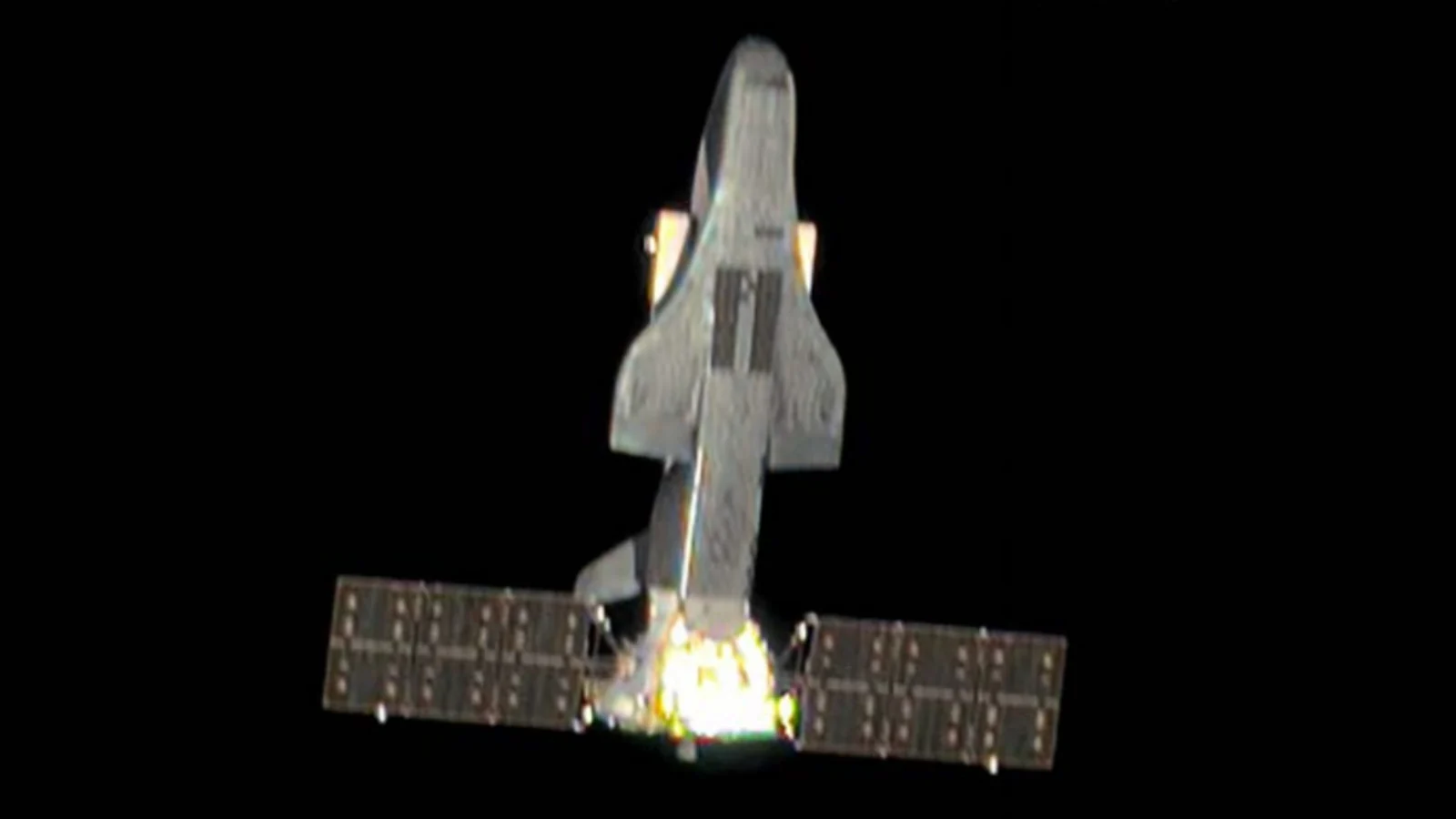
Figure 1: High-resolution optical imagery captured via non-earth imaging (NEI) by a Maxar commercial satellite during an orbital rendezvous with China's reusable experimental spaceplane (Shenlong).
In late October 2026, on page 53 of its publicly released Challenges to Security in Space 2026 report, the U.S. Defense Intelligence Agency (DIA) disclosed high-resolution optical imagery of China’s reusable experimental spacecraft—designated CSSHQ by Western intelligence, and colloquially known as Shenlong (“Divine Dragon”). Captured in May 2024 by a commercial remote-sensing satellite, the imagery had been sitting in Pentagon archives for nearly two and a half years before being abruptly downgraded and declassified.
The release sent ripples through global defense and aerospace communities. Yet to understand what is unfolding in orbit, one must discard the historical template of the 1980s. Unlike President Ronald Reagan’s Strategic Defense Initiative (SDI)—which relied heavily on high-concept optics and narrative leverage to draw the Soviet Union into fiscal exhaustion—the contemporary Sino-American space race has abandoned ideological bluffing. It has transformed into something far more grounded: a grinding, hardware-centric contest of orbital maneuvers, end-to-end supply chain throughput, and the cold economic law of marginal cost per kilogram to orbit.
I. Deconstructing the Signal: Bureaucratic Timing and Orbital Realities
The release of these photographs was not a sudden intelligence breakthrough. It was a calculated political signal—a structured downgrade timed to shape legislative narrative.
Cross-referencing the DIA report text with independent orbital tracking data reveals a precise sequence of events:
- The Acquisition Mechanics: On May 28, 2024, an optical satellite operated by Maxar Technologies (now Vantor) leveraged Non-Earth Imaging (NEI) techniques to capture sub-meter optical imagery of the Chinese spaceplane from a rendezvous orbit approximately 90 kilometers away. At the time, the spaceplane was executing its third orbital test mission (launched in December 2023, returning safely to a runway landing in September 2024 after 268 days in orbit).
- Structural Confirmation: The images ended years of speculation regarding the airframe’s geometry. The vessel features a low-aspect-ratio delta wing blended with a lifting body layout, twin V-shaped vertical stabilizers, an open mid-section payload bay, and an attached aft service module equipped with deployable solar arrays. Most notable for Pentagon analysts, however, was the presence of a small companion object operating in close proximity, hovering and oriented relative to the spacecraft’s aft section.
- Institutional Incentives for Release: Sitting on classified imagery for 30 months only to release it in late 2026 points to defense politics in Washington. The U.S. Space Force (USSF) is approaching a crucial budget cycle, compounded by the fact that China’s fourth orbital mission—launched in early 2026—remains in long-duration orbit. The Pentagon needed a visually unambiguous artifact to anchor its case for expanded capital allocation toward next-generation X-37B modifications and space-based defense programs.
II. Comparative Hardware Paradigms: Shenlong vs. X-37B
To understand the operational dynamics of this contest, the empirical capabilities of both platforms must be evaluated within a unified framework.
| Metric / Technical Dimension | China’s Shenlong (CSSHQ) | U.S. Space Force X-37B (OTV) | Operational Implications |
|---|---|---|---|
| Flight History & Operational Span | First flight 2020; three completed long-duration missions; 4th extended orbital mission ongoing | First flight 2010; seven completed missions (OTV-1 through OTV-7) | Both powers possess mature autonomous runway recovery and lifting-body atmospheric reentry capabilities. |
| Orbital Endurance & Maneuverability | 276 days (2022), 268 days (2023); repeated cross-plane and wide-margin orbital altitude shifts | Reached 908 days (OTV-6); OTV-7 utilized Falcon Heavy to explore highly elliptical deep-space orbits | USSF prioritizes extreme orbital persistence; China emphasizes rapid mission cadence and dense low-Earth orbit (LEO) maneuvering. |
| Rendezvous & Proximity Operations (RPO) | Payload deployment, close-range formation flying, hovering, and re-docking capabilities (confirmed by 2024 imagery) | Classified payload delivery, space-environment materials testing, secondary satellite ejection | Spaceplanes have evolved beyond simple gliders into orbital workhorses capable of physical inspection, payload manipulation, and proximity interaction. |
| Airframe & Service Module Architecture | Lifting body with delta wings; detachable rear service module hosting modular payloads and power arrays | Compact lifting body with twin V-tails; integrated aft service ring; internal solar deployment | Parallel aerodynamic choices, though China’s detachable service module offers distinct flexibility for modular mission payloads. |
The verified ability of the Shenlong platform to deploy sub-payloads, conduct formation flying, and execute reverse docking demonstrates that it is not merely a shuttle for point-to-point transit. It operates as an orbital utility platform—a long-endurance vessel capable of payload deployment, target inspection, and complex rendezvous and proximity operations (RPO) in low Earth orbit.
III. The Cold War Prism: The Illusion and Reality of SDI
As commentators invoke the specter of a “New Space Race,” popular commentary frequently draws parallels to the Strategic Defense Initiative launched in 1983. However, comparing contemporary dynamics to Cold War history ignores a fundamental inversion of economic and technical realities.
1. SDI as High-Dimensional Strategic Bluff
The original “Star Wars” program served as a masterclass in strategic distraction. Leveraging America’s early superiority in computing, software, and media dominance, Washington projected a vision of an orbital defense shield that was physics-adjacent but engineering-impossible at the time:
- Conceptual Unfeasibility: Megawatt-class chemical lasers, X-ray nuclear-pumped directed-energy systems, and autonomous kinetic interceptor networks (“Brilliant Pebbles”) were unworkable within the constraints of 1980s materials science, orbital logistics, and power density.
- Psychological Impact: Despite its practical unfeasibility, SDI created intense strategic anxiety in Moscow. Soviet leadership feared that an effective American missile defense shield would unilaterally collapse the framework of Mutually Assured Destruction (MAD), stripping the USSR of its secondary nuclear deterrent.
- The Attritional Trap: Compelled to respond despite an ailing civilian economy, the Soviet state diverted immense capital into heavy industrial responses: the massive 100-ton Energia-Buran shuttle system (costly, over-engineered, and retired after a single uncrewed flight in 1988) and the short-lived Polyus (Skif-DM) orbital combat platform. The USSR burned real industrial capacity trying to counter American conceptual diagrams and laboratory prototypes, accelerating its own financial exhaustion.

Figure 2: Evolution of strategic logic: Cold War conceptual attrition vs. contemporary orbital industrialism.
IV. Paradigm Shift: Three Structural Fractures in the New Space Dynamics
Equating current orbital competition to Cold War dynamics misses a fundamental shift in technical transparency, industrial capacity, and doctrine.
1. From Conceptual Illusion to Physical Verification
The Cold War SDI era thrived on strategic ambiguity and information asymmetry. Today, conceptual bluffing is obsolete.
China’s operational footprint in space is not limited to secret spaceplanes; it includes the mass deployment of the Qianfan (G60) mega-constellation, the GW satellite network, and the continuous operation of the Tiangong space station. Concurrently, the U.S. leverages commercial assets like Starlink and its military derivative, Starshield, alongside the deep-space capabilities of the X-37B.
Every orbital adjustment, payload separation, and attitude change is physically visible to ground-based phased-array radar networks and commercial space-based optical sensors. In a hyper-transparent orbital environment, neither power can deter the other with unbuilt concepts or narrative spin.
2. The Inversion of Cost Dynamics and Industrial Throughput
During the Cold War, the U.S. weaponized its broad consumer economy and semiconductor sector to outspend a rigid Soviet military-industrial complex. In the current era, the underlying cost dynamics present a very different picture:
- The Industrial Baseline: China’s space access model is designed around long-term unit economics. The development of reusable spaceplanes and launch systems is explicitly tied to driving down the marginal cost per kilogram to orbit. This infrastructure directly supports orbital manufacturing, station logistics, and commercial constellation deployment. Backed by a vast domestic manufacturing supply chain, China’s hardware iteration cycles and engineering throughput serve as an economic buffer against external attritional strategies.
- Defense Procurement Inflation: While private innovation in the U.S.—most notably SpaceX—has revolutionized launch economics through reusable architecture and pushed the limits of heavy orbital launch systems, legacy defense procurement within the Pentagon faces severe structural headwinds. Cost overruns and delivery delays remain prevalent across traditional defense contractors—exemplified by operational setbacks in Boeing’s Starliner program or the high per-launch cost of non-reusable systems like the SLS. Relying on legacy procurement models for high-cadence, multi-orbital operations presents significant long-term fiscal challenges.
3. Generational Shift in Orbital Doctrine
Space is no longer an arena defined solely by high-value, singular targets. During the Cold War, space warfare doctrine focused on anti-satellite (ASAT) weapons designed to destroy isolated, multi-billion-dollar reconnaissance platforms. However, as demonstrated by incidents such as the breakup of US intelligence satellites in orbit, large individual orbital assets are inherently vulnerable to kinetic interceptors and orbital debris.
Modern space power relies on a dual-layer operational model: Distributed Constellations combined with Rendezvous and Proximity Operations (RPO).
- Mega-constellations comprising thousands of low-cost LEO satellites provide network redundancy; no single kinetic strike can disable the system.
- Highly maneuverable spaceplanes like Shenlong and the X-37B operate as multi-role platforms—capable of long-duration loitering, orbital adjustments, payload manipulation, and close-range inspection.
In this environment, static, high-value orbital assets no longer enjoy absolute security. Flexibility and operational tempo have replaced sheer size as the primary metrics of survivability.
V. The Gravity of Industrial Capacity
The DIA’s decision to declassify two-and-a-half-year-old commercial satellite imagery reflects a broader effort within Washington to frame the evolving strategic landscape.
Four decades ago, narrative framing and conceptual asymmetry played a central role in shaping the strategic outcome of the Cold War, capitalizing on systemic vulnerabilities within the Soviet economic engine. Applying that same playbook to today’s competition, however, overlooks the structural reality of modern orbital operations.
Contemporary space power is not defined by cinematic narratives or speculative hardware. It is governed by assembly line throughput, rapid launch turnarounds, and the unyielding marginal cost per kilogram to orbit. As narrative ambiguity gives way to physical reality, power in the orbital domain ultimately rests on a familiar metric: the capacity to build, launch, and sustain physical infrastructure in space at scale.
Related Research & Topics
Tello Mobile eSIM
SafetyWing Nomad Insurance
* Disclosure: This post contains affiliate links. If you make a purchase through these links, V-G Journal may earn a small commission at no additional cost to you. We only recommend services we independently evaluate and trust.
FIRE and Golf:自由旅居之路
专注于为追求 FIRE 与品质生活的人群提供特惠打球权益与候鸟微度假。不持一砖一瓦,运营品质生活。