The Reincarnation of Ma Jiajue: Dormitory Violence and the Crisis of Mandatory Co-Living
Deconstructing the dark internet folklore surrounding campus dormitory violence in China, fact-checking recent stabbing incidents, and examining how mandatory communal housing turns trivial domestic friction into catastrophic violence.

Executive Summary: Whenever rumors of campus dormitory violence surface across the Chinese internet, the name Ma Jiajue resurfaces as an inescapable rhetorical lightning rod. Among Gen Z, this memory has mutated into a grimly cynical meme: the “reincarnated tulku” of a notorious killer returned to the barracks. Yet online sensationalism routinely obscures the structural mechanics beneath the bloodstains: from the historical misremembering of a 2004 hammer bludgeoning as a “knife attack,” to recent unverified social media leaks, to the October 2026 rumors out of Southern University of Science and Technology (SUSTech) in Shenzhen. Piercing through heavy-handed institutional information control—and parsing isolated domestic friction from structural workplace retaliation and external random assaults—is essential to diagnosing the volatile pressure cooker of China’s mandatory university housing system.
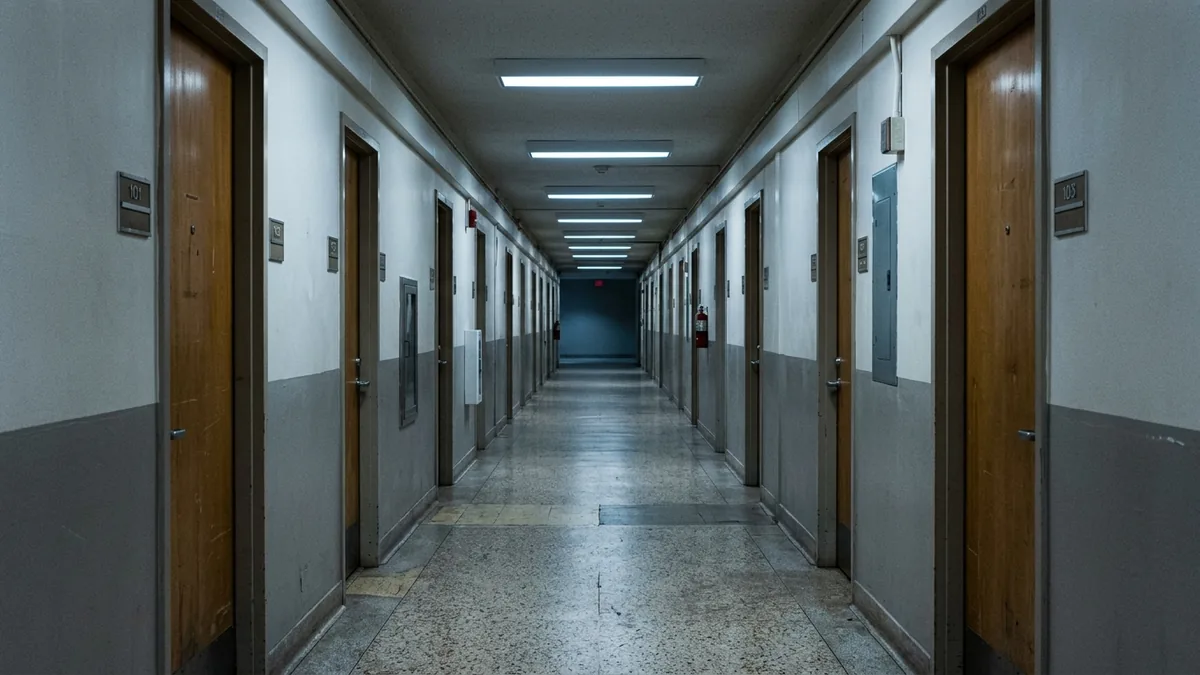
Figure 1: A silent university dormitory corridor late at night: spatial compression and unvented friction in high-density communal living.
1. Deconstructing the Symbol: The Generative Mechanics of the “Ma Jiajue” Meme
On Tieba, Zhihu, and overseas Chinese networks on X (formerly Twitter), whenever reports break of university students drawing blades against roommates, comment sections predictably erupt with black humor: “The reincarnated tulku of Ma Jiajue has arrived,” or “Ma Jiajue II has returned to the dorms.” Grafting an atrocious homicide onto Tibetan Buddhist reincarnation concepts is grotesque online satire, yet its enduring resonance reveals an underlying sociological truth.
The viral potency of this meme across a generation born long after the original crime rests on a confluence of historical myth, demographic coincidence, and acute claustrophobia:
-
Cognitive Drift on Weapons and Nomenclature: Popular folklore persistently mislabels the perpetrator’s name as “Ma Jiajue” (using homophonous characters) and misremembers the weapon as a butcher knife. The actual judicial record from the February 2004 Yunnan University case is unambiguous: Ma Jiajue bludgeoned four classmates to death inside their dorm room not with an edged weapon, but with an iron masonry hammer, hiding their bodies in an armoire before fleeing. He was apprehended and executed by firing squad on June 17, 2004.
-
The Twenty-Year Chronological Convergence: Ma was executed in the summer of 2004. By 2024–2026, the current cohort of Chinese undergraduate and graduate students comprises individuals born between 2003 and 2006. Cynical web commentators latched onto this temporal parallel: The executed killer would, twenty years later, be precisely college-aged and reappearing in the dorms. The algorithmic collision of dates turned historical trauma into a gallows-humor trope.
-
Psychological Deterrence Against Micro-Aggression: Trapped within four- to six-person rooms under state-mandated communal living, students face incompatible sleep schedules, sensory overload, and social ostracization with zero institutional off-ramps. The warning—“Do not push the quiet kid, lest you summon the reincarnated Ma”—has evolved into a weaponized rhetorical shield, using the specter of extreme historical violence to establish an artificial buffer against routine, daily boundary violations.
2. Piercing Information Noise: Fact-Checking Campus Weapon Incidents
When evaluating violent incidents in Chinese tertiary institutions, one must reject the bureaucratic fallacy that “an unconfirmed event equals an invented rumor.” Universities are hyper-sensitive administrative nodes bound by rigid political stability quotas. Their standard operating protocol for internal violent outbreaks is quiet administrative containment and narrative cooling. Barring mass-casualty attacks that bypass local censors, standard police blotters are either delayed, heavily redacted, or omitted entirely.
This vacuum pushes primary footage, eyewitness testimony, and desperate pleas into overseas channels like X. Cross-referencing verified legal verdicts and open-source materials reveals that incidents lazily lumped under the “Ma Jiajue” banner actually stem from radically different structural vectors:
A. Closed-Loop Domestic Attrition: Roommate-on-Roommate Homicide
These cases share distinct hallmarks: the target is hyper-specific (the person sleeping inches away), the catalyst is mundane friction, but the lack of an exit mechanism causes resentment to compound until it erupts:
- The 2016 Sichuan Normal University Case: Freshman Teng Gang, after months of petty squabbles with his roommate Lu Haiqing, dragged him into a study room and inflicted more than 50 fatal knife wounds before dismembering him. This remains one of the few legally certified “roommate slasher” cases of the modern era; Teng received a suspended death sentence.
- The March 2023 Nanjing University of Aeronautics and Astronautics Case: Two fourth-year male students engaged in an escalating argument over a misplaced key and routine noise; one stabbed the other in the chest, resulting in fatal trauma.
- The November 17, 2024 Guangdong University of Technology Case: At the university’s Higher Education Mega Center campus, footage revealed blood-slicked corridors and stairwells. One student sustained critical stab wounds to the back while the attacker barricaded himself in a room before campus security and police breached the door. Witnesses confirmed the assault stemmed from long-simmering interior dorm animosities, not an indiscriminate rampage.
- The November 20, 2024 Hangzhou Dianzi University Case: Extensive blood trails and bloody footprints appeared across the Information Engineering College dormitories, accompanied by midnight emergency vehicles—another manifestation of acute interpersonal combustion within shared quarters.
B. Structural Despair and Anti-Institutional Retaliation (Strictly Distinct from Dorm Feuds)
Public discourse often lazily collapses all university violence into “dorm disputes.” This conflation obscures far darker structural breakdowns:
- The November 16, 2024 Wuxi Vocational College of Arts and Technology Mass Stabbing: Xu Jiajin, a 21-year-old former student, returned to his vocational campus in Yixing and carried out an indiscriminate stabbing spree, killing 8 and injuring 17. Xu left behind a public manifesto denouncing the school’s refusal to issue his diploma, along with grueling, uncompensated factory internship labor, stating he intended to “advance the Labor Law through death.” This was an act of retaliatory despair against an exploitative pipeline, directed at random students. It had zero connection to dorm friction.
- The June 4, 2025 Wuhan University Cafeteria Stabbing: A senior student facing delayed graduation after failing his thesis defense suffered an acute psychological collapse. After posting warnings online, he wounded three individuals in a campus dining hall. The root cause was terminal academic failure coupled with non-existent psychological safety nets.
C. Societal Instability Spilling Across Campus Perimeters
- The September 14, 2026 Guangzhou Higher Education Mega Center Incident: A 35-year-old outsider attacked female university students with a knife outside the GOGO New World commercial complex. This was an external, predatory assault on vulnerable youth, situated geographically near dormitories but utterly detached from campus internal politics.

Figure 2: Typological matrix of extreme university violence and digital subcultural discourse.
3. Dissecting an Incident: The October 12, 2026 SUSTech Dormitory Allegation
In mid-October 2026, social media claims regarding an alleged stabbing at the Southern University of Science and Technology (SUSTech) in Shenzhen offered an ideal case study in how information fragments mutate under algorithmic acceleration and administrative suppression.
A. Primary Source Tracing and Propagation
At 18:08 on October 12, 2026, an X user posted a leak alleging a violent altercation inside a SUSTech residential facility:
“In a SUSTech dorm, one guy wanted to sleep early while the others stayed up late with the lights on. Constant fights broke out, so two guys moved out. Today (October 12) around 3:00 PM, the early sleeper stabbed the remaining guy who stayed behind.”
The post quickly accumulated over 65,000 views, driving secondary discussions exceeding 230,000 impressions. Within hours, aggregator accounts and private group chats amplified the incident into a confirmed “dormitory murder over sleep schedules.”
B. Multi-Source Corroboration and Tiered Fact-Checking
Evaluating the claim against physical plausibility, institutional behavior, and linguistic traces yields the following verification matrix:
| Verification Dimension | Tier / Status | Evidentiary Basis |
|---|---|---|
| Did a concrete conflict occur? | [Substantiated] | The original leak carried a precise timestamp, coherent local terminology, and verifiable structural details. It was not recycled boilerplate. |
| Was the catalyst a circadian/sleep clash? | [Highly Plausible / Structurally Consistent] | The reported progression—clashes over lighting/noise, partial room evacuation, followed by acute violence between the remaining two occupants—mirrors the established lifecycle of unresolved communal housing friction. |
| Was this a fatal stabbing (homicide)? | [Unverified / Disputed] | The primary account alleged only an edged-weapon assault (“stabbed him”), noting bleeding. No medical death certificate or judicial notice of completed intentional homicide has emerged. Upgrading the incident to a “murder” was an artifact of social media exaggeration. |
| Official Institutional Response? | [Managed Silence] | As of mid-October 2026, neither SUSTech administrative leadership nor municipal public security has issued a formal blotter, following standard narrative-containment protocols. |
During the viral propagation of this story, online aggregators also conflated it with unrelated incidents due to linguistic proximity. Users cross-pollinated details from the March 2017 double-homicide at Southern Medical University in Guangzhou, as well as a September 2026 accidental fatal fall at the same medical campus. The shared geographical marker (“Southern”) triggered algorithmic hallucinations across internet forums, muddying public comprehension.
4. Institutional Anatomy: Mandatory Communal Housing and the Abolition of Buffer Zones
From Ma Jiajue’s masonry hammer in 2004 to knife wounds in 2024 and 2026, these tragedies cannot be reduced to personal moral bankruptcy. They represent the inevitable catastrophic failure of an administrative, command-economy communal housing system running headlong into an individualized, privacy-conscious generation.
Much like the logic explored in the analysis of China’s Middle Class and Administrative Governance, higher education residential administration prioritizes low per-capita costs, ease of top-down ideological monitoring, and the preemption of autonomous student assembly. Yet this administrative efficiency creates deadly friction at the micro level:
A. The Deprivation of Physical Boundaries
Contemporary youth are raised in single-child households where private bedrooms, individual boundaries, and noise control are standard. Upon entering university, an administrative decree shoehorns four to six strangers—with wildly divergent socioeconomic backgrounds, personal hygiene thresholds, nocturnal rhythms, and psychological coping capacities—into a twenty-square-meter concrete box.
When an early-rising student is trapped with an esports enthusiast screaming into a Discord channel at 3:00 AM, the room ceases to be a shelter and becomes a sensory centrifuge. Every mechanical keyboard keystroke and flickering lightbulb generates compounded interpersonal depreciation without any acoustic or physical buffer.
B. The Total Absence of an Exit Architecture
In a functioning civil society, irreconcilable friction between housemates is resolved by terminating the lease and walking away. Within the Chinese tertiary system, living off-campus is strictly pathologized by administrative fiat. Securing off-campus housing permission requires layers of bureaucratic approvals: counselor sign-offs, mandatory parental letters, and often psychiatric diagnoses. Internal room transfers are routinely dismissed by administrators as “disrupting collective unity” or “inflating management overhead.”
When friction peaks, if the alienated party lacks the financial means to independently lease an apartment outside the gates—as seen in the SUSTech narrative, where two occupants fled while the remaining two were forced into continued proximity—the participants are locked into a high-stakes, zero-sum war of attrition under the same ceiling.
C. The Bureaucratization of Psychological Care
University political counselors (fudaoyuan) operate primarily under one imperative: preventing coordinated collective disturbances that jeopardize administrative performance metrics. Faced with escalating roommate hostility, their standard intervention is performative mediation—urging both parties to “take a step back” and “make compromises for the collective.”
They possess neither the professional clinical authority to de-escalate acute psychopathology nor the administrative power to instantly reassign housing. Stripped of institutional exits and denied basic personal boundaries, pushed individuals increasingly see asymmetrical physical violence as the only definitive lever left to shatter an unbearable status quo.
5. Conclusion: Breaking the Meme Requires an Exit Strategy
The grim subcultural fascination with the “reincarnated Ma Jiajue” is not an endorsement of murder. It is black humor deployed as a collective coping mechanism—a cry of exhaustion from a generation subjected to mandatory intimacy without a safety valve. Turning these tragedies into internet folklore will not prevent the next blade from being drawn.
Analytical rigor demands that we reject both the official fiction that silence equals tranquility and the apocalyptic internet rumors that turn every bloody dispute into a multi-victim slaughter. We must cleanly distinguish between systemic societal retaliation and domestic room-bound exhaustion.
At the level of institutional governance, the solution to campus violence does not lie in installing more surveillance cameras in student hallways, nor does it lie in confiscating fruit knives during random inspections. It requires dismantling the last vestige of the planned economy: mandatory, randomized collective dormitories.
Universities must lower the administrative barrier to off-campus leasing, construct dedicated quiet single rooms, and institutionalize frictionless, no-fault room transfer mechanisms. Only when an individual has the dignified, structural capacity to walk away does a shared room cease to be an arena for violent attrition.
Related Research & Topics
The Anatomy of Digital Predation: Inside the Syndicate Targeting the Elderly via Livestream Appraisal Scams
Disentangling Dong Mingzhu from Zhuhai's Political Earthquake: The Structural Firewall of Gree’s Mixed-Ownership Reform and Its Hard Fundamental Realities
Tello Mobile eSIM
SafetyWing Nomad Insurance
* Disclosure: This post contains affiliate links. If you make a purchase through these links, V-G Journal may earn a small commission at no additional cost to you. We only recommend services we independently evaluate and trust.
FIRE and Golf:自由旅居之路
专注于为追求 FIRE 与品质生活的人群提供特惠打球权益与候鸟微度假。不持一砖一瓦,运营品质生活。