The Blood Donation Law Revision: A Reckoning with Public Trust and the Limits of Extraction
China's National Health Commission proposes the first major revision to its Blood Donation Law in 28 years, extending the age limit and shortening donation intervals. While medically sound, these technical adjustments have sparked a visceral public backlash, epitomized by the phrase 'blood donation becomes blood extraction.' This essay argues that the public's anxiety stems not from physiological concerns, but from a profound credit deficit in rights fulfillment and a perceived institutionalized extraction of goodwill.

Core Facts & Conflict: The National Health Commission recently sought public comment on the first major revision to the “Blood Donation Law of the People’s Republic of China” in its 28-year history. Two technical parameter adjustments swiftly ignited nationwide debate: the proposed relaxation of the upper age limit for blood donation from 55 to 65, and the shortening of the whole blood collection interval from “no less than 6 months” to “no less than 90 days.”
While these adjustments are well-supported by modern hematophysiology and international practice, they met with a sharp public backlash online, characterized by cynical remarks like “blood donation becomes blood extraction” and “milking the same honest few to death.” This stark public misinterpretation reveals a critical truth: when gaps exist in social trust and rights protection mechanisms, any unilateral technical adjustment aimed at intensifying mobilization will be instinctively interpreted by the public as an institutionalized, unchecked demand.
I. Cold Parameters: Why Medical Consensus Collides with Public Sentiment
From a purely physiological and public health management perspective, the core adjustments in the draft Blood Donation Law are not without merit.
The public’s immediate impression of “intensified extraction” primarily stems from two hard metrics:
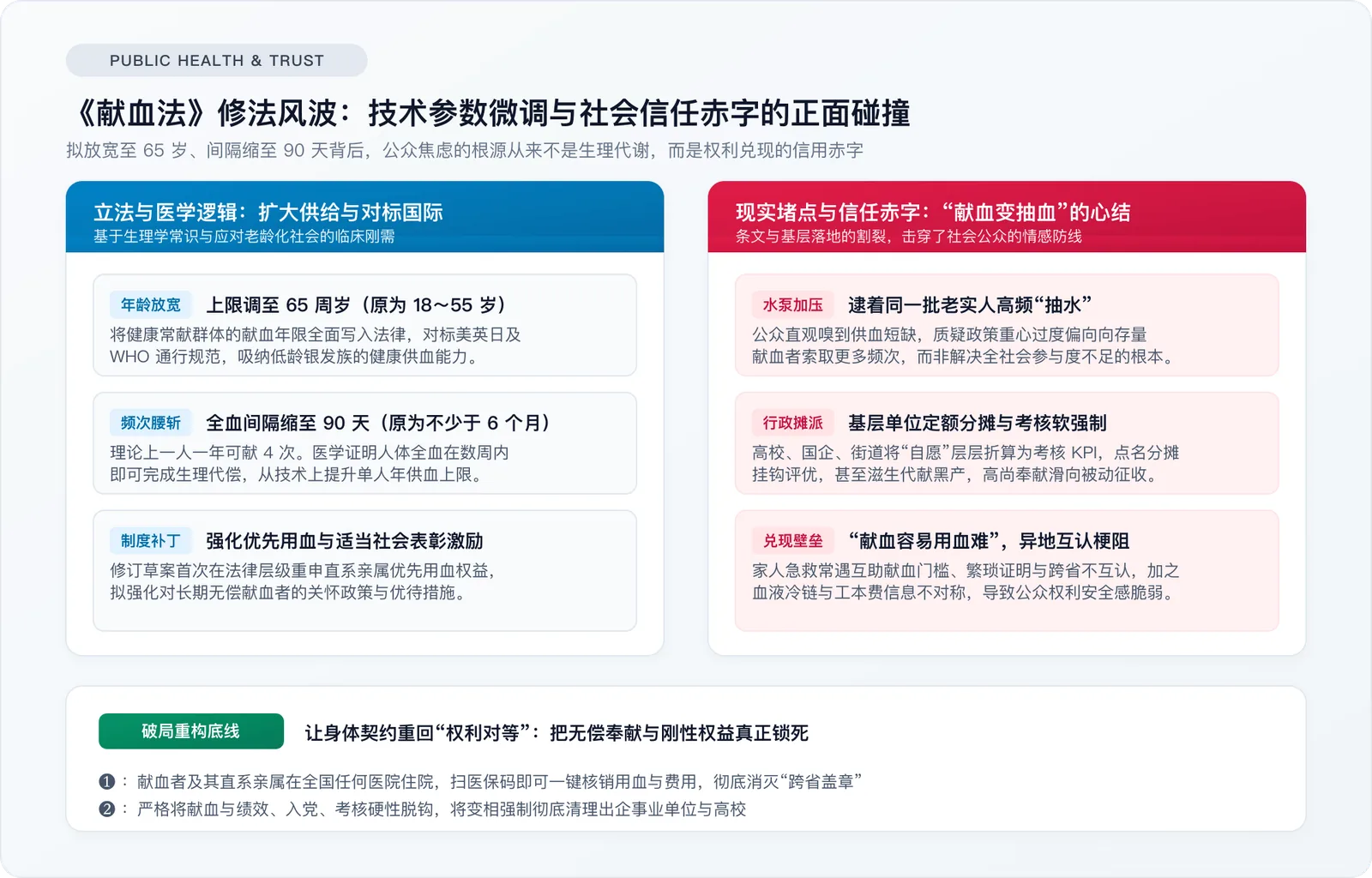
- Relaxed Age Limit: The advocated age for blood donation is proposed to shift from the original “18 to 55 years old” to “18 to 65 years old.” (Some regions had previously piloted extensions to 60 or 65 for healthy, repeat donors; this revision aims to codify it nationwide.)
- Halved Collection Interval: The statutory interval between two whole blood collections is proposed to shorten from “no less than 6 months” to “no less than 90 days (3 months),” theoretically allowing an individual to donate up to four times a year.
Medical experts explain that these adjustments strictly reference World Health Organization (WHO) clinical guidelines and established practices in Europe, America, and Japan. A healthy adult’s red blood cells typically live for about 120 days. After a single donation of 300-400 ml, plasma volume recovers within 24-48 hours, and red blood cells and iron reserves are replenished through physiological compensation within weeks. In the face of severe population aging and an exponential surge in blood demand for oncology and complex surgeries in top-tier hospitals, expanding the legal donor pool and increasing circulation frequency appears to be a self-consistent technical calculation.
However, public health policy is never an isolated laboratory formula; it must be embedded within complex socio-psychological terrain.
When the public sees “frequency doubled, age extended to retirees,” the primary signal they perceive is not “the human body recovers so quickly,” but rather the acute distress of a blood bank in crisis. The real public concern is: facing a continuously widening blood supply-demand gap, the policy focus seems to have shifted to “how to extract higher frequency and longer tenure from the same willing individuals,” rather than reflecting on “why overall societal willingness to participate in voluntary blood donation continues to decline.”
II. From “Contribution” to “Extraction”: The Triple Trust Deficit Behind Public Cynicism
The public’s cynical re-labeling of “blood donation” as “blood extraction” does not stem from ignorance of physiological metabolism. Instead, it is a defensive psychological reaction forged by the long-standing collision of grassroots execution distortions, rights fulfillment blockages, and information opacity in reality.
1. Structural Imbalance: Exploiting Existing Stock, Lacking New Growth
Compressing the interval to 90 days and extending the age to 65 years, from the perspective of the micro-individual, is akin to a public water tap running low, and instead of repairing leaky pipes or finding new water sources, managers opt to crank the same water pump to maximum speed.
Those who consistently participate in voluntary blood donation are often a relatively fixed group of enthusiastic citizens, university students, and grassroots employees of state-owned enterprises and public institutions. When institutional design leans towards “compressing cycles, extending years” to extract from existing supply, the bodies of these “honest few” are inevitably treated as “mobile blood reservoirs” to fill management deficits. This focus on intensifying existing stock naturally triggers moral fatigue and vigilance, as “goodwill is endlessly overdrawn.”
2. Grassroots Execution Distortion: From Voluntary Advocacy to “Administrative Soft Coercion”
While legal texts explicitly state “voluntary and unpaid,” the administrative capillaries often operate under a different logic:
- Layered Quota Assignments: Many state-owned enterprises, public institutions, universities, and community committees receive rigid mobilization quotas from superiors during blood shortage seasons.
- Tied to Performance and Awards: To meet targets, what should be a pure public good is subtly woven by grassroots organizations into performance evaluation systems, implicitly linked to party member assessments, year-end bonuses, and even internship or graduation eligibility.
- Spawning Absurd Proxy Donation Black Markets: In some units where direct coercion of employees is inconvenient, a bizarre phenomenon has even emerged: units pay social individuals on the black market to “donate blood on behalf” to fulfill administrative tasks.
When noble altruistic contribution is hijacked by the KPI gears of bureaucracy, the public’s psychological experience is no longer one of active “social responsibility,” but a passive, even coerced, “body taxation.”
3. The Core Disconnect: “Glorious in Donation, Begging for Blood in Need”
This is the deepest thorn piercing public sentiment.
Years of public service campaigns promise “one person donates, the whole family uses blood for free/with priority.” Yet, in real medical scenarios, ordinary people frequently encounter hurdles in fulfilling this promise:
- The Helplessness of Emergency Mutual Aid Donation: When a direct family member is critically ill and awaiting surgery, relatives, armed with thick stacks of voluntary blood donation certificates, are still coldly informed by the hospital that “clinical inventory is critical; family and friends must first go to a donation center for mutual aid donation before an equivalent blood volume can be approved.”
- Inter-regional Reimbursement and Recognition Barriers: Many migrant workers who donate blood in first-tier cities find that when relatives in their hometowns suffer sudden accidents, they face cumbersome procedures involving obtaining certificates, cross-provincial stamping, and lengthy manual reviews, due to disconnected provincial platforms and disparate blood use policies across regions.
- The Shadow of “Processing Fees”: While the public rationally understands that the hundreds of yuan paid by patients for transfusions are not for buying blood, but for testing, screening, component preparation, cold chain storage, and medical consumables, the “black box” feeling surrounding blood bank financial transparency, blood wastage rates, and blood allocation mechanisms has never been thoroughly dispelled at the institutional level.
The long-standing asymmetry between rights and obligations has made blood donation a high-risk, one-way payment. When people cannot be 100% certain that “the blood I donate today will unconditionally become a life-saving lifeline for my family in crisis,” any legislative proposal to shorten intervals or increase donation frequency instantly activates society’s defense mechanisms.
III. Public Health as a Social Contract: Three Governance Imperatives to Break the Trust Stalemate
To thoroughly dispel the stigmatizing cynicism of “blood donation becomes blood extraction,” the key lies not in how aggressive the numbers in the law are changed or how high the age limit is raised, but in reconstructing this body-based social contract, ensuring that goodwill receives seamless, rigid backing.
Institutional repair must uphold three core imperatives:
1. National Priority Blood Use: “Instant Redemption Without Review,” Eliminating Inter-regional Barriers
National-level coordination must take precedence. The national medical insurance electronic credential should serve as the unified underlying anchor, fully integrating data from all provincial and municipal blood banks with top-tier hospital HIS systems. As long as a donor or their direct family member is hospitalized, the system should automatically recognize the donated volume and prioritize the allocated quota, with costs instantly deducted at the hospital’s settlement end. This would completely abolish the bureaucratic red tape that forces patients’ families to travel across provinces for stamps, and definitively end all implicit rules, such as “mutual aid donation,” that shift blood use risks.
2. Severely Severing Grassroots Administrative Quota Chains
Rigid penalties must be added to legal liability clauses: strictly prohibiting any enterprise, public institution, university, or community grassroots organization from explicitly or implicitly linking voluntary blood donation to awards, promotions, performance evaluations, or disciplinary actions. If fixed quotas are found to be imposed or soft coercion is practiced, the responsible unit’s leadership must be held directly accountable, thereby thoroughly eradicating the “coercion by proxy” toxin from public welfare initiatives.
3. Full-Chain Penetrative Disclosure: Dispelling Cold Chain and Cost Black Boxes
Let sunlight truly illuminate blood banks. Every unit of blood, from needle insertion, testing, and filtration, to component separation, cold chain allocation, and final transfusion into a hospital bed, must be fully traceable with a unique code. Simultaneously, blood banks must regularly disclose their financial income and expenditures, the breakdown of processing fees, and blood wastage rates to the entire society. Only extreme transparency can dissolve long-standing suspicions.
Conclusion: Goodwill Is Not an Infinitely Extractable Reserve Tank
While the human body possesses remarkable hematopoietic regenerative capabilities, society’s moral goodwill is a fragile and easily depleted scarce resource.
When the operation of a vast medical system relies on more frequent needles and a wider age span for its strained sustenance, what truly needs urgent repair is never the citizens’ bone marrow, but rather the institutional credit foundation that once promised “mutual aid” but has repeatedly failed.
Only when every ordinary person who extends their arm can genuinely experience the reassurance and dignity of “no need for connections, no need to beg around, instant life-saving with a scan” when their family is in dire straits, can voluntary blood donation truly shed the shadow of the “administrative blood pump” and return to its original meaning of life-saving solidarity.
Related Research & Topics
Tello Mobile eSIM
SafetyWing Nomad Insurance
* Disclosure: This post contains affiliate links. If you make a purchase through these links, V-G Journal may earn a small commission at no additional cost to you. We only recommend services we independently evaluate and trust.
FIRE and Golf:自由旅居之路
专注于为追求 FIRE 与品质生活的人群提供特惠打球权益与候鸟微度假。不持一砖一瓦,运营品质生活。