The Judo Bite: A Forensic Biomechanical Dissection of Occlusal Force in High-Stakes Competition
A controversial bite during the 2026 Aichi-Nagoya Asian Games Judo Women's 70kg quarter-final sparked widespread online speculation. This essay provides a rigorous forensic odontology and biomechanical analysis of the incident, dissecting the nature of human occlusal force and debunking absurd comparisons to animal bites, all within the context of international judo regulations.

Core Insight: On October 1, 2026, during the Aichi-Nagoya Asian Games Judo Women’s 70kg quarter-final, a ground grapple between China’s Tang Jing and Japan’s Rin Maeda culminated in a controversial bite. The subsequent display of Maeda’s arm injury ignited intense international scrutiny, even spawning absurd online speculation about “canine identification” and “bite force estimation.” From the vantage point of forensic odontology and sports biomechanics, the injury is unequivocally characteristic of human anterior teeth causing blunt contusion, fundamentally distinct from any canine trauma. This essay offers a comprehensive technical post-mortem, integrating forensic bite mark pathology, empirical human maximal occlusal force data, and the International Judo Federation (IJF) officiating framework.
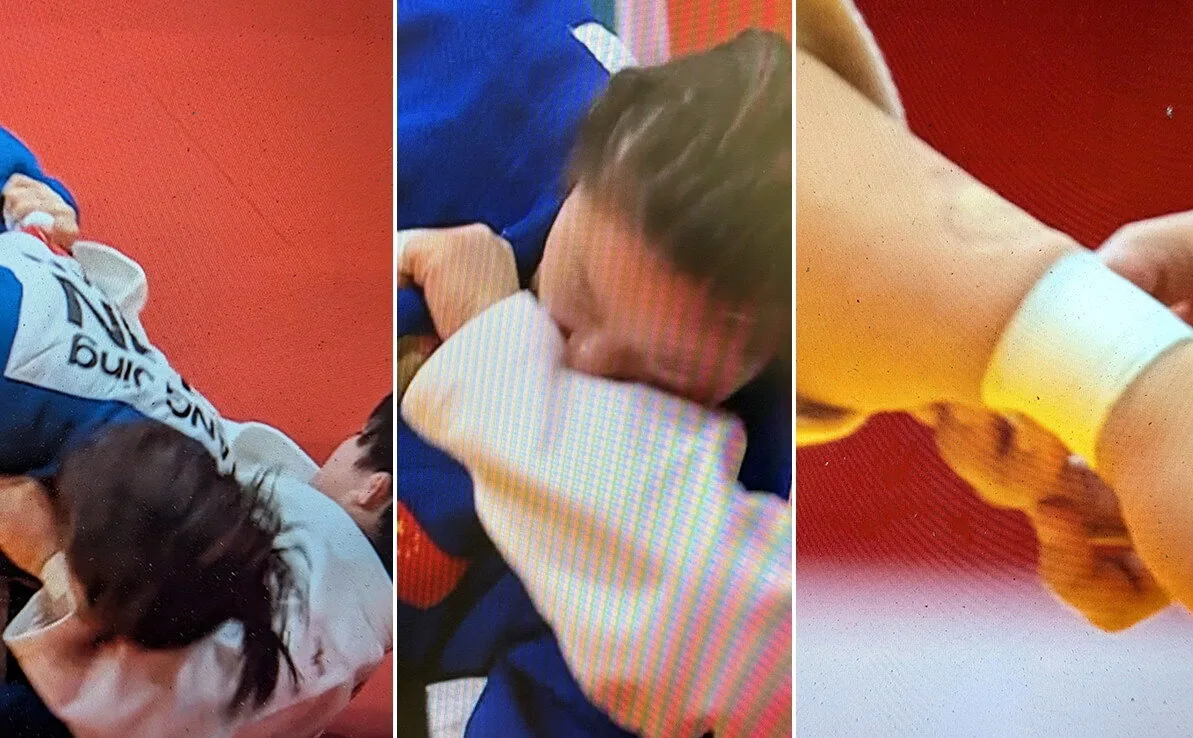
Figure 1: Aichi-Nagoya Asian Games Judo match: ground grappling, biting controversy, and Rin Maeda’s arm bite mark.
I. Reconstructing the Incident: Non-Technical Aggression in Ground Grappling
According to official event records and multi-angle video replays, the incident occurred during a critical quarter-final match in the Aichi-Nagoya Asian Games Judo Women’s 70kg category:
- The Grapple: Offensive-Defensive Phase: Approximately one minute into the match, both athletes transitioned into the Ne-waza (ground grappling) phase. Japan’s Rin Maeda secured a dominant top position, applying rigorous pressure. China’s Tang Jing, in a disadvantaged posture and unable to escape through conventional techniques, leaned forward, opened her mouth, and bit Maeda’s left forearm.
- The Sustained Injury: Maeda immediately signaled to the referee, calling for a foul. However, due to the close-quarters nature of ground grappling and the obscuring bodies, the bite persisted for over ten seconds until the presiding referee noticed the anomaly and forcibly blew the whistle, halting the match.
- CARE System Review and Ultimate Sanction: Following the stoppage, Maeda promptly rolled up her judogi sleeve, revealing a clear, red, swollen row of opposing tooth marks on her forearm to the referee’s table. The officiating team immediately utilized the International Judo Federation’s proprietary CARE video replay system for a slow-motion, panoramic review, confirming the biting action.
- Hansoku-make (Disqualification) Ruling: In accordance with the International Judo Federation’s rigid officiating rules, which strictly prohibit “any unsportsmanlike, non-competitive, or physically dangerous acts of aggression,” the head referee issued the ultimate penalty of direct disqualification to Tang Jing—Hansoku-make (Disqualification). Maeda, by rule, advanced directly to the semi-finals, ultimately securing the gold medal in the category, while Tang Jing forfeited all subsequent repechage matches.
Close-up footage of the bite mark, broadcast globally, quickly went viral. Certain social media platforms erupted with dark humor and absurd conjectures, ranging from “identifying the canine breed” to “estimating bite force.” Yet, beyond the emotional clamor, under the microscope of forensic science and sports biomechanics, the physical attributes of this bite mark yield an indisputable, objective scientific conclusion.
II. Forensic Odontology: The Morphological Chasm Between Human and Canine Trauma
In the judicial forensic practices of forensic pathology and forensic odontology, human bite marks and canine bite marks exhibit distinctly different dental arch anatomical features, force mechanisms, and trauma morphologies:

Figure 2: Forensic Odontology: Morphological and Biomechanical Comparison Matrix of Human vs. Canine Trauma.
1. Fundamental Differences in Dental Arch Geometry
- Human Dentition (Homo sapiens): The human dental arch presents a broad, gentle, and symmetrical flattened U-shape or oblate elliptical double arc. Incisors (central and lateral) are wide with regular edges, canines protrude only slightly, and there are no diastemata (gaps). Bite marks formed by occluding upper and lower jaws consist of continuous, dense bands of minute rectangular contusions.
- Canine Dentition (Canidae): Canids possess a prominent, elongated muzzle, with a dental arch forming a distinct narrow V-shape or acute wedge. Their most salient anatomical feature is the presence of two long, curved, and extremely sharp canines in both the upper and lower jaws. Incisors are reduced and short, and noticeable gaps (diastemata) exist between the canines and premolars.
2. Pathological Characteristics of Injury Types
- Blunt Compression Contusion (On-site Presentation): The injury observed on Rin Maeda’s forearm was entirely composed of flat, continuous, arc-shaped incisor impressions. It manifested as arc-shaped subcutaneous ecchymosis (bruising) and superficial epidermal abrasion, resulting from ruptured capillaries in the superficial dermis, with no deep soft tissue perforations. This trauma is a classic example of closed tissue injury caused by blunt force compression from human anterior teeth.
- Puncture and Laceration Wounds (Canine Signature): When canids attack humans, the primary injury mechanisms involve deep puncture wounds from their canines, often accompanied by muscle lacerations caused by violent head shaking. Had this been a bite from
Related Research & Topics
Tello Mobile eSIM
SafetyWing Nomad Insurance
* Disclosure: This post contains affiliate links. If you make a purchase through these links, V-G Journal may earn a small commission at no additional cost to you. We only recommend services we independently evaluate and trust.
FIRE and Golf:自由旅居之路
专注于为追求 FIRE 与品质生活的人群提供特惠打球权益与候鸟微度假。不持一砖一瓦,运营品质生活。