The Fiscal Ledger of Gold: Provincial Economies, Elite Sports, and the Public's Leisure Deficit
Analyzing the medal distribution in the Asian Games and National Games, this essay dissects the deep logic behind economically strong coastal provinces dominating elite sports. It uncovers the underlying fiscal mechanisms of targeted government procurement, capital-intensive project allocation, and athletic labor mobility, debunking the myth that 'the wealthier, the more active.' We examine the true leisure deficit of urban dwellers and the growing chasm in public fitness.

Core Thesis: Across the competitive landscape of the Asian Games and National Games, the top ranks of the medal tally are consistently dominated by economically powerful coastal provinces like Zhejiang, Guangdong, Shandong, and Jiangsu. These regions contribute over half of the national delegation’s gold medals, a pattern that strongly correlates with their respective GDP rankings. This superficial correlation often fosters a middle-class romantic illusion: “The more affluent a region, the more its people embrace sports, with medals serving as a natural overflow of public health and athletic enthusiasm.” However, conflating the “gold medal industrial assembly line” of elite sports with the “everyday athletic ecosystem” of ordinary citizens is a profound misinterpretation of modern competitive industry and its systemic logic. Medals are never organic fruits of grassroots participation; they are high-precision industrial products, specifically procured by local government treasuries.
I. Capital-Intensive Armament: Gold Medals as Industrially Procured Goods
Modern elite sports have long transcended the classical era of “sheer grit and physical endurance,” evolving into a high-barrier arms race profoundly dependent on capital and technological breakthroughs.
Recent data from the Asian Games and past National Games consistently show economically powerful coastal provinces—Zhejiang, Guangdong, Shandong, Jiangsu, and Shanghai—securing over half of China’s total gold medals. This dominance is particularly pronounced in disciplines like swimming, canoeing, rowing, sailing, fencing, and track cycling.
At its root, these are archetypal “capital-intensive projects”:
- Sunk Costs of Heavy-Asset Venue Operations: An international-standard, temperature-controlled competitive swimming pool or a professional artificial flatwater canoeing course demands initial infrastructure investments in the hundreds of millions of yuan. Annual operational costs—for water filtration, temperature and humidity control, and electricity consumption—can range from millions to tens of millions of yuan, enough to cripple the budget of a fiscally constrained inland prefecture-level city.
- Technological R&D and Rehabilitation Support Armament: From digital fluid dynamics wind tunnel testing, high-precision motion capture analysis, dynamic biochemical indicator monitoring, and hyperbaric oxygen therapy systems, to the recruitment of top-tier international coaching teams, overseas training camps, and costly stem cell treatments for injuries—the “full lifecycle production cost” behind a single gold medal often runs into the tens of millions, or even hundreds of millions, of yuan.
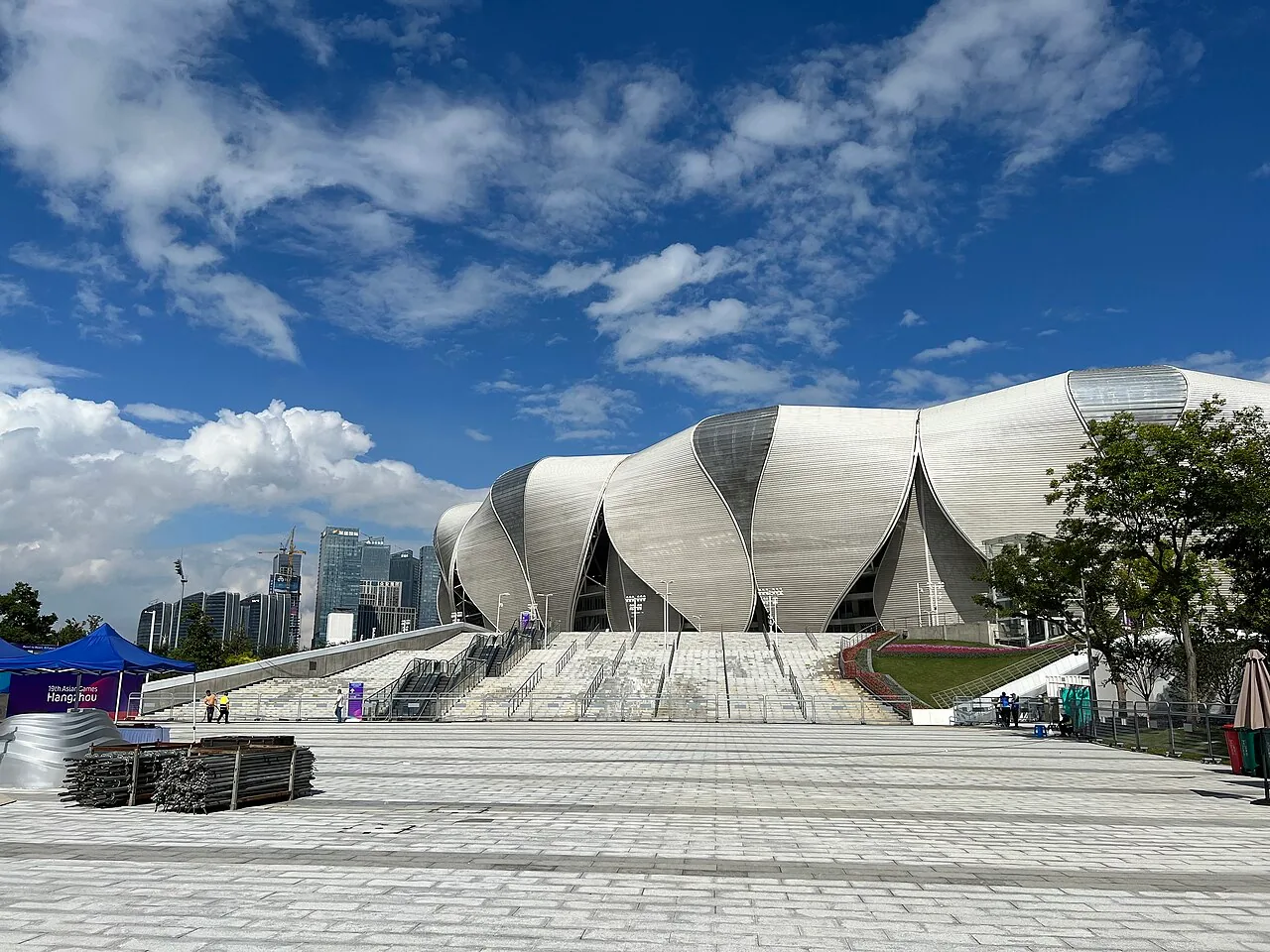
Figure 1: Panoramic view of the Hangzhou Olympic Sports Center Stadium 'Big Lotus' and the Asian Games spectator entrance steps.
Economically powerful coastal provinces possess substantial local general public budget surpluses and massive sports lottery public welfare funds. These resources enable them to construct world-class technological research and development, and nutritional support systems for their provincial teams.
Medals do not reflect spontaneous grassroots athletic vitality; rather, they represent the conversion rate of local government fiscal surpluses into high-precision “human performance manufacturing capabilities” within specific domains.
II. Under Policy Directives: The “Gold Medal Capital Theory” and Cross-Provincial Labor Arbitrage
The concentration of gold medals in affluent provinces is underpinned by an exceptionally sophisticated system of institutional incentives and factor mobility mechanisms:
1. The KPI Leverage of National Games Point Conversion
The General Administration of Sport has long implemented a system where Olympic and Asian Games results are proportionally converted into total points for the National Games. For local sports administrative systems, an Asian Games gold medal is not merely a national honor; it directly translates into hard currency for annual performance evaluations, preferential allocation of institutional quotas, and special budget appropriations.
Provinces and municipalities with stronger fiscal capabilities offer more generous special allocations, gold medal bonuses, and retirement placement promises (institutional positions, substantial severance packages) during the National Games cycle. This naturally creates a more powerful systemic impetus and long-term compound returns on investment during major event cycles.
2. National Acquisition and Refinement of Athletic Labor Resources
Affluent provinces do not solely rely on their own native talent to sweat and toil on the training grounds. Large population provinces in the central and western regions, old industrial bases, and underdeveloped areas possess a vast pool of young talent capable of enduring hardship and high-intensity foundational training. However, after grassroots sports schools, they often face funding gaps for scientific research, medical care, injury rehabilitation, and nutritional support.
At this juncture, economically powerful coastal provinces, leveraging their superior household registration quotas, institutional positions, generous stipends, and research support, complete the “raw material acquisition and secondary refinement” of high-quality athletic labor nationwide through “joint training,” “inter-provincial exchanges,” or talent introduction mechanisms.
This is not a case of “the wealthier, the more active,” but rather the efficient recombination of scarce human athletic capabilities by capital and the system across the nation.
III. Beyond Linear Mapping: Legacy, Selection Archetypes, and Geographic Endowments
While economic might forms the bedrock of modern elite sports, the distribution of competitive gold medals is not a simple, mechanical mapping of GDP. It is also constrained by three key variables:
- Traditional Strengths and Sports Team Technical Legacy
Some central and western provinces, despite not ranking at the top in national GDP, possess decades of technical lineage in specific traditional disciplines. Examples include Hubei’s strong dominance in diving, gymnastics, and rowing, and Sichuan’s continuous breakthroughs in gymnastics, shooting, and rhythmic gymnastics. This long-established intergenerational coaching legacy and specialized training methodology constitute a technical barrier not easily erased by capital in an instant. - Physique Archetypes and Specialized Talent Pool
Shandong, an evergreen powerhouse in national elite sports, not only boasts a multi-trillion yuan economic base but also leverages its vast population and advantageous physique archetypes. The skeletal structure and strength conditions prevalent in the Jiaodong Peninsula and North China Plain have created a long-term talent selection barrier in wrestling, judo, heavy combat sports, large-category rowing and canoeing, and track and field throwing events. - Geographic Climate and Natural Environmental Endowments
Provinces like Yunnan and Guizhou, leveraging their high-altitude endurance training environments, show significant advantages in long-distance running, race walking, and mountain cross-country events. The three northeastern provinces, with their unique long winters, hold a monopolistic position in ice and snow sports. The Jiangnan water towns, meanwhile, possess a deep “waterway culture” gene, giving them an edge in aquatic and swimming disciplines.
IV. A Glaring Irony: “Public Fitness Poverty” in Gold Medal Provinces
If we shift our gaze from the podium to the actual urban landscape, the notion of “the wealthier, the more active” reveals an absurd disconnect in the micro-lives of ordinary people.
Elite sports and public fitness diverge fundamentally in their driving forces and resource logic:
| Assessment Dimension | Elite Sports (Gold-Oriented Industrial Assembly Line) | Public Fitness (Leisure-Oriented Lifestyle Ecosystem) | | :----------------
Related Research & Topics
The Anatomy of Digital Predation: Inside the Syndicate Targeting the Elderly via Livestream Appraisal Scams
Starlink V4 and the Low-Earth Orbit Satellite Arms Race: How a 100,000-Node Optical Mesh Pierces the Submarine Cable Monopoly
Tello Mobile eSIM
SafetyWing Nomad Insurance
* Disclosure: This post contains affiliate links. If you make a purchase through these links, V-G Journal may earn a small commission at no additional cost to you. We only recommend services we independently evaluate and trust.
FIRE and Golf:自由旅居之路
专注于为追求 FIRE 与品质生活的人群提供特惠打球权益与候鸟微度假。不持一砖一瓦,运营品质生活。