The Zero-Sum Fairway: Andrew Novak’s Mexico Open Triumph and the Financial Attrition of the PGA Tour’s Middle Class
Andrew Novak’s dominant win at the 2026 Mexico Open highlights the stark economic divide on the PGA Tour. Behind his $1.08 million payday, mid-tier players battle a steep purse curve, high overhead burn rates, and the unforgiving reality of the new Top 100 card retention cutoff.


Figure 1: Chinese golfer Haotong Li displaying intense focus off the tee. At the 2026 Mexico Open, Li posted a four-round total of 272 (-12) to finish T29, earning $41,100.
At the newly concluded 2026 Mexico Open at Vidanta World, Andrew Novak anchored his campaign with a historic 54-hole tournament record of 190. Closing with a clinical final-round 69, he wrapped up a dominant 259 total (-25) to claim a five-stroke victory and his maiden PGA Tour title. Chinese contenders Haotong Li and Marty Dou (Zecheng Dou) finished their four rounds at 272 (-12, T29) and 274 (-10, T40), respectively.
While social media and mainstream sports outlets celebrated Novak’s $1.08 million payday and 500 FedExCup points, the reality outside the winner’s circle remains vastly more severe. Under the PGA Tour’s restructured status framework—where the card retention line has been squeezed down to a ruthless “Top 100”—the $6 million purse distribution curve drops off like a sheer cliff. For mid-tier players, once non-negotiable weekly travel and operating overhead are deducted, marginal net cash flow vanishes into near-zero territory, leaving them trapped in a grinding war of attrition between point margins and demotion.
I. Tactical Recalibration on the Coast: Deconstructing Novak’s SG Gains at Vidanta
Measuring over 7,400 yards, Vidanta Vallarta in Puerto Vallarta presents a layout where coastal winds and generous fairways reward distance off the tee. Yet, the decisive battlegrounds inevitably shift to green approach proximity and flatstick conversion.
Historically, Novak’s statistical ledger revealed a glaring vulnerability. Entering the week, his Strokes Gained: Putting (SG: Putting) ranked a mediocre 158th on the PGA Tour—the classic signature of a ball-striking Journeyman burdened by an unreliable flatstick. During this championship week, however, Novak displayed an almost robotic resilience under pressure. He led the entire field in SG: Putting (ranking 1st), gaining nearly nine net strokes on the greens over four rounds. Through the first 54 holes, he went a perfect 37-for-37 on putts within ten feet.
Beyond his abnormal putting surge, Novak’s five-shot margin of victory was reinforced by elite approach play and short-game scrambling. He ranked 3rd in SG: Approach for the week. Even on the rare occasions he missed greens, his short game saved par on 15 out of 18 attempts, placing him 3rd in Scrambling.
This performance fits precisely into the quantitative risk management models of modern professional golf. Tour golf is never a fairy tale of flawless execution. As explored in our analysis of “Good Misses” and defensive philosophy in elite play, the real boundary between top-tier winners and mid-pack players lies in converting systemic errors into manageable up-and-down par conversions.
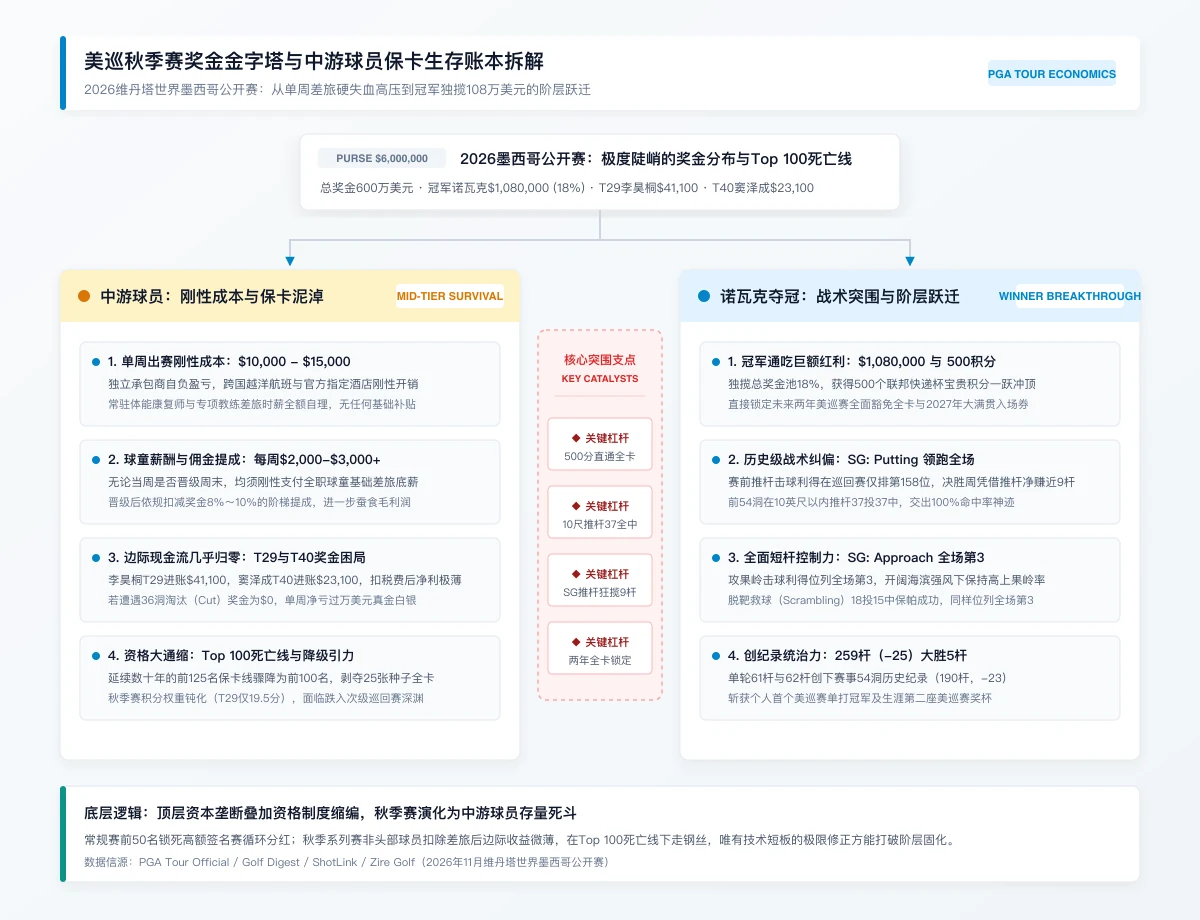
Figure 2: The payout gradient and single-week operating economics for mid-tier players at the 2026 Vidanta Mexico Open.
II. The Actuarial Ledger: Cash Flow Realities Beneath the $6 Million Purse
Stripping away the aesthetic glamor of the winner’s trophy reveals a starkly bifurcated financial balance sheet.
As a crucial stop in the PGA Tour’s FedExCup Fall series, the Mexico Open carried a total purse of $6 million. Standard Tour payout allocation awards 18% ($1.08 million) to the champion, while runners-up Steven Fisk and Kristoffer Ventura earned $534,000 each. Beyond third place, the curve decays rapidly:
| Finish Position | Representative Player | 4-Round Score | Payout (USD) | FedExCup Points | Estimated Net Cash Flow Surplus (Post-Overhead) |
|---|---|---|---|---|---|
| 1st (Solo) | Andrew Novak | 259 (-25) | $1,080,000 | 500 | Structural liquidity transformation; 2-year full exemption + Major invites |
| Tied 2nd (T2) | Steven Fisk / Kristoffer Ventura | 264 (-20) | $534,000 | 245 | Substantial cash reserve; significantly expands retention safety margin |
| Tied 29th (T29) | Haotong Li | 272 (-12) | $41,100 | 19.5 | Thin margin; barely covers full-tier support team operational costs |
| Tied 40th (T40) | Marty Dou | 274 (-10) | $23,100 | 9.6 | Near-zero net cash flow; risks net operational deficit post-tax |
It is easy to categorize any player making a PGA Tour weekend cut as part of an elite financial upper crust. In reality, every professional golfer operates legally and financially as an independent, single-person, unlimited-liability enterprise. A player’s weekly fixed burn rate features an unforgiving baseline:
- Caddie Retainers and Commissions: Full-time PGA Tour caddies command a base salary of $2,000 to $3,000 per week, supplemented by a tiered commission structure of 8% to 10% on prize money for made cuts.
- Support Staff & Travel Overhead: Transatlantic or cross-border flights, tournament host hotel accommodations, plus hourly rates and travel expenses for swing coaches and physical therapists routinely drive direct weekly burn to between $10,000 and $15,000.
- Cross-Border Tax Withholding: As income earned in Mexico and disbursed via the US-based PGA Tour, players face immediate local foreign tax withholdings alongside federal and state obligations.
Take Marty Dou’s T40 payout of $23,100. After deducting his caddie’s share ($1,800) and baseline travel costs ($12,000), his pre-tax operating margin shrinks to a few thousand dollars. Once income taxes are applied, his net take-home pay approaches zero. Haotong Li’s $41,100 for T29 offers only a modest buffer while maintaining high-intensity tour operations. Should a player miss the cut in a given week, they suffer a 100% loss of prize revenue while absorbing a direct, out-of-pocket loss of over $10,000.
III. Life Below the Top 100 Line: FedExCup Decay and the Demotion Trap
If single-week cash flow represents immediate solvency, FedExCup points represent the institutional franchise value that dictates a player’s multi-year survival.
The PGA Tour’s structural overhaul for the 2026 season fundamentally altered the economic landscape for mid-tier players. The historic card-retention threshold—long set at the Top 125—was tightened to the Top 100. As detailed in our breakdown of the PGA Tour’s structural migration and the Top 100 cutoff, this regulatory shift effectively eliminated full-status exemptions for 25 veteran tour spots. Meanwhile, the Top 50 players from the regular season had already secured their positions in the following year’s eight $20 million Signature Events, ring-fencing capital allocation within an elite closed circuit.
For players competing in the Fall Series, the dynamic is an institutional elimination game. Novak’s 500-point haul instantly vaulted him out of the danger zone, securing full Tour status through 2028 and unlocking invitations to the 2027 Masters and PGA Championship. Conversely, Li (19.5 points for T29) and Dou (9.6 points for T40) saw negligible upward mobility on the points list.
With the Fall Series entering its final stretch, the marginal utility of available points is shrinking fast—a pattern analyzed during the Biltmore Championship opener. For Haotong Li, full status on the DP World Tour provides strategic flexibility and alternative scheduling options. But for players who have placed all their operational capital into the PGA Tour system, every club selection over the remaining events is a fight against the gravitational pull of demotion to the Korn Ferry Tour.
Professional sports rarely operate on sentimental terms. Behind the celebration of Andrew Novak’s breakthrough at Vidanta lies a classic story of tactical optimization yielding upward mobility. Yet further down the leaderboard, the cold numbers and modest payouts reflect the unyielding arithmetic governing life on the Tour’s margin.
Related Research & Topics
Tello Mobile eSIM
SafetyWing Nomad Insurance
* Disclosure: This post contains affiliate links. If you make a purchase through these links, V-G Journal may earn a small commission at no additional cost to you. We only recommend services we independently evaluate and trust.
FIRE and Golf:自由旅居之路
专注于为追求 FIRE 与品质生活的人群提供特惠打球权益与候鸟微度假。不持一砖一瓦,运营品质生活。