Why Google Delays Gemini Pro: The Rise of Inference Economics
Google delays Gemini Pro as the AI industry shifts from pre-training parameter vanity to inference economics. Discover why dynamic compute is the new endgame.

Curator’s Note: Over the past six months, Google’s large language model iterations have been staggeringly fast, evolving rapidly from 3.5 to 3.8. Yet, the product matrix presented to developers is highly anomalous: a uniform lineup of Flash, Flash Cyber, Live (real-time full-duplex multimodal), and built-in Extended Thinking. Meanwhile, the former absolute technological totems—Pro and Ultra—have completely vanished. Many developers are asking: Is Google giving up on Pro? Industry insiders reveal that the Gemini 3.5 Pro, originally slated for a mid-year debut, underwent a complete rebuild after rigorous testing. This reflects a violent divergence in the technological paradigms and commercial bottom lines of Silicon Valley’s frontier AI war. The marginal benefits of massive parameters in pre-training have hit a physical wall. Inference economics—centered on concurrent throughput, cost per token, and dynamic chains of thought—is now crushing the vanity era of brushing benchmarks with 100-billion-parameter models.
I. The 3.5 Pro Delay and Rebuild: Pre-training Scaling Laws Hit a “Physical Wall”
In the first half of the large model evolution, the industry worshipped an almost religiously fanatical minimalist philosophy: infinitely stacking parameters and cleaning massive datasets during pre-training. Parameter scales skyrocketed from tens of billions to hundreds of billions or even trillions. As long as the compute cluster scale doubled, general intelligence benchmarks (like MMLU and LMSYS Chatbot Arena) demonstrated smooth, exponential leaps.
However, the Gemini 3.5 Pro prototype faced an internal overhaul precisely because this “brute-force” pre-training Scaling Law slammed into a hard wall, both physically and economically:
- Marginal Collapse of the Intelligence Curve: To squeeze a meager 2-3% improvement on benchmarks, the effective compute (FLOPs), power reserves, and high-quality data consumed during pre-training exploded exponentially. Yet, the model’s comprehensive generalization capabilities hit a visible plateau.
- Severe Imbalance Between Compute and Energy Efficiency: Every forward pass of a large model with 100-billion-level active parameters frantically drains expensive GPU memory bandwidth and data center power. The marginal return of simply stacking parameters in pre-training for intelligence leaps is shrinking sharply.
- The Commercial Pricing Dead End: Massive-parameter models face a devastating commercial dilemma upon deployment. If priced strictly according to real compute and power costs, the exorbitant per-token fee will deter most enterprise clients and developers. If subsidized and dumped at low prices to grab market share, the data center power meters spin backward—the higher the usage, the heavier the losses.
When Wall Street begins scrutinizing tech giants’ Return on Investment (ROI) with a magnifying glass, continuing to push bulky, low-throughput, and commercially awkward large-parameter Pro models becomes a totally bankrupt business logic.
II. From “Parameter Vanity” to “Inference Economics”: The Dimensional Strike of Dynamic Compute
The watershed of the Silicon Valley AI war is fundamentally a shift from the “parameter vanity” of the first half to “Inference Economics” in the second half.
The endgame of the large model era is not about scoring vanity points on closed leaderboards. It lands on actual concurrent throughput and marginal cost per token. The compute paradigm is undergoing a fundamental displacement: a sweeping shift from Pre-training Scaling to Test-time Compute (Chain of Thought scaling).
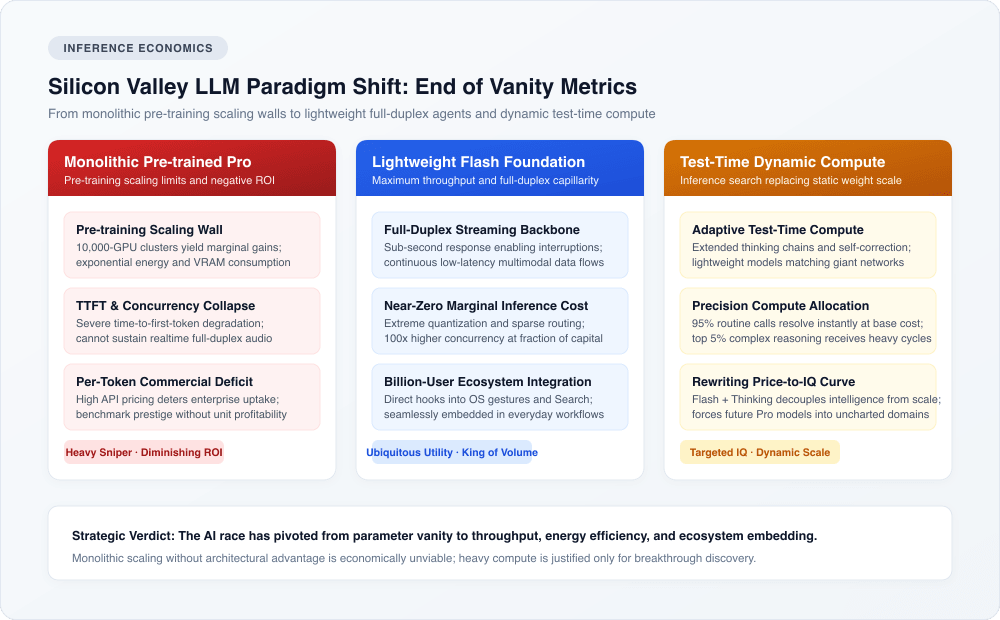
The engineering ledger is brutally clear:
- 95% of Daily Workflows are Over-provisioned: The vast majority of high-frequency requests from developers and end-users—including code completion, formatted information extraction, text polishing, and daily Q&A—simply do not require 100-billion-level active parameters to “shoot mosquitoes with an anti-aircraft gun.” A lightweight Flash foundation model is not only intellectually more than sufficient for these scenarios but also delivers millisecond-level hyper-fast responses at near-zero invocation costs.
- 5% of Deep-water Problems Dynamically Allocate Compute: Only when facing highly difficult algorithmic derivations, complex system architecture refactoring, or long-chain logical games will the system dynamically and on-demand awaken Extended Thinking. It exchanges compute for intelligence bursts by autonomously unrolling self-correction and long-chain exploration during the inference phase.
This composite architecture—extreme optimization in the lightweight base (Flash’s ultimate throughput and ultra-low latency) paired with on-demand Test-time Compute (Extended Thinking)—achieves an irreversible dimensional strike on static, bulky, fully-activated pure large models (Pro) in terms of unit ROI.
III. The Physical Cruelty of Real-Time Interaction: Full-Duplex, Low Latency, and the Throughput Black Hole
If conventional text-based Q&A can barely tolerate the response latency of large models, the dawn of the multimodal real-time interaction battlefield outright sentences traditional massive-parameter architectures to death.
The new interaction paradigm, represented by Gemini 3.8 Live, possesses three rigid traits: full-duplex, ultra-low end-to-end latency (Time to First Token compressed within 200–300 milliseconds), and support for natural interruptions.
This interaction format violently squeezes the backend compute architecture’s throughput:
- Continuous Multimodal Streaming Throughput: Every second the microphone stays open, every frame the camera captures, continuously sprays audio and video token streams into backend data centers. The compute foundation must synchronously and in real-time digest these high-speed data streams.
- The Physical Limits of VRAM Bandwidth and KV Cache: If the backend invokes a Pro-level model with tens or hundreds of billions of active parameters, processing continuous multimodal streaming inputs will push VRAM bandwidth and attention caches to the brink of collapse.
- The Utter Breakdown of Commercial Carrying Capacity: Once millions or tens of millions of users trigger Live interactions simultaneously, a Pro-level model’s 100-billion active parameters will spin data center power meters “faster than light.” No commercial entity on earth can endure such terrifying inference bleeding.
The physical laws of the full-duplex era are ruthlessly strict: the only architectures that can cross the threshold are lightweight models with extremely short time-to-first-token, minimal VRAM footprint, and ferocious concurrent throughput. The Flash ecosystem is by no means a cheap compromise; it is the only viable physical bedrock capable of supporting a real-time multimodal interaction civilization.
IV. The Complete Embedding Logic of Google’s Ecosystem War: Capillary Penetration and “Zero Marginal Cost” Hegemony
Viewed from a commercial strategy dimension, Google’s large model playbook has entirely abandoned the early “arms dealer benchmark show” mindset.
Google’s current strategic goal is no longer building a “single-shot sniper rifle” placed on a pedestal for geeks to run benchmarks. Instead, it aims to inject models like water and electricity seamlessly into the vast ecosystem capillaries of its billion-user base:
- Deep Integration at the Android OS Base: Serving as an OS-level native Agent, providing millisecond-level responses to global gestures, screen context comprehension, and real-time cross-app orchestration.
- Google Search and Real-Time Q&A: Fully integrating with Google Search AI Overviews and Search Live, generating structured answers instantly across tens of billions of search queries daily.
- Workspace Automation: Seamlessly executing information extraction, drafting, and workflow chaining within enterprise streams like Gmail, Docs, and Sheets.
- Chrome Browser Ambient Perception: Delivering low-latency side-panel intelligence while users browse the web and consume digital content.
In these ultra-high-frequency entry points generating tens of billions of daily invocations, latency and cost are matters of life and death. If the compute cost of a single call increases by 0.001 cents, scaled across a billion-user base, it equates to hundreds of millions of dollars in staggering profit bleeding.
The only weapon that can win this ecosystem meat-grinder war is an ultra-lightweight architecture whose cost is so cheap it is practically free, with first-token latency compressed to milliseconds.
V. The Endgame and Rebirth of Pro: Escaping Mediocrity, Returning to Deep Waters
Has Google completely abandoned Pro? The answer is clearly no.
But the past mechanical tiered logic of “Nano - Flash - Pro - Ultra” has been completely voided. In the old system, Pro was nothing more than a mediocre, magnified version—“a few times larger in parameters than Flash, slightly smarter, noticeably slower, and exponentially more expensive.” This mechanical stratification has lost all existential value under the assault of “Flash + Dynamic Chain of Thought.”
If the future Pro wants to re-emerge, it must completely shatter this mediocrity and deliver a generational moat:
- Retreating to the Deep Waters of Absolute Intelligence: Future massive-parameter models will no longer participate in the attrition warfare of everyday arenas like daily chats, text summarization, or low-level code completion. Instead, they will be strictly confined to extremely complex tasks such as autonomous end-to-end engineering refactoring, exploring unsolved scientific laws (e.g., biomolecular structures, synthetic material design), and proving frontier mathematical propositions.
- A Complete Rewrite of the Underlying Architecture: Thoroughly abandoning traditional Dense structures to fully embrace extremely sparse Mixture of Experts (Sparse MoE) architectures, integrating neuro-symbolic reasoning, or embedding deep adaptive memory networks.
- Establishing the Legitimacy of Commercial Premium: Only when Pro’s outputs possess an extremely high intelligence density and irreplaceable commercial value—making enterprise clients willing to pay expensive bills for every deep inference session—will large-parameter architectures earn back their ticket to the compute arena.
In the vast territories of mass applications and high-frequency interactions, the vanity era of simply competing on parameter volume has declared its end. The Flash ecosystem—guided by inference economics, rooted in extreme throughput, and sharpened by dynamic chains of thought—has irreversibly taken over the real world.
Related Research & Topics
Tello Mobile eSIM
SafetyWing Nomad Insurance
* Disclosure: This post contains affiliate links. If you make a purchase through these links, V-G Journal may earn a small commission at no additional cost to you. We only recommend services we independently evaluate and trust.
FIRE and Golf:自由旅居之路
专注于为追求 FIRE 与品质生活的人群提供特惠打球权益与候鸟微度假。不持一砖一瓦,运营品质生活。