Packing Golf into Prime Time & Esports Arenas: The MR Revolution of TGL and WTGL
Tiger Woods and Rory McIlroy drag traditional 18-hole golf into indoor giant screens and hydraulic greens. A deep dive into the mixed reality revolution of tech golf leagues.

Curator’s Note: Traditional golf faces a prolonged “time crisis.” A standard 18-hole tour event often drags on for 4 to 5 hours. Players scatter across hundreds of acres of hilly terrain, slowly advancing under the sun and rain. Fans watching at home struggle to catch any continuous competitive climax. Even more fatal: the average age of the broadcasting audience has long crossed the 60-year-old red line.
As Generation Z’s attention is entirely carved up by short videos, streaming, and the millisecond instant feedback of esports, this centuries-old gentlemen’s game must dismantle its own barriers.
The TGL (Tomorrow’s Golf League), spearheaded by Tiger Woods and Rory McIlroy, and the subsequent women’s league WTGL, represent the most radical self-rescue experiment by professional sports capital. They stuffed 300-yard fairways into giant indoor arenas equipped with mechanical hydraulic greens. Using a 2-hour prime-time slot and a 40-second shot clock, they dragged golf kicking and screaming into the Mixed Reality (MR) era.
I. SoFi Center: The “Hardcore Physics Engine” of the MR Arena
When traditional fans first hear about an “indoor golf league,” their initial reaction is often contempt: isn’t this just putting a premium simulator on a TV screen and playing a video game?
But when you actually examine the SoFi Center, a purpose-built arena in Palm Beach Gardens, Florida, you realize it sits in an entirely different dimension from ordinary home or range simulators. This is a high-tech sports arena tailor-made for Mixed Reality (MR) competition.
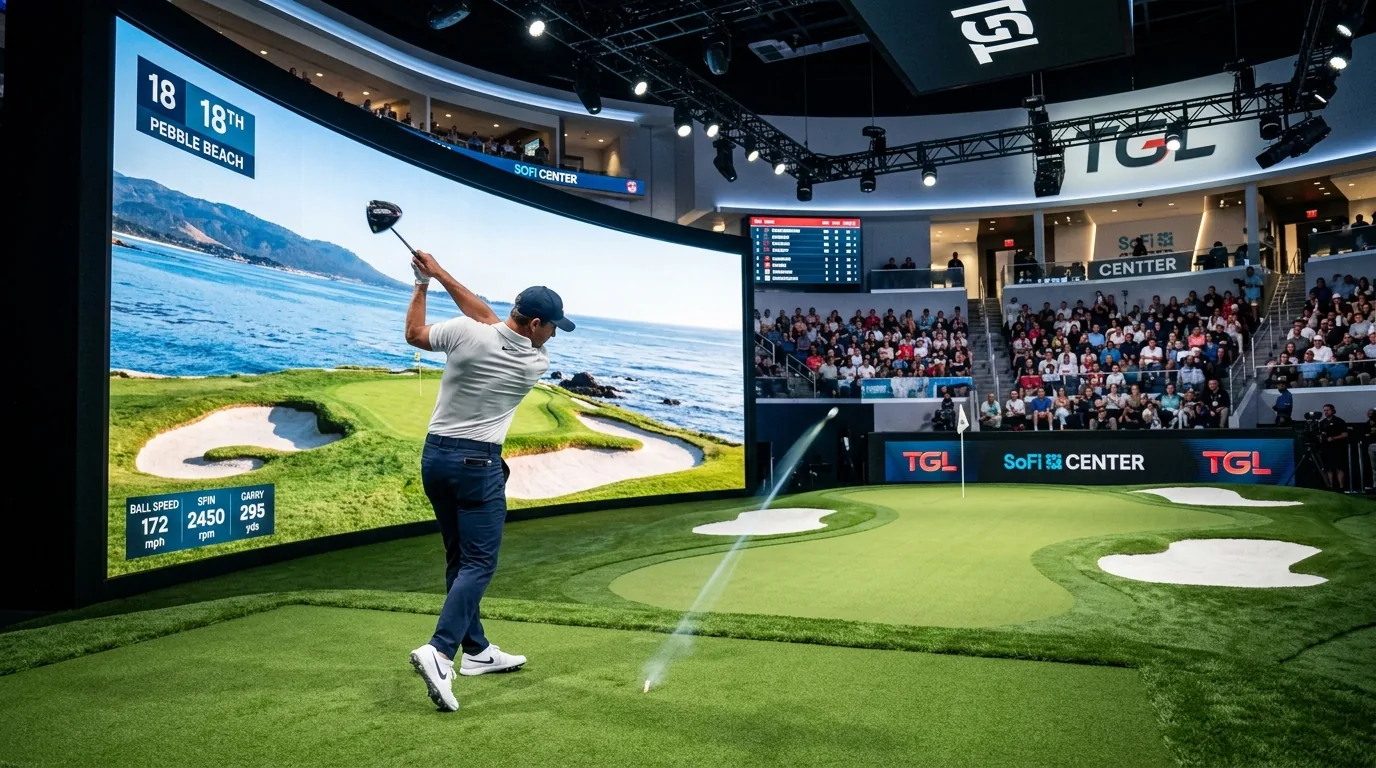
1. 64-Foot Ultra-Large Precision Simulator Screen
During the long game of a hole, players don’t hit into a small canvas. Instead, they stand on a meticulously maintained real-grass hitting zone, facing a giant curved digital screen measuring 64 feet wide by 46 feet high (about 20x14 meters)—over 20 times the size of a standard indoor simulator.
- Real Physical Striking: Players use actual tour-grade drivers and irons to hit fully weighted real golf balls, with ball speeds reaching 170–190 mph.
- High-Precision Radar Capture: A dense array of high-speed optical cameras and radar trackers above calculates the initial ball speed, launch angle, spin, and elevation within milliseconds of the ball striking the impact-resistant screen. It seamlessly extends the trajectory into the treacherous landing spots of the virtual digital course without delay.
2. GreenZone: A Hydraulic Morphing Green with 600 Actuators
If the long-game zone is an extension of digital virtuality, then the short-game and putting area within 50 yards is a physical marvel of mechanical engineering.
At the center of the arena, surrounded by about 1,500 live spectators, lies a 3,800-square-foot (approx. 350 sq meters) real short-game complex (GreenZone):
- Mechanical Hydraulic Lift: Up to 600 motorized actuators and hydraulic jacks are buried beneath the green’s surface.
- Second-Level Terrain Morphing: In the mere dozens of seconds it takes for players to walk from the hitting zone to the green, the underground mechanical structure rapidly raises, twists, and contorts based on the preset digital hole model. Within a minute, it can transform the previous hole’s flat putting surface into a wicked green with severe hidden breaks and side slopes.
- Real Chipping & Putting Texture: The perimeter features real deep rough and pure white sand bunkers. Players must execute precise recovery shots amidst flying sand, retaining the irreplaceable tactile feedback vital for elite pros.
II. Format & Rule Revolution: Eradicating the Drag and Esportsifying Prime Time
A major grievance traditional golf fans constantly voice is “Slow Play.” Some players repeatedly read putts, toss grass to gauge the wind, and take four or five practice swings, easily burning two to three minutes. It severely drains spectator patience.
TGL entirely ditches this bloated rhythm. Its formats and broadcast rules almost entirely mirror the high confrontation and instant suspense of the NBA, NFL, and esports.
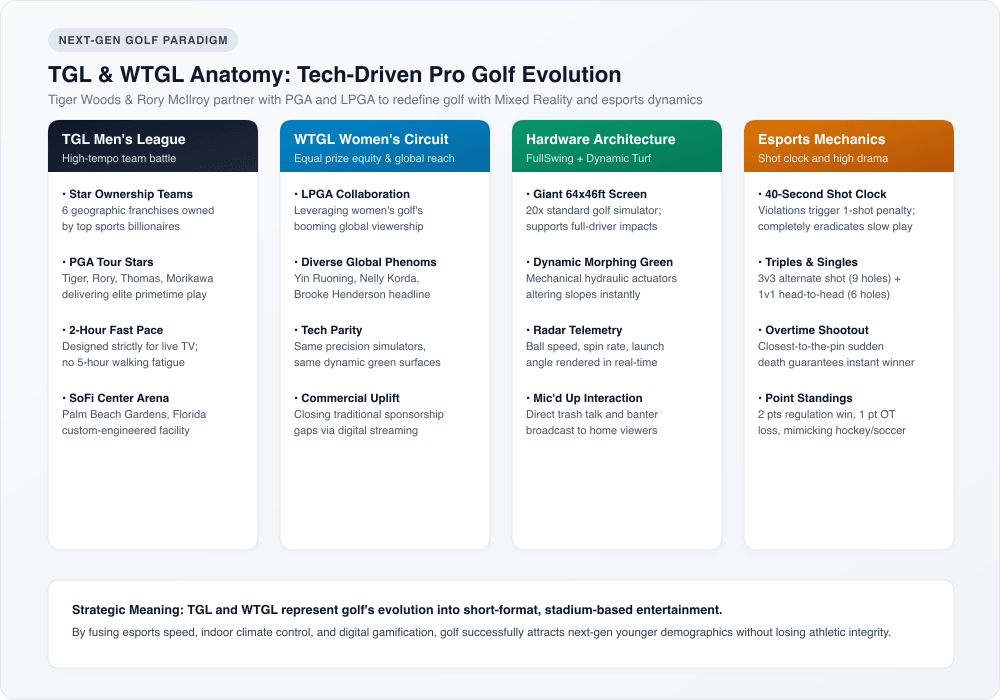 (Note: A localized
-en.png version for this matrix image may need to be created if the original contains Chinese text.)
1. 2-Hour Prime Time and 15-Hole Compact Battles
The matches are strictly designed for prime-time television broadcasting, capping each game at roughly two hours. A full match features only 15 holes, divided into two distinct halves:
- Front 9 (Triples): Each team fields three players taking alternate shots on the same ball until it’s holed, testing tactical synergy and fault tolerance among teammates.
- Back 6 (Singles): The two teams designate one player each for a 1-on-1 head-to-head duel, winner takes the point.
- Overtime (Closest-to-the-pin): If tied after 15 holes, they head straight into a nail-biting 3-on-3 closest-to-the-pin challenge—one shot decides the victory.
2. Shot Clock: 40-Second Countdown
A massive digital countdown clock hangs above the SoFi Center arena. Once a player enters the hitting preparation phase, they must execute the shot within 40 seconds.
Exceeding the time by even one second results in an automatic one-stroke penalty. This rule completely eradicates endless practice swings and hesitation, pushing players’ heart rates and adrenaline to the limit while giving the audience a suffocating sense of racing against time.
3. “The Hammer”: Bringing Board Game Mechanics to the Green
TGL borrows the doubling cube concept from Backgammon:
- Each team holds the privilege to use “The Hammer” three times during a match.
- When a team holds an advantage on a hole or senses an opponent’s instability, the captain can suddenly drop the Hammer to double the point value of that hole.
- The opponent must make a split-second decision: bite the bullet and accept (winning also doubles, losing doubles the deficit), or concede the hole to cut losses. This psychological warfare injects intense, high-stakes game theory into a traditionally reserved sport.
4. Fully Mic’d Up: Shattering the “Silence” Commandment
Traditional courses demand absolute silence from spectators, and whispers between players and caddies are often muted. In the TGL indoor arena, not only are live music and crowd roars fully embraced, but all competing players wear wireless microphones throughout the match.
Players’ raw psychological reactions, tactical debates, self-deprecation after poor shots, and even trash-talking between teams are fed unedited into the prime-time broadcast. It forces elite, distant sports idols to reveal their most authentic and vivid human sides.
III. City-Based Franchises: A New Sports Business Playbook Backed by Elite Capital
Unlike the “nomadic individual entry” model of traditional golf, TGL mimics the four major North American professional sports leagues (NFL, NBA, MLB, MLS) by fully rolling out a City-based Franchises system, creating six permanent clubs:
| Club Name | Core Star Players | Key Backing Ownership Group |
|---|---|---|
| Atlanta Drive GC | Justin Thomas, Patrick Cantlay, Billy Horschel | Arthur Blank (Owner of Atlanta Falcons) |
| Boston Common Golf | Rory McIlroy, Hideki Matsuyama, Keegan Bradley | Fenway Sports Group (Backers of Boston Red Sox, Liverpool FC) |
| Jupiter Links Golf Club | Tiger Woods, Tom Kim, Max Homa, Kevin Kisner | Tiger Woods’ TGR Ventures & David Blitzer |
| Los Angeles Golf Club | Collin Morikawa, Justin Rose, Sahith Theegala | Alexis Ohanian (Reddit Founder), Serena Williams, Giannis Antetokounmpo |
| New York Golf Club | Xander Schauffele, Matt Fitzpatrick, Rickie Fowler | Steve Cohen (Owner of NY Mets, Hedge Fund Titan) |
| The Bay Golf Club | Ludvig Åberg, Shane Lowry, Min Woo Lee | Avenue Sports Fund (Marc Lasry, etc.) |
Looking at the investor roster, this is by no means an insular golf-circle vanity project. It is a “new asset class” forged by a coalition of crossover sports capital, Silicon Valley tech elite, and hedge fund giants.
IV. WTGL: Infrastructure Sharing and Value Reassessment for Women’s Golf
For a long time, women’s professional golf (LPGA), despite matching the men in competitive level, swing tempo, and entertainment value, has faced a massive gap against the PGA Tour in commercial monetization, broadcast slots, and tournament purse sizes.
Standard women’s events are often relegated to off-peak broadcast hours, and their sponsor funding pools remain relatively limited. Investing tens of millions of dollars from scratch to build a high-tech arena exclusively for a women’s tour is almost impossible to justify commercially.
Against this backdrop, TMRW Sports partnered with the LPGA to officially launch the women’s version—WTGL (Women’s Tomorrow’s Golf League) in early 2026.
1. Sharing Top-Tier Hardware and Prime Windows
The inaugural WTGL season is set to tee off from November 2026 through the winter of 2027, similarly housed at the SoFi Center in Palm Beach, Florida.
- Zero Infrastructure Depreciation Burden: WTGL directly reuses the SoFi Center’s state-of-the-art giant simulator screens, mechanical hydraulic greens, and broadcast camera systems.
- Top-Tier Prime Time Broadcasting: Riding on the prime-time broadcast matrix and social distribution networks already established by TGL, it escapes the traditional women’s sports dilemma of “finding your own venues and buying your own airtime.”
2. First Five Franchise Clubs and Super Star Roster
The inaugural WTGL established five franchise teams, with the majority directly linked to men’s TGL clubs to form a unified city matrix:
- Starting Clubs: Atlanta Drive GC, Boston Common Golf, Los Angeles Golf Club, New York Golf Club, and representing America’s industrial heartland, Motor City Golf Club (Detroit).
- All-Star Signed Roster:
- Lydia Ko: Dual Olympic gold medalist and youngest major champion in history.
- Jeeno Thitikul: Thai star consistently ranking at the top of the women’s world rankings.
- Charley Hull: Hugely popular star known for her distinct personality and aggressive swing.
- Rose Zhang: Stanford golf prodigy who won her pro debut.
- Michelle Wie West: The legendary icon returns to competition, injecting massive crossover appeal into the league.
- Ruoning Yin: China’s young major winner and former world No. 1, who officially signed with Motor City GC, becoming a key heavy hitter in the starting lineup.
The birth of WTGL marks a critical leap for women’s sports in the “Tech + Commercial League” dimension. Top female golfers are no longer isolated independent contractors grinding out quiet tour stops; they have become partners empowered by franchise equity, prime-time spotlights, and modern sports IP.
V. The Endgame for Traditional Golf, or a “Digital Exoskeleton” for the Modern Era?
From TGL to WTGL, skepticism has never ceased. Many golf purists argue: without the 7,000-yard march against the wind and grass, without the unpredictability punished by trees and water hazards, golf loses the soul of battling against nature.
But commercial reality is often colder than nostalgia. According to recent viewership statistics, the median age of traditional golf broadcast audiences has climbed to 64; without initiating a self-revolution, the sport awaits cruel elimination by the laws of nature.
TGL and WTGL never intended to permanently abolish the traditional 72 holes of Augusta or St. Andrews. Instead, they function more like a digital exoskeleton custom-built for golf:
- Reconstructing Space: Gathering the thin attention scattered across hundreds of acres of forest and funneling it into a 1,500-seat, fully packed indoor coliseum surrounded by state-of-the-art acoustics and lighting.
- Reshaping Time: Using the 40-second shot clock and 2-hour prime-time window to shatter delay and boredom.
- Closing the Loop on Physics and Algorithms: Finding the ultimate equilibrium in mixed reality between the raw power of a 300-yard physical strike and the millimeter-precise damping of a mechanical green.
Only when a centuries-old sport sets aside its arrogance and willingly dances with the rhythm of esports, hardcore mechanics, and modern commercial capital, does it truly earn its ticket to the next generation.
Related Research & Topics
Tello Mobile eSIM
SafetyWing Nomad Insurance
* Disclosure: This post contains affiliate links. If you make a purchase through these links, V-G Journal may earn a small commission at no additional cost to you. We only recommend services we independently evaluate and trust.
FIRE and Golf:自由旅居之路
专注于为追求 FIRE 与品质生活的人群提供特惠打球权益与候鸟微度假。不持一砖一瓦,运营品质生活。