Living on a US Line: Thirty Days with Tello eSIM, Telecom Defense, and the Tailscale Friction Trap
A 30-day field review of operating Tello eSIM abroad: frictionless remote activation, bank 2FA reliability, and the unexpected security moat of US voicemail. We dissect the $5 nominal versus $7+ real cost ledger and debug why Tailscale breaks iOS Backup Calling.

Executive Summary: A month ago, our field guide on remote US eSIM activation without setting foot in the States detailed the zero-friction deployment of a native US carrier line. Following thirty days of continuous production use, this follow-up examines the true carrying costs, network frictions, and inadvertent security windfalls: from the operational buffer of 300 voice minutes and unlimited SMS to the anti-fraud moat built by T-Mobile voicemail; from the regulatory math behind the $5 nominal versus $7+ actual billing to the routing collision between Tailscale and iOS Backup Calling. Here is our calibrated 8/10 operational assessment.
*Figure 1: Field testing Tello Mobile eSIM under live network conditions outside the US.*
1. The Core Upside: An Operational Shield Beyond Basic 2FA
Once deployed, Tello eSIM quickly outgrew its initial designation as a disposable tool for banking 2FA. Across daily cross-border interactions and multi-SIM device management, three functional advantages stood out:
1. Pure Digital Delivery Without Physical Border Friction
For international operators and digital nomads, acquiring a native US carrier SIM has historically been fraught with physical friction:
- Sourcing legacy physical SIM cards (such as the Ultra Mobile PayGo) demands a 2-to-4-week international forwarding window, steep reseller premiums, and non-trivial customs seizure risks.
- Tier-one US carriers typically mandate that the initial handshake occur on domestic US cell towers, leaving international buyers stranded in a perpetual “No Service” loop.
Tello bypasses physical logistics entirely. Seconds after web checkout, an activation QR code appears on-screen and lands in your inbox. With the E911 emergency address pre-configured in the account dashboard, scanning the QR code provisions the profile onto the device’s secure enclave within minutes. This fully software-defined provisioning reduces the threshold for establishing a sovereign US telecommunications node to its theoretical minimum.
2. Wi-Fi Calling Parity: Abundant Voice and Messaging Quotas
Under Tello’s baseline $5 custom tier, subscribers receive 300 voice minutes alongside unlimited inbound and outbound SMS:
- Zero-Cost Verification Ingestion: Receiving 2FA payloads from institutions such as Chase, Citi, Capital One, and Charles Schwab incurs zero balance depletion. The unlimited messaging tier ensures that high-velocity operational prompts never face quota anxiety.
- Surplus Voice Redundancy: For global asset holders who do not run continuous voice calls, 300 minutes serves as a generous buffer. Its primary utility lies in clearing urgent anti-fraud holds with tier-one US banking desks or settling account lockouts. Over Wi-Fi Calling, packet latency remains imperceptible and audio quality crystalline. A typical month of standard administrative use consumed less than 30 minutes, leaving substantial operational headroom.
3. The Unintended Moat: Voicemail and the Economics of Anti-Fraud
The most compelling operational dividend observed over thirty days was the line’s natural immunity to inbound telecom fraud.
In domestic telecom environments, personal mobile numbers eventually leak into broker aggregators, consumer loan engines, and illicit automated dialing rings. Assigning this native US line as an outward-facing contact created a multi-layered defensive boundary:
| Defense Layer | Attacker Vector & Mechanics | Observed Countermeasure Efficacy |
|---|---|---|
| Prefix Filtering | Automated robocalling engines traverse domestic carrier blocks sequentially. Systems routinely drop +1 strings to avoid triggering carrier-level international dialing safeguards. |
Layer 1: Filters out roughly 90% of automated mass robocalls. |
| Toll Asymmetry | When operators attempt manual outbound calls via local trunks, premium international transit tariffs break the unit economics of cold-calling spam. | Layer 2: Raises the marginal cost of hostile outreach. |
| Native Voicemail | Unanswered or unreachable attempts route immediately to T-Mobile's standard English voicemail platform. Attackers hit an automated wall, aborting social engineering workflows. | Layer 3: Terminates social engineering attacks before contact occurs. |
The baseline peace of mind produced by this physical and cryptographic separation is a substantial, if unintended, security upgrade for anyone weary of persistent telecom noise.
2. Friction Points: The True Balance Sheet and Routing Conflicts
Despite reliable baseline performance, thirty days of high-frequency stress-testing surfaced three notable operational frictions:
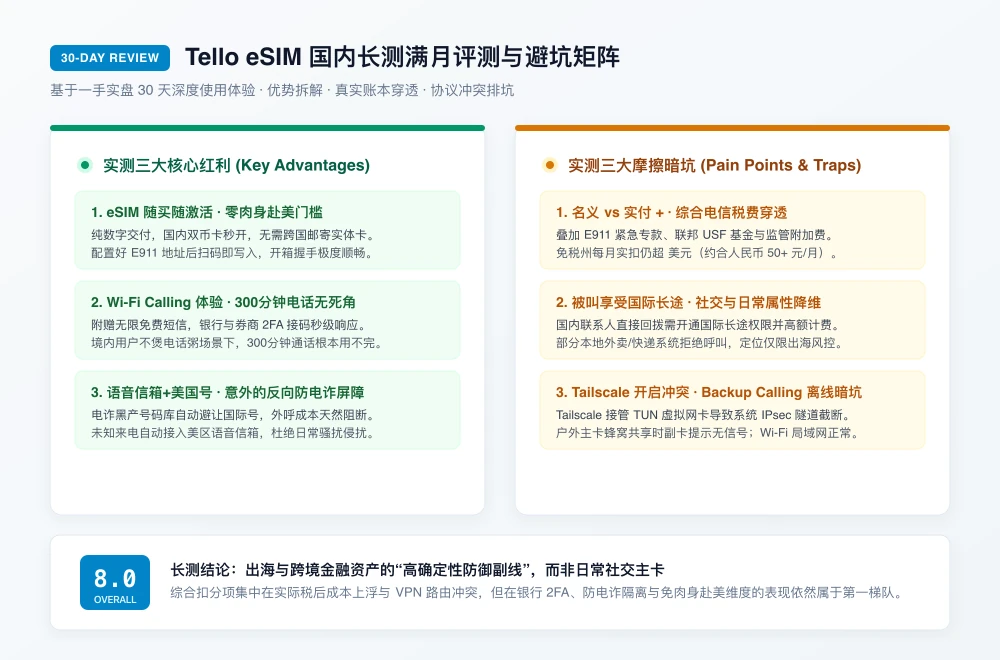
*Figure 2: Performance scorecard and friction matrix for Tello eSIM.*
1. Nominal $5 vs. Actual $7+: Deconstructing the Regulatory Surcharge
Subscribers opting for the advertised $5 tier often expect an exact $5 recurring credit card charge. However, once the renewal invoice settles, the settled transaction lands above $7 per month.
This variance does not stem from carrier gouging, but from mandatory US telecommunications surcharges and statutory fees:
- Federal Universal Service Fund (F-USF): Assessed under FCC mandates to subsidize rural infrastructure, schools, and healthcare connectivity. The assessment rate floats quarterly based on federal targets.
- State & Local E911 Emergency Service Surcharges: Statutorily required fees for local public safety dispatch (which apply even across low-tax jurisdictions such as Delaware, typically ranging from $0.60 to $1.25).
- Regulatory Recovery & Administrative Fees: Cost-recovery surcharges deployed by the carrier to offset ongoing compliance expenses with public utility commissions.
Monthly Cost Breakdown
- Base Plan: $5.00
- Taxes, Surcharges & Regulatory Fees: ~$2.10 – $2.30
- Settled Recurring Card Charge: $7.10 – $7.30 / month
While roughly $7 per month remains exceptionally affordable compared to enterprise roaming contracts, operators tracking marginal subscription costs must account for this 40% delta over the nominal price tag.
2. The Inbound Penalty: Loss of Local Domestic Utility
Holding a foreign sovereign number inevitably isolates you from local everyday communications infrastructure:
- Caller Friction: Local domestic contacts, delivery personnel, or regional vendors dialing your line must possess international calling authorizations and will incur cross-border toll rates.
- Platform Incompatibility: Most regional ride-hailing services, parcel notifications, and municipal identity platforms strictly reject
+1inputs, refusing to send verification OTPs or dispatch automated notifications.
The mandate for this card must remain sharply drawn: It is an operational bridge for cross-border banking, offshore asset custody, digital infrastructure, and compliance verifications. It cannot function as a daily local driver.
3. The Technical Trap: Why Tailscale Kills iOS Backup Calling
This was the most subtle routing failure identified during the 30-day trial.
Modern iOS dual-SIM implementations support Backup Calling (Wi-Fi Calling over Cellular Data): when SIM 1 (a local physical carrier) maintains an active cellular data connection, the core OS can route secondary eSIM traffic through SIM 1’s data pipe. This creates a secure, persistent transit tunnel, enabling out-of-home calling and OTP ingestion (reflected in the iOS status bar as Tello using Cellular Data).
Field testing revealed a critical edge case: Running Tailscale—or any proxy engine that claims the system TUN interface via Apple’s NetworkExtension framework—completely disables Backup Calling.
Observed System Behavior
- Local Wi-Fi Network: With Tailscale active, standard Wi-Fi Calling operates normally; the device maintains
Tello Wi-Ficonnectivity. - Outdoor Cellular Context: With Tailscale active, SIM 1 routes data traffic without issue, but the secondary Tello eSIM drops offline immediately, cycling into “No Service”. Shutting down the Tailscale client restores the backup cellular link within 30 seconds.
The Underlying Network Failure
- IPsec Tunnel Negotiation: iOS Backup Calling initiates a direct, low-level IPsec IKEv2 handshake (targeting UDP 500 and UDP 4500) over the physical cellular data interface back to T-Mobile’s Evolved Packet Core (EPC).
- Virtual Interface Routing Hijack: Tailscale establishes a virtual network interface, rewriting the routing table and capturing global DNS queries. Due to MTU constraints, routing blackholes, or packet encapsulation conflicts over the baseband’s private cellular IP address, the underlying subsystem fails to negotiate T-Mobile’s encrypted IPsec tunnel.
- EPC Heartbeat Timeout: Denied raw UDP transit to its edge gateways, T-Mobile’s core network registers a dead-peer condition. iOS drops the link, displaying “No Service” on the secondary line.
Remediation Protocol
When operating off Wi-Fi while awaiting sensitive banking calls or verification OTPs:
- Temporarily disconnect the Tailscale client on your handset.
- Alternatively, configure your Tailscale ACLs or mobile split-tunnel routing rules to explicitly bypass UDP 500, UDP 4500, and T-Mobile’s authoritative IPsec discovery FQDNs (e.g.,
epdg.epc.mnc260.mcc310.pub.3gppnetwork.org).
3. Field Verdict: The Logic Behind an 8.0 Score
Following thirty days of consistent testing, we rate the Tello eSIM deployment at 8.0 out of 10:
| Dimension | Score | Operational Analysis |
|---|---|---|
| Delivery & Provisioning | 10 / 10 | Zero-logistics activation. Standard international credit cards accepted; instantaneous QR code provisioning completed in under 10 minutes. |
| Banking 2FA & Outbound Voice | 9.5 / 10 | Native T-Mobile postpaid-equivalent allocation passes all institutional risk engines. 300 minutes voice buffer covers emergency compliance calls. |
| Telecom Defense | 9.0 / 10 | Native voicemail and international routing barriers systematically dismantle robocall unit economics, providing robust passive filtering. |
| Carrying Cost Predictability | 7.5 / 10 | Regulatory surcharges lift the effective floor to ~$7+/month. Reasonable in absolute terms, but an unexpected spread for bare-metal budget optimizers. |
| Network & VPN Compatibility | 6.0 / 10 | TUN interface contention from tools like Tailscale breaks outdoor Backup Calling, demanding proactive routing interventions. |
Strategic Recommendations
- Who It Serves: Global operators with modern eSIM-capable handsets who must maintain sovereign access to US depository accounts (Chase, Citi, Capital One), prime brokerage desks (Schwab, Fidelity, Interactive Brokers), or core offshore infrastructure—and who prioritize deterministic compliance over chasing the cheapest possible SIM.
- Who Should Avoid It: Users bound to legacy single-SIM hardware, those seeking a single primary number for everyday local domestic tasks, or individuals hyper-sensitive to a $7 monthly infrastructure overhead.
In cross-border asset custody and sovereign technical setups, knowing the precise boundaries of your tools matters far more than blind adoption. Once you account for its real ledger costs and edge-case network frictions, Tello eSIM remains one of the most reliable, cost-effective US mobile nodes available from anywhere in the world.
Related Research & Topics
Tello Mobile eSIM
SafetyWing Nomad Insurance
* Disclosure: This post contains affiliate links. If you make a purchase through these links, V-G Journal may earn a small commission at no additional cost to you. We only recommend services we independently evaluate and trust.
FIRE and Golf:自由旅居之路
专注于为追求 FIRE 与品质生活的人群提供特惠打球权益与候鸟微度假。不持一砖一瓦,运营品质生活。