Leveraging Tax App Appeals for Unpaid Wages: A Guide to Tax Deterrence and Avoiding Backlash
A viral tactic involves using the personal income tax app to reclaim unpaid wages. This article scrutinizes the conditions under which this strategy is effective, dissects how tax audits dismantle inflated corporate expenses, clarifies the tax bureau's limitations in wage recovery, and provides a practical guide to evidence preservation against potential repercussions.

Executive Summary: Amidst workplace disputes, a peculiar method for wage recovery is gaining traction among employees: when faced with unpaid wages, instead of immediately contacting labor inspection hotlines or initiating lengthy arbitration, individuals are turning to the personal income tax app. By locating the relevant monthly income record and filing an appeal stating, “This income has been declared but not actually received,” many report compelling employers to transfer funds within days to resolve the issue and withdraw the appeal. This grassroots tactic is neither a universal panacea nor a tax evasion scheme; it’s a precise application of administrative deterrence as a leverage tool.

Figure 1: Mobile interface for checking personal income tax details and evidence of employment contracts.
I. Fact Check: The Efficacy Boundaries of Tax App Appeals for Swift Wage Recovery
The widely circulated method is technically and factually sound, demonstrating remarkable efficiency in specific scenarios. However, it’s crucial to understand: this tactic is not a universally applicable legal tool for wage recovery. Its effectiveness hinges on extremely stringent financial prerequisites.
The reason this approach can instantly dismantle an employer’s defenses in certain cases is that the employer, without actually disbursing the full wages to the employee’s bank account, has already completed the personal income tax withholding declaration for “wage and salary income” through the electronic tax bureau’s withholding system.
【Three Preconditions for Effective Tax App Appeals】
- Effective Scenario (Advance Financial Provisioning) ➔ The company faces liquidity issues or intentionally delays payments but, to avoid penalties for late tax declarations or to pre-list labor costs for corporate income tax reconciliation, submits the full employee payroll declaration on time. The employee’s app then shows a clear income record for the month, enabling an appeal.
- Ineffective Scenario (Zero or No Declaration) ➔ Many insolvent companies on the brink of bankruptcy, with completely severed cash flow, often fail to file declarations for months or opt for zero declarations. Employees opening their apps will find the corresponding monthly records blank, leaving no basis for an appeal.
- Complete Blind Spot (Informal Economy & Private Accounts) ➔ Construction labor contractors, small restaurant owners, or some micro-startups frequently settle wages via WeChat, Alipay, or the legal representative’s personal bank accounts, never including these workers in the official tax declaration roster. The personal income tax app is entirely unaware of these off-the-books transactions.
In essence, the personal income tax app appeal is not a magic trick; it requires a “contradictory declaration mark” left by the employer within the tax system to ignite the fuse of administrative scrutiny.
II. Underlying Game Theory: Why Tax Audit Deterrence Outpaces Labor Arbitration?
Employees often find themselves entangled in the cumbersome friction of traditional legal recourse. In standard legal channels, whether lodging a complaint with the labor inspection hotline (12333) or applying for arbitration with the labor dispute arbitration commission, these are fundamentally civil remedies.
From case acceptance, document service, evidence presentation, and cross-examination to scheduling hearings, statutory deadlines typically range from 45 to 60 days. If the employer intentionally delays, leveraging the time differential of first and second-instance civil litigation, a complete resolution can easily stretch to six months or even a year. Given the depreciation of workplace energy and the fundamental nature of employment contracts, the marginal cost of violation is too low, and time invariably favors parties with legal resources and financial reserves.
In stark contrast, filing an appeal on the personal income tax app stating “this income has been declared but not actually received” instantly elevates an ordinary civil employment dispute into a risk control issue at the administrative tax compliance level.
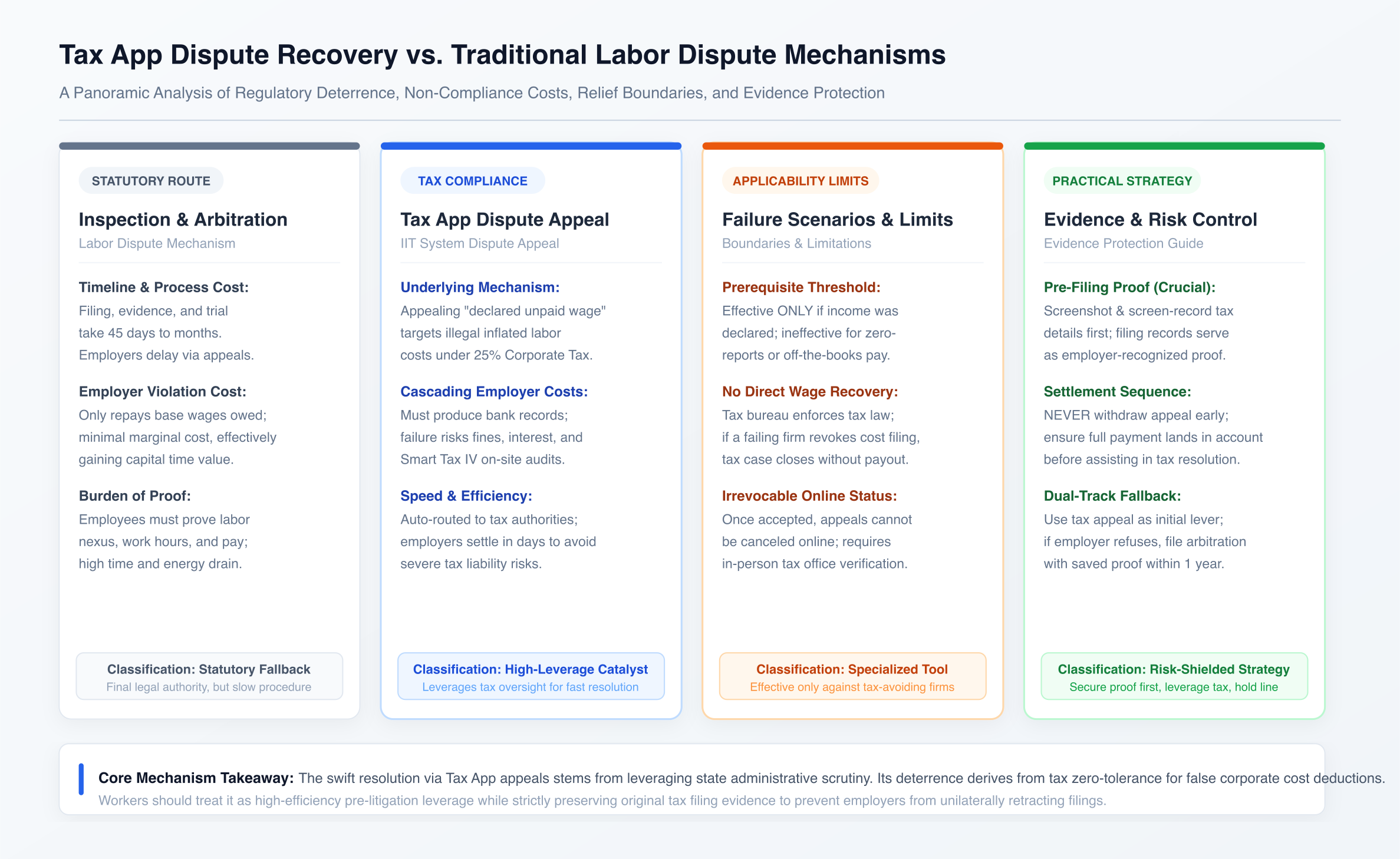
Figure 2: Comparison matrix of tax system appeals and traditional statutory labor rights protection mechanisms.
1. Breaching the “Accrual Basis” and the Red Line of Inflated Corporate Income Tax Expenses
According to China’s “Personal Income Tax Law” and relevant tax collection and management regulations, employers withholding personal income tax on wages and salaries must strictly adhere to the “accrual basis”: the legal obligation to withhold and declare taxes arises only when monetary compensation is actually paid to the taxpayer in that period. Declaring withholding tax before actual payment constitutes fraudulent tax declaration under tax collection and management law.
More critically, this triggers a chain reaction at the corporate income tax level. In the logic of corporate financial costs and employment accounting, actual, reasonable wage and salary expenses can be fully deducted from corporate income tax. At the standard corporate income tax rate of 25%, falsely reporting 1 million yuan in labor costs that were never actually paid directly results in the illegal retention of 250,000 yuan in taxes for the company.
Once an employee submits an appeal via the mobile app, the system directly triggers alerts for “personnel inflation” or “cost fabrication” and routes the case to the relevant tax office based on jurisdiction.
2. Burden of Proof Reversal and the Panic of Comprehensive Audits
In labor dispute arbitration, employees often expend considerable effort gathering chat logs, attendance records, and ID cards as circumstantial evidence. However, within the administrative process initiated by tax authorities, the burden of proof is entirely reversed:
The tax authority does not require the employee to prove they “did not receive the money.” Instead, it directly orders the employer to provide electronic bank statements proving the actual disbursement of wages through the company’s official account within a specified period. Failure to produce genuine payment receipts with bank seals directly implicates the company in falsely reporting expenses and making inaccurate declarations under tax law.
For small and medium-sized enterprise owners, the deterrence from such an audit is exponentially amplified:
- Direct Financial Penalties: Reduction of taxable income, full payment of corporate income tax, daily late payment penalties at a rate of 0.05%, and administrative fines ranging from 0.5 to 5 times the amount of tax evaded.
- Collapse of Credit Rating: The company’s tax credit rating will be directly downgraded to C or D, leading to reduced invoice issuance quotas and potential withdrawal of bank credit lines.
- Risk of Exposing Deep-Seated Irregularities: Under the comprehensive monitoring of the Golden Tax System Phase IV, a single anomaly in labor costs can easily trigger a full-scale on-site audit, exposing long-standing historical issues such as “public-to-private transfers,” “fictitious expense reimbursements,” and “off-the-books accounting.”
Faced with potential back taxes, fines totaling hundreds of thousands of yuan, and a full audit crisis triggered by the non-payment of a few tens of thousands of yuan in wages, any rational employer will quickly weigh the lesser of two evils, proactively settle the outstanding wages in full, and implore the employee to cooperate in resolving the appeal.
III. Potential Pitfalls: Three Systemic Traps to Beware
While tax scrutiny demonstrates a powerful, almost “dimensional reduction” impact in specific contexts, treating it as a foolproof remedy can easily lead employees into secondary predicaments.
| Potential Risk Dimension | Mechanistic Trap & Systemic Reality | Minimum Safeguard |
|---|---|---|
| Statutory Boundaries of Agency Power | The tax bureau lacks the legal authority to recover wages on behalf of individuals. Its core functions are tax collection and audit. If the company is on the verge of bankruptcy and the owner “throws in the towel,” the tax process concludes once the company cooperates with the tax authorities to “correct the declaration,” offset fabricated costs, and pay the taxes. The tax bureau cannot directly freeze or seize the employer’s assets for transfer to employees. | Never rely solely on the tax app appeal as the ultimate recourse; it is merely a leverage tool for pre-litigation negotiation. |
| Destruction of Core Arbitration Evidence | Tax declarations submitted by the employer to the tax system are invaluable written admissions of employment and salary amounts in judicial proceedings. If an appeal is filed directly to nullify these records without prior evidence preservation, and the case is subsequently forced into labor arbitration, the employee will have effectively erased the strongest evidence of the employer’s admission of wage arrears. | Irreversible Evidence Preservation is Mandatory Before Appealing: Conduct a complete screen recording and take extensive screenshots of the tax app’s declaration records, including the employer’s full name and the amount owed. |
| Locked Appeal Withdrawal Procedures | Once an appeal is marked as “accepted” by the relevant tax authority within the tax app, the online channel is typically locked by the system. Withdrawal often requires the individual to visit a tax service hall with identification to provide a written explanation. | Guard against employers’ empty promises of “you withdraw the appeal first, then I’ll pay.” Adhere strictly to the principle of “funds actually received, full amount secured.” |
IV. A Practical Closed-Loop Guide for Employee Rights Protection
Transforming administrative deterrence into legitimate personal rights requires an extremely rigorous operational protocol to avoid falling into an evidentiary vacuum due to improper handling.
Step 1: Pre-emptive Evidence Preservation (Non-Negotiable Rule)
Before clicking any appeal option, open the Personal Income Tax App and navigate to the [Income Tax Details] page:
- Complete Screen Recording: Start recording from your phone’s home screen, capturing your real-name authentication, the query year, and the income type (wage and salary income).
- Archive Extensive Screenshots: Take screenshots of each screen detailing the withholding agent’s full name, declared income amount, tax withheld, declaration date, and other specifics for the relevant month. Back up these records securely to cloud storage and local storage. These details, endorsed by the tax system, hold significant evidentiary weight in subsequent labor arbitration.
Step 2: Precise Appeal Submission for Leverage
After confirming evidence preservation is complete, navigate to the details of the month with unpaid wages, and click [Appeal] in the upper right corner:
- Select “Previously Employed” or the appropriate option based on your actual situation for the appeal type.
- The appeal reason must be precise and restrained. A standard template is:
This income has been declared by the withholding unit, but as of the appeal submission date, I have never actually received this labor remuneration in my bank account. I hereby request an investigation. - After submission, closely monitor the workflow status of the case in the [Appeal Handling Record] section of the app.
Step 3: Bargaining Chip Realization and Dual-Track Legal Safeguard
If the employer seeks reconciliation within a few business days after the appeal submission:
- Insist on the “Funds Received” Principle: Reject any installment promises or verbal agreements. Only after the full amount of outstanding wages has been credited to your account via public-to-private transfer or a traceable bank account should you cooperate by providing a written explanation within the legal framework.
- Initiate a Dual-Track Arbitration Strategy: If the company maliciously corrects its declaration to erase records, or if the employer refuses to cooperate, immediately take your previously preserved tax declaration screenshots and employment contract to the Labor and Personnel Dispute Arbitration Commission to formally apply for arbitration and request asset preservation, ensuring your winning position is secured within the one-year statutory arbitration period.
V. Conclusion: A Microcosm of Administrative Deterrence Replacing Judicial Relief
The popularity of the tax app appeal method for wage recovery profoundly reflects the deep-seated systemic disparities in grassroots workplace dynamics:
The “Labor Law” and labor arbitration system, designed specifically to protect employee rights, often prove to be slow and ineffective in practice due to lengthy procedural delays and low penalties for employer violations. Conversely, the tax collection and management machinery, intended to secure national fiscal stability, inadvertently becomes the most effective leverage tool for ordinary workers due to its unquestionable penetration power and stringent penalty system for non-compliance.
Individuals are not receiving the dignity and efficiency they deserve from specialized labor protection channels. Instead, they must strategically piggyback their private remedies onto the administrative system’s drive to pursue tax violations. This is an effective form of grassroots survival wisdom and a micro-reality that deserves deep consideration from institutional designers.
Related Research & Topics
The Anatomy of Digital Predation: Inside the Syndicate Targeting the Elderly via Livestream Appraisal Scams
Starlink V4 and the Low-Earth Orbit Satellite Arms Race: How a 100,000-Node Optical Mesh Pierces the Submarine Cable Monopoly
Tello Mobile eSIM
SafetyWing Nomad Insurance
* Disclosure: This post contains affiliate links. If you make a purchase through these links, V-G Journal may earn a small commission at no additional cost to you. We only recommend services we independently evaluate and trust.
FIRE and Golf:自由旅居之路
专注于为追求 FIRE 与品质生活的人群提供特惠打球权益与候鸟微度假。不持一砖一瓦,运营品质生活。