The Cognitive Interface: Re-engineering Thought for the Age of AGI
In the era of multi-agent collaboration, vague intent is a prohibitive tax on productivity. This essay explores the shift from intuitive expression to rigid logic protocols, transforming personal experience into high-fidelity cognitive assets for the AGI era.

Executive Summary: Traditional human collaboration relies on tacit understanding and emotional resonance. However, when interacting with AGI and complex multi-agent systems, the only currency that matters is contextual clarity and logical rigidity. Structured expression is not about flowery rhetoric; it is the process of deconstructing vague intuitions and fragmented experiences into deterministic, addressable, and reproducible logical protocols.
Introduction: From Tacit Rapport to Protocol Rigidity
In the theater of human collaboration, we have long relied on the “unspoken”—the shared glance, the industry jargon, the subtle emotional cues over coffee. This reliance on cultural shorthand and subtext is sufficient for aligning intent between humans. However, in the age of autonomous agents, these habits become a catastrophic friction point.
Large Language Models (LLMs) and AGI systems lack physical experience and cannot perceive a user’s psychological fluctuations. Their underlying mechanics are governed by deterministic probability maps and rigorous context windows. When a user provides a vague, ambiguous prompt laced with subjective desires, the machine is forced to guess across a trillion-dimensional latent space. The result is a high “alignment tax”: frequent hallucinations, generic outputs, and “word salad” that lacks any executable value.
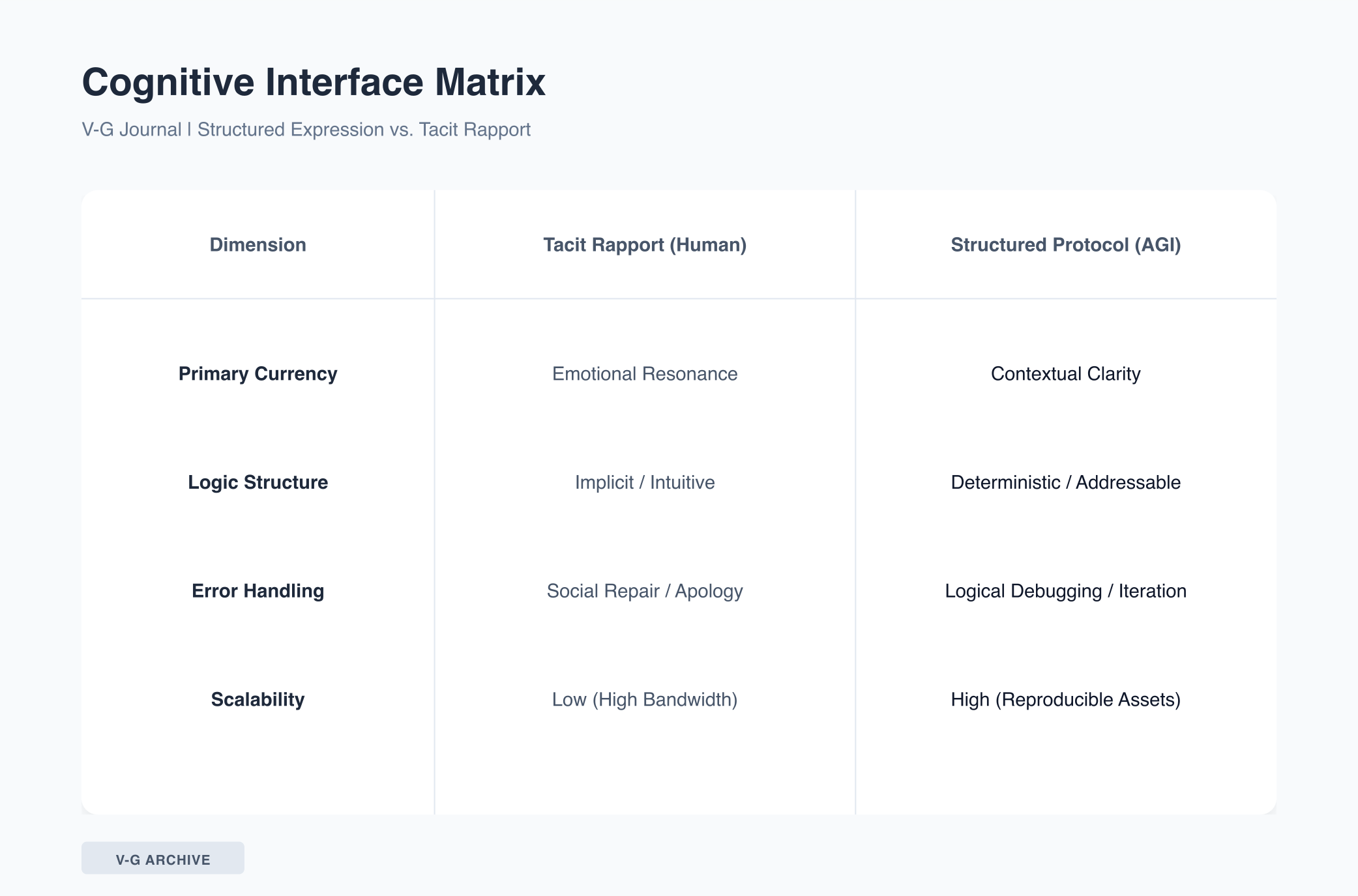
Figure 1: In the context of AGI collaboration, the rigor of the input interface determines the determinism of the output.
The essence of structured expression is not the formalization of natural language, but the translation of raw intuition into a “cognitive protocol” that an algorithm can parse with stability. To ensure personal experience remains a high-leverage asset in the AGI era, we must re-engineer our expression across four engineering layers.
I. Intent as Contract: From “Wishing” to “Defining the API”
The root of most inefficient communication is the speaker’s focus on subjective desires rather than boundary conditions and acceptance criteria. For instance, “Please write a deep market analysis” is, to an LLM, a prompt with near-infinite entropy. It defines neither the input constraints nor the output specifications.
In agentic collaboration, every expression must be treated as a technical API Contract. A valid intent contract requires three rigid elements:
1. Objective Inputs and Context
One must state the objective reality, existing data, and contextual boundaries. The machine does not inhabit your physical world; it requires raw facts. Providing the data point “Return rates for E-commerce Channel A spiked from 3% to 11% last month, concentrated in Size M” is infinitely more effective than saying “Our after-sales experience has been terrible lately.”
2. Hard Constraints and Negative Prompts
Defining the “no-go” zone is often more critical than describing the goal. You must use clear lists to inform the machine of what is strictly forbidden. For example:
- Do not alter the categorization of line items in the original financial statement.
- Do not cite long-tail sources that haven’t been verified against the official database.
- Exclude “price promotions” as an option; focus solutions solely on supply chain and fulfillment latency. Negative prompts prune the generative path, preventing the model from wandering into generic hallucinations.
3. Deterministic Acceptance Criteria
Specify the delivery format in quantifiable terms. Do not ask for “deep analysis.” Instead, demand: “Output a Markdown comparison table with three causal logic chains based on financial KPI shifts, followed by a sensitivity analysis for each.”
Intent Contract Comparison:
- Vague Wish: “Help me optimize our team communication; efficiency is low.”
- API Contract: “Context: A cross-border asynchronous team. Bottleneck: Test regression after code merges takes >6 hours. Without purchasing new SaaS, output a pipeline restructuring plan with 3 automated pre-check nodes (max 15 min runtime each) in Markdown step-by-step format.”
II. Cognitive Atomization: Separating Facts, Mechanisms, and Preferences
Human speech tends to blur objective facts, deductive logic, and subjective bias into a single narrative. When this un-deconstructed information is fed into an LLM, the model often “hallucinates toward the user,” using fabricated logic to validate the user’s preconceived stance.
Structured expression requires a strict tripartite deconstruction:
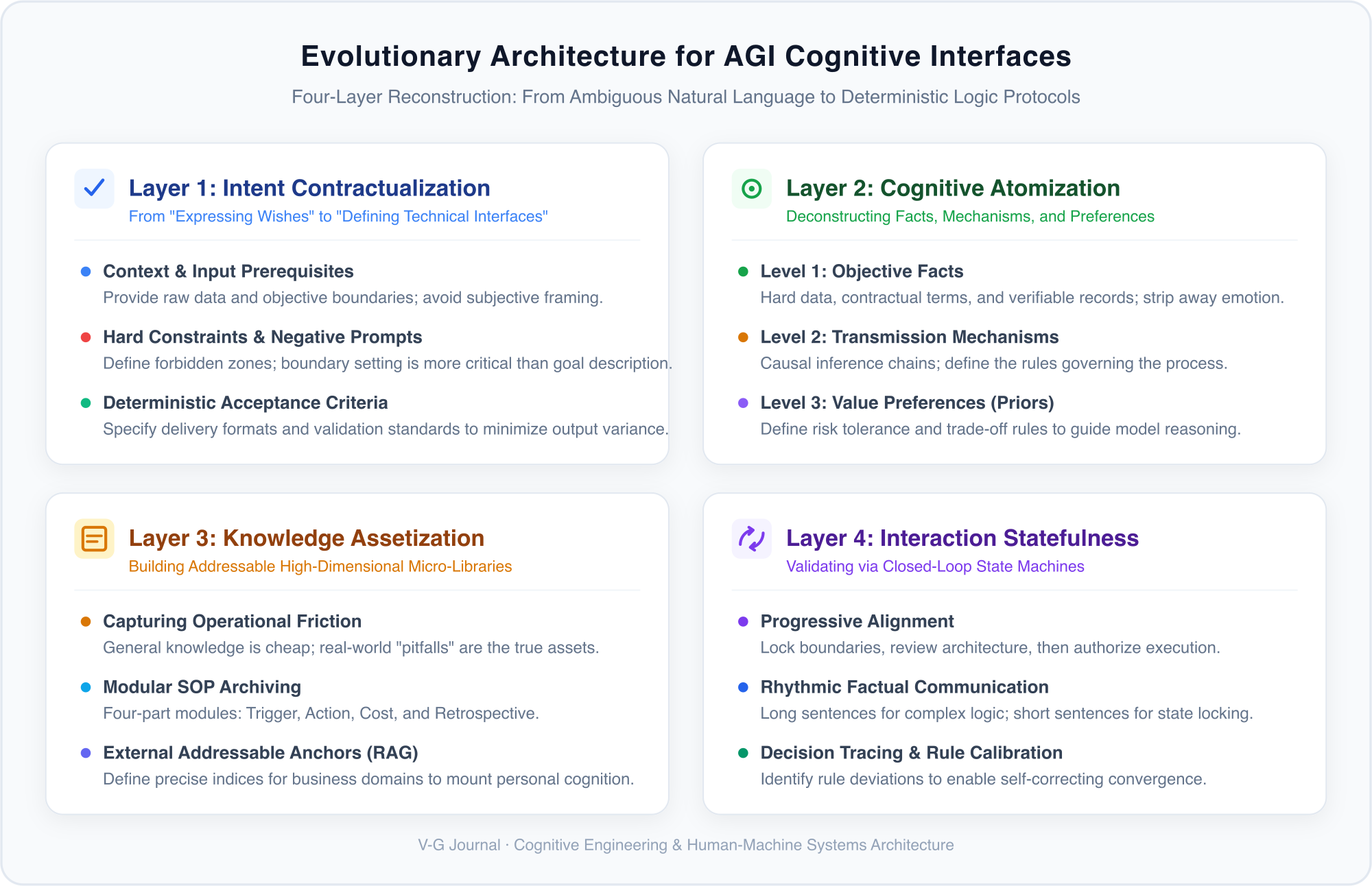
Figure 2: The Four-Layer Evolution Model of Human-AI Cognitive Interfaces.
Layer 1: Objective Facts
Verifiable data, legal statutes, transaction logs, code errors, or physical observations. Facts must be falsifiable and devoid of adjectives. Example: “Fuel surcharges on this route increased by 15% in March 2026.”
Layer 2: Causal Mechanisms
The specific logic chain that leads from Fact A to Conclusion B. Through what institutional rule, market mechanism, or physical law does the transmission occur? What are the friction costs? Mechanisms are the “rules of the game” in the objective world.
Layer 3: Value Preferences (Priors)
The speaker’s risk appetite and subjective trade-offs. Example: “Between system redundancy and hardware cost, I prioritize 99.99% availability,” or “I would rather sacrifice 20% short-term conversion than use deceptive marketing pop-ups.”
By isolating these three, the AGI can perform unbiased logical reasoning based on solid facts while respecting your underlying values (preferences), rather than being hijacked by emotional noise.
| Dimension | Definition | Requirement | Anti-Pattern |
|---|---|---|---|
| Objective Facts | Verifiable data and records | No rhetoric, falsifiable, quantitative | “This vendor is unreliable and always late.” |
| Mechanisms | Causal rules driving A to B | Closed-loop causality, friction costs | “Because they are bad, our project failed.” |
| Preferences | Risk appetite and strategic trade-offs | Explicitly stated, prioritized | “We want absolute safety at the lowest price.” |
III. Knowledge as Asset: Building Addressable Micro-Practice Libraries
In the AGI era, general knowledge and textbook theories have been commoditized. Whether it’s Wikipedia entries, standard marketing frameworks, or basic syntax, the LLM’s mastery exceeds that of most humans. If your expression remains at the level of “What is a SWOT analysis?”, your cognitive value is zero.
The only irreplaceable value lies in the micro-frictions and break-point experiences distilled from high-stakes, high-complexity real-world operations:
1. Documenting Micro-Friction
Do not just record abstract methodologies. Record specific negotiation bottlenecks, the real reasons for customs delays in specific regions, the sensor drift errors of a particular model in high humidity, or the tactical maneuvering during a contract breach. This data—born of real cost and friction—cannot be synthesized by generic training sets.
2. Modular Archiving (SOPs and Case Sets)
Transform scattered experience into standardized modules:
- Trigger Scenario: What specific anomaly or edge case occurred?
- Response Action: What non-intuitive defensive or counter-measures were taken?
- Actual Cost: How much liquidity, compute, or time was consumed?
- Post-Mortem: Why did the original assumptions fail in the face of reality?
3. Creating Addressable Concept Anchors (RAG Context)
Establish precise nomenclature for your proprietary business logic. When these structured experiences are attached to an agent as an external knowledge base (RAG), the AGI provides the general compute, while you provide the “micro-validation rules” tested by the harshness of reality.
IV. Stateful Interaction: The Verification Loop
Effective collaboration with AGI is not a one-way “Question-Answer” broadcast; it is a state-machine transition. Inefficient users send a massive prompt and wait blindly for a result. If it fails, they scrap it and start over—a waste of both compute and time.
High-efficiency expression follows a strict stateful flow:
1. Progressive Alignment
For complex engineering or analytical tasks, never attempt a “one-shot” completion.
- Phase I (Definition Lock): Feed raw materials and context; ask the model to restate the problem and boundaries in its own words to ensure no cognitive drift.
- Phase II (Architectural Review): Ask for an outline or a comparison of technical approaches. Only proceed after human verification.
- Phase III (Execution): Generate results module-by-module, validating each against the criteria.
2. The “Breath” of Fact and Command
When describing complex causality, use structured, compound sentences to detail environmental variables and constraints. However, at key decision points, use short, cold, and unambiguous commands to lock the state.
Example: “Given the ambiguity in the tax treaty mentioned in point three, Hypothesis B is invalid. Discard Option 2. Proceed immediately to detail the compliance path for Option 1.”
3. Rule-Based Calibration
When the model errs, avoid emotional rebukes (“You’re wrong, redo it”). Instead, point to the specific rule violated.
Example: “Conclusion 3 violates the negative constraint: ‘No unsecured short-term credit.’ Remove this path and recalculate the cash flow gap.” Each correction anchored to a specific rule forces the model to converge within the context window, achieving precise self-correction.
Conclusion: Thought as a Pluggable Protocol
Structured expression is not a bureaucratic word game. Its core is using the cleanest language and the tightest logic to clarify who is acting, based on what facts, following which laws of reality, accepting what trade-offs, and delivering what specific output.
As AGI evolves, it will not replace personal expertise; it will act as a high-sensitivity magnifying glass. If your logic is chaotic, the machine will amplify that chaos into massive hallucinations. If your interfaces are clear and your mechanisms are atomic, the machine becomes a high-performance external brain, fully unlocking the value of your cognitive assets.
Related Research & Topics
The Anatomy of Digital Predation: Inside the Syndicate Targeting the Elderly via Livestream Appraisal Scams
Starlink V4 and the Low-Earth Orbit Satellite Arms Race: How a 100,000-Node Optical Mesh Pierces the Submarine Cable Monopoly
Tello Mobile eSIM
SafetyWing Nomad Insurance
* Disclosure: This post contains affiliate links. If you make a purchase through these links, V-G Journal may earn a small commission at no additional cost to you. We only recommend services we independently evaluate and trust.
FIRE and Golf:自由旅居之路
专注于为追求 FIRE 与品质生活的人群提供特惠打球权益与候鸟微度假。不持一砖一瓦,运营品质生活。