The Nobel Prize and the Physics of Discovery: Why Radical Innovation Demands Open Institutions
The breakthroughs honored by the Nobel Prize reveal an unyielding law of scientific philosophy: radical innovation depends on frictionless global collaboration and uncompromised peer review. When scientific ecosystems are dominated by bureaucratic KPIs, they inevitably lapse into derivative, low-risk research.

Executive Summary: The frontier breakthroughs honored by the Nobel Prizes in the natural sciences follow an unyielding law of scientific philosophy: paradigm-shifting discoveries cannot survive in artificial isolation. Modern basic research is high-risk, long-cycle, and deeply uncertain. It demands an unhindered global academic network and the institutional courage to endure sharp peer criticism and systemic trial-and-error. To retreat inward, widen the gap with the global scientific community, and shackle intellect with bureaucratic KPIs—while still expecting Nobel-level breakthroughs—is a fundamental misunderstanding of how science actually evolves.
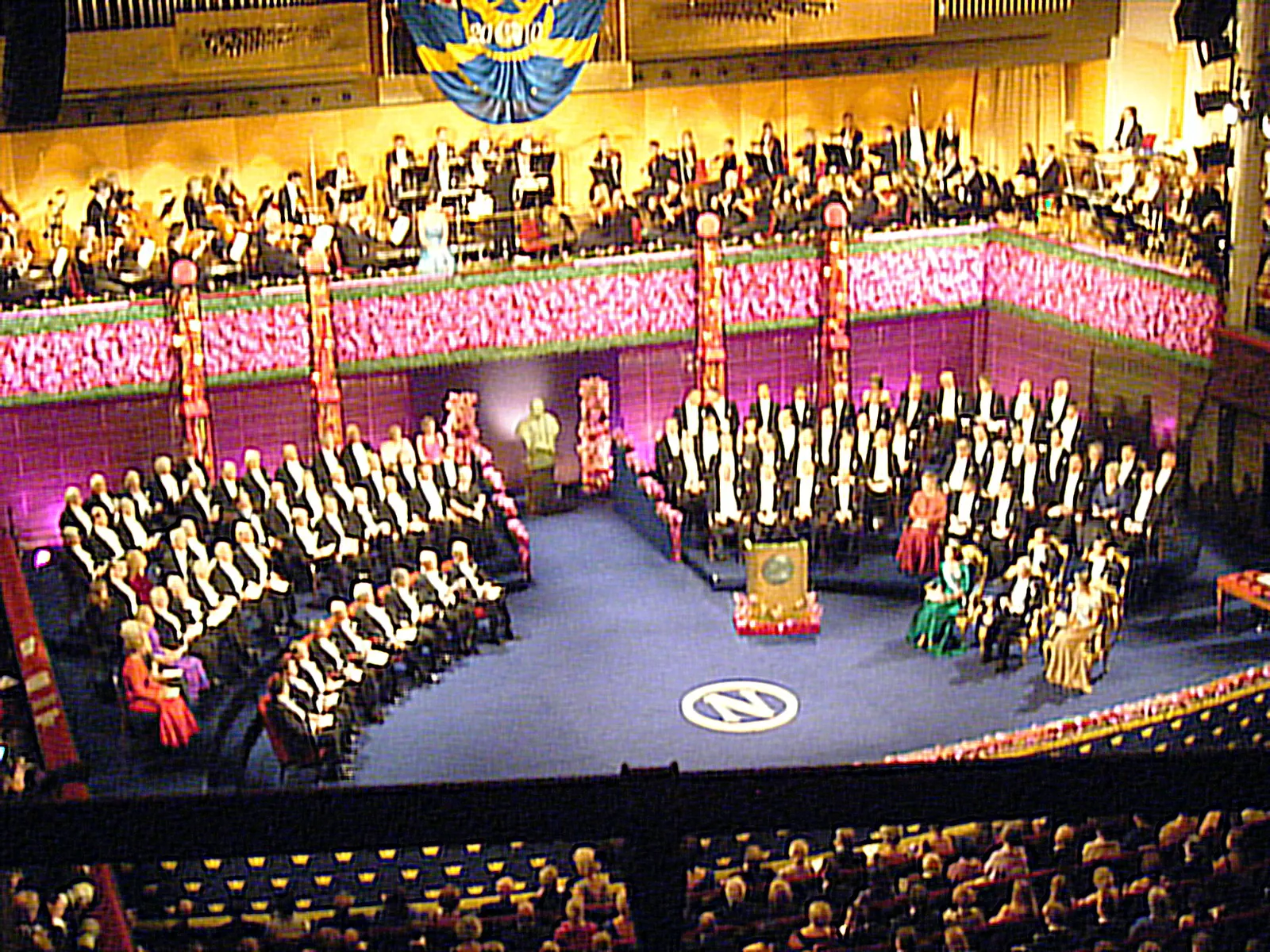
Figure 1: The Nobel Prize Award Ceremony at the Stockholm Concert Hall. The stage brings together frontier pioneers from across the globe, backed by the long-term validation and consensus of a borderless scientific community.
I. The Modern Paradigm Shift: Why Breakthroughs Die in Isolation
In Thomas Kuhn’s The Structure of Scientific Revolutions, scientific progress is not a linear, cumulative addition of incremental facts. Instead, it occurs through “paradigm shifts.” The most revolutionary hypotheses and interdisciplinary discoveries almost always spark at the turbulent boundaries where different cultural backgrounds, heterogeneous academic schools, and diverse intellectual traditions collide.
The physical frontier of modern basic science has long outgrown the era of the lone inventor or the closed workshop. Any breakthrough capable of reshaping the boundaries of human knowledge relies on a global academic network as its foundational infrastructure:
- Decentralized Global Peer Review: A novel hypothesis must immediately be thrown into the arena to face the ruthless scrutiny, replication attempts, and skepticism of the world’s sharpest minds. This unforgiving intellectual friction is precisely what exposes pseudoscience and logical fallacies early on, allowing researchers to pivot away from dead ends.
- Transnational Infrastructure and Data Flow: From the Large Hadron Collider at CERN to globally distributed radio telescope arrays, open-access preprint servers, and protein structure databases, the marginal cost of exploring modern “Big Science” has been drastically lowered by global collaboration.
- The Compounding Cost of Isolation: When physical or digital barriers are erected between a local community and the global scientific network, the cost of validation skyrockets. Researchers in closed systems end up wasting immense capital and talent reinventing the wheel—or spending years down a rabbit hole that their international peers disproved a decade prior.
To disconnect from the main trunk of global academia is to accept an ever-widening cognitive and technological deficit. To isolate oneself from the global network while expecting to claim prizes at the frontier of human intellect is a logical contradiction.
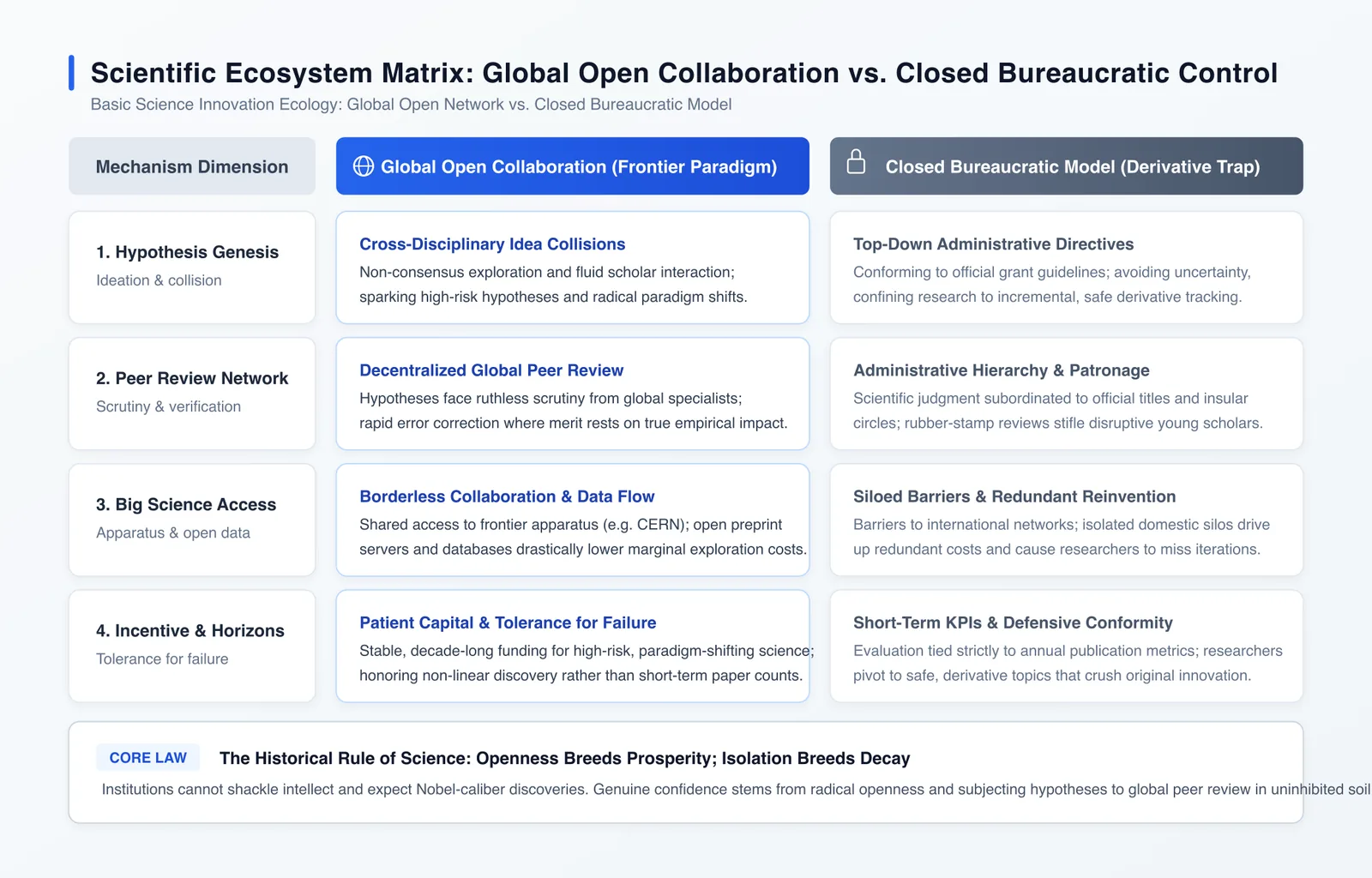
Figure 2: The Scientific Ecosystem Matrix: A multi-dimensional comparison between global open collaboration networks and closed, administratively driven systems.
| Dimension | Global Open Collaboration | Closed Bureaucratic Control |
|---|---|---|
| Evaluation Metric | Peer consensus & empirical validation | Administrative KPIs & publication volume |
| Risk Tolerance | High tolerance for constructive failure | Zero-risk bias, path-dependent incrementalism |
| Resource Allocation | Decentralized, merit-based, fluid | Centralized, hierarchical, rent-seeking |
| Information Flow | Frictionless, global, open-access | Siloed, restricted, inward-looking |
II. Institutional Shackles and Distorted Incentives: How Bureaucracy Smothers Radical Innovation
Basic research is fundamentally different from engineering. Engineering campaigns have clear targets and defined paths; they can be brute-forced through concentrated resources and top-down mobilization. Basic science, however, is a foray into a dark, uncharted forest. Its defining characteristics are “non-consensus” and a high probability of failure.
When institutional shackles are placed on researchers at the source of discovery, the incentives of the entire ecosystem warp systematically:
1. KPI-Driven Survival: The Shift to Derivative Science
When scientific evaluation is dominated by short-term quantitative metrics, annual KPIs, and administrative reviews, rational researchers—driven by self-preservation—make choices that optimize for the system’s metrics rather than truth:
- Risk Aversion: They actively avoid long-cycle, high-risk, paradigm-shifting basic research that might yield zero publications for a decade.
- Path Dependency: They pivot toward incremental, derivative projects—safe topics that guarantee publications, satisfy grant requirements, and chase established global trends.
The result is an inflation of paper counts alongside a famine of original ideas. Researchers become assembly-line workers chasing impact factors, making minor tweaks within existing frameworks while losing the courage to challenge prevailing paradigms or pioneer entirely new fields.
2. The Administrative Capture of Academic Power
When the authority to judge scientific merit and allocate resources is held by administrative bureaucrats and hierarchical titles rather than peer evaluation, the scientific spirit of empirical truth is inevitably corrupted by political maneuvering and academic rent-seeking.
In a rigid hierarchy, challenging authority is often treated as insubordination, and disruptive young scholars struggle to secure funding. If a system could produce Nobel-caliber breakthroughs under such institutional shackles, it would defy both the history of science and the very criteria of the Nobel Prize.
This dilemma—importing advanced hardware while resisting open ideas and institutional reform—is a recurring historical trap. As seen in the institutional divergence between the late Qing Self-Strengthening Movement and the Meiji Restoration (detailed in our analysis of The Institutional Divergence of the Self-Strengthening Movement and the Meiji Restoration), history has shown that buying state-of-the-art instruments without cultivating an institutional soil that tolerates dissent and encourages trial-and-error will never generate self-sustaining scientific momentum.
III. The Verdict of History: Openness as an Absolute Law
Viewed through the lens of institutional economics and civilizational history, there is a rigid, historical correlation between openness and technological prosperity:
- Prosperity is Born of Synthesis: The golden ages of the Han and Tang dynasties flourished because their openness to Western trade, foreign cultures, and external technologies made Chang’an the hub of Eurasian exchange. The Song Dynasty’s maritime trade and technological spillovers established it as a global leader in commerce and industry. Similarly, the economic and industrial miracle of the past forty years of Reform and Opening Up was achieved by deeply integrating into the global division of labor and absorbing international capital, technology, and academic practices.
- Isolation Breeds Cognitive Decay: The maritime bans of the Ming Dynasty and the closed-door policies of the Qing Dynasty coincided with an arrogant indifference to the Industrial Revolution and the rise of modern science. These artificial barriers created a profound cognitive and technological chasm in just a century or two, culminating in historical tragedies when confronted by modern industrial powers.
History repeatedly demonstrates a simple truth: the physical world will keep spinning regardless of any single nation’s participation, but any civilization that cuts itself off from global exchange will inevitably find itself marginalized. Openness breeds prosperity; isolation breeds decay. This objective law tolerates no exceptions.
IV. The Only True Confidence: Unflinching Exposure to Global Scrutiny
True cultural confidence and scientific strength do not come from self-congratulatory domestic circles or state-sanctioned titles. They come from throwing open the doors and subjecting one’s theories, data, and technologies to the unshielded competition of the global market and the international scientific community.
The pursuit of basic science is a collective expedition of human intellect into the unknown. The century-long authority of the Nobel Prizes in the natural sciences is built precisely on its decentralized peer review, its commitment to long-term validation, and its reverence for disruptive truths—all of which transcend geopolitical boundaries.
When confronting the laws of science and history, illusions are useless:
The Core Mechanism: You cannot shackle creativity and expect Nobel-caliber output, nor can you achieve technological sovereignty through self-isolation. True originality grows only in loose, free, and radically open soil. Only by facing global scrutiny and dismantling the institutional barriers that block exploration can scientific innovation escape the trap of low-level replication and reclaim the power to change the world.
Related Research & Topics
The Anatomy of Digital Predation: Inside the Syndicate Targeting the Elderly via Livestream Appraisal Scams
Starlink V4 and the Low-Earth Orbit Satellite Arms Race: How a 100,000-Node Optical Mesh Pierces the Submarine Cable Monopoly
Tello Mobile eSIM
SafetyWing Nomad Insurance
* Disclosure: This post contains affiliate links. If you make a purchase through these links, V-G Journal may earn a small commission at no additional cost to you. We only recommend services we independently evaluate and trust.
FIRE and Golf:自由旅居之路
专注于为追求 FIRE 与品质生活的人群提供特惠打球权益与候鸟微度假。不持一砖一瓦,运营品质生活。