The Anatomy of a Political Precipice: Liu Jianchao and the Logic of Administrative Demotion in Beijing’s Foreign Cadre System
Following reports from the Fifth Plenum of the 20th CCP Central Committee, former IDCPC Minister Liu Jianchao faces a dramatic four-rank demotion to division-level cadre. This analysis tracks his trajectory from foreign minister frontrunner to purged official, dissecting the party's disciplinary mechanics and statecraft priorities.

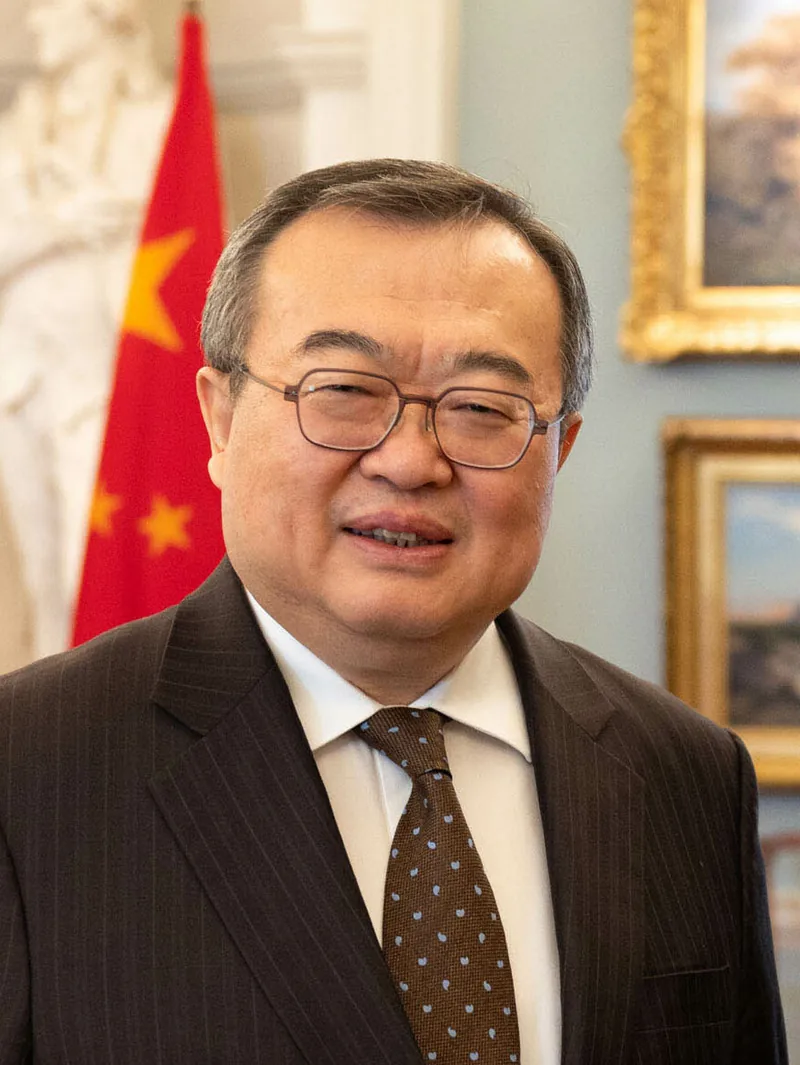
Official portrait of Liu Jianchao during his tenure as Minister of the International Department of the Central Committee of the CCP.
During the Fifth Plenum of the 20th Central Committee of the Communist Party of China (CCP) in late October 2026, reports emerged detailing a significant personnel restructuring within China’s diplomatic apparatus. According to disclosures published by Hong Kong’s Ming Pao, Liu Jianchao—former Minister of the International Department of the Central Committee (IDCPC) and a full Central Committee member—was subjected to a rare disciplinary measure following a Central Commission for Discipline Inspection (CCDI) investigation into serious violations of party discipline and law. His administrative rank was stripped from full provincial-ministerial status (zheng sheng bu ji) down to the county-division level (xian chu ji).
Once viewed by international observers and diplomatic circles as the leading candidate to succeed Wang Yi as Foreign Minister, Liu’s precipitous fall marks the definitive end of his political career. More broadly, it underscores an ongoing institutional realignment across Beijing’s external relations system. Disentangling fact from speculation in such high-stakes political cases requires filtering out public noise and examining verified public records, official transfer patterns, and the internal discipline metrics governing senior cadres.
I. Timeline of a Disappearance: From Washington Prominence to Official Silence
Significant administrative shifts in China’s party-state hierarchy rarely occur in isolation. They leave identifiable structural traces across public activity logs, official press releases, and leadership rosters. Reconstructing Liu Jianchao’s public engagements over the past two years reveals a distinct transition from international prominence to sudden administrative erasure:
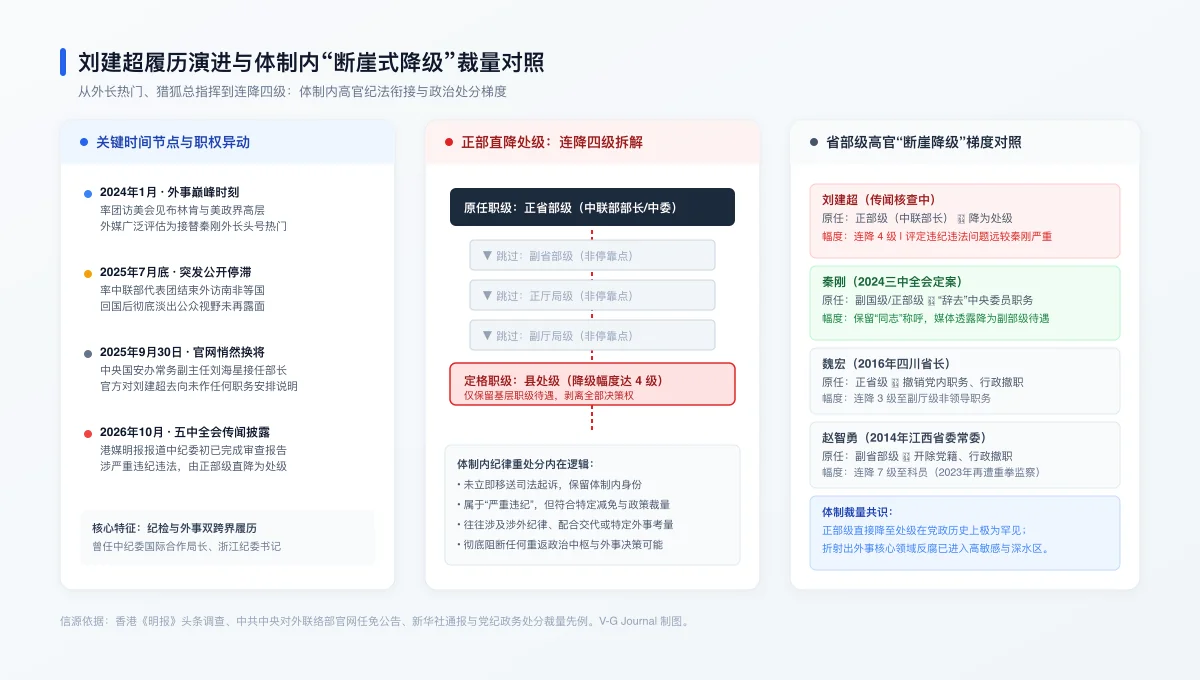
Career evolution and four-rank administrative demotion trajectory of Liu Jianchao.
1. January 2024: The High-Water Mark in Washington
In early 2024, Liu led a high-profile IDCPC delegation to the United States. He delivered a keynote address at the Council on Foreign Relations (CFR) in New York and held talks in Washington with U.S. Secretary of State Antony Blinken to articulate Beijing’s foreign policy stance. Following the removal of former Foreign Minister Qin Gang in mid-2023 and Wang Yi’s temporary reassignment to the role, Liu’s active diplomatic posture led major media outlets—including Reuters and The Wall Street Journal—to designate him as the top contender for Foreign Minister.
2. Late July 2025: Post-Trip Silence
In late July 2025, Liu led an IDCPC delegation to South Africa and Algeria. Official state media reported his return to Beijing at the end of the month. Immediately following this trip, however, his name ceased appearing in CCTV broadcasts and official IDCPC press releases, initiating a multi-month absence from public duties.
3. September 30, 2025: Unannounced Leadership Transition
On September 30, 2025, the IDCPC official portal quietly updated its executive directory. Liu Haixing, formerly Executive Deputy Director of the Office of the National Security Commission (at the full ministerial level), was named the new Minister of the IDCPC. Crucially, official releases omitted standard transition phrasing—such as “assigned to other duties”—which typically accompanies the planned reassignment of senior officials acting in good standing.
4. October 2026: Disclosures During the Fifth Plenum
On October 27, 2026, Ming Pao reported that the CCDI had finalized its investigative report on Liu around early 2026, concluding that he had committed severe violations of discipline and law. The report indicated that Liu was being subjected to a four-rank “cliff-like demotion” (duan ya shi jiang ji) to a division-level non-leadership role. Internal commentary cited in the report suggested his infractions were deemed “significantly more severe than those of Qin Gang,” setting the stage for the formal handling of his Central Committee status at the Fifth Plenum.
II. The Institutional Arithmetic: Deconstructing a Four-Rank “Precipice Demotion”
In China’s cadre hierarchy, demoting an official directly from a full provincial-ministerial level to a division chief represents an extreme disciplinary sanction. Understanding its significance requires breaking down the administrative ranks and the mechanism connecting party discipline with legal prosecution:
| Administrative Rank | Standard Institutional Role | Demotion Trajectory | Political and Material Consequences |
|---|---|---|---|
| Full Provincial / Ministerial | IDCPC Minister, Central Committee Member | Starting Rank | Exercise of core foreign policy decisions; full ministerial privileges and security clearances. |
| Vice Provincial / Ministerial | Vice Governor, Vice Minister | 🔻 Bypassed | Traditional non-criminal demotion tier; bypassed in this action. |
| Full Bureau / Directorate | Mayor, Department Director | 🔻 Bypassed | Core middle-management level; bypassed entirely. |
| Vice Bureau / Directorate | Deputy Mayor, Deputy Director | 🔻 Bypassed | Minimum directorate floor; bypassed. |
| County / Division Level | Division Chief / Non-Leadership Staff | Landing Rank (4-Rank Drop) | Total removal from decision-making; reduction to basic civil service status and minimal benefits. |
1. The Political Depreciation of Skipping Four Echelons
Dropping four administrative steps strips an official of all access to high-level strategic decision-making. Beyond the loss of authority, housing, medical, and personal security entitlements associated with ministerial rank are immediately scaled back to match the standards of a mid-level municipal bureaucrat. Within the party-state bureaucracy, a four-rank demotion effectively functions as complete political neutralization without invoking a public judicial trial.
2. Administrative Demotion Versus Judicial Referral
As analyzed in the context of judicial sentencing and party discipline dynamics, an investigation by internal discipline authorities does not automatically lead to criminal prosecution. Under the CCP Disciplinary Regulations and the Law on Administrative Punishments for Public Servants, opting for a severe administrative reduction rather than referring a case to the Procuratorate typically reflects specific institutional trade-offs:
- Categorization of Infractions: The violations may center heavily on political discipline, foreign affairs management regulations, or confidentiality breaches rather than straightforward personal bribery.
- Cooperation and Asset Recovery: The subject may have fully cooperated with internal investigators and surrendered all financial gains linked to the infractions, fulfilling criteria for mitigated administrative handling.
- State Security and Information Containment: Senior foreign affairs roles deal directly with sensitive bilateral matters and state secrets. Resolving the matter through severe internal discipline avoids public trial proceedings that could expose sensitive foreign policy operations.
3. Historical Precedents in Administrative Reductions
Comparing this case to other high-profile disciplinary actions since 2012 contextualizes the severity of the penalty:
- The Qin Gang Precedent (Soft Landing): At the Third Plenum in 2024, the Central Committee accepted Qin Gang’s “resignation” from the Central Committee. Official statements retained the honorific “comrade,” and reports indicated he retained a non-leadership vice-ministerial status—a relatively minor rank adjustment.
- The Wei Hong Precedent (Three-Rank Drop): In 2016, former Sichuan Governor Wei Hong was stripped of his party positions and reduced to a vice-directorate non-leadership post (fu ting ji), representing a three-rank drop from full ministerial status.
- The Zhao Zhiyong Precedent (Seven-Rank Drop): In 2014, former Jiangxi Standing Committee member Zhao Zhiyong was expelled from the party and demoted from vice-provincial level down to a basic clerk (ke yuan), dropping seven ranks in an early example of extreme administrative demotion.
- The Liu Jianchao Case (Four-Rank Drop): A four-rank drop for a active full minister and sitting Central Committee member remains exceptionally rare, reinforcing internal reports that his breaches were handled with marked severity relative to other recent foreign ministry cases.
III. The Paradox of the Disciplinarian: From Fox Hunt Director to Investigated Subject
Liu Jianchao’s career path was unusual for a career foreign service officer, featuring cross-system transitions into the party’s internal discipline and anti-corruption apparatus:
Beginning his career in the Foreign Ministry’s Translation Department, Liu served as Director-General of the Information Department, Ministry Spokesperson, Ambassador to the Philippines and Indonesia, and Assistant Minister of Foreign Affairs. Between 2015 and 2018, however, he was transferred out of traditional diplomacy into senior internal security and oversight roles:
- In 2015, he was appointed Deputy Director of the National Bureau of Corruption Prevention, head of the international fugitive recovery team (Operation Fox Hunt), and Director-General of the CCDI’s International Cooperation Bureau.
- In 2017, he was dispatched to Zhejiang Province as a member of the Provincial Standing Committee and Secretary of the Provincial Commission for Discipline Inspection, overseeing early pilot programs for national supervisory reforms.
- In 2018, he returned to foreign affairs as Deputy Director of the Office of the Central Foreign Affairs Commission.
- In 2022, he took charge of the IDCPC, ascending to full provincial-ministerial rank.
During a critical phase of China’s anti-corruption campaign, Liu directed international asset recovery operations and mastered the procedural mechanics governing party oversight and cross-border financial tracking. That an official with deep technical expertise in institutional discipline subsequently fell subject to those same mechanisms highlights the expansive reach of the current oversight environment.
IV. Verification Matrix: Official Records versus Disclosed Intelligence
When dealing with high-level personnel changes in sensitive policy sectors, establishing clarity requires separating verified public events from unconfirmed reporting:
| Verification Dimension | Key Event Elements | Documented Evidence | Status |
|---|---|---|---|
| Removal from Office | Replaced by Liu Haixing as IDCPC Minister in Sept 2025 | IDCPC portal leadership directory updated Sept 30, 2025; no standard reassignment notice provided | Established Fact |
| Cessation of Official Duties | Total absence from state media following July 2025 foreign trip | Zero references across CCTV and state media databases from August 2025 onward | Established Fact |
| Completion of Investigation | CCDI finalized investigative report, citing severe violations | Reported by Ming Pao; official public release from central authorities currently pending | Credible Leak / Awaiting Official Communiqué |
| Administrative Demotion | Stripped of ministerial rank; demoted four levels to division chief | Single-source news disclosure; aligns with internal disciplinary handling of foreign affairs cadres | Primary Claim / Consistent with Discipline Logic |
As observed in similar structural audits of state personnel changes and institutional investigations, senior leadership transitions are governed by strict information controls prior to formal announcements. However, sudden leadership swaps on official portals, combined with extended absences during critical diplomatic windows, typically serve as leading indicators of internal disciplinary action.
V. Structural Takeaways: Foreign Policy Cadres under Total Discipline
Historically, China’s diplomatic corps operated with a degree of functional autonomy, driven by the specialized requirements of international engagement and global protocol. Recent personnel actions demonstrate that the party’s central anti-corruption and political compliance standards now apply with equal force across external-facing institutions.
Within the logic of party statecraft, a four-rank administrative demotion is not a sign of leniency. It represents the complete liquidation of an official’s political standing. By stripping away rank, institutional resources, and platform access, the system neutralizes political influence while containing the broader organizational and international fallout of a open courtroom trial. Liu Jianchao’s step down from foreign minister frontrunner to division-level cadre reflects the absolute priority placed on political compliance within Beijing’s foreign policy structure.
Related Research & Topics
Tello Mobile eSIM
SafetyWing Nomad Insurance
* Disclosure: This post contains affiliate links. If you make a purchase through these links, V-G Journal may earn a small commission at no additional cost to you. We only recommend services we independently evaluate and trust.
FIRE and Golf:自由旅居之路
专注于为追求 FIRE 与品质生活的人群提供特惠打球权益与候鸟微度假。不持一砖一瓦,运营品质生活。