The iPhone Duo Crease, AI Inertia, and the Breakdown of Apple's Fast-Follower Playbook
With the $1,999 iPhone Duo launching straight into hinge creasing, fractured iOS 27 app scaling, and a $999 out-of-warranty screen repair bill, the first-generation Apple curse strikes again. Beyond hardware growing pains, this post-launch stumble reveals a structural turning point: Cupertino's storied playbook of late-entry market dominance is collapsing against material physics and the generative AI transition.

Executive Summary: In October 2026, Apple finally shipped its seven-years-in-the-making foldable flagship: the iPhone Duo (starting at $1,999). Within two weeks, the launch ran into a wall of mechanical reality. Early adopters documented deepening display creases, sporadic centerline micro-fractures, hinge friction chatter, and severe application scaling artifacts under iOS 27. The company responded by quietly publishing emergency care guidelines, while setting out-of-warranty inner-display replacements at an eye-watering $999. From the original Apple Watch to the first-generation Vision Pro, the golden rule of Apple hardware has asserted itself once more: never buy generation one. More critically, the Duo exposes a deeper institutional shift. Up against the physical boundaries of material science and the architectural paradigm shift of generative AI, Apple’s legendary playbook—arriving late, perfecting the formula, and hoovering up industry profits—has reached its limit. A three-trillion-dollar empire is quietly transitioning from a category-defining pioneer into a defensive incumbent protecting its tollbooth.
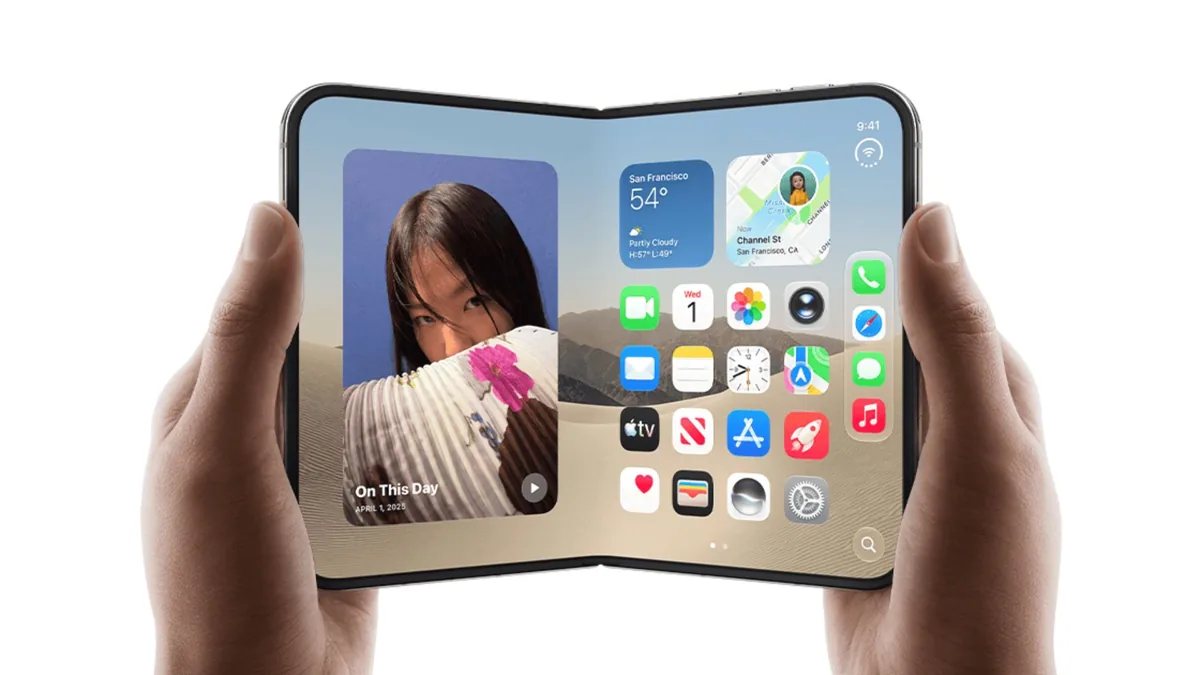
Figure 1: The iPhone Duo, unfolded into its 7.6-inch interior panel. The central hinge crease remains visible, while iOS 27 relocates the traditional bottom dock into a vertical strip along the right bezel.
I. The $1,999 Paid Beta: Three Engineering Stumbles of the iPhone Duo
Before the Duo arrived, tech circles operated under an article of faith: Samsung, Huawei, Xiaomi, and OPPO had spent six years taking the arrows in the foldable wilderness so that Apple could saunter in late, solve every lingering mechanical defect, and drop a definitive, market-closing product.
That myth cracked within seventy-two hours of delivery. Buyers who paid $1,999—scaling beyond $2,399 for higher storage tiers—discovered that supply-chain leverage cannot rewrite the laws of physics. As detailed in our earlier foldable iPhone engineering and procurement analysis, the Duo ran headfirst into three structural design compromises:
1. Hinge Friction and the $999 Display Tax
On stage, Apple lauded its “Variable Torque Hinge”—an assembly of over one hundred micro-machined titanium components paired with an internal titanium support matrix and a nano-texture matte finish designed to “optically neutralize” the crease through controlled light diffusion.
Real-world mechanical fatigue tore through the marketing copy:
- Permanent Crease Deepening: The nano-texture finish mitigates reflections only at straight-on viewing angles. Under ordinary daily cycles, the 7.6-inch ultra-thin glass (UTG) and polymer stack suffer plastic deformation along the stress axis. Run a finger across the center seam, and the trough feels indistinguishable from that of any Android competitor.
- Centerline Micro-Fractures and $999 Repairs: Across Reddit and developer forums, initial buyers began posting photographs of sudden ink-black liquid leaks along the folding axis without impact drops. Apple quietly posted an emergency support page detailing proper hinge maintenance and debris prevention. For users without AppleCare+, the out-of-pocket invoice for a replacement folding panel came in at $999—precisely half the cost of the device itself.
2. Regressing Ten Years in Biometrics to Shave Millimeters
In an obsession with achieving an impossibly thin unfolded profile, Apple’s packaging engineers ran out of internal volume. The TrueDepth camera array could not fit inside the shaved-down display bezel.
Instead of engineering an under-display breakthrough, Apple made an astonishing trade-off on a two-thousand-dollar flagship: it removed Face ID entirely. In its place sits a capacitive Touch ID sensor baked into the side power button, supplemented by proximity unlocking via the Apple Watch. Unfolding the device into a two-handed slate turns every authentication and payment prompt into an awkward thumb stretch across a razor-thin chassis.
3. iOS 27: Broken App Continuity and Dock Whiplash
Mechanical compromises are understandable; software incoherence from Apple is not.
The Duo runs a 5.4-inch external panel and a 7.6-inch inner canvas, driven by the A20 Pro’s dual-display controller. Yet, early reviews from across the industry converged on a single verdict: third-party software scaling is a mess. When unfurled from the compact exterior screen to the squarish interior panel, top-tier social, streaming, and enterprise apps routinely stall out—either letterboxing with wide margins reminiscent of early iPad compatibility modes or blowing up mobile feeds into barren, low-density views.
Worse, iOS 27 attempts to resolve thumb-reach limitations by wrenching the 19-year-old dock away from the bottom of the screen. In unfolded mode, the dock sits pinned vertically along the right bezel (Figure 1), with system navigation controls shifted to the right flank. This arbitrary break from direct manipulation forces users to constantly unlearn their muscle memory depending on whether the phone is opened or closed.
II. The First-Generation Curse: Why Early Adopters Always Pay Twice
The Duo’s launch friction is not an anomaly. A historical audit of Apple opening brand-new hardware categories over the past fifteen years confirms an unwritten rule: generation-one Apple hardware is an engineering validation test financed by its most loyal customers.
| First-Gen Category | Launch Year & Base Price | Core First-Gen Defects & User Pain Points | The True Maturity Baseline |
|---|---|---|---|
| Original iPad | 2010 ($499) | Brick-like weight (680g), a paltry 256MB of RAM causing perpetual Safari reloads, zero cameras; rendered obsolete within 11 months | iPad 2 (2011): 33% thinner, dual cameras, dual-core A5; anchored the line for half a decade |
| Apple Watch (Series 0) | 2015 ($349–$17,000) | Anemic S1 SiP with 15-second third-party app launch spinners; non-waterproof; zero native GPS; the 18k Edition became a paperweight | Series 3 / Series 4 (2017–2018): Cellular independence, performance maturity, modern edge-to-edge display |
| 12-inch MacBook | 2015 ($1,299) | Debuted the flawed Butterfly Keyboard, where single dust particles paralyzed keys; triggered multi-year class actions and repair programs | M1 MacBook Air (2020): Scissor switches restored, fanless architecture perfected via in-house silicon |
| Apple Vision Pro | 2024 ($3,499) | Punishing 650g facial strain, external tethered battery with 2-hour limits, missing killer apps; turned into an idle shelf piece within months | Still undergoing multi-year weight and cost restructuring |
| iPhone Duo | 2026 ($1,999) | Rapid crease degradation, spontaneous centerline fractures, $999 panel repairs, Face ID removed, fragmented dual-screen app scaling | Anticipated at Gen 2 or 3 (circa 2028), pending under-display sensors and OS maturity |
Why do Apple’s initial outings consistently suffer from structural compromises?
- Tooling and Margin Amortization: Commissioning bespoke titanium hinge lines and custom ultra-thin glass yields brutal early-stage scrap rates. To protect Cupertino’s baseline 45%+ gross margins, engineering teams are forced to carve out other costs—sacrificing Face ID hardware and cramping the cover display down to a narrow 5.4 inches.
- The Developer Secrecy Lock-In: Prior to public launch, Apple’s institutional paranoia prevents third-party developers from accessing real-world hardware for responsive layout tuning. Millions of developers get their hands on new form factors at the exact same moment retail buyers do. The ecosystem requires two product cycles simply to catch up with the industrial design.
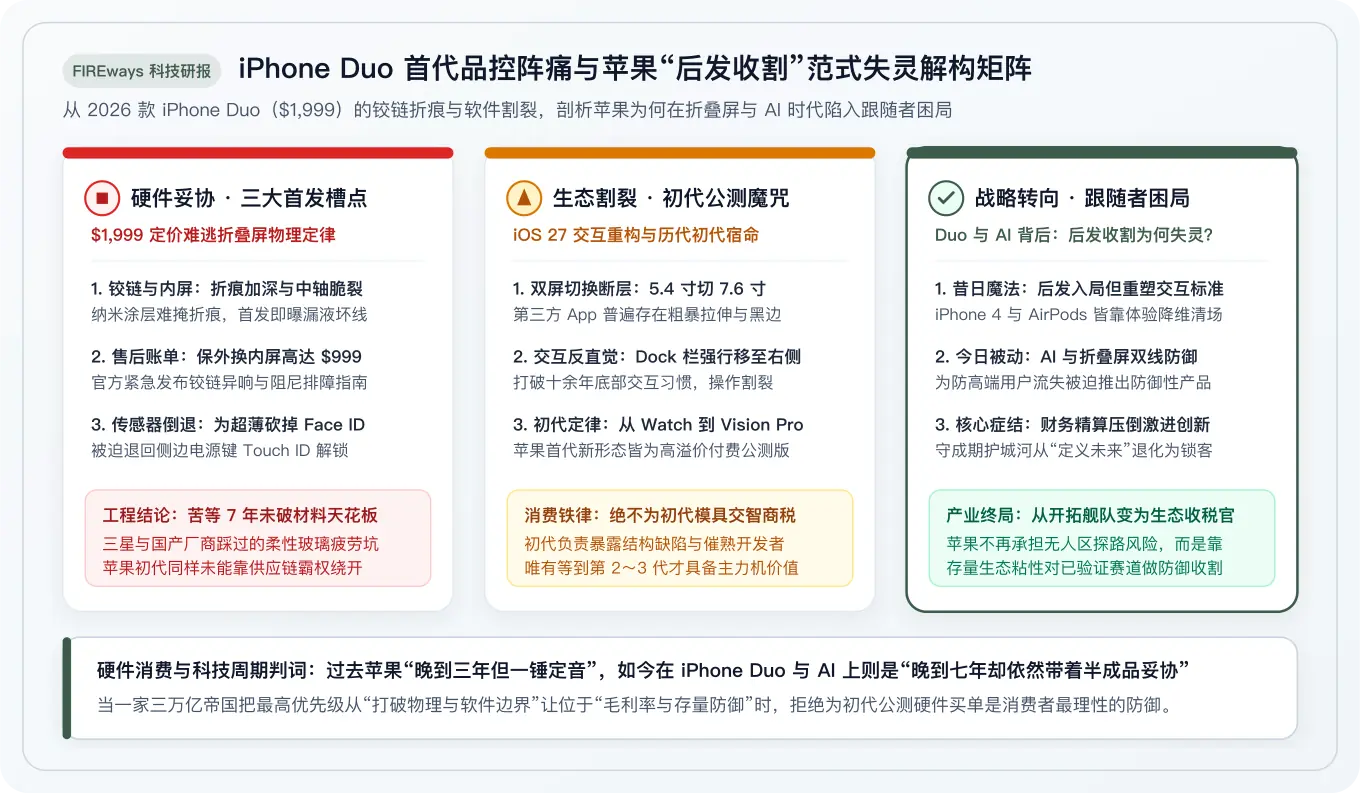
Figure 2: The mechanics of the generation-one curse: balancing supply chain yield amortization against software friction and corporate risk aversion.
III. Duo and AI: From Category Pioneer to Defensive Gatekeeper
The question is not merely whether the Duo is ready for purchase. The real question is institutional: why has the company that once redefined personal computing, tablets, and personal audio spent the last half-decade playing catch-up across both foldables and generative intelligence?
For years, market analysts cheered Apple as the ultimate “fast follower.” The myth was comforting: Apple never had to invent the MP3 player, the smartphone, or true-wireless earbuds. Let rivals expend capital clearing the minefields, then arrive with refined industrial design and an integrated operating system to sweep the table.
In the dual battles of foldable mechanics and generative software, that playbook broke down for three structural reasons:
1. Material Science Cannot Be Solved with Checkbook Dominance
When Apple disrupted straight-panel smartphones, capacitive touch, or wireless audio, the bottlenecks were largely matters of system integration, silicon node timing, and latency optimization. Cupertino simply reserved TSMC’s bleeding-edge production runs and built custom co-processors to establish clear performance daylight.
Foldables do not care about capital expenditure. The challenge of flexing an ultra-thin glass sheet and OLED stack through a sub-two-millimeter bend radius hundreds of thousands of times without fatigue is an impasse of solid-state mechanics and polymer chemistry. Apple waited seven years after Samsung’s original Galaxy Fold stumble. The resulting Duo proved an uncomfortable reality: Apple spent those seven years waiting for component costs to fall to corporate margin targets, not inventing physics-defying miracles. A late entry yielded an identical crease, identical drop fragility, and regressive biometrics.
2. The Locus of Computing Has Left the Device Shell
While foldables present a hardware challenge, generative intelligence threatens Apple’s ecosystem foundation. As explored in our work on the slowdown of frontier models and regulatory capture and edge-based interactive computing architectures, the locus of user engagement is drifting away from isolated app silos toward unified intent extraction and autonomous agents.
Apple found itself immobilized by its own success:
- The Pioneer’s Neglect: Apple shipped Siri in 2011, then left it stagnant for a decade as a glorified kitchen timer until OpenAI and Google flipped the computing architecture on its head.
- Economic Cannibalization: Apple’s revenue relies on high-margin local silicon sales tied to a 30% toll on App Store transactions. Fully committing to server-side agentic workflows presents a double hazard: absorbing astronomical inference bills erodes hardware margins, while headless, cross-application AI execution threatens to bypass the App Store’s revenue-generating interfaces entirely.
3. The Actuary’s Triumph Over the Product Adventurer
When an enterprise tops a three-trillion-dollar valuation on four hundred billion in revenue, capital preservation replaces technical daring. Under Tim Cook, product visionaries stepped down, and industrial logistics reigned. The governing metrics became supply chain yield, earnings per share, buyback efficiency, and upgrade cycle predictability.
In an actuarial culture, waiting is no longer a tactical pause; it is institutional paralysis:
- The Duo exists not because Cupertino discovered an urgent new paradigm for human-machine interaction, but because high-tier Android foldables began siphoning off $1,500+ enterprise customers across Europe and Asia.
- Neither the iPhone Duo nor Apple Intelligence represents an offensive strategy. They are defensive moat-patching operations designed to curb churn among high-net-worth users locked inside the blue-bubble garden.
IV. Analytical Verdicts
When an ecosystem’s retention relies less on breathtaking innovation and more on the sheer switching costs of iMessage, iCloud, and family-sharing lock-in, its character changes. It stops acting like an exploratory fleet and starts behaving like a digital utility board.
Verified Analytical Verdicts
- Finding 1 (Empirical Fact · The Duo’s Initial Hardware Stumble): Launched in October 2026, the $1,999 iPhone Duo compromises on three fronts: permanent optical crease degradation on its 7.6-inch display with early reports of centerline failure ($999 for out-of-warranty screen replacements), the total removal of Face ID for a power-button Touch ID sensor, and an iOS 27 UI update that pushes the dock vertically rightward while struggling with legacy third-party app scaling.
- Finding 2 (Consumer Axiom · The First-Generation Penalty): From the 2010 iPad and 2015 Apple Watch to the 2015 butterfly-switch MacBook and 2024 Vision Pro, Apple’s inaugural form-factor releases consistently serve as capital-intensive open betas for early adopters. Disciplined buyers avoid generation one, waiting until generation two or three for tooling stability and software maturity.
- Finding 3 (Structural Verdict · The Exhaustion of the Fast-Follower Playbook): The Duo’s compromises, coupled with Apple’s scramble in foundation models, reveal that Cupertino’s “arrive-late-and-dominate” playbook has run dry. Trapped by the physical limits of flexible materials, conflicting software business models, and the risk aversion of a balance-sheet giant, Apple is no longer charting consumer tech’s frontier—it is defending its perimeter.
Related Research & Topics
Tello Mobile eSIM
SafetyWing Nomad Insurance
* Disclosure: This post contains affiliate links. If you make a purchase through these links, V-G Journal may earn a small commission at no additional cost to you. We only recommend services we independently evaluate and trust.
FIRE and Golf:自由旅居之路
专注于为追求 FIRE 与品质生活的人群提供特惠打球权益与候鸟微度假。不持一砖一瓦,运营品质生活。