The Class Ledger of Contamination: Macro Desensitization and the Myth of Collective Fate
Dismissing public apathy toward food safety as 'acceptance' ignores the brutal economic reality beneath the surface. This is not peace, but a systemic surrender—where macro-level desensitization masks a micro-level struggle for biological survival.

Editor’s Note: A common, seemingly stoic sentiment often echoes through social discourse: “We all eat the same oil and drink the same milk. If 1.4 billion people are being poisoned together, then effectively, everyone is healthy. Why worry?”
To categorize this mood as a peaceful acceptance of collective misfortune is to mistake a defensive scab for healed skin. It fails to read the visceral class ledger written in blood and bile.
This is not tranquility. It is total macro-level desensitization coupled with extreme micro-level panic. It is the “macro-abandonment” of public governance expectations, forcing every household to retreat to the edge of their own dinner plates in a desperate, individualized war for survival.
I. Mental Anesthesia: The Low-Cost Psychological Shock Absorber
The notion that “if everyone is poisoned, no one is” is essentially a low-cost psychological shock absorber birthed by survival instinct.
Modern existence requires navigating thousands of ultra-processed industrial products daily: from the flash-frozen buns at a morning convenience store to the “composite meal kits” of office lunch deliveries, and soy sauces with ingredient lists longer than a technical manual. The average worker possesses neither a portable mass spectrometer nor the bargaining power to audit a globalized upstream supply chain.
If one had to mentally process the periodic table of elements before every $3 meal, the nervous system would collapse long before the toxins caused chronic organ failure.
Distributing disaster is humanity’s oldest psychological healing mechanism:
- If I am the sole victim of tainted oil, it is a targeted injustice—a precise murder that triggers explosive victim rage.
- If the entire society is sipping from the same poisoned cauldron, the toxin is downgraded to “background radiation,” as inevitable as gravity or the air we breathe.
Consequently, the public has collectively engineered a brand of dark humor: “What doesn’t kill you makes you stronger,” or “We are forging diamond bodies through industrial sorcery.” This isn’t enlightenment; it is a cynical anesthesia applied to the self in the face of an uncontrollable industrial juggernaut.
II. The Body Never Lies: The Collapse of Pretense in the Face of Crisis
Move your gaze away from social media memes and toward the actual flow of capital and emergency “bank runs” on resources, and you will find that no one is truly at peace.
In recent years, consumer behavior regarding food has become schizophrenic—outwardly cynical, yet inwardly terrified:
The Reality Map: From Rhetorical Desensitization to Physical Bank Runs
Trigger Event Public Reaction Economic/Social Consequence The “Tech & Magic” Additive Scandal Outrage over industrial additives. Billions wiped from condiment giants’ market caps; “Zero Additive” becomes the mandatory marketing shield for all brands. Fuel Tanker Cross-Contamination Discovery of industrial coal-to-oil tankers hauling cooking oil. Home oil presses and imported extra-virgin olive oil sell out instantly. Families pay 5x shipping to source “village-pressed” oil rather than trust supermarket shelves. Pre-prepared Meals in Schools Rumors of industrial meal kits entering cafeterias. Submissive office workers transform into fierce resistors, waking up an hour early to hand-deliver thermal lunchboxes through school fences.
This ledger reveals a singular truth: The bottom line still exists, and the panic has never been extinguished.
As long as risk remains an abstract macro-probability, people will joke about “collective poisoning.” But the moment the toxin becomes concrete—a specific bottle of oil, a specific additive, or a threat to their defenseless children—the mask of “calm” shatters in seconds.
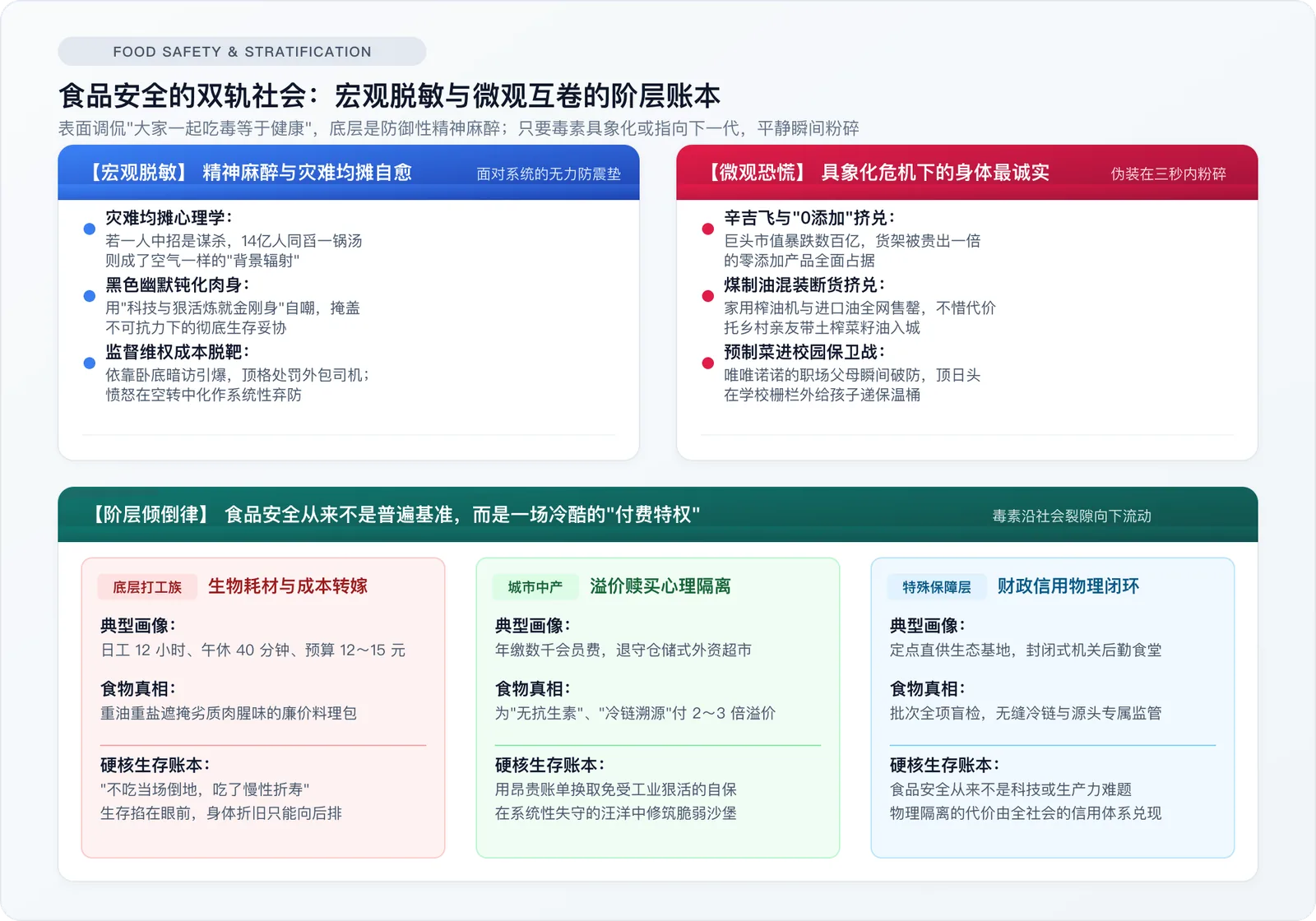
III. Food Safety as a “Paid Privilege”
The perceived numbness in daily life stems from the fact that pursuing “clean” food has become a luxury good, requiring a massive premium in both capital and time.
Food safety is not distributed evenly. Like gravity, it follows the cracks in the social structure, dumping its toxic externalities onto those with the least bargaining power and the tightest schedules:
1. The Underclass: Biological Consumables for Additives
For those working 12-hour shifts with 30-minute breaks and a $2 lunch budget, the food industry can only provide one thing: frozen meal kits where heavy oils, salts, and high-concentration essences mask the scent of low-grade protein. They aren’t ignorant of the preservatives or trans fats; they are simply governed by a cold survival logic: “If I don’t eat, I collapse from hypoglycemia now; if I do eat, I merely shorten my life later.” The body’s depreciation is a debt pushed into the distant future.
2. The Middle Class: Buying a Psychological Firewall
The middle class anchors its sense of security in membership warehouses and boutique importers. They willingly pay annual fees and 3x premiums for “antibiotic-free” and “cold-chain direct” labels. This expenditure is essentially a ransom paid to commercial entities for “psychological immunity” from industrial shortcuts. Yet, this defense is fragile; when the upstream bulk supply chain fails systematically, even the high-end shelves are rarely spared.
3. The Protected Loop: Physical Isolation and Fiscal Credit
At the top, there are closed-loop systems: dedicated ecological farms, rigorous batch testing for heavy metals, and institutional cafeterias where ingredients are transparent and subsidized. In this physical vacuum, food safety is not a challenge of technology or logistics—it is the manifestation of fiscal credit and exclusive supply.
The idea that “1.4 billion people are being poisoned together” is a comforting myth for the victim. The reality is: Some have dedicated airbags; some build fragile sandcastles with their wallets; and the vast majority use their bare organs to absorb the impact of industrial cost-cutting.
IV. Systemic Fatigue: Macro Abandonment, Micro Cannibalization
Why is collective anger becoming rarer in the public square?
Because after every wave of fury, the public discovers the same thing: The cost of civic oversight is prohibitively high, the accountability mechanisms frequently miss their mark, and the rewards for corporate non-compliance remain astronomical.
Looking back at the major food safety scandals of the last two decades—from clenbuterol and melamine to “gutter oil” and tanker contamination—almost none were caught by the routine regulatory net. They were exposed by undercover journalists risking their lives or by internal whistleblowers after a fallout over spoils.
The post-scandal crisis management has become a predictable loop:
- An exposé triggers a digital tsunami.
- An “emergency task force” is formed, promising a “thunderous crackdown.”
- A few low-level scapegoats—contracted drivers, small workshop owners, or shell-company middlemen—are heavily fined.
- The news cycle moves on. The underlying drive to suppress costs remains, and the industry quietly slides back into its original orbit.
When the public realizes that the channels for systemic correction—public participation, institutional whistleblowing, and legal recourse—have been effectively welded shut, intense anger becomes a form of self-harm.
Thus, systemic fatigue evolves into the current status quo: “Total macro-abandonment, desperate micro-cannibalization.”
Facing the vast, disordered beast of the food industry, no one harbors any naive illusions of self-purification. People use memes to deflect despair on social media, but the moment they return to their own tables, they become hyper-vigilant “preppers,” spending every spare cent and hour trying to wash a small patch of clean ground out of the mud.
This is not “letting go.” It is the final, desperate stand of atomized individuals who, with the public lines of defense in ruins, have nothing left to gamble with but their own bodies and the fate of their children.
Related Research & Topics
Tello Mobile eSIM
SafetyWing Nomad Insurance
* Disclosure: This post contains affiliate links. If you make a purchase through these links, V-G Journal may earn a small commission at no additional cost to you. We only recommend services we independently evaluate and trust.
FIRE and Golf:自由旅居之路
专注于为追求 FIRE 与品质生活的人群提供特惠打球权益与候鸟微度假。不持一砖一瓦,运营品质生活。