Fan Bingbing's Aimeishen Bankruptcy and the 67 Million Debt Pursuit: A Legal and Reputational Game
An in-depth analysis of the 67 million RMB debt pursuit by Hile Entertainment against Fan Bingbing and Fan Chengcheng. From a drama's collapse to Aimeishen's bankruptcy with only 22.03 RMB remaining, this piece dissects the legal battles over corporate personhood, contempt of court, and celebrity reputation, revealing the truth behind the industry's deleveraging.

Core Insight: Hile Entertainment, indirectly held by screenwriter Ning Caishen, has publicly demanded 67 million RMB in investment arrears from Fan Bingbing, also naming her brother Fan Chengcheng. The once multi-million RMB valued celebrity shell company, Wuxi Aimeishen, has been liquidated with only 22.03 RMB left, leaving creditors in a predicament of winning a judgment but facing unenforced debt. This confrontation pits the limited liability shield of commercial entities against the sensitivity of top-tier celebrities’ public image, starkly illustrating the irreversible deleveraging of China’s film and television industry post-capital boom.

Figure 1: Fan Bingbing in a formal public appearance. The Aimeishen company, once valued in the hundreds of millions and associated with her, has recently become a focal point of commercial legal disputes due to its bankruptcy liquidation case.
I. The Core Narrative: A 67 Million RMB Judgment and a 22.03 RMB Liquidation
The catalyst for this public debt demand traces back to the 2017 capital frenzy in the film and television industry, specifically the high-profile historical drama The Legend of Dugu (originally titled Win the World). Wuxi Aimeishen Film and Television Culture Co., Ltd. (in which Fan Bingbing held a 74.5% stake and served as legal representative) entered into a significant investment agreement with Hile Entertainment. Subsequently, due to scandals involving key cast and crew, including tax issues, the drama’s broadcast was indefinitely postponed, leaving substantial production and investment funds in limbo.
The legal validation process has long concluded. In September 2021, the Beijing High People’s Court issued a final judgment ordering Aimeishen to return 67 million RMB in principal and profits to Hile Entertainment, along with overdue penalty interest.
However, the creditor, armed with the High Court’s final judgment, encountered a harsh reality upon seeking enforcement:
- No Executable Assets: Court investigations revealed that Aimeishen’s bank accounts, real estate, and external investments were virtually non-existent.
- Bankruptcy Liquidation Concluded: In December 2023, the Binhu District People’s Court of Wuxi ruled Aimeishen bankrupt and concluded the liquidation proceedings. The ruling disclosed that five creditors had filed claims totaling approximately 222 million RMB, yet the bankruptcy administrator found that the company’s remaining assets available for distribution amounted to a mere 22.03 RMB.
- Questionable Separation of Responsibilities and “Golden Cicada Shedding”: Company registration records show Fan Bingbing resigned as legal representative in January 2019 and transferred her equity to employee Zhou Haiguo in September 2020. Her mother, Zhang Chuanmei, also transferred her remaining 25.5% stake to Xing Ruxiang (who is now subject to consumption restrictions) in November 2020. Hile Entertainment alleges that these precise changes in legal representation and equity transfers were orchestrated to evade debt.
From a capital darling once valued in the hundreds of millions to a residual balance of 22.03 RMB – not even enough for a bowl of noodles – at the time of bankruptcy, this stark contrast forms the basis for the creditor’s public pressure campaign.
II. The Reputation Collateral Logic: Why Name Fan Chengcheng?
In Hile Entertainment’s public letter, Fan Chengcheng, currently experiencing a career upswing and active in commercial endorsements, was also named alongside Fan Bingbing. The letter cited audit reports and bank statements to claim:
- Between 2018 and 2020, Aimeishen transferred over 200 million RMB to Fan Bingbing’s related personal studios and nearly 10 million RMB to Fan Chengcheng’s solely-owned studio.
- From 2021 to 2024, Fan Chengcheng’s studio transferred funds to Aimeishen’s wholly-owned subsidiary (Beijing Ershihua Company) to cover its employee salaries and operational expenses.
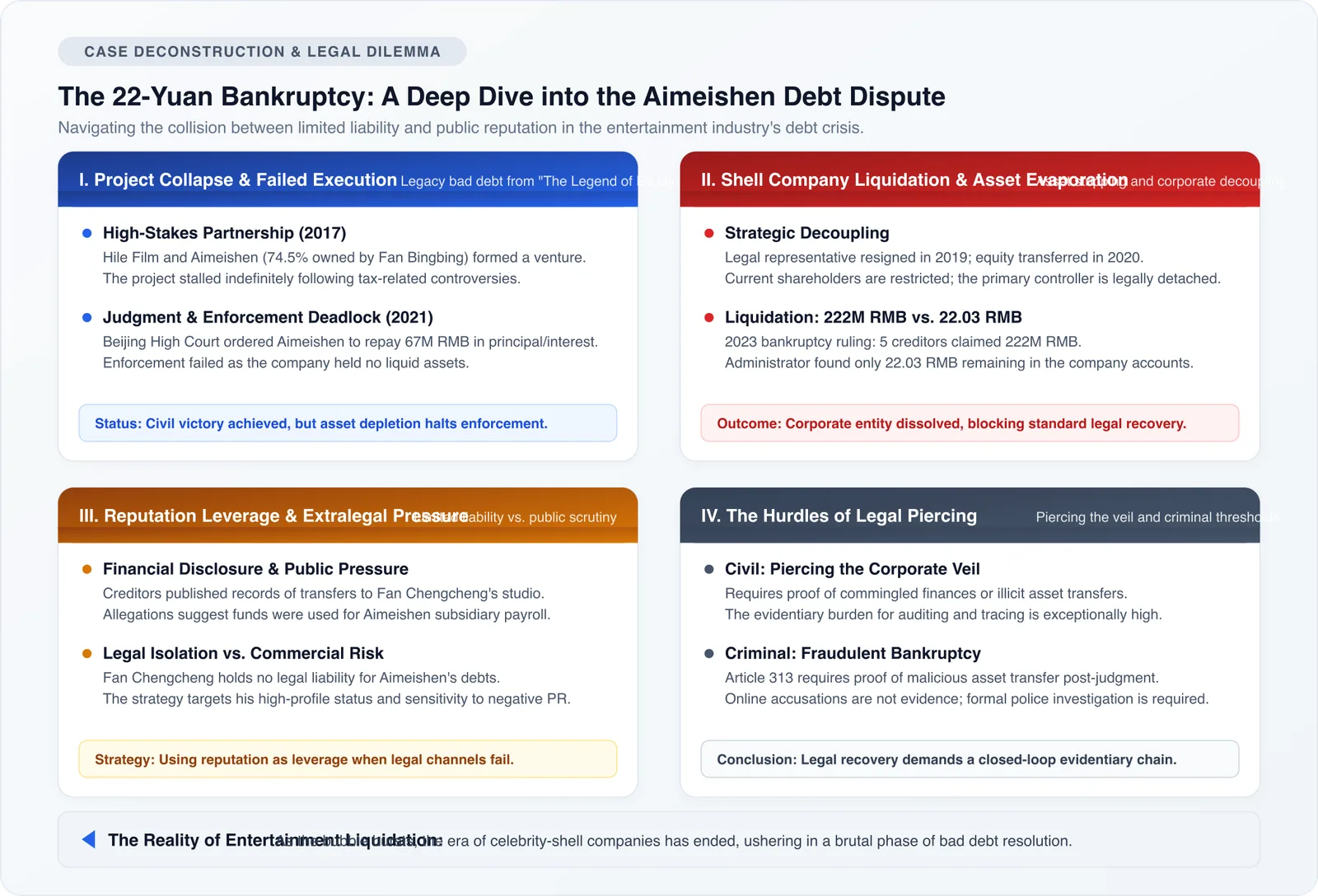
Figure 2: A comprehensive matrix illustrating the fund flow, legal thresholds, and reputational game mechanisms in the Aimeishen bankruptcy liquidation case.
There is a clear hierarchical disconnect between commercial legal principles and public perception:
- Legal Independence: Fan Chengcheng has never served as a shareholder, director, or legal representative of Aimeishen, nor has he provided any personal joint guarantee for the 67 million RMB investment. Commercial transactions or fund transfers between two independent entities or studios do not legally constitute grounds for joint liability for the parent company’s debts.
- Reputational Entanglement: Commercial endorsement and performance contracts in the entertainment industry carry stringent moral hazard clauses tied to an artist’s public image and public opinion risks. By placing the top-tier brother in the spotlight of the public letter, the creditor effectively exchanges the “limited liability of a commercial entity” for the “commercial reputation of a leading celebrity,” attempting to exert extra-judicial pressure on the core parties through public opinion shockwaves and the anticipated risk of damaged brand endorsements.
III. The Clash and Two Substantive Hurdles for Legal Penetration
In response to the public letter’s accusations, Fan Bingbing’s team, through Beijing Lanpeng Law Firm, issued a stern statement emphasizing the strict separation of “corporate legal person liability and natural person individual liability,” opposing the use of public opinion to influence judicial proceedings, and clearly stating that claims for shareholder joint liability must be pursued through formal legal channels.
From a professional legal perspective, creditors face two significant hurdles in substantively piercing Aimeishen’s limited liability veil and pursuing personal claims:
1. Civil Recourse Threshold: Corporate Personhood Piercing and “Lifting the Corporate Veil”
China’s Company Law is built upon the foundation of shareholder limited liability. To breach this protective barrier, the plaintiff must prove that the company’s shareholders and the company exhibit “a high degree of commingling of corporate personhood,” meaning:
Criteria for Determination: The company’s assets are indistinguishable from the shareholder’s personal assets, accounts are used interchangeably, finances are not separated, or shareholders abuse the company’s independent legal status and limited liability, maliciously withdrawing capital, or transferring company assets without compensation to evade debts, thereby severely harming creditor interests.
In such litigation, mere unilateral transfer records are insufficient to directly establish commingling. Judicial audits are required to verify the true legal nature of these funds (whether they represent business labor settlements, loan transactions, or gratuitous transfers). Only after a rigorous, closed-loop evidentiary process can the court legally order shareholders to bear joint liability to the extent of withdrawn or illegally transferred assets.
2. Criminal Accountability Threshold: Judicial Boundaries of Contempt of Court and Fraudulent Bankruptcy
The “transfer of assets suspected of illegal criminal activity” often mentioned in public discourse primarily corresponds to two criminal offenses in the legal system:
- Article 313 of the Criminal Law [Crime of Refusing to Execute Judgments or Rulings]: The core element is “the ability to execute a judgment or ruling of the People’s Court but refusing to do so, under serious circumstances.” If the party subject to enforcement or a controlling shareholder with payment obligations, after a judgment becomes effective or during enforcement proceedings, knowingly possesses the obligation to perform but intentionally conceals, transfers, or gratuitously disposes of assets, rendering the effective ruling completely unenforceable, they commit this crime.
- Article 162-2 of the Criminal Law [Crime of Fraudulent Bankruptcy]: A company or enterprise commits fraudulent bankruptcy by concealing assets, incurring fictitious debts, or transferring or disposing of assets by other means, severely harming the interests of creditors or others.
The initiation and conviction for these offenses are strictly controlled by public security organs (economic investigation departments, procuratorates, and court enforcement departments). The evidentiary standards for subjective intent, closed-loop tracking of fund flows, and causality are extremely rigorous. The fragmented transaction records presented in the public letter fall far short of the evidence required for criminal charges.
IV. Industry Observation: Entertainment Gossip Recedes as Bad Debt Liquidation Enters a Cruel Cycle
In recent years, headlines in the entertainment sphere on social platforms have shifted from early-stage relationship gossip and scandals to “failed earn-outs,” “empty shell bankruptcies,” “consumption restrictions,” and “public debt demands.” This phenomenon is not an isolated incident but an inevitable outcome of the profound structural adjustment in China’s film and television entertainment industry:
- Historical Echoes of Bursting Hot Money Bubbles: Between 2015 and 2017, the entertainment sector experienced peak valuations, with capital aggressively binding top artists through “high-premium acquisitions of celebrity shell companies,” “huge guaranteed distributions,” and “high-multiple earn-out agreements.” As industry regulations tightened and the capital wave abruptly receded, the high-leverage assets hidden beneath the prosperous facade of yesteryear began to collapse with project failures.
- From “Incremental Concealment” to “Stock Deleveraging”: During the industry’s expansion phase, production companies and investors could often mask historical accounting losses by launching new projects and introducing subsequent rounds of funding. However, as the entertainment industry enters a phase of contraction, quality improvement, and de-financialization, the entire ecosystem lacks sufficient hot money to act as a buyer of last resort. Unresolved historical bad debts are now starkly exposed on the platforms of judicial enforcement and public opinion pursuit.
The meager 22.03 RMB remaining on Aimeishen’s books serves as a cold, sharp slice, marking the end of the celebrity capital frenzy era. When legal defenses and commercial reputation leverage collide violently in the public sphere, it is not merely a dispute between two companies but a prolonged liquidation process for the entertainment industry to pay for its past over-financialization.
Related Research & Topics
The Anatomy of Digital Predation: Inside the Syndicate Targeting the Elderly via Livestream Appraisal Scams
Starlink V4 and the Low-Earth Orbit Satellite Arms Race: How a 100,000-Node Optical Mesh Pierces the Submarine Cable Monopoly
Tello Mobile eSIM
SafetyWing Nomad Insurance
* Disclosure: This post contains affiliate links. If you make a purchase through these links, V-G Journal may earn a small commission at no additional cost to you. We only recommend services we independently evaluate and trust.
FIRE and Golf:自由旅居之路
专注于为追求 FIRE 与品质生活的人群提供特惠打球权益与候鸟微度假。不持一砖一瓦,运营品质生活。