The Mechanics of Rational Malice: Deconstructing the Myth of Poison as a Weapon of the Weak
A criminological and sociological deconstruction of intellectual poisoning crimes, examining the David Xu Berkeley cadmium case and the Tsinghua Zhu Ling tragedy to analyze how hyper-credentialed elites weaponize information asymmetry for frictionless malice.

Executive Summary: Reducing poison to a “woman’s weapon” remains one of the most persistent cognitive biases inherited from Victorian penny dreadfuls and the golden age of Agatha Christie. Popular imagination presumes that the physically formidable inevitably resort to fists, while the physically weaker party must rely on clandestine chemistry. Modern forensic toxicology and empirical criminology tell a starkly different story: in absolute terms, male perpetrators account for the overwhelming majority of lethal poisonings. Poisoning was never an equalizer of physical strength. It is an expression of extreme risk aversion—a pathological pursuit of zero-friction violence enabled by instrumental rationality. From the California cadmium poisoning case of metallurgist David Xu—which reignited global fury in 2026 following his expungement petition—to the haunting, unresolved thallium poisoning of Zhu Ling at Tsinghua University, the cold-blooded theater and legal arbitrage executed by academic overachievers in the shadows reveal an evil far more protracted, disguised, and chilling than any impulsive street violence.
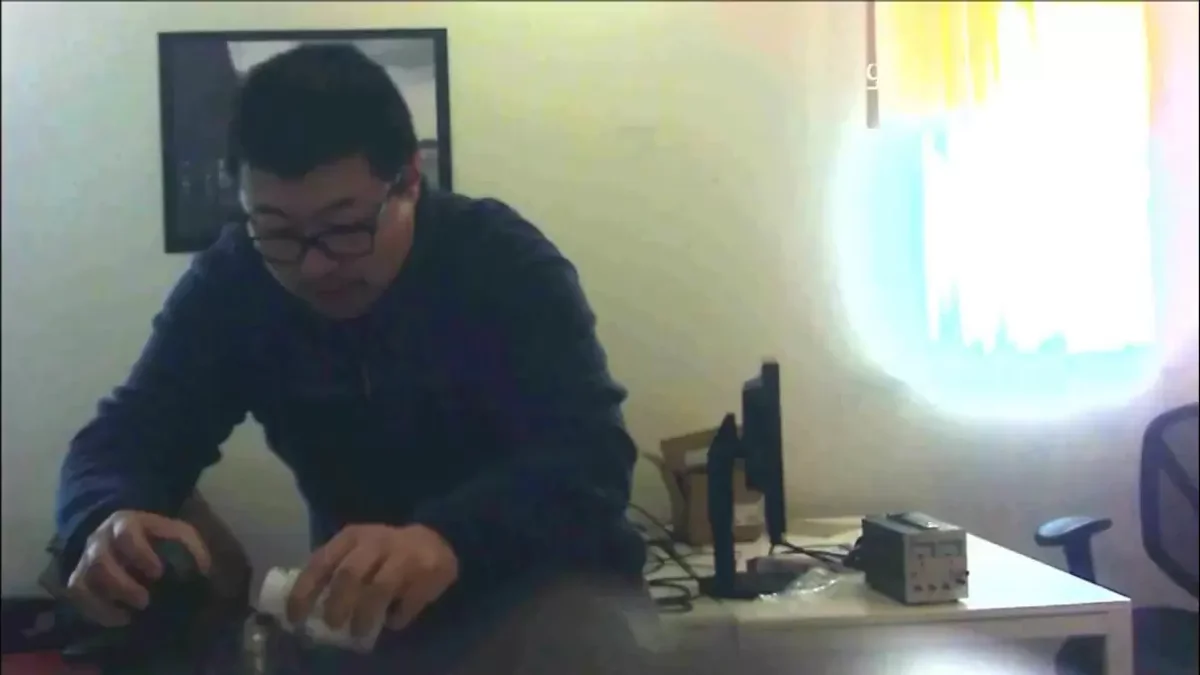
Figure 1: Pinhole camera footage from the victim's desk: indisputable visual evidence of David Xu introducing toxic heavy metal cadmium into Rong Yuan’s water bottle.
I. Dispelling the Gender Trope: Criminological Data vs. Literary Dramatization
In cultural discourse and traditional legal lore, the aphorism that “poison is a woman’s weapon” is often cited as self-evident truth. This perception owes its longevity to sensationalized 19th-century press coverage and the dramatic conventions of classic detective fiction. When narrative drama requires an outwardly delicate antagonist incapable of hand-to-hand combat, odorless arsenic and rapid-acting cyanides offer the cleanest literary vehicle.
Subjected to empirical forensic pathology and criminological datasets, however, this trope collapses under structural statistical distortion:
-
The Overwhelming Male Majority in Absolute Terms: FBI homicide analyses and modern forensic pathology consistently indicate that men commit roughly 85% to 90% of all violent crime. Even when isolating the absolute number of deliberate poisonings resulting in death or grievous bodily harm, male suspects outnumber female suspects by a significant margin. Labeling poison as an inherently female device is a textbook statistical fallacy of composition.
-
The Distortion of Relative Proportions and Media Saliency: The misconception stems from a radical disparity in denominators. Because women commit fatal physical assaults at extraordinarily low rates, poisoning accounts for a slightly higher percentage within that tiny baseline compared to bludgeoning, firearms, or edged weapons. Amplified by sensationalist media coverage of the “femme fatale,” this statistical artifact calcified into an unexamined cultural archetype.
-
The True Preconditions of Poisoning: Criminological consensus confirms that poisoning is governed by three operational prerequisites: stealth, total avoidance of open confrontation, and privileged access to lethal agents. The method filters not for chromosomes or physical mass, but for an offender’s psychological defense mechanisms and access to domain-specific tools.
When a highly credentialed, mathematically optimized intellect chooses predation, poisoning becomes an almost intuitive algorithmic preference: maximum damage at minimum personal risk.
II. The Berkeley Case of David Xu: Specialized Knowledge and the Pathological Meritocrat
In the autumn of 2026, investigative exposés published by the San Francisco Chronicle and The San Francisco Standard, alongside the public release of unredacted high-definition surveillance footage, propelled a long-suppressed poisoning case in Berkeley back into global scrutiny.
The case illustrates not merely how elite technical competence can be weaponized into an instrument of murder, but how the hyper-optimized exam-taker class executes systemic deception and institutional manipulation:
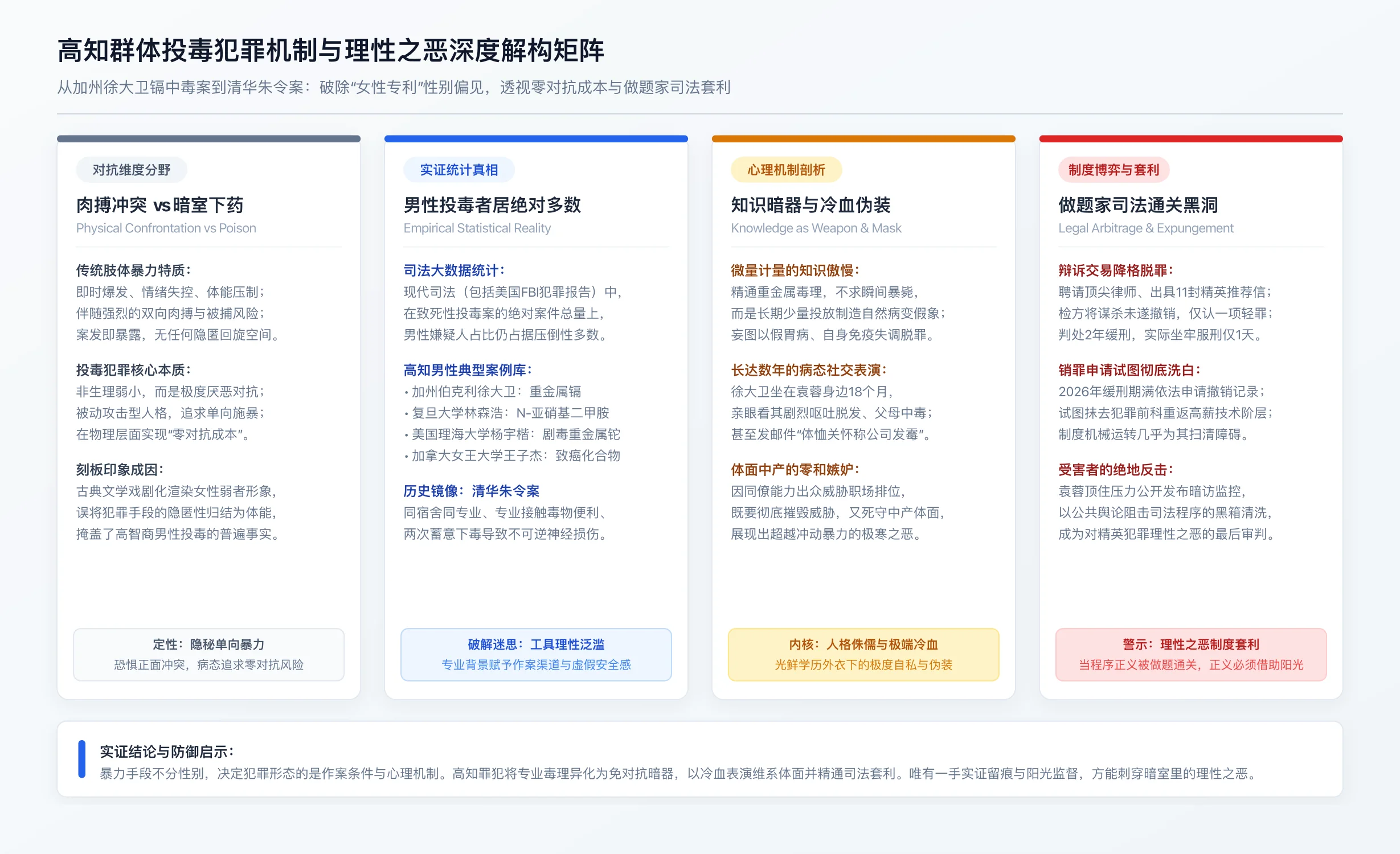
Figure 2: Analytical matrix dissecting the mechanisms, psychological profile, and institutional arbitrage of elite poisoning crimes.
1. Academic Pedigree and the Micro-Jealousy of Zero-Sum Competition
The perpetrator, David Xu (then 41), and the victim, Rong Yuan (then 50), were both PhDs in Materials Science from the University of California, Berkeley. Both had studied under National Academy of Engineering member and world-renowned materials scientist Robert Ritchie. Following graduation, both were employed as core materials scientists and metallurgical failure-analysis engineers at Berkeley Engineering and Research, Inc. (BEAR), a prominent forensic engineering consultancy.
On paper, Xu represented the archetypal success story of the immigrant meritocracy: elite doctorate, California licensed professional engineer (PE), comfortable Bay Area home, and a family with two young children. Within BEAR, he had long been the sole specialist in advanced materials characterization.
In early 2017, Yuan—his senior peer from the same laboratory—joined the firm. Bringing deeper institutional experience, fluency across laboratory machinery, and an aggressive capacity for business development, Yuan quickly challenged Xu’s perceived indispensability. Xu’s hostility did not manifest as technical debate or direct professional confrontation. Instead, he initially attempted to bar Yuan from key testing equipment under the pretext that she might damage the instruments. When Yuan rebuffed these gatekeeping attempts, Xu converted his metallurgy expertise into a silent, chemical weapon.
2. Eighteen Months of Protracted Torment and Sociopathic Performance
Beginning in 2017, Yuan’s health deteriorated precipitously. What started as persistent dry heaves, hair loss, and an unexplained metallic taste escalated into severe vomiting and debilitating systemic fatigue. She cycled through emergency rooms and traveled to China for exhaustive clinical evaluations. Convinced she was dying of occult gastric cancer, she underwent repeated endoscopies, all of which returned inconclusive results.
Throughout this year-and-a-half ordeal, Xu sat at the desk directly adjacent to hers. He watched his former lab mate grow emaciated and gray-faced day after day, all while maintaining the polished decorum of a cordial corporate peer. A revealing episode occurred in November 2018: after Yuan emailed the team to call in sick following an acute bout of violent vomiting, Xu replied with calculated concern:
“You should rest well at home and come back when you feel better, no need to rush to the office. I think BEAR is moldy.”
While using toxicological knowledge to titrate dosages so that the symptoms mimicked systemic illness, he actively seeded deceptive diagnostic explanations, deflecting suspicion onto environmental mold.
3. Pinhole Surveillance and Collateral Casualties
Because Yuan frequently brought her office water bottles home, her aging parents consumed the contaminated liquid. Her father—a robust man who walked six miles daily and carried 50-pound bags of rice up stairs—rapidly declined into bedridden immobility. He ultimately died of congestive heart failure induced by toxic overload.
In early 2019, suspecting that the recurrent, unusually bitter and acidic taste in her water was unnatural, Yuan discreetly installed a pinhole camera at her cubicle.
The captured footage documented cold-blooded predation. On the morning of February 11, 2019, Xu approached Yuan’s desk while the office was empty and handled her water bottle. On March 4, the camera recorded Xu holding a small plastic vial, pouring liquid into her thermos, and returning thirty seconds later to adjust the bottle’s orientation to hide residue.
Subsequent municipal police lab tests revealed that the water bottle contained concentrations of cadmium—a bioaccumulative, carcinogenic heavy metal—up to 3.5 million times the federal drinking water threshold.
III. Historical Echoes: The Zhu Ling Tragedy and Academic Asymmetry
Placed in a broader sociological and historical frame, the David Xu case reveals a familiar architecture. Three decades earlier, the catastrophic thallium poisoning of Zhu Ling at Tsinghua University displayed an identical interplay of micro-envy, technical asymmetry, and covert hostility.

Figure 3: Zhu Ling, class of 1992 at Tsinghua University: an exceptional talent destroyed by covert academic toxicity.
Between late 1994 and spring 1995, Zhu Ling, a physical chemistry and instrumental analysis major in Tsinghua’s Class of 1992, was deliberately poisoned with high-purity thallium salts on two separate occasions. Zhu was an extraordinary student: a core musician in the university orchestra skilled in the guqin and zhongruan, an elite academic, and a certified competitive swimmer.
The Zhu Ling case shares structural hallmarks with modern intellectual poisonings:
-
Peer Hierarchies and Resentment: Within an insular academic and laboratory environment, exceptional visibility often triggers deep hostility in insecure peers. Poisoning requires no physical violence; it requires only the surreptitious introduction of an odorless, colorless metal into toiletries, contact lens cases, or drinkware.
-
The Moat of Asymmetric Knowledge: Like cadmium, thallium was largely inaccessible to the general public, and its clinical manifestations were alien to general practitioners. The perpetrator exploited institutional blind spots, calculating that the victim’s hair loss, abdominal agony, and neurological degeneration would be misdiagnosed as Guillain-Barré syndrome or acute gastroenteritis until irreversible brain damage occurred.
-
Destruction of the Evidentiary Trail: Just prior to Zhu Ling’s diagnosis via the early global internet, a bizarre burglary emptied her dormitory room. Her personal cup, medicinal herbs, shampoo, and contact lens cases vanished, severing the physical chain of custody. Closed residential quarters, combined with boundary erosion, provide ideal cover for unilateral malice.
Global academia contains numerous parallels where male researchers used laboratory supplies for homicidal ends:
- The Fudan University Poisoning (2013): Medical graduate student Lin Senhao, triggered by mundane roommate friction, used the laboratory toxin N-nitrosodimethylamine to contaminate a dormitory water dispenser, causing the fatal acute liver failure of roommate Huang Yang.
- The Lehigh University Case (2018): Chemistry student Yukai Yang methodically poisoned his African-American roommate over several months by dosing his milk, mouthwash, and food with thallium, inducing agonizing neurological neuropathy.
- The Queen’s University Case (2018): Polymer chemistry postdoctoral researcher Zijie Wang laced a former colleague’s food and water with N-nitrosodimethylamine due to academic jealousy, caught only after the victim set up a hidden camera.
These cases reinforce a consistent truth: high-aptitude violence rarely relies on kinetic strength. Its lethality stems from transforming technical education into an asymmetric weapon designed to bypass direct conflict entirely.
IV. The Pathological Meritocrat and Legal Arbitrage
Unlike impulsive offenders whose post-arrest reactions swing between panic and confession, high-functioning poisoners routinely transfer their structural problem-solving habits directly into the legal arena. They treat criminal defense as an optimization puzzle, exploiting procedural loopholes to neutralize the consequences of their actions.
1. From Attempted Murder to Probation: The Anatomy of a Plea Deal
David Xu initially faced charges of premeditated attempted murder alongside two felony enhancements for poisoning, carrying a potential sentence of life imprisonment.
Xu immediately deployed his socioeconomic capital: hiring premier private defense counsel, framing the crime as an isolated workplace dispute, and securing eleven character reference letters from fellow academics, colleagues, and friends. The presiding judge observed that these testimonials read remarkably like stellar corporate job recommendations.
Navigating an Alameda County District Attorney’s office focused on diversion and decarceration, the defense negotiated an extraordinary plea bargain: the attempted murder charges were dropped. Xu entered a plea of no contest to a single count of felony poisoning, receiving two years of probation, a token restitution fee of approximately $7,000, and credit for just one day served in jail.
2. The 2026 Expungement Petition: Erasing the Paper Trail
If the original sentence highlighted structural leniency, developments in 2026 underscored how procedural law can be used to scrub the past.
Having satisfied the terms of his probation without committing new offenses, Xu formally petitioned the California courts for felony record expungement under state penal provisions. Under statutory procedure, judges routinely grant expungement to probationers who complete their terms without violations. Approval would seal his conviction from conventional corporate background checks.
Through this procedural maneuver, Xu sought to clean his slate and return to high-paying engineering roles as a Berkeley-minted specialist. In this clean algorithmic loop, Yuan’s permanent neurological and organ damage—and her father’s fatal heart failure—were reduced to minor procedural setbacks to be erased.
Faced with this outcome, her health permanently impaired and unable to sustain full-time engineering work, Yuan broke seven years of silence in 2026. She released the pinhole surveillance tapes and forensic toxicological records to the press. Public visibility became her only available tool against a quiet institutional whitewashing.
V. Analytical Frameworks and Defensive Countermeasures
Violence has no inherent gender. Its execution reflects the perpetrator’s psychological posture and operational access.
Stripped of Victorian myths, the criminological profile of high-intellect poisoning sharpens considerably:
| Metric | Impulsive Physical Violence | Intellectual Shadow Poisoning |
|---|---|---|
| Psychological Profile | Affective dysregulation; overt escalation; borderline traits | Passive-aggressive; deeply deceptive; pathologically conflict-averse |
| Primary Objective | Immediate catharsis; physical dominance over target | Asymmetric destruction; total preservation of personal safety |
| Chosen Medium | Blunt instruments, edged weapons, firearms (kinetic trauma) | Toxic heavy metals (Cd, Tl), lab-grade carcinogens (mimics illness) |
| Post-Offense Behavior | Panic, flight, or spontaneous confession | Superficial charm, mock empathy, calculated mitigation |
| Legal Strategy | Reactive defense; straightforward evidentiary chain | Sophisticated plea deals, elite testimonials, post-conviction expungement |
For individuals operating within hyper-competitive corporate, scientific, or academic environments, these cases offer critical defensive takeaways:
-
Screen for Extreme Passive-Aggressive Patterns: Be cautious of individuals who consistently avoid transparent communication, maintain an excessively smooth facade, and display quiet resentment when peers advance. Those who cannot process competitive displacement yet lack the courage for direct disagreement are far more prone to asymmetric hostility than volatile, expressive personalities.
-
Trigger Multi-Panel Toxicological Screenings for Atypical Declines: When unexplained, progressive physiological breakdown occurs without a clear etiology—persistent nausea, neurological pain, sudden alopecia, or unprovoked organ dysfunction—break the diagnostic routine. Insist on specialized toxicology panels covering heavy metals (cadmium, thallium, arsenic, lead, mercury) and non-standard chemical compounds.
-
Objective Physical Evidence Remains the Ultimate Defense: The confidence of the intellectual predator rests entirely on the assumption that shadow acts leave no direct signature. Both Rong Yuan at Berkeley and the targeted researcher at Queen’s University survived legally because they deployed objective, immutable video surveillance. When cold malice is forced into the daylight, the academic veneer and the legal maneuvers designed to protect it finally fall away.
Related Research & Topics
The Anatomy of Digital Predation: Inside the Syndicate Targeting the Elderly via Livestream Appraisal Scams
Starlink V4 and the Low-Earth Orbit Satellite Arms Race: How a 100,000-Node Optical Mesh Pierces the Submarine Cable Monopoly
Tello Mobile eSIM
SafetyWing Nomad Insurance
* Disclosure: This post contains affiliate links. If you make a purchase through these links, V-G Journal may earn a small commission at no additional cost to you. We only recommend services we independently evaluate and trust.
FIRE and Golf:自由旅居之路
专注于为追求 FIRE 与品质生活的人群提供特惠打球权益与候鸟微度假。不持一砖一瓦,运营品质生活。