Selective Telemetry and the Data Monopoly: Deconstructing the Aito M9 Crash in Shenmu
An autopsy of corporate PR asymmetry, flawed crowdsourced AI video forensics, and the urgent mandate for public data sovereignty in the age of connected vehicles.

Executive Summary: Following a fatal single-vehicle collision and post-impact fire involving an Aito M9 in Shenmu, Shaanxi, the automaker’s hasty public statement triggered a severe crisis of institutional trust. By selectively highlighting an entry speed of 139.1 km/h, the manufacturer sought to anchor public perception around driver negligence. Yet this narrative deliberately omitted the single most vital metric—the actual speed at the moment of impact—while withholding the raw, unedited Event Data Recorder (EDR) telemetry for the five seconds preceding the crash. In response to this corporate data monopoly, netizens attempted “algorithmic self-rescue” via video-based AI speed calculations. Though technically flawed due to optical distortion and variable frame rates, these crowdsourced attempts reflect a deep-seated public vulnerability when confronted with a black-box cloud ecosystem.
Late on the night of October 17, 2026, at approximately 23:25, a severe single-vehicle accident occurred at an intersection in Shenmu, Yulin, Shaanxi Province. An Aito M9 collided directly with a steel traffic signal pole located in the center divider. The front compartment ignited almost instantly, and flames engulfed the vehicle, resulting in the death of the driver at the scene.
On October 21—days after the incident, but well before traffic police or accredited third-party forensic institutions could complete their official investigation—Aito’s customer service handle published a formal “Statement Regarding the Vehicle Incident in Shenmu, Shaanxi.”
This rushed announcement immediately provoked widespread skepticism regarding the integrity and transparency of smart vehicle telemetry.

Figure 1: Public surveillance footage in Shenmu, Shaanxi: The Aito M9 striking the central signal pole and catching fire.
I. Deconstructing Corporate Narrative: The Mechanics of Selective Disclosure
In modern vehicular forensics, technical data releases demand contextual integrity and chronological continuity. Examined through an analytical lens, the official statement released by Aito demonstrates a clear posture of defensive public relations:
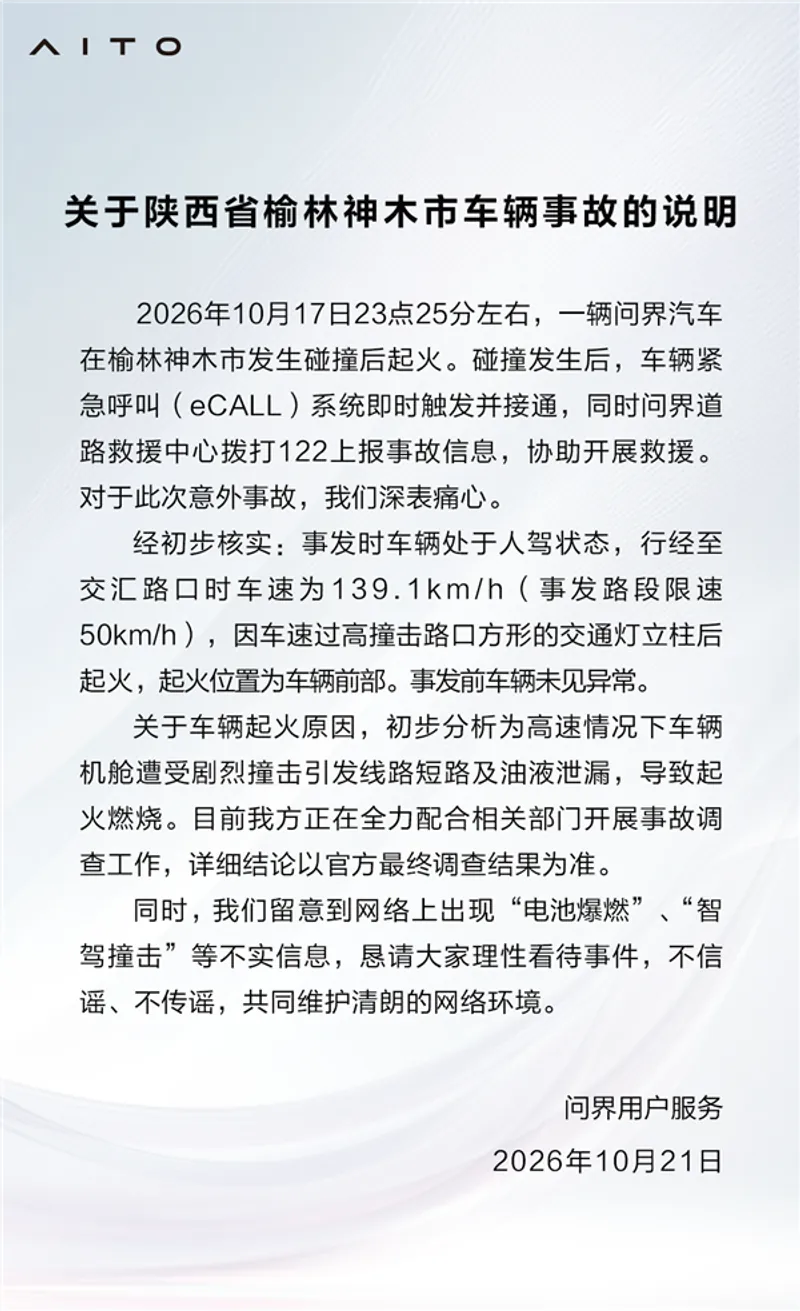
Figure 2: The official statement from Aito: Disclosing entry speed and manual driving status while omitting critical impact velocity.
A rigorous breakdown reveals three structural flaws in the company’s disclosure:
1. Conceptual Substitution: Substituting “Intersection Entry Speed” for “Impact Speed”
The official statement prominently features the line: “When entering the intersection, the vehicle reached a speed of 139.1 km/h (against a posted limit of 50 km/h).” By framing the incident around this dramatic violation, the manufacturer sought to fix a narrative of sole driver responsibility in the public mind.
However, multi-angle surveillance footage circulating online shows that as the vehicle entered the intersection and approached the pole, its high-mounted rear brake lights were illuminated. This indicates that the driver was actively executing an emergency braking maneuver.
Between the vehicle’s entry point and the physical point of impact lay a deceleration zone of several dozen meters. The crucial question remains unanswered: What was the vehicle’s actual speed at the exact instant of impact? To what degree did the mechanical braking system reduce velocity after the pedal was depressed—down to 80 km/h, 60 km/h, or lower? On this metric, the manufacturer remained silent.
2. Monopolizing the Black Box: Withholding Raw EDR Datasets
A modern electric vehicle is both a mechanical transport and a networked telemetry hub. Under regulatory standards such as GB 39732-2020 (Event Data Recorder System for Light Vehicles), a vehicle’s EDR must record key dynamic parameters for the 5 seconds prior to a collision:
- Accelerator pedal position (percentage of travel);
- Brake pedal switch status and master cylinder hydraulic pressure;
- Individual wheel speeds, ABS, and ESP intervention timing;
- Autonomous Emergency Braking (AEB) target detection status and failure modes;
- Longitudinal and lateral acceleration changes (Δv) during impact.
An automaker equipped with real-time cloud backend logging possesses millisecond-level visibility into these sequences. Yet, while the family operated at a total information disadvantage, the manufacturer released a single isolated data point favorable to its narrative (139.1 km/h), keeping the underlying binary EDR dataset strictly proprietary. This selective disclosure weaponizes an information asymmetry to preemptively manage liability.
3. Player and Referee: Deflecting Engineering and Thermal Integrity Questions
The statement attributes the fire to “a severe impact to the front compartment causing internal short circuits and fluid leakage.” It further emphasizes that the high-voltage battery did not experience thermal runaway and that the vehicle was in manual control mode rather than autonomous driving mode.
For a flagship vehicle positioned in the luxury segment, valid engineering questions persist: Did the high-voltage automatic disconnect and fuel-line shutoff valves activate according to design parameters? Did the flush, retractable door handles deploy automatically post-collision to facilitate rescue? Asserting that a customer care center assisted in dialing emergency services does not alter the harsh reality of a narrow evacuation window during a post-impact fire.
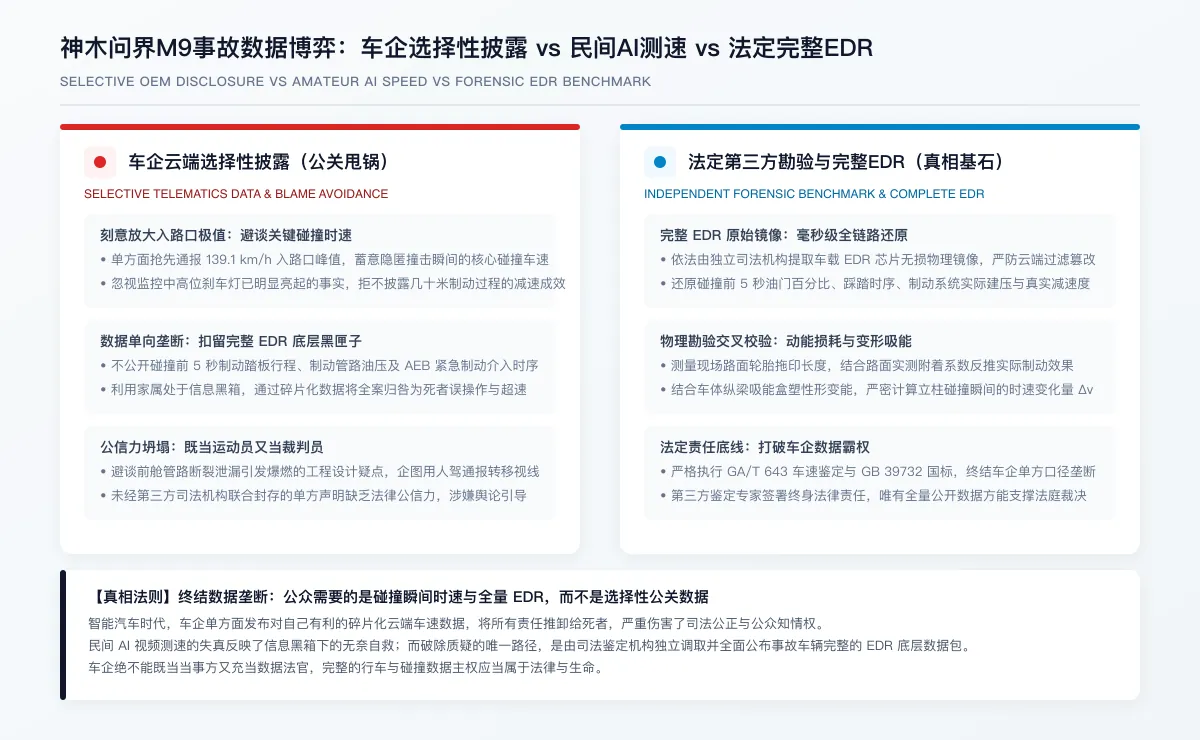
Figure 3: Multi-dimensional comparison matrix: Corporate selective disclosure, netizen AI estimates, and forensic EDR requirements.
II. Crowdsourced AI Forensics: Algorithmic Self-Rescue in an Information Vacuum
Faced with a corporate data monopoly and selective press releases, online discourse reacted sharply. Content creators and automotive technology enthusiasts turned to public surveillance footage, attempting to estimate the vehicle’s speed using computer vision scripts and frame-by-frame analysis. Several asserted that the impact speed was “under 50 km/h” or “between 70 and 80 km/h.”
This phenomenon—netizens employing improvised AI tools to challenge official corporate narratives—represents a form of public “algorithmic self-rescue.” Yet, from a rigorous evidentiary standpoint, uncontrolled video speed calculations suffer from profound technical limitations:
| Evaluation Dimension | Corporate Cloud Disclosure | Crowdsourced AI Video Analysis | Accredited Judicial Forensics & Full EDR |
|---|---|---|---|
| Data Openness | Discloses entry speed (139.1 km/h) while withholding full EDR logs | Estimates pixel displacement from low-resolution web videos | Extracts raw binary chip images for transparent cross-examination |
| Braking Reconstruction | Omits deceleration curve after brake light illumination | Vulnerable to Variable Frame Rates (VFR) and dropped frames | Records pedal depth, hydraulic pressure, and deceleration at millisecond resolution |
| Impact Velocity | Unreported; focuses on entry speed | Lacks 3D spatial control networks; subject to 20%–40% error margins | Calculates Δv via structural deformation energy and EDR records |
| Fire Cause Analysis | Attributed broadly to short circuits and fluid leaks | Limited to external optical flames; cannot diagnose internal circuits | Forensic teardown of high-voltage disconnects, wiring, and fuel conduits |
| Evidentiary Weight | Unilateral statement lacking third-party verification | Uncalibrated algorithm; inadmissible as formal legal defense | Signed by certified forensic engineers subject to professional liability |
The primary reason crowdsourced scripts yield severe errors—such as underestimating speed to below 50 km/h—lies in the technical reality of public security camera streams. These systems frequently use Variable Frame Rate (VFR) compression and wide-angle lenses prone to optical distortion. Attempting to convert pixel movement to velocity without establishing a 3D spatial control grid, measuring road surface friction coefficients (μ), or accounting for longitudinal slope yields uncalibrated, anecdotal outputs.
However, the core takeaway remains clear: Crowdsourced AI forensics emerged precisely because the automaker exerted a telemetry monopoly and issued a one-sided PR statement. Had the manufacturer transparently released the complete deceleration curve, public debate would not have devolved into algorithmic conjecture.
III. The Forensic Baseline: Physical Traces and EDR Telemetry
In mature accident reconstruction methodologies, neither corporate self-assessments nor uncalibrated crowdsourced calculations serve as dispositive evidence. The true legal baseline rests upon immutable physical artifacts combined with certified vehicular EDR telemetry.
1. Mechanical Reconstruction from Physical Skid Marks
When emergency braking causes tires to slide across pavement, leaving physical marks, kinetic energy dissipation is strictly governed by classical mechanics and thermodynamics. Forensic examiners map these skid marks using total station survey equipment while measuring localized surface friction:
Mechanical Calculation for Velocity: v₀ = √(2 · g · φ · S)
- g: Acceleration due to gravity (9.8 m/s²)
- φ: Measured road friction coefficient (accounting for moisture, gravel, and gradient)
- S: Precisely measured length of effective braking skid marks (Note: For rigid barrier impacts, the velocity change Δv must also integrate the plastic deformation energy absorbed by the longitudinal beams, subframe, and barrier structure)
Because these calculations rely on physical evidence documented at the scene, they cannot be altered or recontextualized by corporate communications teams.
2. Forensic Binary Extraction of EDR Modules
Under forensic standards such as China’s Road Traffic Accident Scene Examination Rules (GA 41-2014) and GB 39732, investigating authorities and accredited forensic experts conduct a non-destructive physical extraction of the EDR chip. This involves connecting directly to the Airbag Control Unit (ACU) hardware interface to dump raw Hex/Bin files.
Only a complete, unedited EDR file answers the fundamental questions:
- Did the driver apply maximum brake pedal pressure during the 5 seconds prior to impact?
- Was there any anomalous delay in the build-up of hydraulic braking pressure?
- What was the exact velocity change (Δv) at the millisecond of initial impact with the barrier?
IV. Integrated Fact-Check Findings
Synthesizing public video footage, official statements, and forensic engineering standards yields the following structured determinations regarding the Shenmu crash:
[Fact-Check Determinations]
- Finding 1: The official corporate statement relies on selective disclosure — Substantiated. Utilizing its exclusive access to cloud-logged data, the manufacturer released the 139.1 km/h intersection entry speed prior to the conclusion of the official forensic investigation. By omitting the impact velocity, braking efficiency, and complete EDR logs, the statement functions primarily as a defensive public relations effort.
- Finding 2: Netizen AI calculations asserting an impact speed under 50 km/h — Unsubstantiated (Technical Error). Lossy video compression, frame-rate fluctuations, and wide-angle lens distortion introduce non-linear errors into uncalibrated video analysis, rendering these low-speed claims forensically invalid.
- Finding 3: Independent third-party extraction and publication of full EDR binary data is required — Essential for Procedural Due Process. Automakers cannot act simultaneously as data custodians and factual arbiters. Establishing true impact speed, braking response, and thermal propagation mechanisms requires audited access to raw onboard memory files and physical scene telemetry.
V. Structural Reflection: Data Sovereignty in the Age of Connected Mobility
The Shenmu Aito M9 crash highlights an issue broader than a single traffic accident: the structural vulnerability of individual vehicle owners when confronted with corporate data monopolies.
Similar to the evidentiary dynamics detailed in our analysis of crime rates, judicial risks, and personal defense strategies, the entity that controls raw telemetry controls the narrative, both in the court of public opinion and within the legal system.
Historically, mechanical vehicle investigations relied on visible brake marks and physical component teardowns conducted in open physical space. Today, connected electric vehicles stream massive operational logs to proprietary corporate cloud servers, while owners and surviving family members lack direct access to raw onboard system logs. Following a severe incident, an automaker can leverage this data asymmetry—releasing isolated parameters that shield the brand while shifting responsibility entirely to the operator.
To correct this imbalance, regulatory frameworks and judicial procedures must establish two structural safeguards:
- Mandatory Escrow for Accident Telemetry: Following any fatal or severe collision, cloud-logged telemetry and physical EDR data should be automatically synchronized to an independent, accredited third-party data repository. Automakers should be prohibited from unilaterally decrypting, editing, or selectively releasing telemetry prior to official regulatory review.
- Enforceable Consumer Access Rights: Raw EDR logs and critical operational metrics belong fundamentally to the vehicle owner, not as proprietary trade secrets of the manufacturer. In safety-critical disputes, automakers must be legally obligated to provide unedited, raw binary datasets to investigators and affected parties.
When human life is lost, sophisticated public relations narratives cannot substitute for objective proof. Restoring institutional trust in smart mobility requires dismantling the corporate data black box, ensuring that both digital telemetry and physical evidence remain subject to rigorous, independent forensic scrutiny.
Related Research & Topics
Tello Mobile eSIM
SafetyWing Nomad Insurance
* Disclosure: This post contains affiliate links. If you make a purchase through these links, V-G Journal may earn a small commission at no additional cost to you. We only recommend services we independently evaluate and trust.
FIRE and Golf:自由旅居之路
专注于为追求 FIRE 与品质生活的人群提供特惠打球权益与候鸟微度假。不持一砖一瓦,运营品质生活。