The $300 Million Leak: Anatomy of an AI Server Smuggling Pipeline and the Fragility of Export Controls
A deep dive into the federal indictment of Earthmade Computer Inc., revealing how high-density AI servers bypass US export controls through bonded port re-billing and offshore financial loops.

Executive Summary: A federal grand jury in the Central District of California has issued a criminal indictment (Case No. 2:26-cr-00618-ODW) against Earthmade Computer Inc. and its principal, Greg Lui. The charges allege the illegal smuggling of over $300 million worth of high-end AI servers—equipped with restricted Nvidia A100 and H100 GPUs—to China between 2023 and 2024. By analyzing the indictment, this essay deconstructs the mechanics of “bill washing” in bonded ports and offshore financial closures, revealing the systemic vulnerabilities of current export control regimes in the face of globalized supply chains.
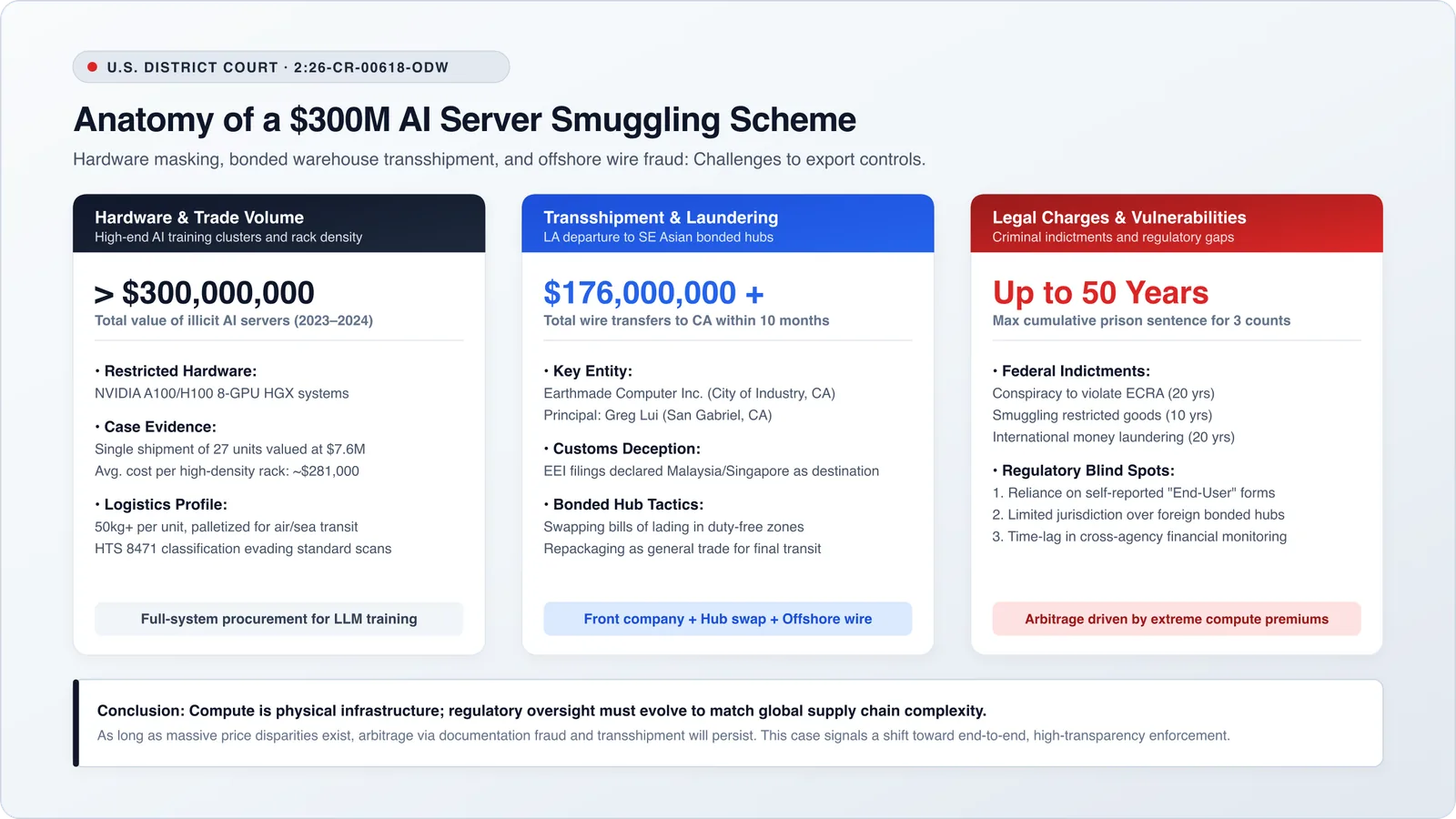
Figure 1: Key elements and transnational smuggling allegations in the Central District of California criminal case (2:26-cr-00618-ODW).
I. The Scope: A California Proxy and a $300 Million Compute Pipeline
According to the criminal complaint released by the Department of Justice’s National Security Division and the U.S. Attorney’s Office, Greg Lui (also known as Yiu Kong Lui), a 38-year-old resident of San Gabriel, has been apprehended by federal agents.
The core of the indictment is stark: between 2023 and 2024, the defendant utilized Earthmade Computer Inc.—a legally registered entity in the City of Industry—to illicitly transfer high-performance AI servers to Chinese buyers. These units were outfitted with Nvidia A100 and H100 GPUs, hardware strictly regulated by the Bureau of Industry and Security (BIS) under the Department of Commerce.
The prosecution has leveled three felony charges:
- Conspiracy to violate the Export Control Reform Act (ECRA) and Export Administration Regulations (EAR): Maximum 20 years imprisonment.
- Smuggling restricted items from the United States: Maximum 10 years imprisonment.
- Conspiracy to commit international money laundering: Maximum 20 years imprisonment.
The cumulative statutory penalty reaches 50 years. Financial records indicate that between January and October 2024 alone, Earthmade’s U.S. bank accounts received over $176 million in wire transfers from Malaysian-linked freight entities.
In an era of unprecedented export restrictions, how did such a massive volume of restricted hardware clear domestic procurement, exit customs, and reach its final destination?
II. Deconstructing the Smuggling Mechanism: From Local Proxies to Bonded Port “Bill Washing”
Unlike the fragmented “suitcase trade” of consumer electronics, industrial-scale model training requires hardware with uncompromising physical specifications.
As we noted in our analysis of Google’s TPU space-based data centers, the foundation of AI compute is not the individual die, but the high-density rack—a complex integration of liquid/air cooling modules and NVLink/InfiniBand high-speed backplanes. The smuggling network’s operations were built entirely around these physical realities.
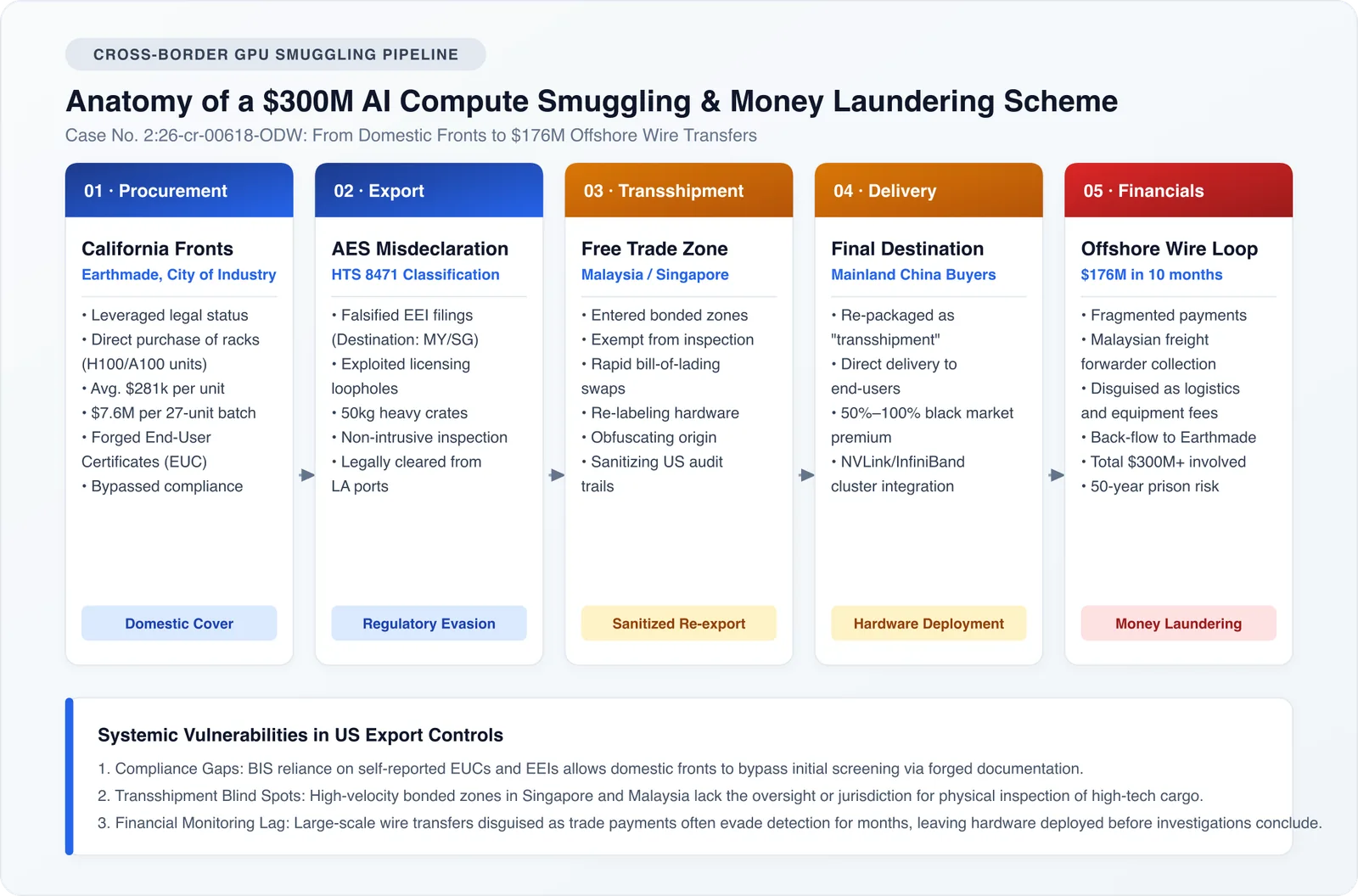
Figure 2: The five-stage transnational pipeline of Earthmade’s AI server smuggling and offshore capital return.
1. The Physical Entry Point: $280,000 High-Density Racks
The indictment provides granular evidence: one specific procurement batch consisted of 27 high-performance servers with a total order value of $7.6 million.
This averages to approximately $281,000 per server.
This price point aligns perfectly with the industry cost for an 8-way Nvidia H100/A100 HGX system. These units typically weigh over 50kg and are shipped in reinforced industrial crates on standard wooden pallets, requiring forklifts and heavy cargo aircraft for transport.
The successful departure of such massive equipment stems from a structural mismatch between physical form and customs classification. In the international Harmonized Tariff Schedule (HTS), these servers are categorized under code 8471 (Automatic Data Processing Machines). Without a physical teardown or a live boot to inspect BIOS and GPU firmware, standard X-ray scans cannot distinguish between a compliant rendering unit and a restricted, top-tier compute accelerator.
2. The Procurement “White Glove”: Exploiting Local Entity Status
The network’s first step was securing hardware quotas at the front end of the supply chain.
Earthmade, as a California-based system integrator with a physical office, warehouse, and established operating history, acted as a “white glove.” This domestic status allowed it to bypass the heightened scrutiny distributors apply to offshore buyers. Earthmade placed orders with U.S. OEMs and authorized distributors under the guise of domestic commercial contracts.
To clear internal compliance checks, the defendants signed fraudulent End-User Certificates (EUCs), claiming the servers were destined for data centers in Malaysia and Singapore for routine civilian use.
3. Legal Departure: Exploiting the Regulatory Lag of Neutral Third Countries
Under the Automated Export System (AES), freight forwarders must submit Electronic Export Information (EEI). Earthmade’s filings consistently listed Malaysia and Singapore as the final destinations.
At the time, the threshold for permit approval and end-use verification for Southeast Asian nations lagged significantly behind the standards applied to direct exports to China. When the cargo was loaded at LAX or the Port of Long Beach, the documentation appeared complete and the destination neutral. The regulatory system flagged these as low-risk commercial trades, allowing them to clear the first leg of the journey.
4. Regional Hub “Bill Washing”: The Bonded Warehouse Maneuver
The most critical “physical masking” occurred in Southeast Asian free trade zones (FTZs).
Upon arrival in Singapore or Port Klang, Malaysia, the goods entered bonded warehouses. These zones possess sovereign transit attributes—exempt from duties and deep inspections:
- Re-billing: Overseas freight forwarders in the network took possession in the bonded zone, immediately swapping the original U.S. Bills of Lading for new documents that repackaged the cargo as general transit goods.
- Dummy Servers: Evidence suggests the group maintained “dummy” servers with standard configurations to obfuscate serial numbers and technical specs in the event of a random administrative audit.
- The Second Leg: Once the paperwork was “washed,” the servers were re-shipped as routine re-exports to mainland China, delivering the compute to buyers waiting at the port of entry.
5. The Financial Loop: $176 Million in Fragmented Offshore Wires
Parallel to the flow of goods was a sophisticated, fragmented offshore financial chain.
The end buyers did not wire funds directly from China to Earthmade. Instead, payments were laundered through Southeast Asian intermediaries and offshore shell companies. Bank records obtained by the FBI and IRS Criminal Investigation (IRS-CI) show that between January and October 2024, two Malaysian freight companies wired over $176 million to Earthmade’s California accounts, disguised as “equipment prepayments” and “logistics service fees.”
By leveraging California-based procurement, Southeast Asian “bill washing,” and offshore wire settlements, the smuggling route achieved a closed-loop operation across ten thousand miles.
III. Systemic Anatomy: Why Export Controls Fail in Practice
From a legal and trade perspective, the Earthmade case is not an isolated incident of non-compliance; it is a symptom of a systemic failure in an administrative-based export control architecture facing complex global supply chains.
| Regulatory Dimension | Current Mechanism | Smuggling Counter-Tactics | Core Blind Spot |
|---|---|---|---|
| Trust-Based Reporting | Relies on signed EUCs (BIS-711) and EEI self-reporting. | Local integrators actively collaborate in fraud, inventing third-country buyers. | Paper audits cannot penetrate intentional fraud by domestic entities. |
| Physical Verification | Customs relies on X-ray scans and HTS code matching. | 50kg industrial packaging (HTS 8471) hides internal GPU specs. | Impossible to perform teardowns and firmware checks on thousands of heavy units. |
| Extraterritorial Jurisdiction | Relies on Export Control Officers (ECOs) for site visits. | Rapid “bill washing” and re-exporting in bonded zones. | U.S. agents lack permanent enforcement rights in foreign FTZs; severe manpower shortage. |
| Financial Monitoring | FinCEN relies on bank Suspicious Activity Reports (SARs). | Fragmenting payments into trade-based wires via legitimate freight accounts. | High-volume trade wires are difficult to distinguish from legitimate commerce. |
1. The Disconnect Between “Good Faith” and Physical Reality
The current export control regime is built on “paper compliance”—a system designed for an era where legitimate firms were expected to self-regulate. When a well-established domestic firm chooses to act as a proxy, the defense mechanism collapses. Customs officials, faced with hundreds of pages of compliant documentation, lack the technical means to open server chassis and run diagnostic software to verify CUDA core configurations.
2. High-Velocity Trade Hubs as Regulatory Havens
The lifeblood of modern shipping is turnover. Hubs like Singapore and Port Klang process hundreds of thousands of containers daily. The “tax-free, high-speed, no-inspection” nature of bonded zones provides the perfect physical barrier for freight forwarders to destroy original bills of lading and generate new manifests. The mismatch between spatial jurisdiction and the speed of global trade creates a massive window for arbitrage.
3. The Arbitrage Fever of Compute Scarcity
The effectiveness of any administrative ban is limited by the economic laws of supply and demand.
Training frontier models requires massive inter-card bandwidth; remote cloud access is no substitute for local, high-density clusters. When advanced GPUs command a black-market premium of 50% to 100%, the potential for nine-figure profits is enough to drive commercial entities to risk extreme legal penalties. As long as the price wall for physical hardware exists, smuggling channels will continue to evolve.
IV. The Regulatory Aftermath and Industry Impact
The Earthmade indictment signals an evolution in how high-tech supply chains will be policed:
- The Rise of Inter-Agency Strike Forces: This case was investigated by the “Disruptive Technology Strike Force”—a joint effort between the DOJ, FBI, Defense Criminal Investigative Service (DCIS), and BIS. Future enforcement will merge counter-intelligence, national security, and financial crime tactics.
- Tightening the Third-Country Net: The U.S. is moving to extend unilateral licensing requirements to dozens of transit hubs in Southeast Asia and the Middle East. “Look-through” permits for data centers in these regions aim to close the bonded port loophole.
- Hardware-Level Telemetry as a Mandate: Paper invoices are failing. OEMs and ODMs are facing unprecedented “Know Your Customer” (KYC) pressure. We are likely moving toward a standard where physical hardware must include Secure Boot chips, GPS/network telemetry, and remote activation locks that require periodic “handshakes” with the manufacturer’s cloud to remain functional.
The Earthmade case may have closed one $300 million pipeline, but in the global game of compute-driven industrial competition, the battle over supply chains, finance, and physical hardware is only entering its most volatile phase.
Related Research & Topics
The Anatomy of Digital Predation: Inside the Syndicate Targeting the Elderly via Livestream Appraisal Scams
Starlink V4 and the Low-Earth Orbit Satellite Arms Race: How a 100,000-Node Optical Mesh Pierces the Submarine Cable Monopoly
Tello Mobile eSIM
SafetyWing Nomad Insurance
* Disclosure: This post contains affiliate links. If you make a purchase through these links, V-G Journal may earn a small commission at no additional cost to you. We only recommend services we independently evaluate and trust.
FIRE and Golf:自由旅居之路
专注于为追求 FIRE 与品质生活的人群提供特惠打球权益与候鸟微度假。不持一砖一瓦,运营品质生活。