The Sabbath, Eastern Rhythms, and the 996 Conundrum: A Genealogy of Work Hours
The notion that 996 work culture stems from Eastern religions lacking a 'Sabbath' is a profound misreading of both religious history and labor evolution. This essay dissects the trajectory of work hours, from Abrahamic divine rest and Eastern agrarian rhythms to the brutal realities of early industrialization and modern legal weekends. It argues that work hour systems are fundamentally products of power dynamics, not cultural destiny.

Core Thesis: A pervasive, yet specious, cultural fatalism permeates contemporary workplaces: the belief that the West, with its monotheistic ‘Sabbath,’ naturally enjoys paid weekends, while China, steeped in Buddhist and Taoist traditions, lacks a rigid religious concept of rest, thus condemning East Asian workers to ‘996’ and hyper-competition. This is not merely a superficial misinterpretation of two-millennia-old religious traditions and agrarian rhythms; it’s a facile cultural determinism used to excuse contemporary systemic imbalances and the absence of robust labor-capital negotiation. Only by examining transcendent divine law, Eastern calendrical rituals, industrial labor movements, and modern employment contracts within a unified historical framework can we truly grasp the evolving nature of the right to rest.
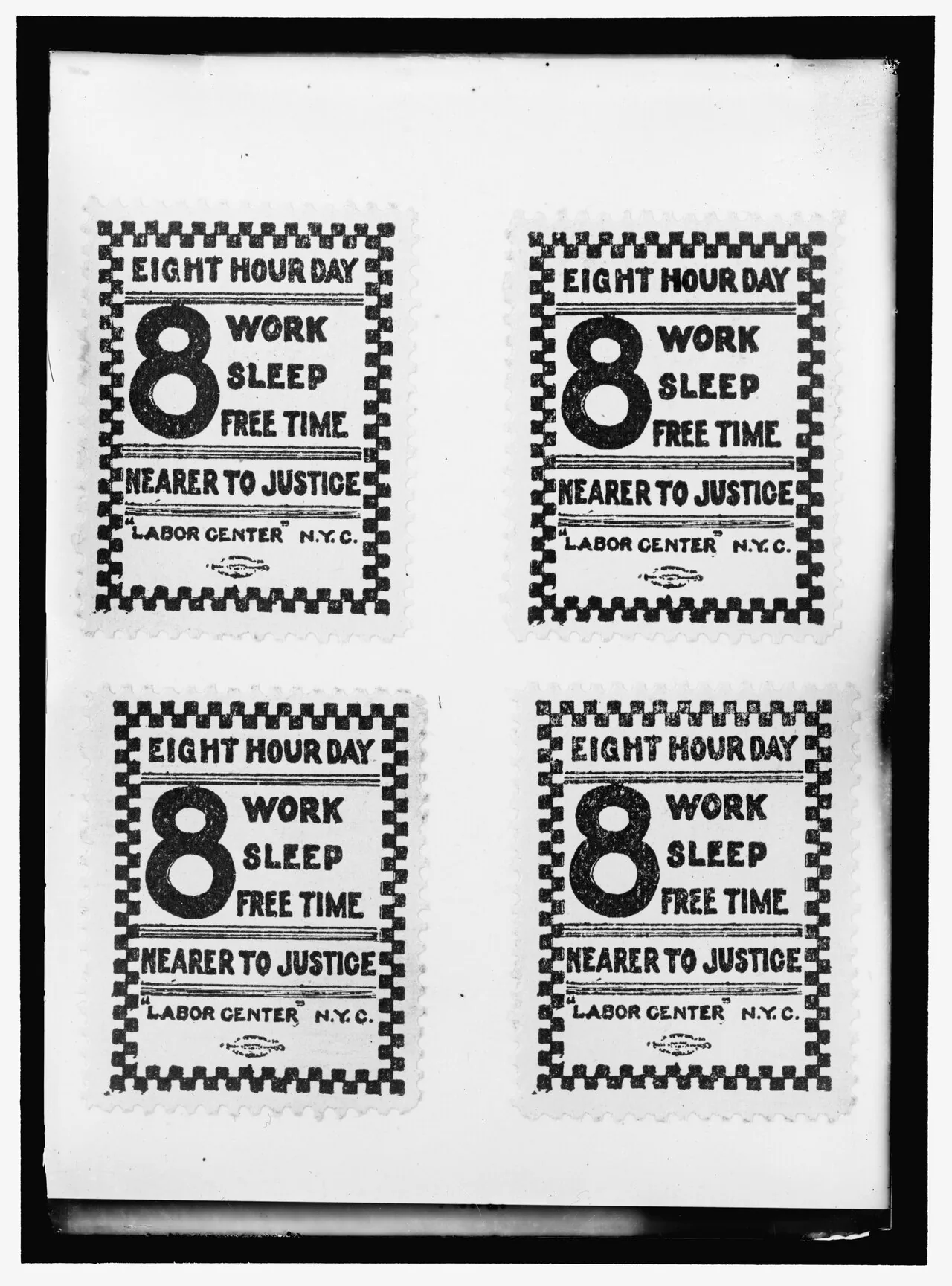
Figure 1: Early 20th-century labor movement historical print advocating for the eight-hour workday (8 hours work, 8 hours sleep, 8 hours free time)
I. Transcendent Divine Law & Sacred Interdiction: The Sabbath as Divine Blockade, Not Labor Benefit
The Abrahamic monotheistic religions (Judaism, Christianity, Islam) established strict periodic days of rest, not out of secular humanitarian concern for the working class, but from a transcendent divine law forcibly interdicting secular temporal power.
1. Creation Myth and the Inviolable Divine Covenant
In the Book of Exodus and the Ten Commandments, the commandment regarding the Sabbath (Shabbat) carries absolute, rigid divine legal force: “Remember the Sabbath day, to keep it holy. Six days you shall labor and do all your work, but the seventh day is a Sabbath to the Lord your God.”
In traditional Jewish doctrine and ancient Hebrew law, the cessation of work on the Sabbath possessed three profoundly groundbreaking characteristics:
- Universal, Undifferentiated Coverage: On the seventh day, not only landowners and heads of households had to rest, but also their slaves, maidservants, resident foreigners, and even their working animals. All creative and productive labor had to cease.
- Theological Redefinition of Labor: Within a theological context, humans were not the absolute private property of slave owners or secular rulers, but creations of God. The establishment of the Sabbath was, in essence, a divine declaration to secular authority: your exploitation of physical labor ends here; you shall not transgress the boundaries of divine law.
- Divine Sanction for Non-Compliance: In classical antiquity, violating the Sabbath prohibition by lighting fires, plowing, or engaging in commercial transactions was considered a grave offense against God. This “rest” was fundamentally an act of reverence and adherence to the Creator, a form of “sacred immunity,” rather than a welfare benefit later negotiated by labor unions.
In 321 CE, Roman Emperor Constantine I issued an edict establishing Sunday (Dies Solis) as a legal day of rest throughout the Roman Empire. This act marked the state apparatus formally stamping legal approval on religiously mandated cessation of work, transforming the Christian “Lord’s Day” from a religious ritual for believers into a public temporal order for society at large.
However, this sacred immunity, rooted in transcendent monotheism, never found fertile institutional ground within the soil of Eastern civilizations.
II. Did the East Truly Lack Rest? The Triple Rhythms of Celestial Timing, Lunar Phases, and Imperial Grace
Attributing East Asian overwork to Buddhist and Taoist traditions “lacking a concept of rest” is a classic cognitive bias, tailoring Eastern history to a Western monotheistic template. Eastern civilizations were not devoid of rest mechanisms; rather, they organized time according to a fundamentally different cosmology, lunar-celestial timing, and secular political logic.
1. Buddhism’s Internal Regulation: Uposatha and Vassa
Original Buddhism not only did not advocate for “996 overtime,” but quite the opposite: its initial monastic rules strictly prohibited monks from engaging in secular agricultural production or commercial trade. Ancient Indian monastics had to subsist on alms, the core purpose of which was to sever completely their attachment and craving for secular production chains.
Buddhism established a highly rigorous rhythm of rest and self-reflection:
- Lunar Cycles and Uposatha Days: Buddhism inherited the ancient Indian Shramana tradition, establishing “Uposatha days” based on lunar phases (the 8th, 14th or 15th, 23rd, 29th or 30th days of each lunar month, commonly known as the “six or ten fasting days”). On these days, the monastic community would gather for recitation of precepts, confession, and reflection; lay practitioners would observe the “eight precepts of fasting,” setting aside field labor, business dealings, and secular sensory pleasures to focus on cultivating body and mind.
- Vassa (Rain Retreat): During India’s annual monsoon season (roughly the fourth to seventh lunar months), when vegetation flourished and insects proliferated, the Buddha mandated that monastics must reside in monasteries for three to four months, ceasing their travels and wanderings. This constituted a periodic, hundred-day system of holistic rest and spiritual introspection.
2. Taoism’s Natural Rhythms and Life Restoration
In Taoist philosophy, “Dao follows nature,” “tension and relaxation,” and “quietude and non-action” are core tenets for structuring life’s rhythms. As explored in our analysis of Lao-Zhuang Daoist Philosophy and Modern FIRE, traditional Chinese timekeeping was never based on an artificially abstract “seven-day mechanical cycle,” but was deeply intertwined with the grand natural rhythms of heaven and earth:
- Diurnal Micro-Cycles: “Work at sunrise, rest at sunset,” aligning with the physiological rhythms of the sun’s rise and fall, opposing excessive labor that defied celestial timing.
- Seasonal Macro-Cycles: “Spring for birth, summer for growth, autumn for harvest, winter for storage.” In traditional agrarian societies known for intensive cultivation, when fields froze in winter, there was a natural “winter leisure” period lasting two to three months, accompanied by intensive rituals, community festivals, New Year celebrations, and recuperation.
3. Secular Dynastic Holidays: From Han Dynasty ‘Xiumu’ to Ming Autocratic Regression
At the secular institutional level, China’s ancient bureaucracy developed clear statutory work and rest rotation mechanisms as early as two millennia ago:
| Historical Period | Holiday System | Duration & Scope of Statutory Holidays | Nature of Mechanism & Power Logic |
|---|---|---|---|
| Han Dynasty | One ‘Xiumu’ every Five Days | Work four days, the fifth day for collective rest to return home for ritual bathing, hair washing, changing clothes, and visiting parents. | Personal hygiene for officials and care for clan ethics; institutionalized regular rest. |
| Tang & Song Dynasties | Decadal Rest & Festival Long Breaks | One day of rest every ten days (Xunxiu), plus 7 days each for Yuanzheng (Lunar New Year) and Winter Solstice, 4 days for Hanshi and Qingming Festivals, and additional days for Mid-Autumn, Double Ninth, and Buddhist/Taoist festivals, totaling 60-100+ paid holidays annually. | Economic prosperity and ritual order in a flourishing era; the civil service enjoyed ample leisure and cultural life. |
| Early Ming Dynasty | Extreme Autocratic Squeeze | Emperor Zhu Yuanzhang, while abolishing the chancellery and consolidating imperial power, directly cancelled Xunxiu, leaving court officials with only three annual holidays: Lunar New Year, Winter Solstice, and the Emperor’s birthday. | The state apparatus leaned towards extreme autocratic mobilization, reducing officials to endlessly exploited instruments of governance. |
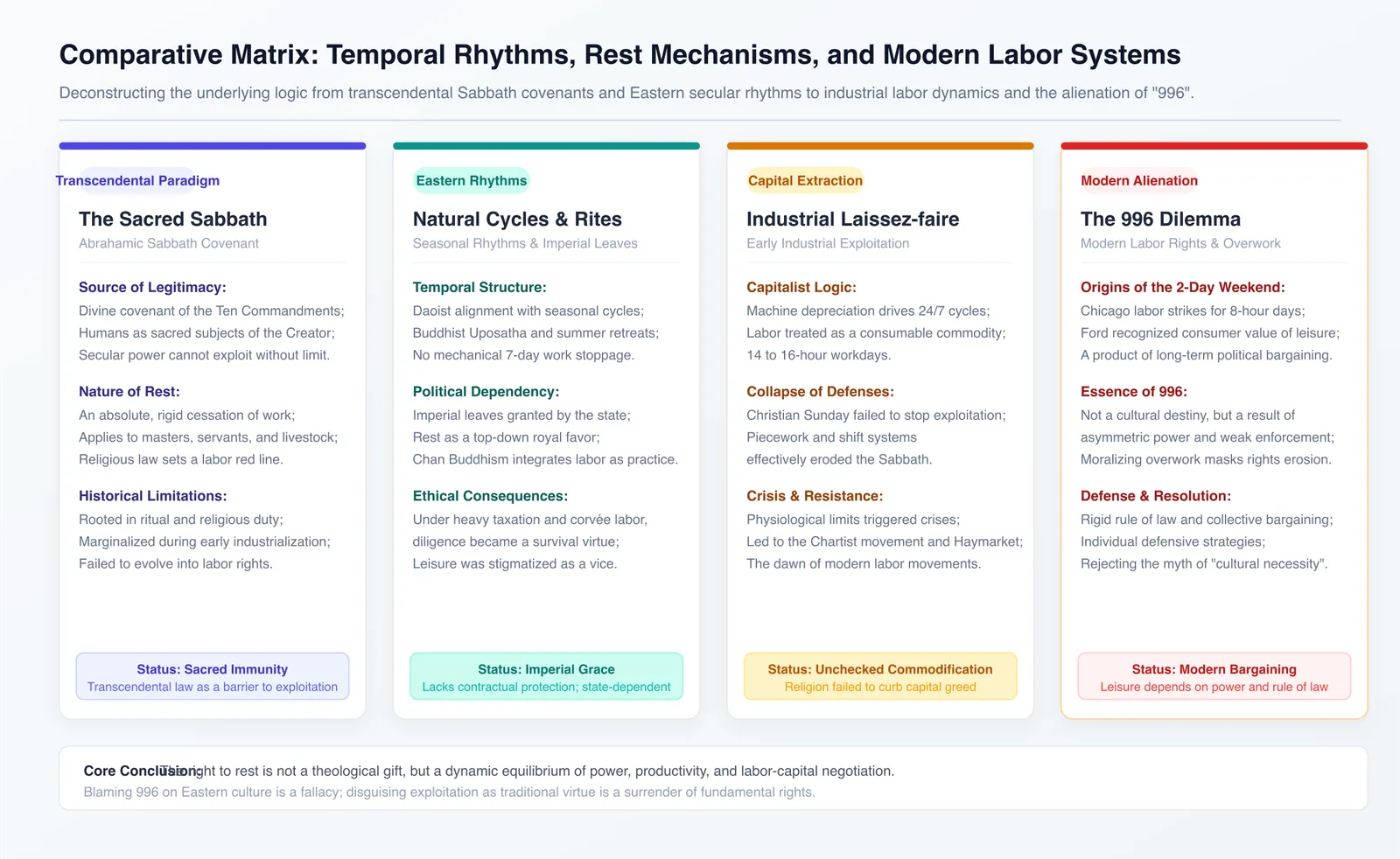
Figure 2: Comparative Matrix of Civilizational Time Rhythms, Rest Mechanisms, and Modern Work Hour Systems
4. The Critical Juncture: Religious Subservience and the Discipline of Diligence
Why did the East’s rich rhythms fail to solidify into rigid modern labor holiday rights? The core issue lay in the absolute monopoly of secular imperial power and the deep subservience of religion:
- “Without reliance on the sovereign, the Dharma cannot be established”: This assertion by the Eastern Jin monk Dao’an reveals the underlying political reality of religious survival in China. Chinese history never saw the emergence of an independent ecclesiastical court transcending imperial power. Both Buddhism and Taoism remained subservient to the unified secular state. Religions were not only powerless to issue mandatory work hour laws to emperors but, if careless, could be deemed “parasites of the people” by the court for occupying land and able-bodied labor, leading to “Three Wus and One Zong” style persecutions.
- Zen Buddhism’s Survival Shift: From Seclusion to ‘Farming and Zen in Equal Measure’: By the Tang Dynasty, to mitigate the existential crisis of being criticized for not working, Zen master Baizhang Huaihai established monastic rules promoting “farming and Zen in equal measure,” enshrining the famous dictum: “A day without work is a day without food.” Monastics had to personally cultivate fields, and labor itself was even elevated as a tool for spiritual practice and meditation. When religion itself sacralized labor, secular society lost its internal religious justification for legitimate cessation of work.
- Household Registration and Moral Shackles: Under the heavy burden of land taxes and corvée labor, maxims like “The land rewards the diligent” and “Endure the bitterest, become the best” were repeatedly forged into moral tenets for the lower classes to maintain subsistence. Leisure was no longer seen as a natural right of life but was disciplined by the ruling order and clan ethics as the original sin of “idle hands” or “profligate and neglectful.”
III. The Brutal Truth of the Industrial Revolution: Modern Weekends Were Never a Divine Gift
Many subconsciously believe that the Western weekend is a natural legacy chimed into existence by church bells. This is a profound misunderstanding of modern economic history and the history of class struggle.
1. The Complete Collapse of Religious Defenses in Early Capitalism
After the Industrial Revolution erupted in Britain in the mid-118th century, despite widespread Christian belief, capitalists never showed leniency to workers due to religious mandates for Sunday rest, facing the 24-hour depreciation pressure of expensive steam engines and textile machinery.
In the early laissez-faire capitalist phase:
- Factory workers (including vast numbers of child laborers and women) commonly worked 14 to 16 hours a day, six days a week.
- The so-called Sunday religious rest was significantly eroded by piece-rate wages, harsh disciplinary systems, and shift work, often becoming unpaid hours for machine cleaning and workshop maintenance.
- Religious precepts rapidly crumbled in the face of the “complete commodification of labor” brought by machine production, utterly powerless to prevent the human body from being consumed like a disposable battery.
2. The True Foundation of the Weekend: Blood, Struggle, and the Consumer Logic Loop
The widespread “eight-hour workday” and “weekend” in modern society are the culmination of two centuries of brutal real-world bargaining between labor and capital, alongside the evolution of economic logic:
- Labor Movements Forged in Blood: From the Chartist movement of British workers in the early 19th century to the bloody Haymarket Affair on May 1, 1886, where hundreds of thousands of American workers struck for “eight hours for work, eight hours for recreation, and eight hours for rest.” Workers paid an immense price to force legislators to establish rigid work hour limits in factory laws.
- The Awakening of Capital’s Intrinsic Consumer Logic: In 1926, Henry Ford fully implemented a five-day, 40-hour workweek in his automobile factories without reducing workers’ wages. Ford’s motivation was far from religious charity; he keenly understood the cyclical ledger of the macroeconomy: if workers exhausted all their energy on the assembly line daily with no weekend leisure, they would have neither the time nor the opportunity to purchase cars, clothing, and other industrial consumer goods. Ample leisure time is the core fuel upon which modern mass consumer society operates.
- Organized Bargaining and Rigid Legal Enforcement: The legitimate collective bargaining power of unions, the normalized intervention of labor inspection mechanisms, and strict enforcement that criminalizes excessive overtime are what prevent labor laws on paper from becoming dead letters.
Western workers enjoy weekends, never relying on Old Testament Sabbath scriptures, but rather on the legal defenses carved out by modern labor movements and the economic self-sufficiency of a mature consumer society.
IV. Deconstructing the 996 Conundrum: Refusing to Package Systemic Flaws as ‘Cultural Destiny’
With the historical and institutional context clarified, the contemporary reality of work hours in China presents a clear picture: **we were never ‘destined for 996’; attributing the work hour dilemma to Buddhist and Taoist traditions
Related Research & Topics
Tello Mobile eSIM
SafetyWing Nomad Insurance
* Disclosure: This post contains affiliate links. If you make a purchase through these links, V-G Journal may earn a small commission at no additional cost to you. We only recommend services we independently evaluate and trust.
FIRE and Golf:自由旅居之路
专注于为追求 FIRE 与品质生活的人群提供特惠打球权益与候鸟微度假。不持一砖一瓦,运营品质生活。